Reviewed by Tara Sullivan · Updated August 2026 · 11 min read
Almost every rule you learned for long fine hair inverts when you cut it short, and nobody warns you. On long hair the enemy is weight — the hair is heavy, the weight drags the roots flat, and the fix is subtraction. At short length there's barely any weight left, so the enemy becomes direction.
A short strand sets in whichever direction it dried, and there's no length hanging below it to pull it back out again — which is exactly why a well-shaped short cut can be genuinely wash-and-wear, as the over-70 cuts show. Which means the whole style is decided in the four minutes after your shower, and no amount of product applied to dry hair will undo a bad dry.
Two other things flip at the same time: product amounts drop to about a quarter of what you used before, and placement becomes surgical, because a blob on short hair stays a blob rather than being spread by gravity. And day two is genuinely harder, not easier — there's no length to tuck, pin or hide behind. Below: the drying order that is the style, how little product actually means, what each of the three short shapes needs, and the ninety-second day-two reset.
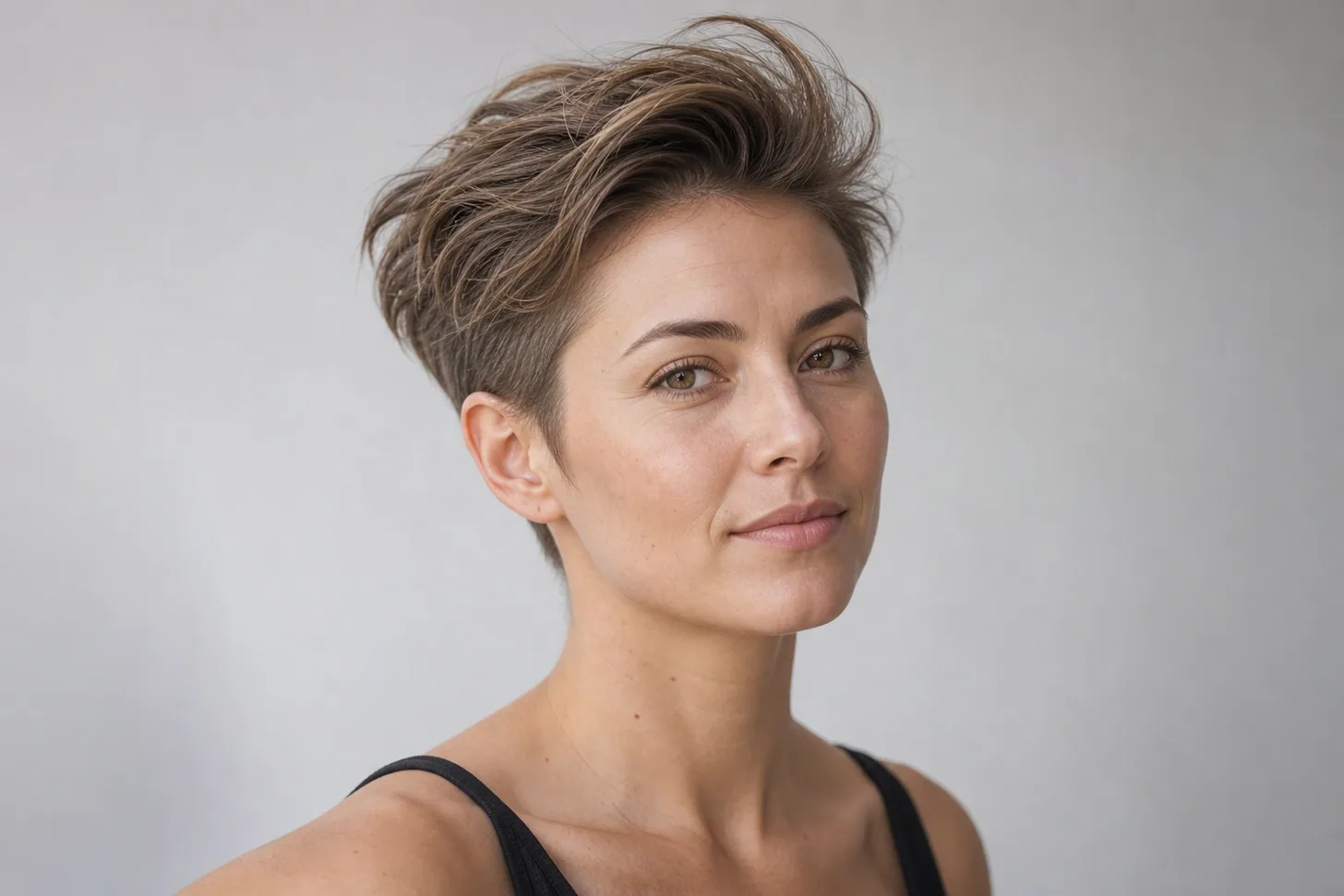
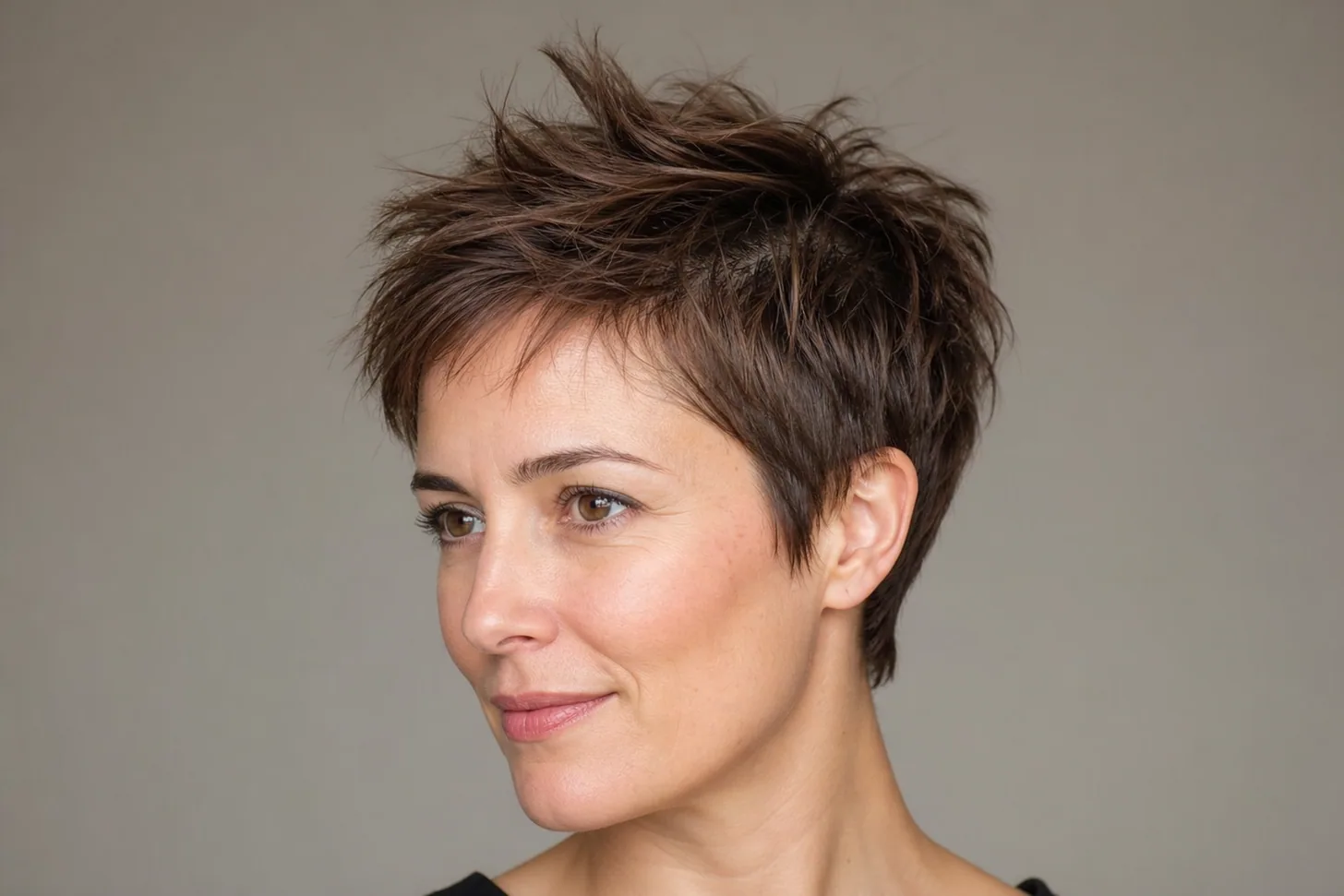
All roots, no hiding place — which is why the drying does almost all of the work.
Short fine hair goes flat differently
This is the thing to understand before anything practical, because it explains why the advice you're used to stops working.
Long fine hair goes flat by being pulled down. Every inch adds mass, mass pulls toward the floor, and the roots lose the fight by mid-morning. That's why the whole long-hair playbook is about removing burden: less product, lighter formulas, conditioner kept off the roots, weight taken out of the interior.
Short fine hair goes flat by lying down. At two or three inches there's almost no mass left to pull anything anywhere. What there is instead is a strand short enough to hold whatever position it set in — and hair sets as it dries. Dry it lying against your scalp and it stays lying against your scalp, all day, with nothing hanging below to drag it loose. That's a completely different failure, and it has a completely different fix.
Two consequences follow, and they're the spine of this page. The drying is the style, not preparation for it. And the cut carries far more of the load than it did at length — a good short shape half-styles itself, and a poor one can't be rescued by technique.
If your short cut fights you every morning no matter what you do, the honest possibility is the cut, and what your stylist is actually doing covers what to ask for next time.
The four-minute dry, in order
Do this and most days need nothing else. Skip it and nothing you do later recovers it.
Blot, don't rub. Ten seconds with a towel pressed against the head. Short hair is mostly root, and roots are where friction damage shows first — towel-drying fine hair has the method.
One root product, on damp hair. A pea of mousse or four spritzes of root spray, worked into the roots at the crown and the front with fingertips. This is the only product that goes on wet, and it's the one doing the lifting.
Rough-dry against the fall, with your fingers. The critical step. Push each section in the opposite direction to the way it naturally sits — front section pushed back, crown pushed forward, sides pushed up — and keep the dryer moving. Not a brush. Fingers, because they lift and separate where a brush smooths and flattens. Sixty to ninety seconds.
Then place it, and dry it there. Only once the roots are about 80% dry do you decide where the hair actually goes. Direct it into position with your fingers and hold it there with warm air for a few seconds, then hit it with the cool shot. The cool air is what sets it — warm air makes hair pliable, cool air fixes the shape.
Finish dry, at the surface only. A little texture spray, paste or powder worked through the top with fingertips. Small amounts, and see the next section for how small.
Don't brush afterwards. Everything you just built is at the roots, and a brush lays roots down. If the perimeter or the fringe needs tidying, do that with a small brush before you finish the roots, not after.
The most common thing I see after a big cut is a client using her old routine at a quarter of the scale and wondering why it doesn't work. She's halved the product, which is sensible, but she's still drying her hair the way she did when it was long — head upright, dryer pointing down, hair falling into place as it goes.
At shoulder length that's fine, because the weight of the length keeps some tension in the roots. On a pixie it's fatal: you're actively drying the hair into the flat position and then trying to argue it out afterwards with paste.
Flip your head, or push everything the wrong way with your fingers, for the first ninety seconds. It feels ridiculous and it looks ridiculous while you're doing it. Then stand up, place it, and cool-shot it. That single change is the difference between a crop that stands up and one that sits on your head like a swimming cap.
SB
— Simone Baptiste, Senior Stylist
How little product actually means
People cutting their hair short know they'll need less. Almost nobody guesses how much less. And on short hair, placement matters more than amount, because there's no length for gravity to spread things along — a blob stays a blob.
The universal technique: warm it in your palms until your hands look nearly empty, then touch it into the hair. Never apply directly from the tube to the head at this length.
Product
Amount
Where
Wet or dry
Mousse or root spray
A pea; or 4 spritzes
Roots at the crown and front only
Damp, before drying
Texture spray
2–3 short bursts, 8in away
Through the top, fingertips in
Dry, at the end
Texture powder
A dusting — the easiest to overdo
The crown and the part line
Dry, at the end
Light paste or clay
Less than a pea, warmed in the palms
Fingertips through the surface only
Dry, at the end
Hairspray
A light mist from a foot away
Over the finished shape
Dry, absolutely last
Cream, oil, serum, leave-in
None
Nowhere — these belong on long ends
—
Matte beats shiny at this length. Shine reveals the surface of the hair and can make a fine crop look sparse, while a matte or slightly gritty finish makes strands separate and stand apart — which reads as volume. It's the entire reason texture powders and dry sprays exist for short hair, and the reason a glossy pomade that looks incredible on thick hair will make yours look like it needs washing.
There's no length to fall back on, so the direction you dry it in is the haircut you're wearing that day. The good news is that this makes a pixie the most transformable short cut: the same cut can go sleek and forward, textured and tousled, or swept back, purely on how you dry it.
Root product plus finger-drying against the fall plus a dry texture finish is the whole routine, and it's genuinely under four minutes. See pixie cuts for fine hair for the shapes. All three dress up for an occasion without needing to be made to look longer — the versions are in bridesmaid hairstyles for fine and thin hair.
The crop lives or dies on its outline
At the shortest lengths, styling barely exists — the cut is doing almost everything, and what you're managing day to day is the perimeter and the fringe rather than volume. Product needs drop close to zero; a touch of paste or powder at the top is often the whole routine. What goes up is the trim frequency, because at this length two weeks of growth changes the shape. Very short haircuts for fine hair has the range.
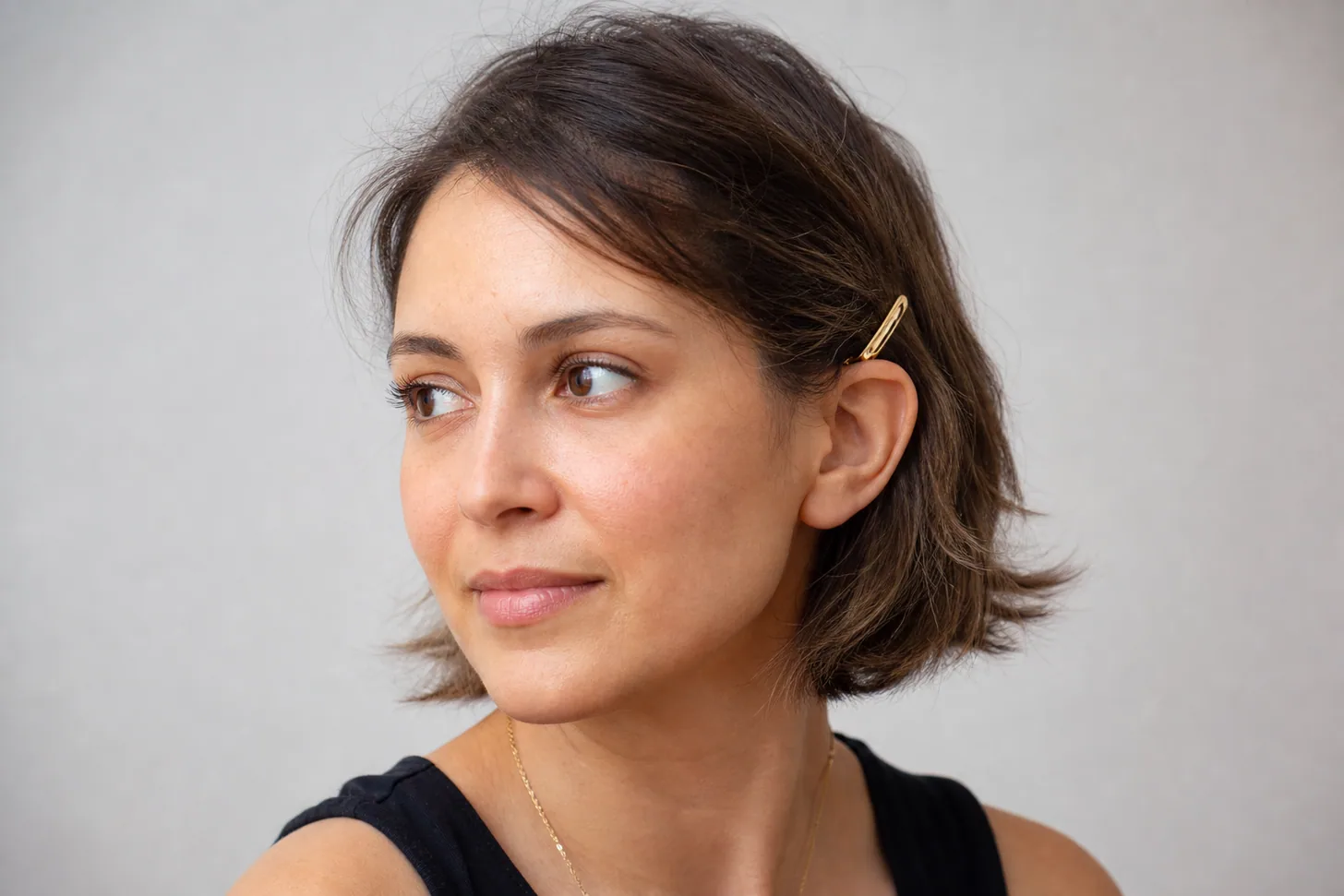
The short bob has just enough weight to fight you
The trickiest of the three, because it's the only one with enough length for weight to still be a factor while being too short to pull itself into place. The failure mode is specific: it goes flat at the crown and puffs at the sides, turning triangular.
The fix is to dry the crown up and back first, and the sides down and slightly under, which is the opposite instinct on each. How to blow-dry a bob at home is the step-by-step, and the bob for fine hair covers which version suits you. On short hair a mini flat iron gives bend and separation that a barrel cannot reach — see curling fine hair with a flat iron.
Day two, when there's nowhere to hide
Short hair is often sold as low-maintenance, and on wash day it genuinely is. Day two is where the honesty is needed, because it's harder than at length rather than easier. With long hair you can put it up, tuck it back, add a headband — a hundred ways to make unwashed hair a deliberate choice. A pixie is entirely roots, and there's nothing to do with roots except deal with them.
The ninety-second reset, and it isn't dry shampoo:
Wet the roots only. Damp fingers, or a comb dipped in water, run through the root area. Not the whole head — you're not washing it.
Re-dry against the fall. Thirty to sixty seconds with the dryer, pushing sections the wrong way, exactly as on wash day. This is what actually fixes it, because the problem is the direction the hair set in overnight, not the oil.
Cool shot, then finish. Set it, then a little texture powder or spray at the top.
Dry shampoo after this, if you need it — for the oil, not for the shape. It absorbs; it doesn't redirect. Applied instead of the re-dry it leaves you with flat hair that's also chalky.
And a note on washing frequency: short fine hair is nearly all root, so it reads greasy sooner than the same scalp did under long hair — there's no length for the oil to travel down and disappear into.
Washing more often is usually correct here rather than a failure of discipline, and how often to wash fine hair makes that case properly. If your roots are oily but your ends still feel dry even at this length, oily roots and dry ends applies to the bottom third of a bob too.
Chair-side note
Nobody tells you that the sleeping matters more at short length, and it's the reason so many people think their pixie "doesn't hold". At shoulder length you wake up with bed hair in the mid-lengths and the roots are broadly where you left them. On a crop, the roots are the hairstyle, and eight hours of a cotton pillowcase pressing them in one direction is a full re-style you didn't ask for.
Two things fix most of it: a silk or satin pillowcase, which lets the hair slide rather than compress, and getting into the habit of not going to bed with damp hair, because damp short hair sets overnight into whatever shape the pillow gives it and it will be set hard by morning. That's also why the day-two fix is water and a dryer rather than product — you're not adding anything, you're undoing the pillow.
SB
— Simone Baptiste, Senior Stylist
If you're growing it out
The awkward stage lasts as long as it does mostly because of one instinct: people stop booking appointments so it grows faster. That's exactly backwards.
What makes a growing-out short cut look untidy isn't length — it's different sections reaching different lengths at different speeds, so the shape stops being a shape. Trimming the nape and around the ears every six to eight weeks while leaving the top and front to grow keeps a deliberate outline the whole way through, and it costs you nothing you wanted to keep.
The second lever is direction. As the top gets longer it'll want to fall forward and lie flat, which is when a deep side sweep and a root product start earning their keep — and when a headband or a couple of clips become genuinely useful rather than a compromise.
Set expectations honestly on the timeline too: hair grows about a centimeter a month, so a pixie to a chin-length bob is closer to a year than a season. Growing out short hair has the stage-by-stage plan.
When styling isn't the problem
It fights you the same way every single morning.That's usually the cut, not your technique — at this length the shape does most of the work. Cutting techniques decoded covers what to ask for.
One section stands up or refuses to sit, always in the same place.That's a growth pattern rather than a styling failure. See cowlicks on fine hair.
It looked great in the salon and never again.Ask to be shown the dry-off at your next appointment. A good stylist will happily walk you through it, and at short length the drying is most of the result.
The ends look wispy and see-through.At short length that usually means the perimeter was razored or thinned. It grows out; ask for blunt next time.
You genuinely don't want a four-minute routine.That's a fair thing to want, and short fine hair is a harder sell than the internet suggests. Low-maintenance cuts for fine hair is the honest alternative.
FAQ
Dry it in the direction you want it to go, because on short hair the drying is the style rather than a preparation for it. On long fine hair the enemy is weight, and the fix is removing things. At short length there's almost no weight left, so the enemy becomes direction: a short strand sets in whatever direction it dried in, and there's no length hanging below it to pull it out of that position again. Which means the whole game is played in the four minutes after your shower. Rough-dry the roots with your fingers, pushing every section against the way it naturally falls, and only then place the hair where you want it and dry it there. A short cut dried flat is flat until you wet it again, and no product applied afterwards will lift it.
Roughly a quarter of what you used at your old length, and placement matters more than amount. The instinct after a big cut is that there's less hair so you need less product — right, but people underestimate by how much. A pea of cream is a full application for a pixie. A single pump of mousse is enough for a short bob. Two pea-sized amounts of anything is already too much and will show as separated, greasy-looking pieces within an hour, because there isn't enough hair to distribute it across. The second half is placement: on long hair you can be vague, because gravity and length spread the product for you, whereas on short hair a blob stays a blob. Warm whatever you're using between your palms until your hands look almost empty, then touch it in.
Two, and a third only if you want a stronger look. One root product used on damp hair before drying, which is what creates the lift, and one dry finishing product for definition and grip. That's genuinely it for most days. The root product can be a mousse or a root spray, worked into the roots at the crown and front. The finishing product should be a dry texture spray, a light paste or a texture powder rather than anything creamy — creams and pomades are formulated with enough weight to control thick hair and will flatten a fine crop instantly. If you want more hold for an occasion, a light mist of hairspray goes last, from further away than feels natural. Anything oily, rich or described as smoothing belongs on the ends of long hair, not here.
Get height at the crown, keep the cut blunt at its edges, and add grip rather than shine. Height is the main one: short hair standing away from the scalp reads as more hair, and short hair lying against it reads as less, so every part of the routine that builds lift is also making it look thicker. The second is the cut — at short lengths the cut carries far more of the load than product ever will, so an outline that stays blunt rather than being razored or thinned is doing a great deal of work for you. The third is finish. Shine reveals the surface of the hair and can make it look sparse, whereas a matte or slightly gritty finish makes strands separate and stand apart, which reads as volume. That's the whole reason texture powders and dry sprays exist for this length.
Wet the roots — not the hair — and dry them again. That's the honest answer and it takes about ninety seconds. Day two is harder on short hair than long, which surprises people who cut it short expecting less work: with long hair you can pull it up, tuck it back or add a headband, whereas a pixie is entirely roots and there's nothing to hide behind. So the fastest reset is damp fingers or a wet comb through the root area only, then a hairdryer while pushing the sections against their natural fall. That resets the direction the hair set in overnight, which is the actual problem. Dry shampoo helps with oil but won't reverse a direction, so use it after the re-dry rather than instead of it.
Fingers for the roots, a brush only for the perimeter, and never a brush as the last thing you do. Brushing lays hair down flat and smooth, which is the opposite of what a short fine style needs at the roots, and it drags scalp oil through hair that has very little of it to spare. Your fingers are the better tool at this length because they lift and separate where a brush smooths. Where a small brush earns its place is on the perimeter of a short bob or the fringe of a pixie, where you want the outline to sit cleanly — so do that part first, then finish at the roots with your fingers, and don't go back over the top with the brush afterwards or you'll flatten everything you just built. Brushes for fine hair covers which ones suit.
Keep cutting it — and cut the parts that aren't the length you want. The instinct is to stop going to the salon so it grows faster, which is exactly why the awkward stage lasts as long as it does. What makes a growing-out short cut look untidy isn't length, it's different sections reaching different lengths at different speeds, so the shape stops being a shape. Trimming the nape and around the ears every six to eight weeks while leaving the top and front to grow keeps a deliberate outline the whole way through. The other lever is direction: as the top gets longer it'll want to fall forward and flat, so this is the stage where a deep side sweep and a root product earn their keep. Expect it to take longer than you think — hair grows about a centimeter a month.
It suits it better than almost anything else, for a mechanical reason rather than a stylistic one. Fine hair goes flat because weight pulls it against the scalp, and the longer the hair the more weight is doing the pulling. Take the length off and the same amount of hair stands further away from the head, which is what fullness actually is — that's why so many fine-haired women report their hair looking thicker after a big cut when nothing has changed about the density. The honest counterweight is that short hair shows the cut: there's nowhere for a poor shape to hide, the trim schedule shortens to six to eight weeks, and the daily styling is a genuine four minutes rather than optional. If you like doing your hair, it's the easiest win available. If you want to wash it and leave, it's a harder sell than the internet suggests.
Eleven years cutting fine hair. Simone's rule for a short cut: spend the first ninety seconds drying it the wrong way, and the rest of the morning takes care of itself.
Images in this article are AI-generated illustrations, not photographs of real clients or results. See our image policy.
Results vary with hair type, density, and growth patterns. This guide is educational and not a substitute for an in-person consultation with a licensed stylist.
Get the good hair intel
One honest, stylist-written guide in your inbox each week. No hype.

 SB
SB