Reviewed by Tara Sullivan · Updated August 2026 · 11 min read
If your curls drop out by lunchtime, the tool is probably part of the problem. A curling iron sets a coil, and a coil has to fight gravity along its entire length. A flat iron sets a bend, and a bend only has to hold a direction.
That is a far smaller thing to ask of a light strand, which is why flat-iron waves are still visible at six in the evening on hair that cannot keep a curling-iron curl past noon. The catch is that the flat-iron technique is genuinely harder to learn — there is a wrist rotation, and getting it wrong leaves a crease rather than a curve.
This page teaches three versions in order of difficulty, gives the temperature fine hair actually needs rather than the one printed on the iron, covers short hair separately because the geometry changes, and is specific about why curls drop and why they go stringy. The curling-iron method for fine hair is a different technique with its own page; this one assumes you are reaching for the straightener.
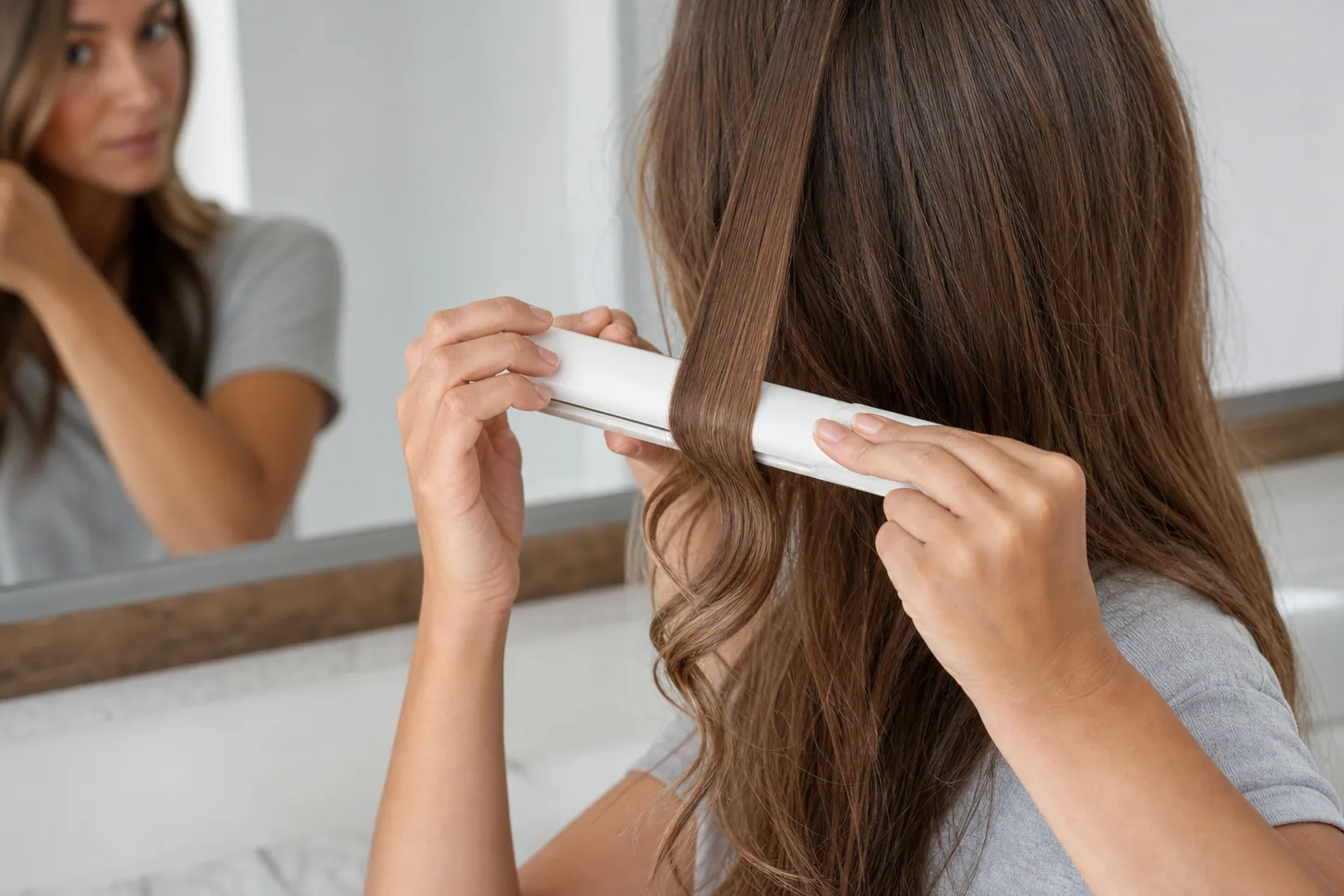
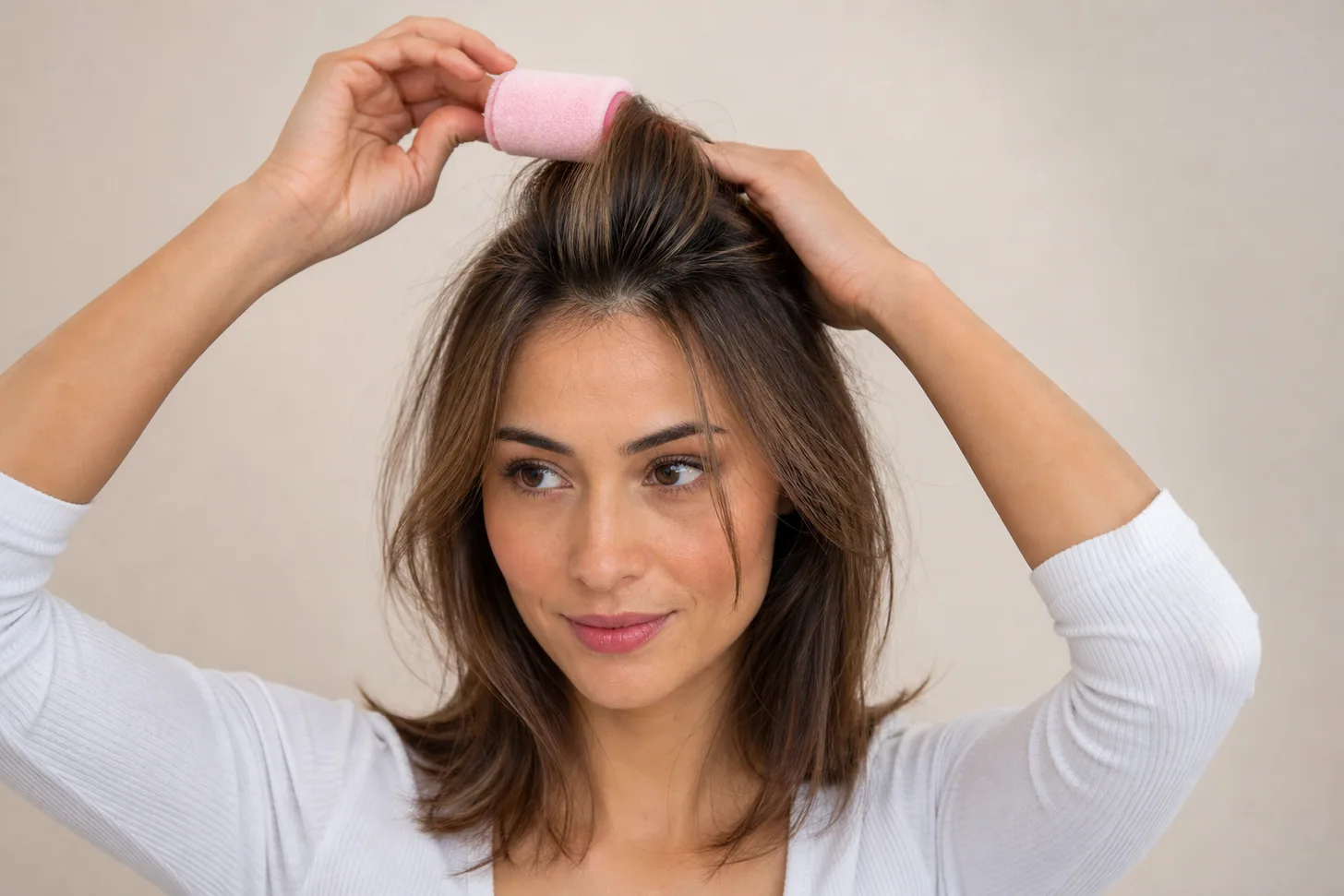
The whole technique in one frame: the iron rotated a half turn, clamped at the mid-length, and travelling downward without stopping.
Why a flat iron holds better than a curling iron on fine hair
Hair holds a shape because heat temporarily breaks the hydrogen bonds inside the strand and the strand re-forms them in whatever position it happens to be in as it cools. That is the whole mechanism, and it is why the cooling step matters more than the heating step — a point why fine hair won't hold a style works through in detail.
What changes between the two tools is the shape those bonds have to hold.
A curling iron produces a coil.The hair is wrapped around a barrel, so every part of the spiral is holding up the weight of everything below it. Fine hair has very little mass to anchor that, so the coil begins to unwind under its own weight the moment it is released. It does not fall out all at once; it relaxes, and by mid-afternoon it has relaxed into a slight wave and then into nothing.
A flat iron produces a bend.The hair is folded over a fixed radius and travels past it. The result is an S-shape running down the strand, and an S only has to keep pointing the way it was set. There is no spiral to unwind. A bend on fine hair degrades far more gracefully than a coil does — it goes from a defined wave to a soft one, which still looks intentional.
There is a second, quieter advantage. A flat iron contacts the strand from both sides at once, so the hair reaches setting temperature in a shorter pass than it would spending the same time against one hot surface.
Less time hot is the entire heat-damage equation for fine hair, which has less cortex to spare than anyone. And it is one tool for two jobs: if the waves collapse at three in the afternoon, you can smooth the same hair rather than starting over.
What the curling iron still wins on is definition. If you want a round, distinct, uniform curl, the barrel gives you that and a flat iron does not. On fine hair, though, defined curls separate as they drop — and separation without body is the exact thing people mean when they say their hair looks stringy.
The temperature fine hair actually needs
Nearly every flat iron sold defaults to a setting built for average-to-coarse hair, and fine hair does not need it. A fine strand has less mass, so it reaches the temperature of the plate faster than a thick one — the same dial that merely warms coarse hair will overcook fine hair in the identical pass.
Your hair
Start here
Ceiling
Note
Fine and virgin (never coloured)
300 °F / 150 °C
330 °F / 165 °C
Most fine hair sets a bend at the bottom of this range. Try there first.
Fine and colour-treated
280 °F / 140 °C
310 °F / 155 °C
Lightened hair has a compromised cuticle and takes heat faster still. Making colour last covers the trade.
Fine but high density
310 °F / 155 °C
340 °F / 170 °C
More hair, same fine strands — take more sections rather than more heat.
Fine and coarse-textured or resistant
320 °F / 160 °C
350 °F / 175 °C
The one group that genuinely needs the upper end. Thin coarse hair explains why.
Damaged, brittle, or mid-repair
Do not curl with heat this week. Heatless methods get you a similar bend overnight.
Test on one section underneath, let it cool completely, and raise the heat by a single increment only if the bend genuinely refused to take. If you find yourself passing over the same section three times, the cause is nearly always damp hair or a section that is too thick — and turning the dial up fixes neither.
One rule with no exceptions: the hair must be bone dry. Water inside the shaft turns to steam against a plate above roughly 125 °C and expands, forming air cavities inside the fibre — the deformity dermatologists call bubble hair, which shows as visible blisters along the strand and snaps at those weak points.
Wet hair also swells by up to about a third of its diameter, so the cuticle is at its most vulnerable at precisely the moment it is under the most heat. Wait for your heat protectant to dry too; a damp product film is still water against a hot plate.
Chair-side note
The thing that surprises clients most when I do this on them is how little I touch the hair. I set a section, I catch it as it comes off the plates, I clip it to the side of her head, and I do not look at it again until the whole head is done and cold.
Most people at home do the exact opposite — they run a section, then immediately shake it out to see whether it worked. That shake is what kills it. The hair at that moment is warm and soft and completely uncommitted, and every bond you just broke is deciding what shape to re-form in.
If it is hanging straight down in your hand while it makes that decision, it re-forms straight. The technique on this page is easy. The waiting is the part people cannot do, and it is worth more than the wrist rotation.
SB
— Simone Baptiste, Senior Stylist
The three flat-iron curls — and which one to learn first
All three do the same physical thing at different scales. Learn them in this order; the first one works on the first attempt and the third takes a week of mornings.
The bend — easiest, and the one that holds longest on fine hair
Clamp a one-inch section at the mid-length, tilt the iron so the plates sit at about 45 degrees to the floor, and glide down without rotating at all. The hair folds over the lower plate edge as it travels, and you get a single wide C-curve through the bottom half of the section. That is it — no wrist movement, nothing to get wrong.
It looks like the least impressive of the three and it is the one I recommend most for fine hair. A single wide bend has almost nothing to lose as it relaxes: it goes from a defined C to a soft one and stops there. It is also the only version that reliably survives being slept on.
The ribbon curl — the classic, and the one people mean by "flat iron curls"
Clamp at the mid-length, rotate the iron a half turn away from your face so the section wraps over the body of the iron, and glide down in one slow continuous movement while holding that rotation. The hair comes off the plates as a loose spiral.
Two things go wrong here and both are fixable. If you rotate and then start moving, you get a hard crease at the fold, because the hair sat still against a hot plate at an angle.
Start the glide and the rotation together. And if you stop partway down to adjust your grip, you will leave a mark exactly there — on fine hair a crease is visible from across a room, because there is not enough hair around it to disguise it. Keep moving to the ends, always.
The rotation direction is worth being deliberate about: away from the face on both sides opens the face up, and alternating the direction section by section gives a more natural, less set result. On fine hair, alternate — uniform curls read as a hairstyle, and a hairstyle on thin hair reads as trying.
The S-wave — the most root volume, and the hardest
Take a wider section, and instead of one continuous glide, work down the strand pressing the hair alternately forward and backward — clamp, bend the section toward you, release a little, travel an inch, bend it away, and so on. The result is a flat zigzag rather than a spiral, which is the shape you see in a crimped or "cool-girl" wave.
This is the only one of the three that adds any height near the roots, because the first bend can sit within an inch or two of the scalp without collapsing. It is also fiddly and unforgiving, and on very fine hair it can go from textured to crimped in one pass too many.
Twenty minutes on a bob, half an hour on longer hair, the first few times. It gets faster.
Start bone dry.Not "mostly dry." See the temperature section above for why this is the one rule with no exceptions.
Mist a weightless heat protectant, then wait for it to dry.Even coverage matters more than quantity — patchy protectant means unprotected sections. A lightweight spray formula rather than a cream; creams weigh a bend straight before you have finished the other side of your head.
Build some grip if the hair is freshly washed.Clean fine hair is slippery and holds nothing. A light mousse dried in, or a mist of dry texture spray before you start, gives the strands something to hold onto. Second-day hair curls better than clean hair, every time — second-day fine hair is the wider case for it.
Section the hair into four, then work in one-inch panels.A section thin enough to see the plate through is a section that sets in one pass. Too thin, though, and each piece becomes a rope — an inch is the sweet spot on fine hair, and it is wider than most tutorials tell you.
Clamp two to three inches down from the scalp.Never at the root. A bend at the root pulls the hair flat to the head, and root lift is the thing fine hair can least afford to lose.
Rotate and glide together, in one continuous movement.Slow and unbroken. Do not stop, do not reposition, do not squeeze. Light pressure — pressing hard creases the hair and makes the iron drag.
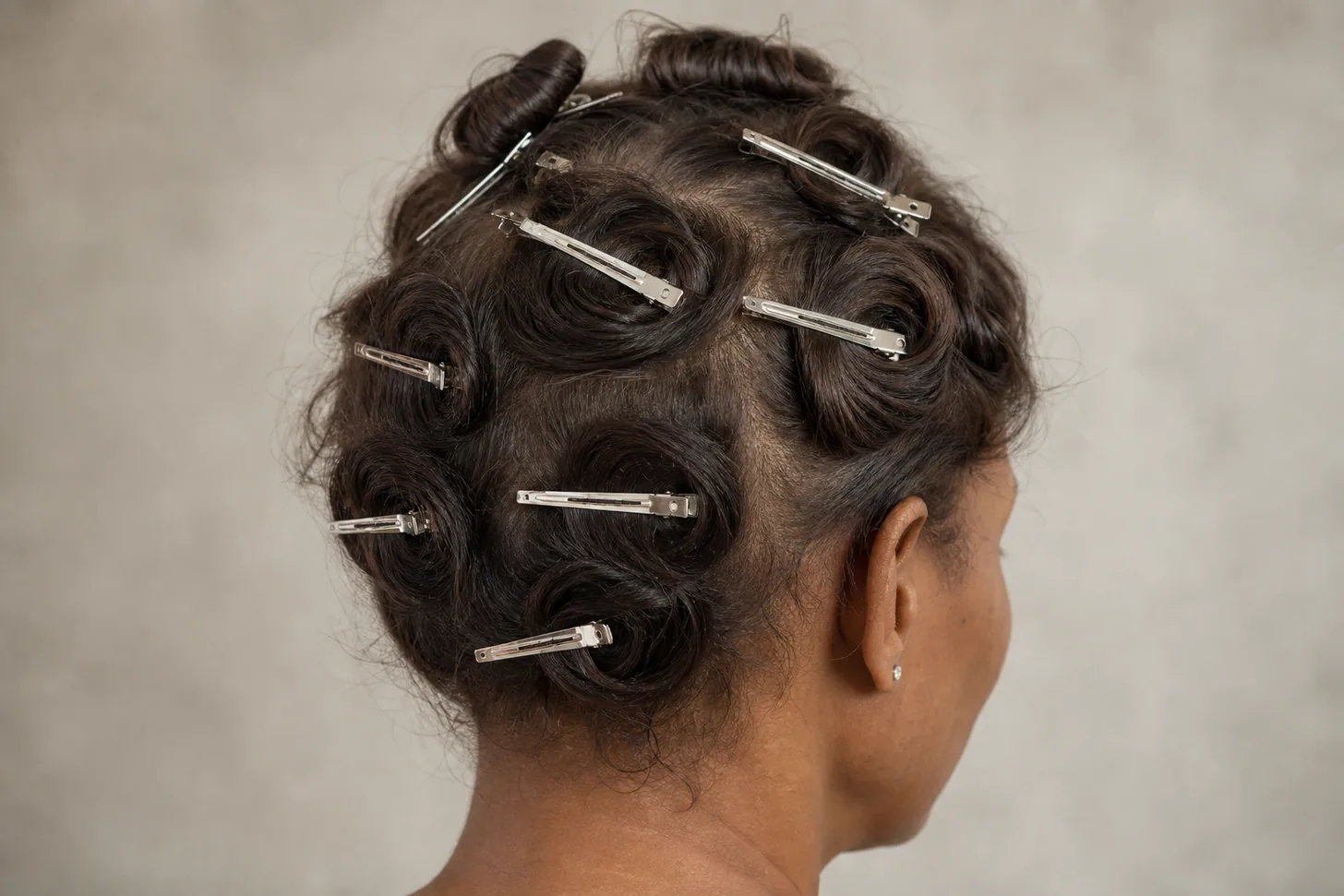
Catch each bend and clip it to cool.Coil it loosely against your head and hold it with a flat clip. This is the step that separates a wave that lasts a day from one that lasts an hour, and it costs about fifteen seconds a section.
Wait until the whole head is cold, then break the shape with your fingers.Unpin from the bottom up. Separate in pieces by twisting rather than raking through — raking makes everything uniform, which is the opposite of the goal. Finish with one light pass of flexible hairspray held at arm's length.
How to curl short hair with a flat iron
On a bob or a pixie the limitation is not technique, it is geometry: a one-inch plate cannot complete a half rotation inside three inches of hair without the iron meeting your scalp. So the adjustments are all about the tool and the direction rather than the wrist.
Go narrower.A half-inch or three-quarter-inch plate with rounded edges solves most of the problem on its own. The narrow-plate picks are the same ones used for bangs.
Work in horizontal rows from the nape up.Clip everything above the row you are on. On short hair you cannot see what you are doing, so a system matters more than it does on long hair.
One bend per section, not a curl.Aim to put a single directional bend in the last two inches. That is all a short cut needs, and attempting a full spiral in four inches of hair produces a crimp.
Direction builds the shape.Bend the sides outward and the back sections under. That combination gives width at the cheekbone and roundness at the back of the head, which is where fine hair reads flattest — see the flat back of the head.
Leave the fringe until last and use a lower setting.Fringe hair is the shortest, finest hair on your head and it takes heat fastest. Styling bangs on fine hair has the specifics.
On a pixie, honestly, skip the curl and use the iron for direction only — a bend at the ends and a lift at the crown. Styling short fine hair covers the full routine, and it is mostly not an iron.
Why your curls drop within the hour
This is the complaint, more than any other, and it has four causes. They are listed in the order they are usually to blame.
You touched it while it was still warm.Hair sets as it cools, not as it heats. Shaking a section out to check it, thirty seconds after making it, is asking the bonds to re-form in a straight hanging position — which they will. This one cause accounts for more dropped curls than the other three combined.
The hair is too clean and too conditioned.A freshly washed, well-conditioned fine strand has a smooth, slippery surface and nothing for a neighbouring strand to hold onto. Curl second-day hair when you can, or build grip back in deliberately.
The sections were too thick.Only the outside of an over-thick section reaches setting temperature. The inside never got hot, never re-formed, and pulls the outside straight within the hour.
There is weight in the lengths.Oils, serums, leave-in creams and rich masks will straighten a bend in fine hair no matter how well it was set. What order to apply products and oily roots and dry ends both come back to this.
If you have fixed all four and the wave still goes flat by mid-morning, the problem is not the curl — it is that the hair has no structural support underneath it. That is a cut question rather than a styling one, and haircuts that look thicker is where it belongs.
Stringy versus piece-y — what actually went wrong
Stringy is separation without body: the bend is there, but the sections have collapsed into thin ropes with nothing holding them apart. Piece-y is the same separation with substance behind it. The difference is almost never the iron.
Your sections were too narrow.A quarter-inch section of fine hair is a few dozen strands and it will always look like a rope. Go wider than feels right — a full inch.
You raked instead of twisting.Fingers pulled straight through separate everything evenly into small strands. Take a half-inch of hair between finger and thumb and twist it once instead.
You finished with something shiny.Shine products lie the strands flat against each other. A dry texture spray does the opposite — it grits the surface so pieces hold apart.
Every section went the same way.Uniform bends read as a set hairstyle, and a set hairstyle on fine hair reads sparse. Alternate direction section by section.
If you want the waves to survive into tomorrow, the answer is the same as for every other fine-hair style: do less to them tonight. Pin them loosely, sleep on silk, and refresh with texture spray rather than reheating. Sleeping on fine hair has the method, and a silk pillowcase is the one purchase that genuinely helps here.
When a flat iron isn't the right tool
Your hair is mid-repair or actively breaking.No amount of technique makes heat a good idea this month. Heatless volume methods get a similar bend overnight, and breakage on fine hair is the page to read first.
You want a defined, round curl.A flat iron cannot give you that, and forcing it produces creases. Use the curling-iron method, which is built for definition.
Your hair is naturally curly and fine.You do not need to make a curl, you need to keep the one you have. Thin curly hair and diffusing fine hair are the right routes.
Your real problem is flat roots.Bends in the lengths do nothing for the top of the head, and the S-wave only helps a little. Root volume and how to fix flat hair are the actual fixes.
You are ironing more than two or three times a week.Fine hair has less cortex to lose, so cumulative heat shows sooner on it than on any other hair type. Alternate with heatless days and use a lower setting on the days you do.
FAQ
Yes, and for most fine hair it holds better than a curling iron does. The reason is mechanical. A curling iron wraps hair around a barrel and sets a coil, and a coil has to fight gravity along its whole length — on fine hair, which has very little mass to anchor a shape, it starts unwinding almost immediately. A flat iron sets a bend instead: the hair is folded over a fixed radius and only has to hold a direction, not a spiral. That's a much smaller thing to ask of a light strand, which is why flat-iron waves are still visible at six in the evening when curling-iron curls have dropped by lunchtime.
Start between 300 and 330 °F, which is well below the default on most irons. A fine strand has less mass, so it reaches the temperature of the plate faster than a coarse one — the same setting that merely warms thick hair will cook fine hair in the identical pass. Test on one section underneath, let it cool completely, and raise the heat one increment only if the bend genuinely refused to take. If you're passing over the same section more than twice, the problem is almost always section thickness or damp hair rather than insufficient heat, and turning the dial up fixes neither.
Four causes, in the order they're usually to blame. You touched it while it was still warm — hair sets as it cools, so shaking a section out to check it undoes the pass you just made. The hair was too clean and too conditioned, so there's no grip between strands for the shape to hold onto. The sections were too thick, so only the outside of each one reached setting temperature. Or there's product weight in the lengths — any cream, oil or rich conditioner will pull a bend straight within the hour no matter how well it was set.
Use a narrow iron and change the direction rather than the technique. On a bob or a pixie the limitation is geometry, not skill — a one-inch plate can't complete a rotation in three inches of hair without hitting your scalp. A half-inch or three-quarter-inch iron with rounded edges solves most of it. Work in horizontal rows from the nape upward, clamp about an inch from the root, and aim for a single bend per section rather than a full curl. Turn the iron so the bend goes outward at the sides and under at the back, which builds shape rather than volume you can't see.
A flat iron, for two reasons beyond the bend-versus-coil argument. It heats the strand from both sides at once, so the hair reaches setting temperature in a shorter pass and spends less total time hot. And it's one tool for two jobs — if the waves drop halfway through the day you can smooth the same hair rather than starting again. A curling iron gives a rounder, more defined curl and is the better choice if that's specifically what you want, but on fine hair a defined curl separates as it drops, and that separation is what looks stringy. The curling-iron method is worth knowing too.
No. This is the one rule here with no exceptions and a real clinical consequence. Water inside the shaft turns to steam against a plate above about 125 °C and expands, forming air cavities inside the hair — the deformity dermatologists call bubble hair, which shows as visible blisters along the fibre and snaps at the weak points. Wet hair also swells by up to about a third of its diameter, so the cuticle is most vulnerable at exactly the moment it's under the most heat. Fine hair has less cortex to lose to begin with. Dry it completely, wait for the heat protectant to dry too, then iron.
Stringy is separation without body. The bend is there, but the sections have collapsed into thin ropes with nothing holding them apart, and on fine hair that happens for two reasons. Either the sections were too narrow — a quarter-inch section of fine hair is a handful of strands and will always look like a rope — or there's weight in the hair pulling each section together. Take wider sections than feels right, keep anything creamy off the mid-lengths, and finish with a dry texture spray rather than a shine product. Break the bends apart by twisting rather than raking through them.
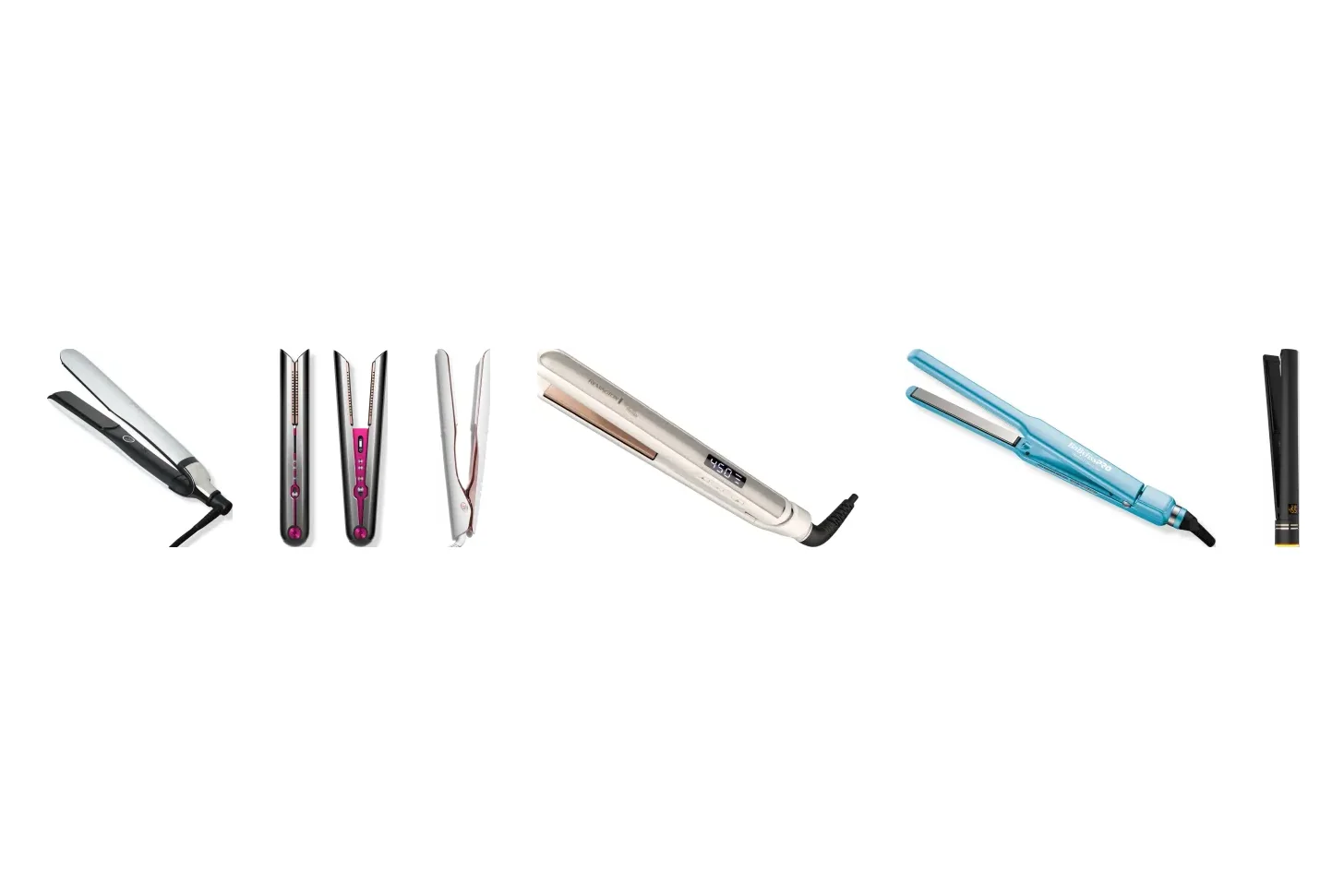
Not special, but the plate edges matter more than anything else on the spec sheet. A curling pass needs the hair to fold over the outside of the iron, so square-cornered plates put a crease at the fold instead of a curve. Rounded or bevelled edges are what let the hair travel smoothly around the body of the iron. Beyond that: a plate an inch wide or narrower, a genuine low-temperature setting rather than one fixed heat, and enough weight that you aren't fighting it. Ceramic is the sensible default for fine hair because it heats evenly and forgives a slow hand — the flat iron picks go through the trade-offs.
Eleven years cutting and styling fine hair. Simone will spend fifteen seconds a section clipping a wave to cool, because the alternative is doing the whole head again at three o'clock.
Images in this article are AI-generated illustrations, not photographs of real clients or results. See our image policy.
Results vary with hair type, density, and growth patterns. This guide is educational and not a substitute for an in-person consultation with a licensed stylist.
Get the good hair intel
One honest, stylist-written guide in your inbox each week. No hype.

 SB
SB