Reviewed by Tara Sullivan · Updated August 2026 · 11 min read
Fine hair is very rarely flattened by the wrong product. It's flattened by four products where two would do, applied in an order that buries the one doing the work. A root spray under a styling cream is carrying that cream all day.
A leave-in on top of a serum on top of an oil is three products doing one job. And a heat protectant applied after a cream isn't touching your hair at all — it's sitting on the cream.
Two rules fix most of it: thinnest to thickest, wet before dry, and the root gets one product, maximum. Below: the wet sequence and the dry sequence in order, how much of each actually means (in objects, not pumps), the three overlaps almost every fine-hair stack contains, and a two-week subtraction test that will tell you which of your products you'd genuinely miss.
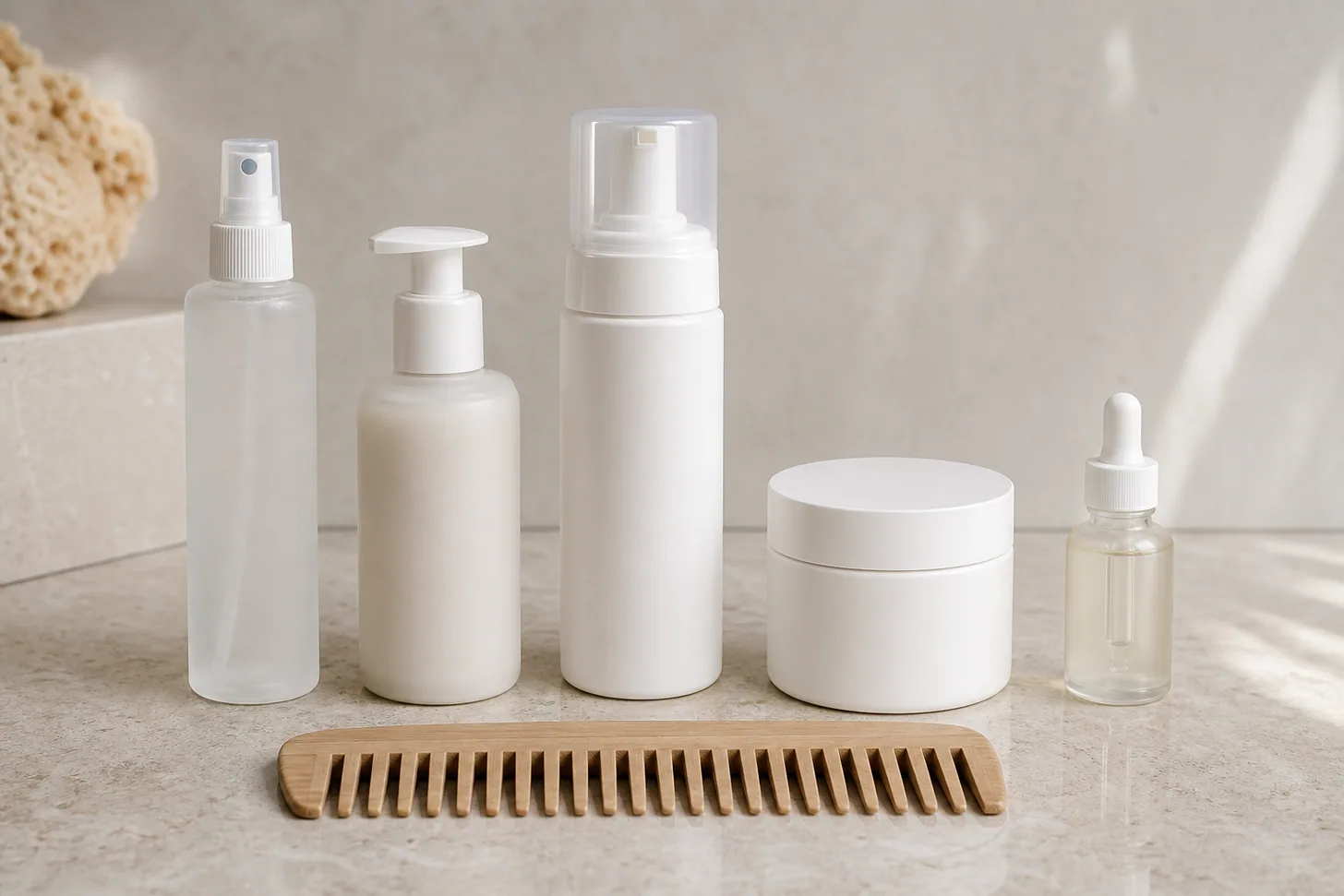
Left to right is the order: thinnest first, thickest last, and only one of them near the roots.
The two rules that decide almost everything
You can forget the rest of this page if you keep these.
Rule one: thinnest to thickest, wet before dry. A watery product can't get through a film that's already on the strand. Spray a liquid leave-in onto hair that's already carrying a cream and most of it sits on the surface and evaporates — you paid for it and your hair never met it.
Work up the viscosity ladder instead: water-thin sprays, then foams, then lotions and creams, then oils, then anything you'd call a wax or a paste. The same logic puts wet-hair products before dry-hair products, because a product designed to be diluted by the water in your hair behaves very differently on a dry strand.
Rule two: the root gets one product. One. This is the rule specific to fine hair, and it's the one people break without noticing, because root products don't look like each other. Mousse is a root product. Root lifter is a root product.
Dry shampoo is a root product. Texture spray is usually a root product. Volume powder is a root product. Stack three of those and the hair at your crown is holding more product than it weighs — which is exactly the flat, separated, slightly tacky result the products were bought to prevent.
Everything else on this page is those two rules applied to a real morning.
Chair-side note
When someone tells me nothing gives them volume, I don't ask what they're using — I ask them to show me the order. Nine times out of ten they've got a good root spray and they're putting it on first, then combing a leave-in through the whole head afterwards, which drags the root product down the shaft and coats it.
The spray never had a chance. I get them to swap two steps, change nothing else, and the difference the next morning is bigger than switching brands ever is.
The other thing I watch for is the hand rub: people pump a cream into one palm, rub both hands together, and then start at the top of the head, which puts the heaviest concentration of product exactly where fine hair can least afford it. Start at the ends. Whatever's left on your hands by the time you work upward is the right amount for the mid-lengths, and nothing should reach the roots at all.
SB
— Simone Baptiste, Senior Stylist
The wet-hair sequence, in order
Start from towel-dried, damp hair — not soaking. Blotting first isn't fussiness: water already in the strand dilutes everything you put on it, so product applied to dripping hair is both weaker and more likely to be rinsed down the shaft into the ends. Towel-drying fine hair properly covers the two minutes that make the rest of this work.
1. Heat protectant or leave-in — first, and on damp hair. It has to touch the strand to work, so nothing goes underneath it. Comb it through with a wide-tooth comb so it's distributed rather than sitting in patches. If your styling cream already contains heat protection, that is your protectant and you skip this step rather than doing both.
2. Root product — into the roots only, on lifted sections. Mousse or root spray, applied by lifting sections up and away and working it into the root area with fingertips. Not sprayed at the top of your head like a mist, which lands mostly on the surface hair and coats the very strands you want standing up. This is your one root product — see root lifters or mousse for which one suits you, and then pick one.
3. Cream, lotion or serum — mid-lengths and ends, starting at the ends. Ends first, working upward with what's left on your hands. Nothing above the ears. If you're using a styling cream and a serum, ask yourself honestly what each is for; on most fine hair one of them is redundant.
4. Oil — last, and only on genuinely dry ends. Two or three drops, rubbed between the palms until your hands look empty, then pressed onto the last inch or two. Oil goes last because it's the thickest thing in the routine and because it seals — anything applied on top of it is applied on top of a barrier. Hair oiling for fine hair covers the version that doesn't flatten.
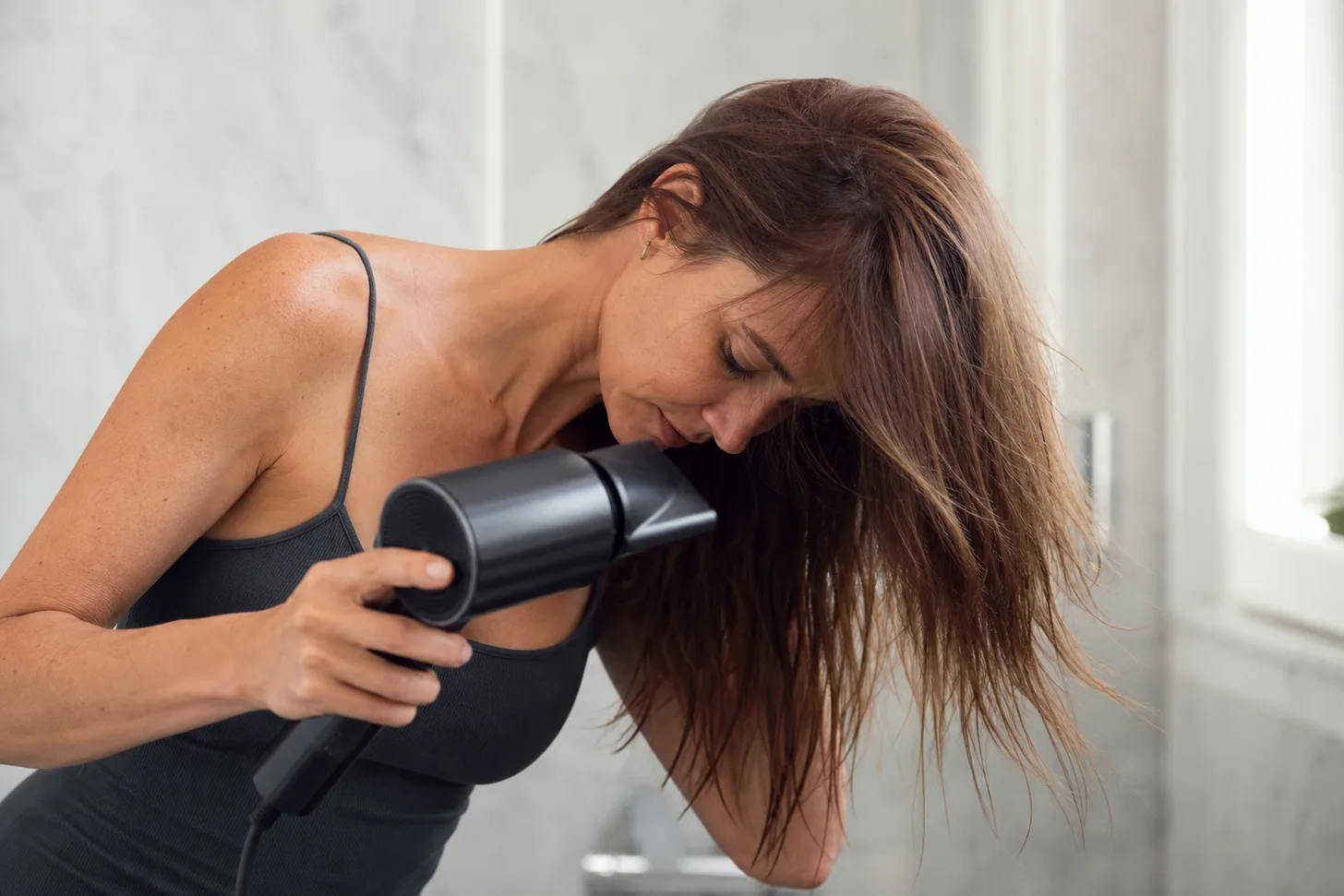
Then dry. Roots first, against the direction they fall, before you touch anything with a brush. That ordering matters as much as the products: hair that dries in the direction it naturally falls has already set flat by the time you pick up a round brush.
The dry-hair sequence, in order
Different products, same logic — and the sequence people most often invert.
1. Dry shampoo or texture spray, at the roots. Whichever of these you use, it goes first and it goes on the scalp area in sections, worked in with fingertips rather than left sitting on the surface. This is the dry-hair version of your one root product. See dry shampoo picks and texture spray for the distinction, which is mostly oil-absorption versus grip.
2. Shape the hair. Backcomb if you're going to, set the part, place the sections. Everything you want held has to exist before anything fixative goes near it.
3. Hairspray, last, from further away than feels natural. A fixative sets the shape underneath it, which is why it can't come first. About a foot back, a light mist, and then leave it alone — brushing after hairspray breaks the film and leaves you with the residue and none of the hold. Hairspray for fine hair covers which finishes stay soft.
The single most common error in this sequence is hairspray before texture spray, which glues the hair into the shape it was already in and then adds grit on top of a set surface. The second most common is brushing after the hairspray. Pomade belongs at the very end of the dry sequence and in a much smaller quantity than the tin implies — pomade for fine hair has the dosage.
The whole order in one table
Wet column first, dry column second. You will not use every row — most fine hair uses two or three of them on a normal day.
Order
Product
Where it goes
How much
Wet 1
Heat protectant / leave-in
Mid-lengths and ends, combed through
1–2 spritzes per section, or a pea of cream
Wet 2
Mousse or root spray (pick one)
Roots only, on lifted sections
A golf ball of mousse; 4–6 spritzes of spray
Wet 3
Styling cream or serum
Ends first, working up; nothing above the ears
A pea to the shoulder, two past it
Wet 4
Oil
The last inch or two, pressed on
2–3 drops, hands rubbed until they look empty
Dry 1
Dry shampoo or texture spray (pick one)
Roots, in sections, fingertips in
Short bursts, 8–10 in from the scalp
Dry 2
Volume powder, if you use it
The part and crown only
A dusting — this is the easiest one to overdo
Dry 3
Hairspray
Over the finished shape
A light mist from about a foot away
What "some" actually means, in objects
Instructions written for average hair are written for more hair than you have. Fine hair takes very little to coat, and the gap between enough and too much is roughly half a pump — which is why measurements in real objects beat "a small amount" every time.
Mousse: a golf ball. Most bottles describe an orange. An orange is two or three days of mousse for shoulder-length fine hair.
Cream or leave-in: a pea to the shoulder, two peas past the shoulder blade. Dispense it, then look at it — if it's covering your palm, that's four times what you need.
Serum or oil: two to three drops. Rub between both palms until your hands look empty, then touch the ends. If your hands still look shiny, you have too much on them and it's going somewhere.
Root spray: four to six spritzes on lifted sections, not a mist over the top of the head.
Dry shampoo: short bursts from eight to ten inches, in sections, then thirty seconds to absorb before you touch it. Applied close and immediately rubbed, it cakes.
And the rule that saves most people: start with half of what you think, style, then add. You can always add. Once fine hair is over-loaded there is no correction — only another wash.
The three overlaps almost every fine-hair stack contains
When I go through someone's bathroom shelf, the problem is almost never a bad product. It's two or three products quietly doing the same job, bought at different times for different reasons.
Overlap one: two root products. Mousse and root lifter. Or root lifter and texture spray. Or dry shampoo used for volume and a volume powder. All of these add grip and body at the root, and stacking them doesn't compound the lift — it compounds the weight, and weight always wins. Keep the one that suits your hair and drop the rest.
Overlap two: three slip-and-shine products. A leave-in conditioner, a serum and an oil are all, functionally, smoothing agents for the lengths. Fine hair can carry one of them. Two is usually why the ends look glossy at 8am and stringy by lunchtime. Decide which problem you actually have — detangling, frizz, or dry ends — and keep the one product that solves it.
Overlap three: conditioner and leave-in doing the same work. If you're conditioning in the shower and then adding a leave-in, check what the leave-in is for. If the honest answer is "the ends feel dry", the fix may be a better rinse-out conditioner and no leave-in at all — how much conditioner fine hair actually needs is the wider version of that question.
Chair-side note
The tell for product overload isn't greasiness, and that's why people miss it for months. Greasy hair from an unwashed scalp is shiny at the roots and moves as a mass. Product-overloaded fine hair does something different: it looks fine for about an hour, then goes limp, and the strands start separating into visible ropes instead of sitting together.
Run a finger down a length and it feels very slightly tacky, like the surface has been handled. And your brush will tell you before your mirror does — a faint film on the bristles that you have to actually pick off, rather than the loose hairs you'd expect. When I see that combination I don't recommend anything. I take three things away.
SB
— Simone Baptiste, Senior Stylist
The two-week subtraction test
This is the only reliable way to find out which of your products is earning its place, and it costs nothing.
Clarify once to reset. Start from a clean baseline, because otherwise you're testing on top of whatever is already built up. A clarifying wash once, not repeatedly.
Go down to two products for a week. One root product, one length product. That's it. Yes, it will feel underdressed on day one.
Add one thing back, and only one, for the second week. The one you missed most. Give it the full week before judging, because a single bad-hair day proves nothing.
Notice what you didn't miss. This is the actual output of the test. Most people find they miss one product out of four, and that the other three were costing them volume the whole time.
If two products genuinely isn't enough — and for some hair it isn't — you'll know by the end of week one, and you'll know exactly which gap you're filling rather than guessing. If your roots still won't hold with a clean slate and one good root product, the problem isn't the stack, and why fine hair falls flat works through the other four causes.
When the order isn't your problem
Your hair is flat straight out of the shower, before any product.Nothing in a bottle causes that. Look at the cut and the way you dry it — root volume for fine hair and blow-drying for volume.
Everything feels coated even on wash day.That's buildup or minerals, not sequencing. See hard water and fine hair before you rearrange your shelf.
Your roots are oily by lunchtime whatever you do.That's a wash-cadence question, not a product-order one — how often to wash fine hair.
Your ends look stringy no matter how little you use.Product can't fix a worn perimeter. Trims for fine hair is the honest answer.
You're using products designed for thick or curly hair.Order won't rescue a formula built to weigh hair down on purpose. The product guides are sorted by what suits fine hair.
You genuinely enjoy the routine.If a six-step morning is a pleasure rather than a chore and your hair looks the way you want, none of this is a rule. It's a diagnosis for people whose hair isn't cooperating.
FAQ
Thinnest to thickest, wet before dry, roots before lengths. On wet hair: heat protectant or leave-in first, then a root product worked into the roots only, then a cream or serum on the mid-lengths and ends. On dry hair: texture spray or dry shampoo at the roots first, then any finishing product, then hairspray last, because it sets everything underneath it. The reason the order matters is that a thin liquid can't get through a film that's already on the hair, so anything watery applied after something creamy mostly sits on top and evaporates. Fine hair shows this faster than any other type, because the amount of product it takes to coat a fine strand is very small and the margin between enough and too much is about half a pump.
Two on a normal day, three if you're heat styling, four only for an occasion — usually one root product and one length product, plus a heat protectant if a hot tool is coming out and a finishing product if you need hold. Most stacks that flatten fine hair aren't five bad products, they're five products of which two or three are doing the same job. A mousse and a root lifter are both root volume. A leave-in, a serum and an oil are all slip and shine. A texture spray, a dry shampoo and a hairspray all add grip at the root. Doubling up doesn't double the effect — it doubles the weight, and weight is the one thing fine hair has no capacity for.
Before, in almost every case, because it needs direct contact with the hair to work. If a cream or an oil is already on the strand, the protectant lands on the product rather than the hair. The exception is a styling cream whose label says it contains heat protection — in that case it is the protectant and you don't need a second one. Apply to damp hair, comb through with a wide-tooth comb so it's distributed rather than patchy, and let it dry down before the hot tool touches it. Applying any protectant to soaking-wet hair and immediately straightening is the version that damages, because the water flashes to steam inside the strand. Heat protectants for fine hair has the picks.
Less than the bottle says, and the useful measures are objects rather than pumps. Mousse: a golf ball, not the orange most instructions describe. Cream or leave-in: a pea for shoulder-length hair, two peas past the shoulder blade. Serum or oil: two or three drops in the palm, rubbed into both hands until they look empty, then touched onto the ends only. Root spray: four to six spritzes on lifted sections, not a curtain sprayed at the top of the head. And the general rule that saves most people — start with half of what you think, style, then add. You can always add. Once a fine head of hair is over-loaded, the only fix is washing it again.
Damp, not soaking, and at the roots rather than through the lengths. Mousse works by setting as it dries, so it needs to be wet enough to spread and dry enough that it isn't simply diluted and rinsed down the shaft by the water still in the hair. Towel-blot first, until the hair is damp rather than dripping. Then work it into the root area with your fingertips, lifting sections as you go, and let whatever's left on your hands go through the mid-lengths. Mousse on dry hair does very little except sit on the surface, and mousse through the ends of fine hair is the commonest cause of the crunchy, separated look people blame on the product itself.
After. Hairspray is a fixative — its job is to set whatever shape is already there, so anything you want it to hold has to be in place first. Texture spray adds grip and body, so it goes underneath. The order that works on fine hair is dry shampoo or texture spray at the roots, then shape the hair, then a light mist of hairspray from about a foot away. Two habits matter more than the order here: spray from further back than feels natural, because a close spray wets one patch and leaves a stiff spot; and don't brush after hairspray, because you break the film and you're left with the residue and none of the hold.
Usually because the volume product is underneath something heavier, or because there's more than one of it. A root lifter applied first and then covered by a cream, a leave-in or an oil is carrying that weight all day, and it was never designed to lift a strand that's been coated afterwards. The second common version is stacking: mousse plus root lifter plus texture spray is three root products, and by the third one the hair at the crown is holding more product than it weighs. Take everything except one root product away for a week and see what happens. If your roots hold better with less on them, that was the problem — and no fourth product would have fixed it.
On fine hair, easily — and the tell is specific. Product overload doesn't look greasy the way an unwashed scalp does. It looks limp within an hour of styling, the hair separates into distinct strands rather than moving as a mass, it feels slightly tacky when you run a finger down a length, and a brush comes out with a faint film on the bristles. The fix is subtraction rather than a stronger product: clarify once to reset, then rebuild with one root product and one length product for two weeks and add back only what you actually miss. Most people find they miss one thing out of four, and that the other three were costing them volume.
Eleven years styling fine hair. Simone's rule for a bathroom shelf: one product for the roots, one for the ends, and start with half of what you think.
Images in this article are AI-generated illustrations, not photographs of real clients or results. See our image policy.
Results vary with hair type, density, and growth patterns. This guide is educational and not a substitute for an in-person consultation with a licensed stylist.
Get the good hair intel
One honest, stylist-written guide in your inbox each week. No hype.

 SB
SB