Chair-side note
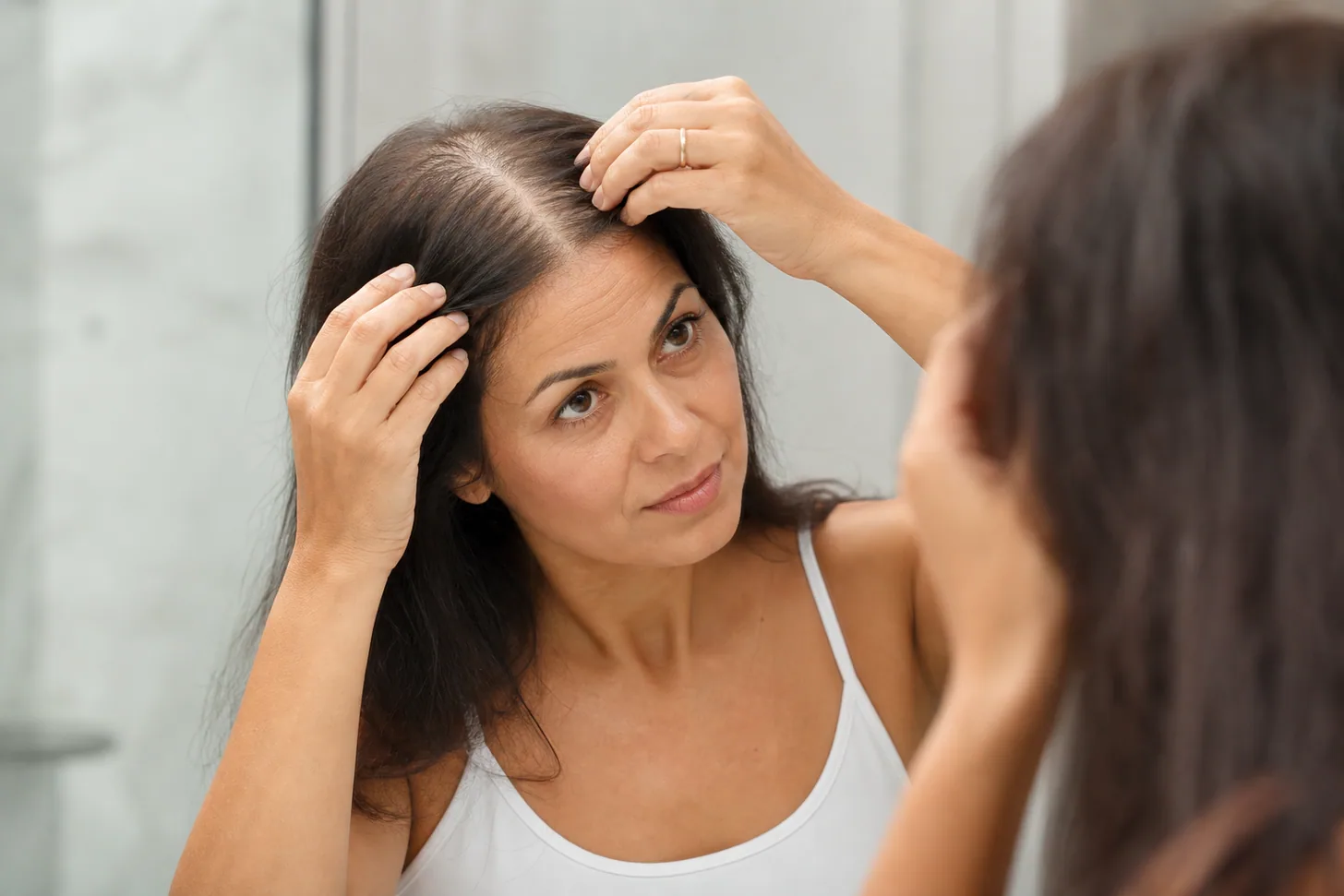
January is when people book in convinced something has gone wrong. The sentence is almost always the same — it's been coming out all winter — and then we talk it through and the heavy shedding was in October, and what's actually happening now is that their hair is flat, charged and clinging to their head, so it looks like there's less of it.
Those are two completely different problems and only one of them has a fix. The tell I ask about is the drain: heavy shedding is something you notice in the shower and on the pillow, whereas winter thinness is something you notice in the mirror at 4pm. If the drain has calmed down and the mirror hasn't, this page is your page. If the drain is still going in February, that's not the season.

MH
The winter shed is mostly an autumn shed
Human hair does have an annual rhythm, and it does not peak when people think it does.
The largest systematic study on this followed 823 healthy women over six years using trichograms — microscopic root analysis that shows what proportion of hairs are in each phase of the cycle. Published in Dermatology in 2009, it reported "annual periodicity in the growth and shedding of hair, manifested by a maximal proportion of telogen hairs in summer," with a smaller second peak in spring — and, in the authors' words, "the telogen rates were lowest in late winter."
Telogen is the resting phase, and it lasts roughly three months. A hair that enters telogen isn't lost at that moment; it sits in the follicle until it's released. So a peak in resting hairs in July shows up as a peak in visible shedding around October.
That's the mechanism, and it's the same one that explains the delay in postpartum shedding. The other half of the year — where that summer peak comes from, and what else the season does to fine hair — is in fine hair in summer.
Population-scale search behavior lines up with it. A 2018 time-series analysis of Google Trends data in the British Journal of Dermatology, covering eight countries across twelve years, found summer and fall associated with the greatest interest in hair loss — not winter.
None of this means your winter shedding is imaginary. It means that if it's genuinely heavy in January, the season is an unlikely explanation and it's worth looking at the other candidates rather than waiting for spring. The AAD's guidance on excessive shedding versus hair loss is the right first read, and fine hair or thinning? is the fine-hair version of the same question.
Static: the physics, and why fine hair gets the worst of it
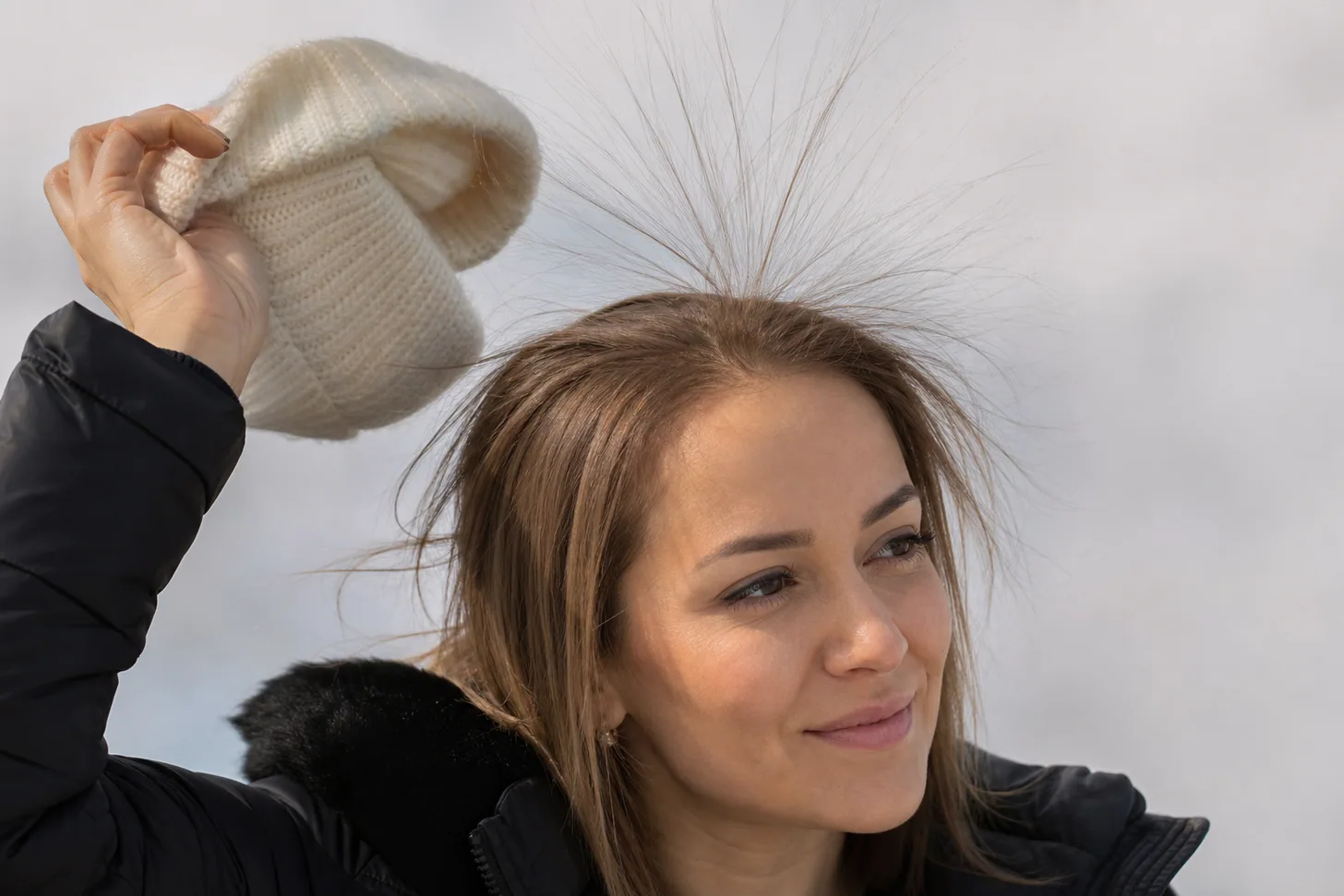
Static is the winter complaint that fine hair owns outright, and it's genuinely a physics problem rather than a hair-health problem.
Charge is generated all year and only stays put in winter
Every time a comb, a brush, a hat or a jumper moves across your hair, electrons transfer between the two surfaces and the hair is left carrying a charge. Every strand carries the same charge, and like charges repel — so the strands push away from each other, which is exactly what flyaway is.
That happens in July too. What differs is how fast the charge drains away, and that depends on moisture. Hair is hygroscopic: it takes up water from the air, and its water content tracks the relative humidity around it.
A paper in the Journal of the Society of Cosmetic Chemists puts the relationship plainly: "At low humidities, static charge becomes relatively important … As the humidity is increased, the moisture content of hair also increases and its ability to acquire an electric charge decreases."
Indoor heating is what turns this from a seasonal detail into a daily annoyance. Heating cold outside air without adding moisture drops indoor relative humidity substantially, so you spend the whole winter in air that keeps your hair dry enough to hold a charge.
Fine hair moves further under the same push
Here's the fine-hair-specific part, and it's the reason your housemate with thick hair doesn't know what you're complaining about. The repulsive force between two charged strands doesn't care much how thick they are. What they weigh, and how stiff they are, absolutely does. A fine strand has a fraction of the mass and a fraction of the bending stiffness of a coarse one, so the same electrostatic push lifts it further and holds it there longer.
Low density compounds it in the usual way: fewer strands means fewer neighbors to lie against and physically hold each other down.
What actually stops it
- A humidifier, in the room you sleep in. This is the only intervention that treats the cause rather than the symptom, and it does more than any bottle. If you do one thing from this page, do this one.
- Condition every wash, on mid-lengths and ends. Conditioner's cationic ingredients are attracted to the negatively charged hair surface and neutralize charge as well as smoothing it. Fine hair is chronically under-conditioned out of a fear of weight — the right amount in the right place is in how much conditioner fine hair actually needs.
- A light leave-in on the ends only. Ends carry the most charge and the least weight. Our picks are in leave-in conditioners for fine hair.
- Change the comb before you change the routine. Plastic is one of the most reliable charge generators there is. A metal-toothed comb or a boar-bristle brush generates far less, and boar bristle also distributes what little sebum you have down the shaft. See combs for fine hair.
- Mist the brush, not the hair. A light spray of water on the bristles adds enough surface moisture to drain the charge without wetting your roots and undoing your volume.
- Natural fibers next to the hair. Wool and acrylic hats and scarves are enthusiastic charge generators. A satin or silk lining solves it almost completely.
And two overcorrections worth naming, because both are widely recommended and both are wrong for fine hair:
Heavy oils and rich creams. They stop static instantly by adding weight and conductive surface — and then flatten fine hair for the next two days. You've traded an hour of flyaway for a week of limp. If you want the oil approach, the limits are in oiling fine hair.
Washing more often. Static feels like "my hair is doing something weird," and the instinct is to wash. That removes the small amount of surface lipid that was helping. Cadence guidance is in how often to wash fine hair.
Hat hair is a set, not a squash
The mental model most people have is that a hat presses the hair down and it should spring back. It doesn't, and the reason is why the fix is counterintuitive.
Hair holds whatever shape it's in while it dries and cools. That's the entire principle behind a blow-dry, a roller set and a heatless overnight curl — you put the hair in a shape, then let it cool in that shape, and it stays.
A hat pulled onto hair that is still even slightly warm or damp does exactly the same thing, except the shape is flat against your skull. By the time you take it off, the set is done.
Preventing it:
- Let hair cool completely before the hat goes on. Not "mostly dry" — cool. Two minutes of standing at the door beats anything you can do afterwards.
- Line the hat with satin or silk. Less friction, less charge, and less compression at the hairline.
- Size up slightly. A hat that grips is a hat that sets.
- Set the roots up before you leave. A root-lift spray at the crown, dried in with cool air, gives the hair something structural to return to — the method is in how to get root volume in fine hair, and the product options are in root lifters for fine hair.
- Take it off indoors, immediately. The twenty minutes at your desk is when the set finishes.
Recovering it, in about ninety seconds: flip your head forward, spray dry shampoo at the roots only, massage with fingertips, flip back and blast for five seconds with cool air. Do not re-wet the roots — you'll simply set them flat again.
If a hat is a daily fixture all winter, the wider fix is a cut that holds shape without root support: see low-maintenance cuts for fine hair, or the flat hair diagnostic if it's flat in July too.
The coat-collar line
This one is invisible until it isn't, and it's specific to hair long enough to reach a collar.
A coat collar, a scarf and a bag strap all sit at approximately the same height. Hair that reaches that height spends the entire season being rubbed against wool at one fixed point, hundreds of times a day, in a way it isn't rubbed at any other point along its length.
The result is mid-shaft breakage in a horizontal band — short broken pieces at shoulder height rather than frayed ends — and the effect is that hair appears to have stopped growing, which is the complaint I actually hear in March.
Fine hair reaches this point faster because there's less fiber to abrade through before the strand fails. The fixes are entirely mechanical:
- Pull your hair out over the collar rather than tucking it inside the coat.
- Put a silk or satin scarf next to the hair, with the wool one outside it.
- Wear long hair in a low, loose braid under a coat — contained, and not rubbing loose against wool.
- Move the bag strap, or wear it across the body on the other side.
If tangling is part of the picture — and wind plus wool means it usually is — the handling sequence in how to keep fine hair from tangling matters more in winter than at any other time of year.
Wet hair, cold air, and what's actually true
Going out with wet hair will not give you a cold. Colds are viral, and the temperature of your head is not the mechanism.
There is still a good hair reason not to. Wet hair is measurably weaker than dry hair — water swells the fiber and disrupts the hydrogen bonding that gives it rigidity, so it stretches further and breaks more easily under the same handling.
Add a hat pulled over it, a collar rubbing it and wind tangling it, and you're manipulating hair at its most fragile point in the cycle. If it actually freezes, the strands go stiff and brittle, and anything that bends them sharply — a hat brim, a hood, a scarf — can break them.
On fine hair, which has the least fiber to lose to begin with, this is a genuine contributor to the mid-length breakage that shows up in February. Fifteen minutes with a dryer on medium heat and a heat protectant is a smaller cost than the breakage. The technique that gets it done fast without flattening the roots is in how to blow-dry fine hair for volume, and the protectant options are in heat protectants for fine hair.
What to change in the routine — and what not to
Most winter hair advice is written for coarse, dry hair and reads as: add richness everywhere. On fine hair that is how you spend January flat. The winter version of the fix is a gentler shampoo rather than a richer one, which is the argument in shampoo for dry, fine hair.