Chair-side note
Every year, without fail, I get a run of appointments in the second half of October from people convinced something is wrong. And every year I ask the same question — what were you doing in July? — because the answer to what's coming out of your head in autumn was written a hundred days earlier.
The one that catches people out is the summer where nothing memorable happened: no illness, no crash diet, just heat, a lot of swimming and not much sleep. That's still a summer, and hair keeps its own calendar. What I can actually do in October is address the appearance; what would have helped is a hat in July.

MH
The shed you'll see in October is being set now
This is the fact that reframes the whole season, and it's the same study read from the other end of the year.
Kunz, Seifert and Trüeb followed 823 healthy women over six years using trichograms — microscopic root analysis showing what proportion of hairs sit in each phase of the growth cycle. Published in Dermatology in 2009, the work found "annual periodicity in the growth and shedding of hair, manifested by a maximal proportion of telogen hairs in summer," with a smaller peak in spring — and, in the authors' words, "the telogen rates were lowest in late winter."
Telogen is the resting phase, and a hair that enters it isn't lost at that moment. It sits in the follicle for roughly three months before it's released. So a July peak in resting hairs surfaces as a peak in visible shedding around October — long after the cause, and long enough to be blamed on something else entirely.
The winter half of this story, including why January shedding usually isn't seasonal at all, is in fine hair in winter.
Two useful things follow. First, if your hair sheds hard every autumn and settles by December, that pattern is well documented and not a sign of anything wrong. Second, an autumn shed that doesn't settle, or that comes with a visibly widening part, isn't the season — fine hair or thinning? is the right next read.
Humidity doesn't frizz fine hair so much as un-style it
The frizz framing is a bit misleading for this hair type. What humidity mostly does to fine hair is undo the work you did at 7am.
Water is the styling agent, and the air is supplying it
Every dry style — a blow-dry, a set, a straightening — works by breaking the hydrogen bonds in keratin with water and letting them re-form in a new position as the hair dries. Hair is hygroscopic, meaning its water content tracks the humidity around it. Step outside into damp air and the air starts putting the water back, and those bonds re-form in whatever shape the hair natively wants to be. Your style isn't being attacked; it's being reversed.
The Journal of the Society of Cosmetic Chemists adds the physical half of it: as relative humidity rises, hair's moisture content rises and fiber swelling increases. A swollen fiber has a rougher surface and sits differently against its neighbours — which is where the frizz half of the complaint comes from.
Fine hair loses the set fastest because there's less holding it
The same reason fine hair doesn't hold a curl is the reason it doesn't hold anything else in August. A style is only as durable as the amount of fiber committed to it, and there's simply less fiber. Low density compounds it: fewer strands means fewer neighbours holding each other in formation.
What helps, in order:
- Finish every style with the cool shot. The shape sets as the hair cools, not while it's hot. A style put down warm is only half set and will surrender to the first damp air it meets. This is the highest-return thirty seconds in summer.
- Hold it with a light, flexible hairspray — not a cream and not an oil. A film that resists moisture is what you want; weight is what you can't afford. Our picks are in hairsprays for fine hair.
- Choose a style that survives being un-set. Anything that depends entirely on a blow-dry is a two-hour style in August. A shape cut into the hair holds when the styling doesn't.
- Stop fighting frizz with weight. The instinct to smooth it with something rich buys an hour and costs a day — the full approach is in taming frizz on fine hair.
The part line is the sunburn nobody protects
This is the section that's genuinely about health rather than appearance, and it applies specifically to this audience.
The scalp is skin. A part line is a narrow strip of that skin, uncovered, held at close to the angle that faces the midday sun most directly — and low density means less hair filtering the light that reaches it. It's also the one patch of skin nobody ever inspects. The AAD's guidance on how to apply sunscreen names it directly: "If you have thinning hair, either apply sunscreen to your scalp or wear a wide-brimmed hat."
Practically, a stick or a spray formula is far easier to run along a part than a lotion, and a hat is easier than either. If your thinning is at the crown or the part, this is a reason to take coverage for thinning fine hair seriously as sun protection and not only as styling.
The hair itself takes damage too, and it's permanent in the literal sense. Ultraviolet light breaks disulfide bonds in keratin and degrades melanin — which is why sun-exposed hair lightens, roughens at the surface, gets more porous and breaks more easily when combed. Hair isn't living tissue, so none of that is repaired; it accumulates until you cut it off.
Fine hair crosses the visible threshold sooner because each strand has less material to lose, and light or colour-treated hair has less melanin absorbing the radiation before it reaches the protein. If you're colour-treated, this compounds with what the colour already did — highlights on fine hair covers that side.
Green hair is copper, not chlorine
Worth knowing because the wrong culprit leads to the wrong fix, and half the internet is treating chlorine for a copper problem.
The green discolouration dermatologists call chlorotrichosis is caused by exogenous copper accumulating in the hair — most often from the copper-sulfate algicides added to inadequately maintained pools, and sometimes from copper plumbing. Chlorine's role is to oxidise the copper and help it bind, which is how it took the blame.
A 2024 case report in Skin Appendage Disorders notes that it "primarily affects individuals with light-colored hair" and those with "preexisting structural hair damage" from chemical, thermal or mechanical sources — because porosity is what lets the copper deposit in the first place.
That combination, light and porous, describes a lot of colour-treated fine hair. It's why the same pool turns one swimmer green and leaves the next unaffected, and it isn't about how much time you spent in the water. If you're unsure where your hair sits, porosity and fine hair explains the test.
What actually works:
- Saturate your hair with tap water before you get in. Hair can only hold so much water; a strand already full of clean water takes up far less pool water. This is free, takes thirty seconds, and almost nobody does it.
- A light leave-in conditioner as a barrier. The case report above recommends a conditioner with quaternary ammonium compounds before exposure — which is what most leave-ins are built on. It also gives fine hair something to slip through rather than tangle in.
- Rinse immediately after, not when you get home. The deposition happens while the water is sitting on the hair.
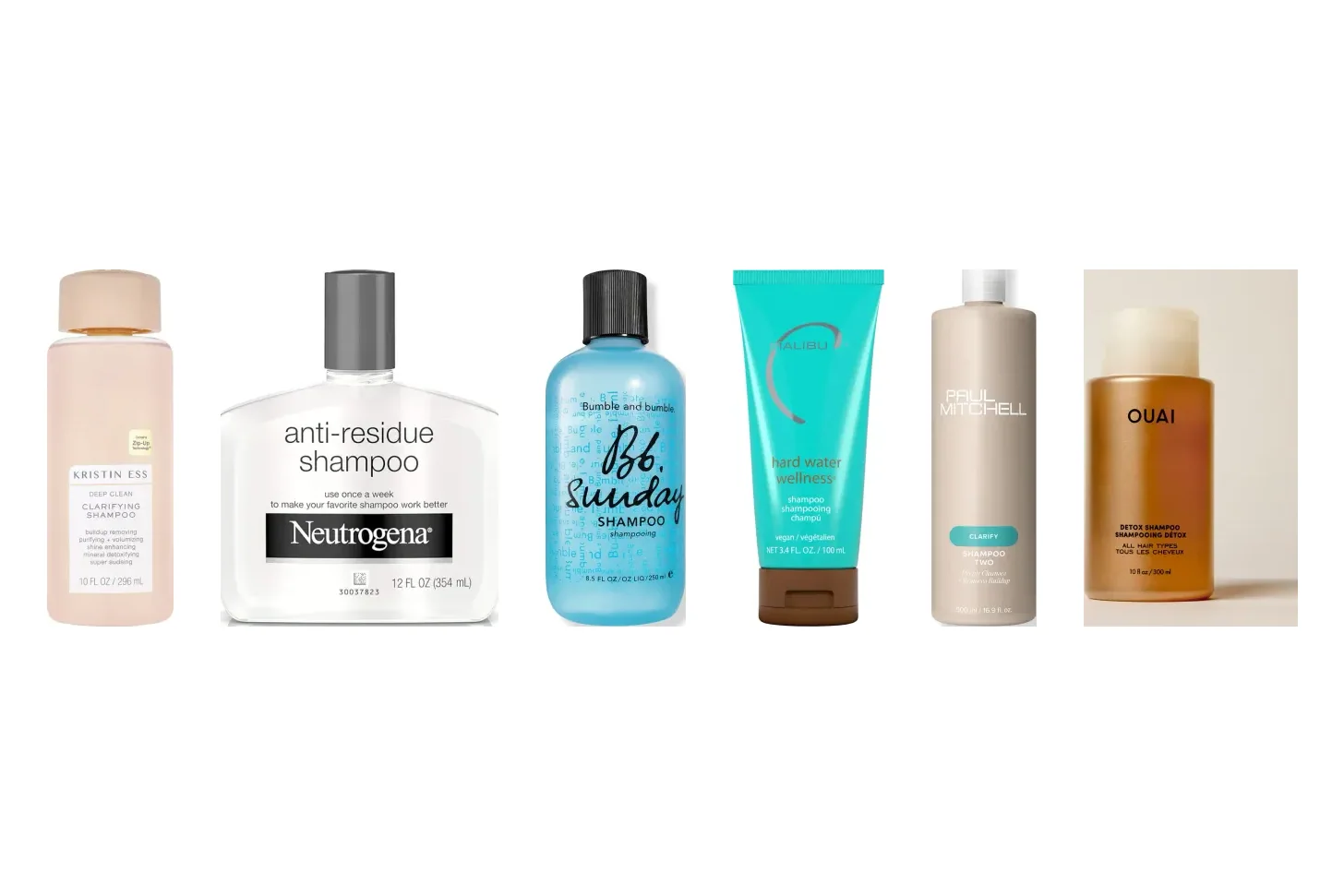
- A chelating or clarifying shampoo weekly if you swim often. Metal deposits are removed by chelating agents such as EDTA, not by ordinary shampoo — see clarifying shampoos for fine hair. The same chemistry that handles hard water on fine hair handles this.
Sea water is a different and gentler problem: salt draws water out of the fiber and leaves it rough and matte, which is the texture people like on purpose. It doesn't deposit metal. Rinse and condition and it's largely undone.
Sweat is a scalp event, not a lengths event
This is where most summer routines go wrong on fine hair, and the correction is small.
Sweat is produced at the scalp, sits at the root and collapses volume within hours — so the urge to wash daily in August is entirely rational. The mistake is washing the lengths daily along with it. Your ends aren't dirty; they're being stripped, in the season when UV and pool water are already roughing up the cuticle.
The practical version is to separate the two. On gym or heat days, shampoo the root area only and rinse the lengths through, then condition mid-lengths to ends as usual. Keep the full wash on your normal cadence. If summer has genuinely moved your wash frequency up, that's fine — just move the shampoo and not the whole routine. How often to wash fine hair has the reasoning at greater length.
One more, because it's specific to this season: don't leave a sweaty scalp under a tight hat or a helmet for hours. Warm, occluded, damp skin is not a good environment for a scalp, and the resulting itch is usually treated as dandruff when it's simply an environment problem. If a beachy finish is the summer look you want, choose the low-salt versions in our sea salt spray picks for fine hair rather than a classic surf spray.
What to change, and what to leave alone
Most summer hair advice is written for coarse or dry hair and reads: add moisture and weight everywhere. On fine hair that is how you spend August flat.