Reviewed by Tara Sullivan · Updated July 2026 · 10 min read
There is no single best hair color for thin hair, but there are two rules that quietly decide whether any shade flatters it. The color needs variation inside it, and it needs to sit reasonably close to your scalp tone.
Variation gives the eye shadows to read as depth; closeness to your scalp means that wherever the hair is sparse, the skin showing through does not announce itself. Those two requirements pull in different directions for some people and the same direction for others, which is why "go lighter" is good advice for one head and useless for the next.
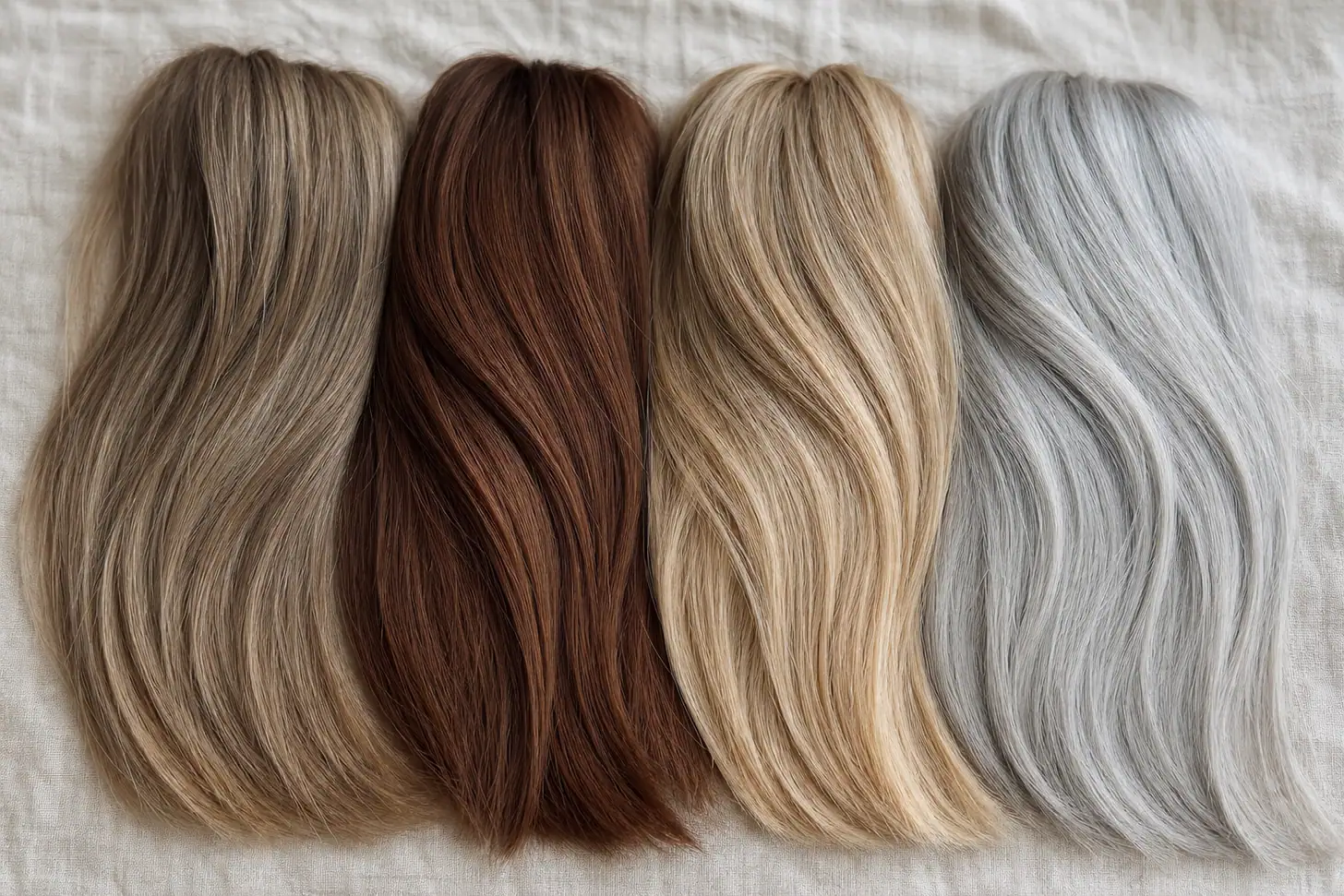
Below are 16 shades that satisfy both — soft neutrals, warm tones that advance, deeper shades done properly, and gray-blending options — plus two flat colors I would talk you out of. This page is about the shade; the placement techniques that deliver it are in highlights for fine hair and balayage for fine hair.
Chair-side note
The consultation question that changes everything, and almost nobody expects it: I part the hair and look at the color of the scalp, not the hair. A fair scalp under dark hair is the hardest brief in fine-hair color, because every place the density drops turns into a bright line against a dark frame.
The same client in a medium bronde looks like she has noticeably more hair, and she has not gained a single strand. Clients with deeper scalp tones get the opposite advice from me — rich, dark, glossy color sits close to their scalp and looks full, while going pale would create the very contrast I spend my day trying to avoid. One rule, two completely different appointments.
PN
— Priya Nair, Master Colorist
The two contrasts that decide everything
Fine-hair color advice usually collapses into one line — "avoid black", or "go lighter" — and it collapses because it is trying to describe two different mechanisms with one rule. Separate them and the whole subject becomes simple.
Contrast
What it is
You want it…
Because
Within the hair
Variation between lighter and deeper pieces
High-ish (but soft)
Shadows read as layers of hair behind layers of hair
Hair against scalp
Gap between your hair color and your scalp color
Low
Wherever density drops, a big gap makes the skin obvious
That is the whole framework. A fair-scalped person in flat jet black fails on both counts at once — no variation, maximum scalp contrast — which is why it is the most punishing combination for low density. A medium bronde with soft dimension passes both. Someone with a deeper scalp tone can wear a rich espresso and pass both as well, provided the color is not flat.
One more variable sits underneath both: whether you are dealing with fine strands, genuinely low density, or the two together. Color can only address how it looks, not how much of it there is, and the distinction changes what you should ask for — it takes two minutes in fine hair versus thin hair.
Soft neutrals and brondes
The safest, most flattering territory for most fine hair: medium shades that carry variation without demanding much lifting. Four of the five below can be achieved with a demi-permanent color or a low-lift gloss rather than bleach.
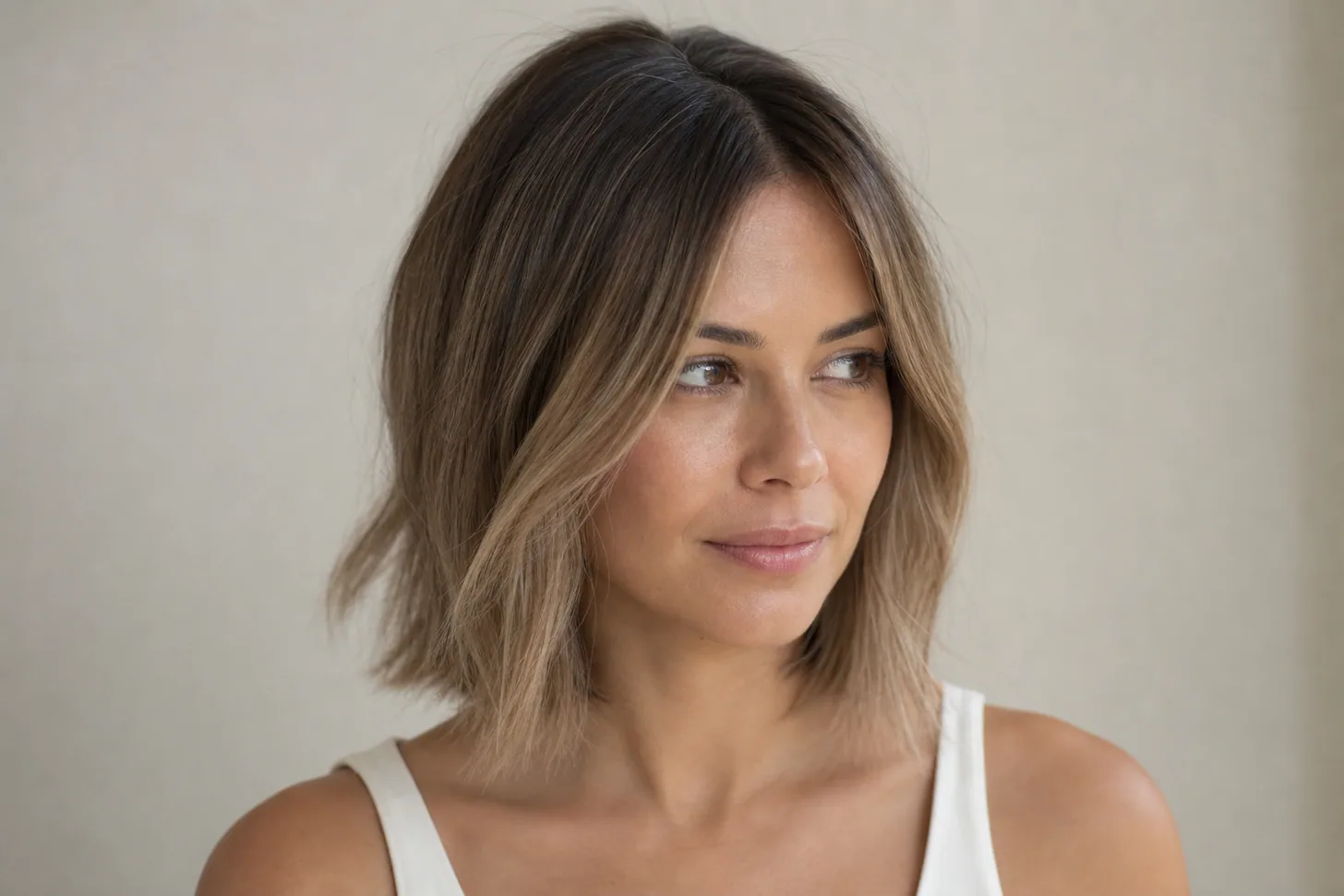
fine shoulder-length hair in soft bronde with subtle tonal variation, three-quarter view, natural daylight
1
Bronde
The shade that sits between brunette and blonde, and the most reliable answer in this entire gallery. It carries both tones at once, so it has variation built into the base before anyone touches it with a highlight, and it is close enough to most fair-to-medium scalp tones to keep the part quiet. It also grows out with almost no line, which on fine hair is worth as much as the color itself.
fine hair in cool mushroom brown with ashy tonal depth, mid-length, soft studio light
2
Mushroom Brown
A cool, softly ashy light brown that reads modern and expensive without any brightness. Its usefulness on fine hair is that it is a low-level color with genuine tonal complexity, so you get depth without going dark enough to fight a fair scalp. The maintenance caveat is real: cool tones fade warm, and fine hair is often porous enough to fade faster than average, so plan a gloss every six to eight weeks.
fine hair in sandy blonde with a slightly deeper root, collarbone length, soft natural movement
3
Sandy Blonde
Neither golden nor ash, which is exactly why it works: a neutral sandy blonde has enough warmth to look like hair and enough restraint to avoid brassiness. On a fair scalp it is close to ideal, because the hair-to-scalp gap nearly disappears while the shade itself keeps some variation. Ask for it kept a shade deeper at the root rather than uniform from scalp to ends.
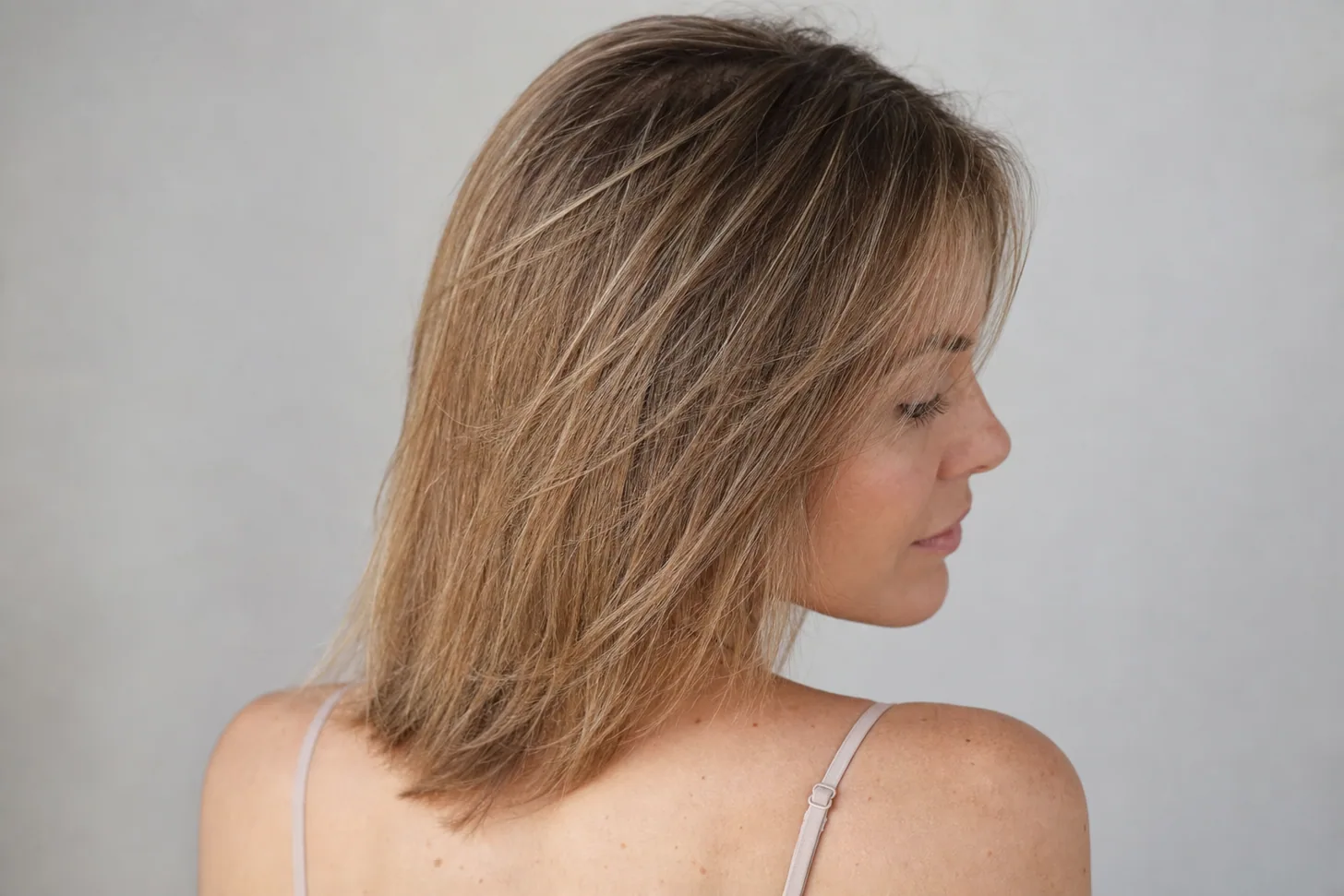
fine hair in beige blonde with a deliberately deeper shadow root, showing contrast at the scalp, back view
4
Beige Blonde With a Shadow Root
Blonde, but with the first two or three inches deliberately left or made a level or two deeper. The shadow does the heavy lifting: it puts depth exactly where a part line would otherwise go pale, and it turns a six-week regrowth problem into a three-month one. Anyone who wants to be blonde with fine hair should be asking for this version rather than the uniform one.
fine hair in light neutral brown with soft dimension, glossy finish, mid-length
5
Light Neutral Brown
The unglamorous choice that flatters an enormous number of people. It is dark enough to look like a real, deliberate color and light enough that a fair scalp does not shout through it, and because it needs no lifting it can be done entirely with a deposit-only demi — which is gentler on the strand and adds shine rather than costing condition. If your hair has been over-lightened for years, this is often the road back.
Warm shades that advance
Warm tones advance visually while cool tones recede, so warmth sits forward and makes hair look like it occupies more space. That is not marketing — it is the same reason a warm-painted wall makes a room feel smaller and closer. On fine hair the effect is small but free.
fine hair in chestnut brown with warm caramel dimension woven through, shoulder length, warm light
6
Caramel Chestnut
The brunette version of bronde, and the shade I recommend most often to people who do not want to be blonde. Caramel pieces through a chestnut base give brown hair the shadows it is usually missing, and the warmth means the lightened pieces never have to travel far enough to hit the orange stage brunettes dread. It suits warm and neutral complexions particularly well.
fine hair in warm honey blonde with golden dimension, mid-length with soft waves
7
Honey Blonde
Golden, warm, and forgiving in a way that ash blondes are not — as it fades it goes softer rather than brassier, which means the gap between appointments is livable instead of anxious. For fine hair that is a practical advantage worth more than the shade itself, because every appointment you skip is lifting you did not do. Best on warm and neutral skin tones; it can look sallow against very cool complexions.
fine hair in golden brown with subtle warm depth, glossy, shoulder length, natural light
8
Golden Brown
A medium brown with the warmth turned up rather than filtered out. Where cool browns can go flat and slightly matte on fine hair, a golden brown reflects light back, and shine is itself a density signal — dull hair reads as sparse regardless of how much of it there is. This one is achievable with a demi-permanent color on most natural bases, which makes it one of the least damaging options here.
fine hair in soft copper with strawberry tones, mid-length, showing rich warm reflect
9
Soft Copper or Strawberry
Red family shades sit closer to most scalp tones than either very dark or very pale hair does, and they carry an enormous amount of visible reflect, which is why fine red hair often photographs fuller than fine blonde hair. The honest trade-off is fade: red molecules are large and wash out faster than any other family, so expect a color-depositing conditioner in your routine and a refresh every few weeks.
Deeper shades, done properly
Dark hair is not off-limits for fine hair — flat dark hair is. If your scalp tone is deeper, these three are often more flattering than anything lighter, because the hair sits close to the skin beneath it.
fine dark hair in espresso brown with warm reddish dimension visible in the light, glossy finish
10
Espresso With Warm Dimension
Deep brown with warmth deliberately left in it, so that the hair shifts between a near-black and a warm brown as it moves. That shift is doing the same job a highlight does — giving the eye two tones to compare — without any lightening at all. The whole look depends on gloss: dark hair that is dull looks flat and sparse, dark hair that shines looks solid.
fine hair in mocha brown with woven deeper lowlights creating depth, mid-length, back view
11
Mocha With Woven Lowlights
The reverse of the usual appointment: instead of lifting pieces lighter, the colorist deposits pieces deeper through a medium brown base. Nothing is lightened, so the strand pays nothing, and the head gains exactly the contrast it was missing. This is the single most underrated service for fine hair that has been highlighted for years and has drifted to one flat pale tone.
fine hair in soft black with subtle brown-violet dimension on a deeper scalp tone, glossy, shoulder length
12
Soft Black, Not Flat Black
A black that has been formulated with a brown or violet-brown undertone rather than a solid opaque one, so it still moves in the light. On deeper scalp tones this is often the most flattering option available, because the hair-to-scalp contrast is minimal and the shine is maximal. On a very fair scalp the same shade is the hardest thing to wear with low density — the entry at number 15 explains why.
Gray, silver, and blending
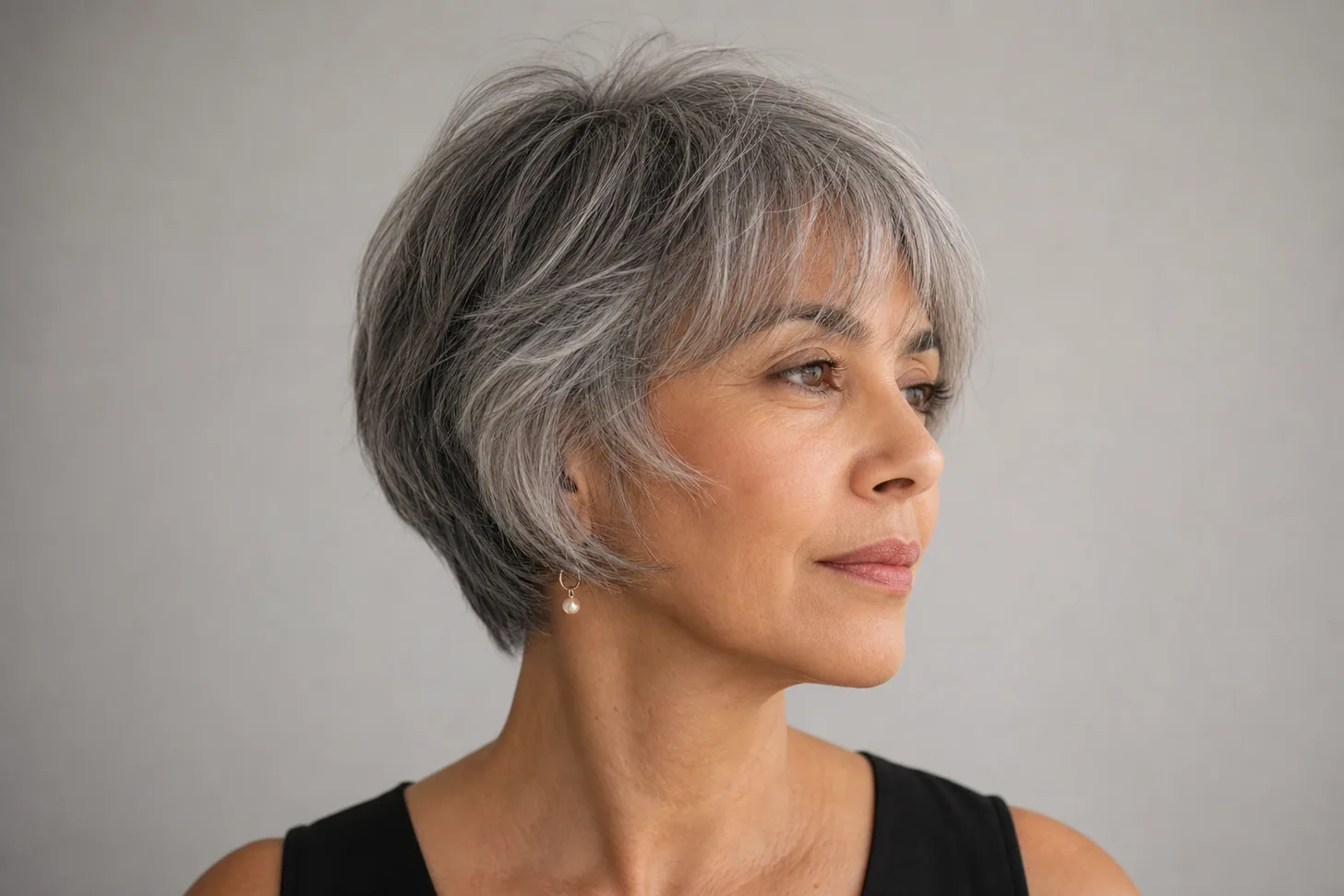
Hair grays because follicles stop producing melanin, and no product reverses it (American Academy of Dermatology). What you can decide is whether to fight the regrowth every four weeks — a schedule fine hair does not enjoy — or work with it.
fine graying hair with soft blonde blending so grays read as highlights, mature woman, natural light
13
Blended Gray
Rather than covering grays, the colorist adds soft lightness around them so they read as highlights instead of intrusions. The dimension is free — the gray is already a second tone — and the regrowth stops being an emergency, which for fine hair means far fewer chemical services per year. It pairs naturally with the low-maintenance shapes in our gallery for mature fine hair.
fine silver-gray hair with a pearl toner, soft and luminous rather than yellow, chin-length bob
14
Pearl-Toned Silver
For hair that is mostly or entirely gray already, a pearl or violet-leaning toner turns a yellowed, dull silver into something luminous — and shine is the whole game here, because gray hair has a different surface texture and can look dry when it is not. It costs the strand nothing, since toning deposits rather than lifts. Budget for a purple-toned shampoo used sparingly, once a week at most, or you will end up lilac.
Two to skip
Both are popular, both photograph well on dense hair, and both fail on fine hair for the same underlying reason: they are flat.
flat single-process jet black on fine hair with a fair scalp, showing a visible bright part line, illustrating what to avoid
15
Flat Single-Process Jet Black — on a fair scalp
It fails both tests at once: no variation for the eye to read as depth, and the widest possible gap between hair and a pale scalp, so every place the density drops turns into a bright line. It is also the hardest color to leave, since removing black is a correction job rather than a color appointment. If you love the drama, take the soft black at number 12 instead, and ask for warmth left in it.
uniform all-over platinum blonde on fine hair with no root depth, slightly translucent ends, illustrating what to avoid
16
Flat All-Over Platinum
Fairly, the scalp contrast is low, and that genuinely helps. Everything else is against it: reaching platinum means lifting a fine strand further than almost any other service, the result has no depth left anywhere in it, and the maintenance is a root touch-up every few weeks on hair that is already at its limit. If platinum is the goal, take the rooted, shadowed version at number 4 and accept it as the fine-hair edition.
Try: "My hair is fine and I want it to look fuller rather than just different. Can you look at my scalp tone and tell me whether going lighter or staying where I am will hide my part better? I would like tonal variation rather than one flat shade, a deeper root, and as little lifting as we can get away with — a demi or a gloss if that will do it."
Ask what the color will cost you in maintenance before you agree to it, in appointments per year rather than in money. Fine hair does best on a schedule of a few gentle services rather than many small corrective ones, and a shade you have to defend every four weeks is the wrong shade regardless of how it looks on the day.
Almost everyone notices it after a permanent color: the hair has more body, holds a blow-dry longer, and does not go flat as fast. The mechanism is not mysterious.
Oxidative color raises the pH to open the cuticle so pigment can develop inside the strand, and doing so removes part of the natural lipid layer and leaves the surface rougher (Hair Cosmetics: An Overview, International Journal of Trichology). Rougher strands catch on each other rather than sliding into a flat sheet, so the hair sits fuller.
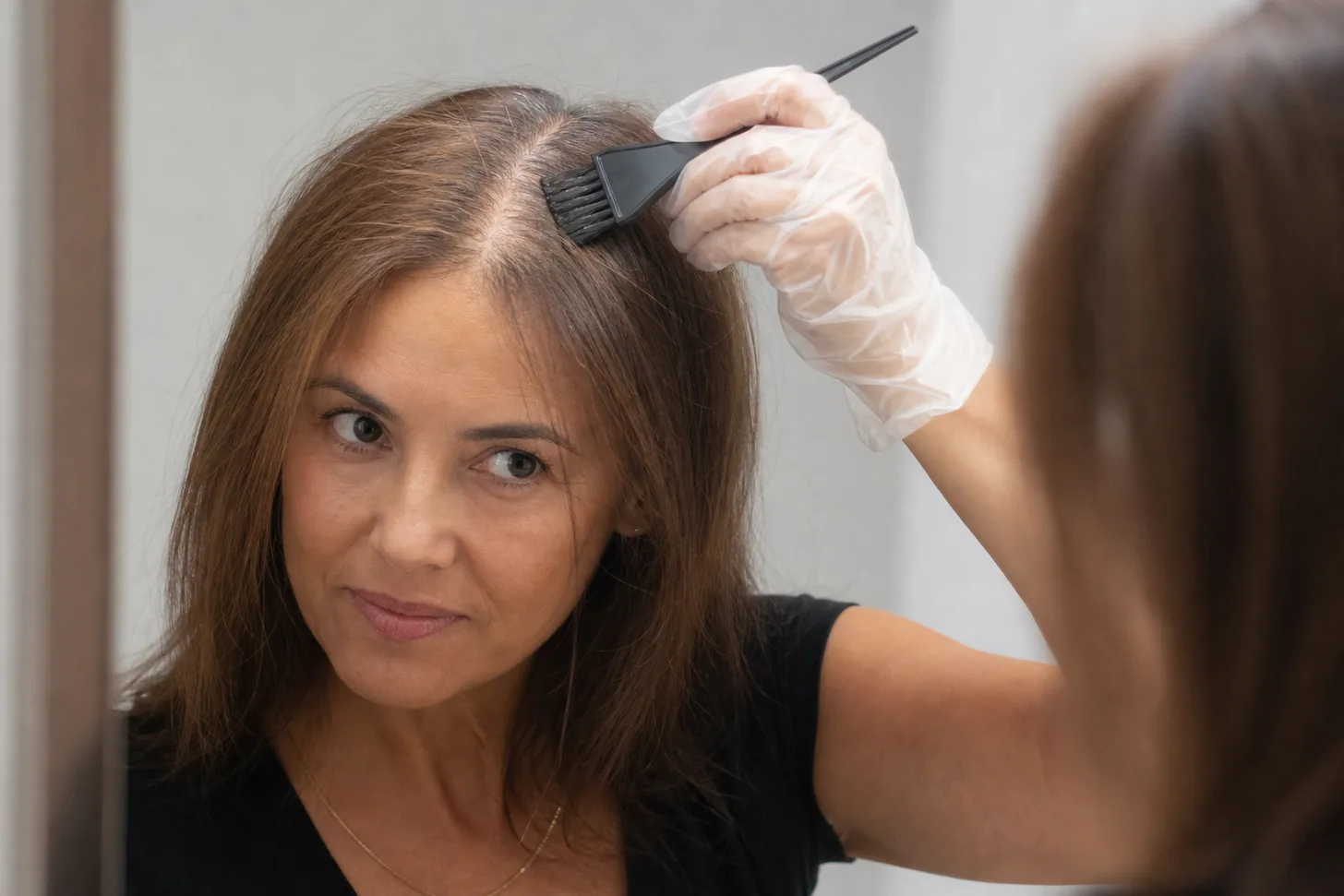
It is worth being honest about what that means: the body is real, and it is mild surface damage doing the work. Demi-permanent colors and glosses are gentler — they carry lower peroxide and no ammonia, sit mainly on the cuticle, and fade out rather than growing out — but they also deliver less of that grip.
For most fine hair the sensible pattern is a demi or gloss as the regular service and permanent color only when you genuinely need gray coverage or a real change of level. The corollary question — whether coloring costs you hair — is worth settling separately, in does coloring thin your hair.
When to change something other than your color
Your scalp is showing more than it did a year ago. Color changes how that looks, not what is causing it. Start with telling fine hair from thinning, and see a dermatologist if it is recent or accelerating.
Your hair feels spongy or stretches when wet. That is over-lifted fine hair. No shade will fix it — deposit-only color and repair for a few months first.
The problem is really the cut. Flat, shapeless fine hair reads sparse whatever color it is. The shapes that build weight where fine hair needs it are in our haircut galleries for fine hair.
You are choosing a shade to hide a widening part. Color helps, but the fastest wins are styling ones — the coverage techniques are in coverage for thinning-on-top fine hair.
You have had a reaction to hair dye before, however mild. Sensitivity to dye ingredients builds with exposure. Tell your colorist, and do not skip the patch test.
FAQ
Any shade that carries tonal variation within it and doesn't sit far away from your scalp tone. Those are two separate requirements and both matter. Variation — bronde, caramel through chestnut, sandy blonde over a dark blonde base — gives the eye shadows to read as depth, which a single flat shade can't do. Closeness to your scalp tone matters because wherever hair is sparse, the scalp shows through, and the bigger the gap between hair color and scalp color the more obvious that patch becomes. This is why very dark hair on a fair scalp is the hardest combination for low density, and why medium, dimensional shades flatter almost everyone.
It depends far more on your scalp tone than on any rule. If your scalp is fair, going darker increases the contrast between hair and scalp and makes the part, the crown, and the hairline more visible — so a medium, dimensional shade usually flatters more than a deep one. If your scalp tone is deeper, dark hair sits much closer to it and a rich espresso or soft black can look full and glossy rather than sparse. What's true for everyone is that flat, uniform color of any depth reads as less hair than the same color with variation woven through it.
Lighter often helps, but not because light hair is thicker — because it narrows the gap between your hair and a fair scalp, so the sparse areas stop announcing themselves. The catch is that going lighter means lifting, and lifting is the thing fine hair has the least tolerance for. The version that gets the benefit without the bill is a medium base with fine, low-contrast lightness woven through the top layer and around the face, and a shadow left at the root. That reads lighter overall while asking far less of the strand than an all-over lift.
A shade with depth at the root and no strong contrast against your scalp. Keeping the first couple of inches slightly deeper than the lengths puts shadow exactly where the scalp would otherwise catch the light, and it makes the part line read narrower. What works against you is the opposite instinct — brightening the top of the head, which removes the last bit of contrast disguising the gap. Root shadow first, dimension second, brightness only around the face. Colored root touch-up sprays and powders do the same job between appointments.
Permanent color makes fine hair feel and behave thicker, which isn't quite the same as being thicker. Oxidative color has to raise the pH to open the cuticle so pigment can develop inside the strand, and that process leaves the surface rougher and strips some of the natural lipid layer. Rougher strands catch on each other instead of sliding into a flat sheet, so colored fine hair usually holds a blow-dry and a style better than virgin hair does. The body is real; it's also mild surface damage doing the work, which is why a deposit-only gloss is the better everyday choice if you don't need to lift.
Two, and both fail for the same reason — no variation. Flat single-process jet black on a fair scalp is the most difficult combination for low density, because it maximizes hair-to-scalp contrast and reflects light in a way that shows every gap. Flat all-over platinum is the other: the scalp contrast is low, which helps, but the color has no depth left in it and getting there costs a fine strand more lifting than almost anything else. Both are salvageable with dimension — a soft black with warm lowlights, or a rooted, shadowed blonde — but neither works flat.
Twelve years coloring at a high-end studio, now a Redken-certified educator who trains stylists in balayage, foilyage, and color correction. Priya's rule for fine hair: the goal is dimension, not maximum lift.
Images in this article are AI-generated illustrations, not photographs of real clients or results. See our image policy.
Results vary with hair type, density, and growth patterns. This guide is educational and not a substitute for an in-person consultation with a licensed stylist or colorist.
Get the good hair intel
One honest, stylist-written guide in your inbox each week. No hype.

 PN
PN