Most of the time it isn't thinner. It's lying differently — and in a mirror those look identical. Start from a baseline that removes a lot of unnecessary worry: nobody is symmetric. Skulls differ side to side, hairlines are rarely mirror images, and hair doesn't grow at identical density across a scalp, so almost anyone who looks closely enough will find a difference.
On top of that sit six mechanical causes that make one side look sparser without a single hair being lost — the biggest of which is that a side part deliberately puts most of your hair on one side, so the short side genuinely has less hair on it and always did.
Then there's the side you sleep on, the whorl at your crown sending hair one way, your dominant hand doing more of the work, and the ear you tuck behind. Below: the two-minute test that tells "less hair" from "different fall", each cause and its fix, and the specific patterns that mean this is a medical question rather than a styling one — because a seventh cause does exist and it looks different from the other six.
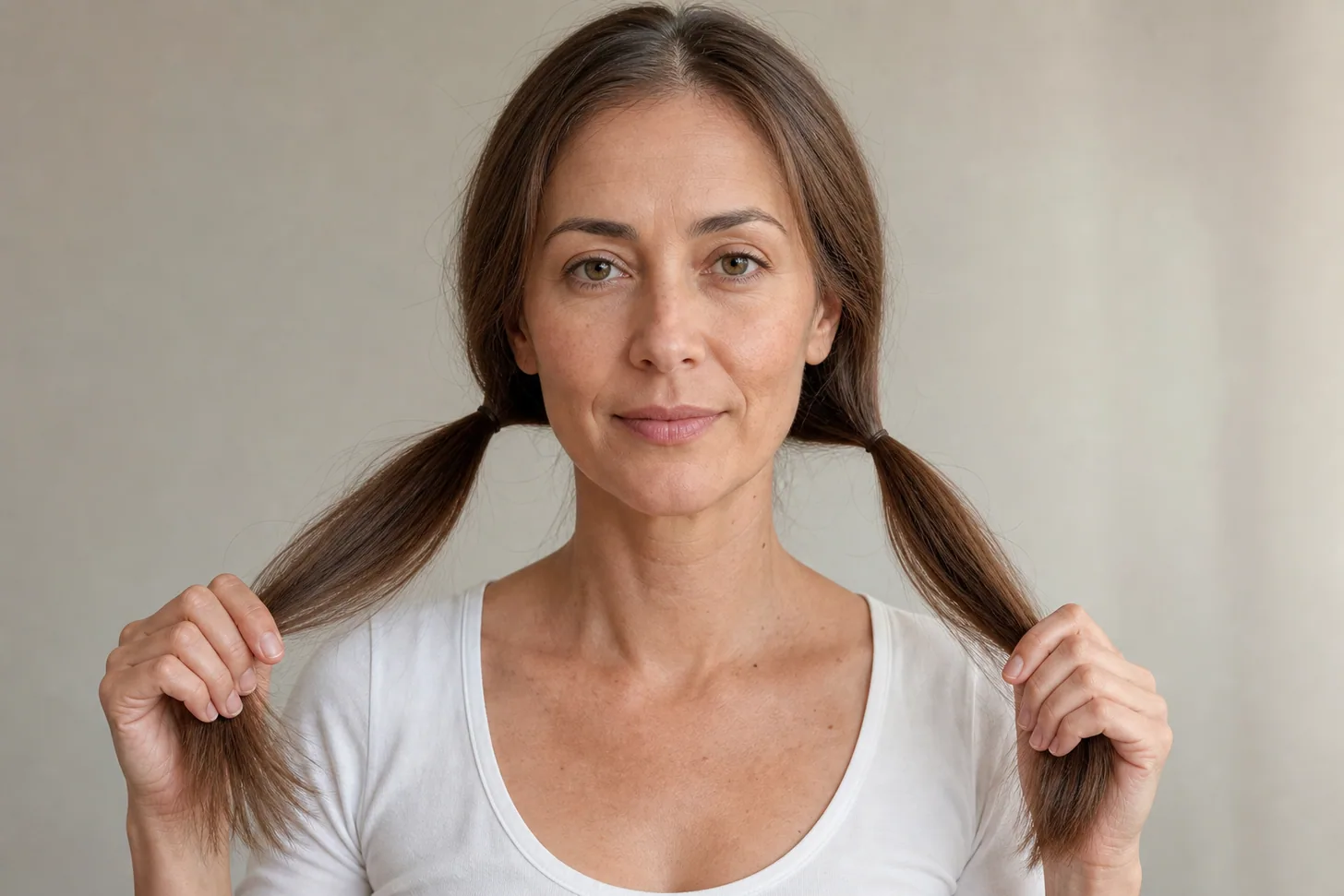
The test that settles it: take the hair off your head and compare it directly, rather than judging how it falls.
Start here: nobody is symmetric
Before diagnosing anything, it's worth knowing what normal looks like — because the standard most people are unconsciously measuring against is a mirror image, and human heads aren't one.
Skulls are slightly asymmetric. Ears frequently sit at marginally different heights. Hairlines are rarely identical on both sides, and eyebrows almost never are. And hair density genuinely varies across a scalp rather than being evenly distributed. Look closely enough at anyone and you'll find a difference.
So finding an asymmetry isn't evidence of a problem. What matters is whether it's changing. A mild difference you've had for as long as you can remember is your head. A difference that has appeared or widened over months is a different question entirely, and it's the one worth measuring rather than agonizing over.
That distinction — long-standing versus new — is the single most useful thing to establish, and it's why the next section is a measurement rather than an opinion.
The two-minute test
The mistake almost everyone makes is judging by how the hair falls. Fall is affected by the part, the drying, the whorl, the pillow and the light. Density isn't. So take the hair off your head and compare it directly.
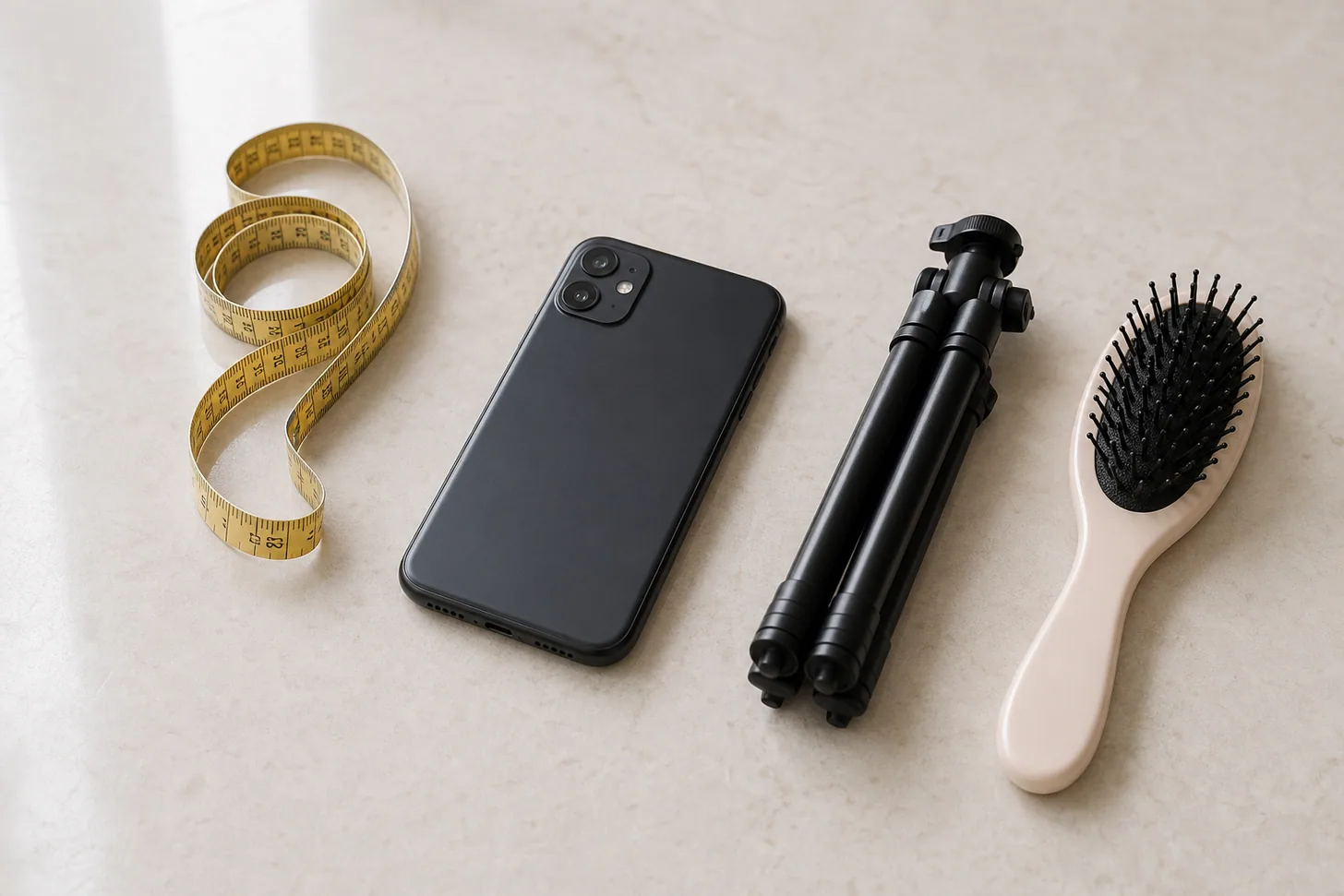
Part your hair down the exact center, with a comb. Fingers won't give you a genuinely central line, and a line that's even slightly off makes the test useless.
Gather each side into a loose low ponytail at the same height, one in each hand, behind the ears.
Compare by feel first, then with a tape. A tailor's tape around each gives you a number rather than an impression. Note both.
Do it in window light, not under a ceiling light. Overhead lighting shines straight down onto the part and exaggerates any visible scalp — it's responsible for a great deal of unnecessary alarm.
Photograph both temples from the same distance while you're there, so you have a baseline to compare against in three months.
Reading it: if the two feel like the same amount of hair and the numbers are close, your density is even and what you're seeing is how the hair sits — causes one to six below. If one side is clearly and repeatably less, that's a real difference, and the last section of this page applies.
If you want the fuller version of measuring hair over time — the photo protocol, why counting shed hairs is a poor instrument — how to tell if anything is actually working covers it.
Chair-side note
I do this test at the basin two or three times a month, and the result surprises people almost every time. A client is certain the left side is disappearing; we part it centrally, gather both sides, and the two are indistinguishable in her own hands. What she was seeing was a deep right part that had been in the same place for eight years, sending nearly all her hair to one side and leaving the other temple exposed in every photograph.
Nothing was lost. It was distribution. The reason it's worth doing physically rather than talking her out of it is that reassurance doesn't stick and a tape measure does — she can repeat it at home in three months and get her own answer rather than remembering what I said. And when the test does show a real difference, we both know it in two minutes rather than after a season of guessing.
MH
— Megan Holloway, Editor-in-Chief
The six causes that aren't hair loss
1. Your part is doing it, and it's the commonest reason by far
A side part divides your hair unevenly on purpose. Most of it goes to the long side; much less goes to the short side. So the short side has genuinely less hair on it, has always had less hair on it, and will look sparser at the temple in every photograph. The deeper the part, the more pronounced.
There's a second contribution: hair that has fallen the same way for years lies flat in that direction and stops standing up at the root, so the exposed side gets flatter as well as sparser. The test is to move the part to the center for a week and look again.
If the sides even out, that was it — and moving your part periodically is a good habit regardless, because it stops one strip of scalp being permanently exposed. How to part fine hair covers where it should sit.
2. The side you sleep on
Eight hours a night of compression sets the roots on that side flat against the scalp, which on fine hair reads as noticeably less volume by morning. The same friction, repeated over years, also contributes to mechanical wear — the 2015 hair cosmetics review is direct that "Abrasion and friction are impactant factors that cause hair damage by protein loss", and a cotton pillowcase supplies plenty of both.
What that produces is flatness and breakage on one side, not fewer follicles. Fixes: a silk or satin pillowcase so hair slides rather than drags, and a deliberate re-dry of the flattened side in the morning rather than styling around it. Sleeping with fine hair has the rest.
3. The whorl at your crown
Hair grows out of the crown in a spiral, which sends it around the head in one direction. That means one side is being combed and dried with the growth and the other against it — so the same cut behaves differently on each. It's why one side tucks neatly and the other flicks out, and why a bob can turn under on the left and out on the right.
This is a growth pattern, not a fault, and it's answered with directional drying rather than more product: dry the stubborn side against its natural fall while it's wet, set it cold. If it still fights you, a stylist can cut a fraction differently on that side to compensate. Cowlicks on fine hair is the full treatment.
4. Your dominant hand
You brush, dry, straighten and curl with one hand, which means one side gets more passes, more tension, and the hot tool held closer and more confidently. The non-dominant side typically gets less handling — which sometimes means it's in better condition, and sometimes means it's less well styled and therefore looks worse.
Worth noticing which of the two you have, because they point opposite ways: if the dominant side is rougher or shorter at the ends, that's handling damage. If the non-dominant side simply looks less finished, that's technique.
The tell is short, blunt-ended broken hairs at that temple rather than an evenly sparse area. Alternate the side you tuck on, and consider whether the front is simply too short to stay put and needs growing or re-cutting. Thinning at the hairline and temples covers the tension picture properly.
6. Straps, seatbelts and the phone
A bag carried on the same shoulder, a seatbelt crossing the same side, a phone held against the same ear, a car window you always rest against. Each is repeated friction in one place. Individually trivial; over years, enough to produce roughness and breakage on one side and not the other.
It's the easiest category to fix — alternate shoulders, move the strap outside your hair — and the easiest to dismiss, which is why it's worth a moment's honest thought about your actual daily habits. If the difference shows most at the temple, an asymmetric cut answers it directly — see cuts for a receding hairline and thinning temples.
Which is it?
What you see
Most likely
What to do
Short side of a side part looks sparse at the temple
The part — distribution, not density
Move it centrally for a week and re-look
One side flat every morning, recovers when re-dried
The side you sleep on
Silk pillowcase; re-dry that side against its fall
One side flicks out, the other tucks under
The crown whorl
Directional drying; a cut that accounts for it
One side rougher or shorter at the ends
Dominant-hand handling, or a strap
Ease off the heat and tension on that side
Short broken hairs at one temple
Tension — tucking, or a habitual pull
Alternate sides; see the hairline guide
Ponytail test shows both sides equal
Any of the above — density is fine
Treat it as a styling problem, and stop worrying
A smooth patch with a defined edge
Not a styling cause
See a dermatologist — read the next section
The seventh cause, and how it looks different
Everything above is mechanical and reversible. There is a category that isn't, and it's worth being able to recognize, because it doesn't look like any of the six.
The distinguishing feature is an edge. Styling causes produce gradual, diffuse differences that blend into the surrounding hair. The pattern that needs a doctor is a discrete area with a boundary.
There's a round or oval patch with a defined edge, smooth rather than stubbly.
The difference appeared quickly, or has visibly widened over weeks to months.
The affected side is sore, itchy, scaly, red or painful.
There's a receding hairline or a band of short broken hairs at one temple.
The one-sided loss came with shedding elsewhere, or with other symptoms — fatigue, weight change, cycle changes. Which blood tests actually matter is worth reading before you go.
Take photographs before the appointment. The difference is frequently less visible under clinic lighting than it is at home, and a set of dated pictures from your own bathroom is genuinely useful evidence rather than an imposition.
When one-sided isn't the real question
Both sides are thinning, and one is just ahead.Diffuse loss shows first where hair is naturally sparsest, which is rarely symmetric. Fine hair or thinning? separates the two.
The hairs coming out are short and blunt at both ends.That's breakage rather than loss, and it's a handling problem you can fix — breakage on fine hair.
You've noticed it only in photographs.Cameras and overhead light both exaggerate visible scalp. Do the ponytail test in daylight before drawing any conclusion.
It started after a big life event three months ago.Diffuse shedding lags its trigger by about twelve weeks and can look uneven. See the three-month rule.
It's been like this your whole life.Then it's how you're built, and the useful work is a cut and a part that flatter it rather than a diagnosis.
FAQ
In most cases it isn't thinner, it's lying differently — and the two are hard to tell apart in a mirror. Start from the fact that nobody is symmetric: skulls, faces and hairlines aren't mirror images, and hair doesn't grow at identical density across a head. On top of that baseline sit six mechanical causes that make one side look sparser without any hair being lost. A side parting puts most of your hair on one side by design, so the short side genuinely has less hair on it and always did. Sleeping on the same side compresses that side every night. The whorl at your crown sends hair one way, so one side is combed with the growth and one against. Your dominant hand styles one side more. And a side you habitually tuck behind your ear is under repeated tension.
Take the hair off your head and compare it directly rather than looking at how it falls. Part your hair down the exact center with a comb — fingers won't give a genuinely central line — then gather each side into a loose low ponytail at the same height and hold one in each hand. If the two feel like the same amount of hair, and a tape measure around each gives a similar number, your density is even and what you're seeing is how the hair sits. If one side is clearly and repeatably less, that's a real difference worth taking further. Do it on dry, unstyled hair in front of a window rather than under a ceiling light — overhead lighting exaggerates any scalp that shows and is responsible for a great deal of unnecessary worry.
It can make that side look flatter and can contribute to breakage, but it doesn't reduce how much hair grows there. Eight hours a night of compression sets the roots on that side flat against the scalp, which on fine hair reads as noticeably less volume by morning, and the same friction over years contributes to mechanical wear — a 2015 review of hair cosmetics is direct that abrasion and friction cause hair damage by protein loss, and a cotton pillowcase supplies plenty of both. What that produces is flatness and breakage on one side rather than fewer follicles. The fixes are a silk or satin pillowcase, which lets hair slide rather than drag, and a deliberate re-dry of the flattened side in the morning rather than styling around it.
Yes, and it's the most common reason people conclude they're losing hair on one side. A side part divides your hair unevenly on purpose: most of it goes to the long side and much less to the short side. So the short side genuinely has less hair on it, always has, and will look sparser at the temple in any photograph — the deeper the part, the more pronounced. There's a second contribution: hair trained to fall one way for years lies flat in that direction and stops standing up at the root. The test is to move the part to the center for a week and look again. If the sides even out, the part was the cause — and moving it periodically is a good habit anyway, because it stops one line of scalp being permanently exposed.
Repeatedly, over years, on the same side, it can contribute to thinning at that temple — and it's the most overlooked source of tension here. The mechanism is the one behind traction alopecia, which the AAD attributes to hairstyles that pull, and its advice applies just as well to a habit: avoid frequently wearing hairstyles that pull on your hair, and switch up your hairstyle regularly so your hair can recover. Tucking isn't a hairstyle, but it's a small repeated pull on the finest hair you own, several times an hour, always in the same direction. The tell is short, blunt-ended broken hairs at that temple rather than an evenly sparse area. Alternate the side you tuck on, and consider whether the front is simply too short to stay put.
Yes, and the baseline is worth stating plainly because it removes a lot of unnecessary worry. Human bodies aren't symmetric: skulls differ slightly side to side, hairlines are rarely mirror images, ears sit at marginally different heights, and hair doesn't grow at exactly the same density across a scalp. Almost everyone who looks closely enough will find a difference, and finding one isn't evidence of a problem. What matters isn't whether the two sides differ but whether the difference is changing. A mild asymmetry you've had for as long as you can remember is your head. A difference that has appeared or widened over months is a different question — and that's the one worth measuring, photographing and, if it continues, taking to a dermatologist.
Because of the whorl at your crown, which sends hair around the head in one direction. Hair emerging on one side is being combed and dried with the direction of growth, and on the other against it, so the same cut behaves differently on each. It's why one side tucks neatly and the other flicks out, why a bob can turn under on the left and out on the right, and why one side always seems to need more work. It's a growth pattern rather than a fault, and the answer is directional drying rather than more product: dry the stubborn side against its natural fall while it's wet and set it with cool air. If it still fights you, ask your stylist to cut a fraction differently on that side — a cut that ignores the whorl will always be a daily argument.
When the loss is patchy rather than diffuse, when it has a defined edge, or when it's getting worse over weeks rather than being long-standing. The particular pattern to know about is alopecia areata, which the AAD describes as causing sudden hair loss that often begins as a round or oval, smooth balding patch on the scalp, typically without swelling or discoloration of the skin. A smooth, clearly bordered bald patch on one side isn't a styling issue and needs a diagnosis rather than a different parting. Other reasons to book: a sore, itchy, scaly or painful area on that side, a receding hairline or short broken hairs at one temple, or any one-sided loss that appeared quickly. Take photographs beforehand — the difference is often less visible under clinic lighting than at home.
Fourteen years in fine-hair care, eight of them behind the chair. Megan's first move on any one-sided worry: a comb, a central part, and a tape measure — because reassurance doesn't stick and a number does.
This article is for general education and is not medical advice, and the checks described here are not a diagnosis. A smooth, clearly bordered patch of hair loss, a sore or scaly scalp, or one-sided loss that has appeared or widened quickly should be assessed by a board-certified dermatologist.
Images in this article are AI-generated illustrations, not photographs of real clients or results. See our image policy.
Results vary with hair type, density, and growth patterns. This guide is educational and not a substitute for an in-person consultation with a licensed stylist or physician.
Get the good hair intel
One honest, stylist-written guide in your inbox each week. No hype.

 MH
MH