The same flaking looks worse on fine hair
Worth establishing first, because it changes how alarmed to be.
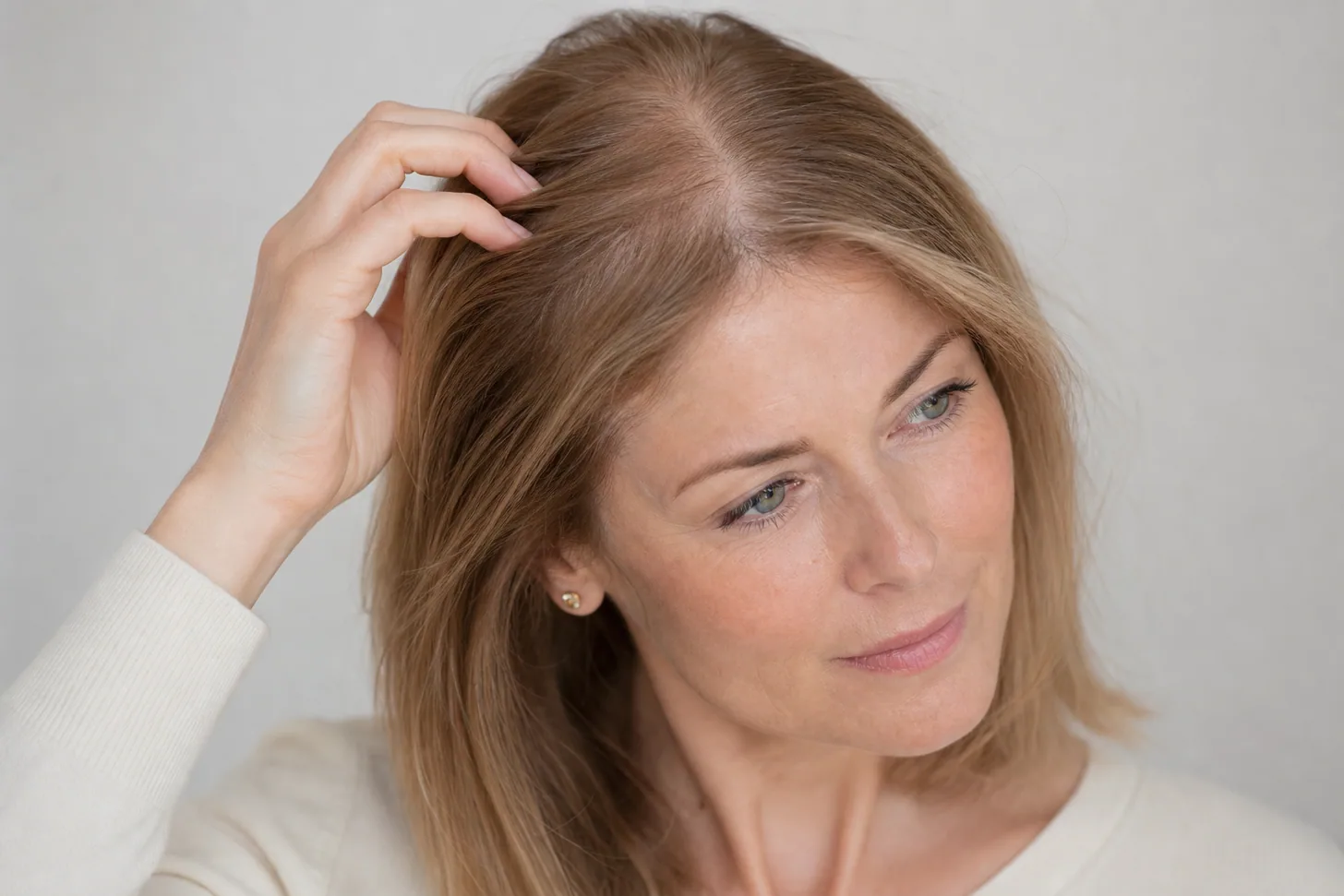
Flaking shows up in two places: on the scalp, and on your shoulders. Fine, lower-density hair loses on both counts. More scalp is directly visible through the hair — particularly along the part, which is where flakes gather anyway — so what would be buried in a dense head is in plain sight. And fewer, finer strands catch and hold less of what sheds, so more of it reaches your clothes rather than staying in your hair.
The consequence is genuinely reassuring: if you have fine hair and you're worried about your flaking, you probably have milder dandruff than a thick-haired friend who hasn't noticed hers. You're seeing more of the same amount. It doesn't make it less annoying, but it does mean the treatment you need is usually the ordinary over-the-counter one rather than something drastic.
Dandruff isn't dryness — it's three things at once
This is the section that changes what you do, so it's worth the two minutes.
Dandruff and seborrheic dermatitis, per a genome-level review in the Journal of Investigative Dermatology Symposium Proceedings, "share an etiology dependent upon three factors: sebum, microbial metabolism (specifically, Malassezia yeasts), and individual susceptibility." All three have to be present. Remove any one and the flaking stops — which is the good news buried in a complicated sentence, because it means you have more than one lever.
Sebum is the food supply
Your scalp produces oil. That's normal and necessary and there's nothing wrong with it. It's simply the first ingredient in the process, which is why washing frequency turns out to be a real treatment variable rather than a comfort preference.
The yeast is the processor, and the by-product is the problem
Malassezia lives on nearly everybody's scalp and isn't an infection you caught. It's lipid-dependent — it can't make its own fats, so it takes them from your sebum. The same review identifies M. globosa as "the most likely initiating organism by virtue of its high lipase activity," and confirms that this lipase is actually expressed on the human scalp.
The lipase splits the triglycerides in your sebum; the yeast consumes the parts it wants and leaves free fatty acids sitting on your skin. And the experimental finding that ties it together: "oleic acid alone can initiate dandruff-like desquamation" in susceptible people.
So the flakes are your skin's inflammatory response to a by-product of your own oil. Not dryness. This is the entire reason the "moisturize a dry scalp" instinct backfires, and it's covered properly below.
Susceptibility is why your partner doesn't have it
The yeast and the sebum are on almost everyone. The reaction isn't. Individual susceptibility is the third leg, it's largely out of your hands, and it's why this is a thing you manage rather than a thing you did wrong. It also explains flare patterns — stress, cold weather, illness — that have nothing to do with hygiene.
Dry scalp and dandruff are different problems
They get the same shelf in the pharmacy and want opposite treatments, so it's worth five seconds of diagnosis.
The AAD's own summary is that dandruff "shows up as small pieces of dry skin flaking off your scalp" and is often linked to seborrheic dermatitis, caused by yeast on the skin, while dry skin "happens when skin loses too much water" — from harsh products or from weather.
In practice they look and feel different:
- Dandruff: larger, often slightly yellowish or greasy-looking flakes that cluster near the part and the crown. The scalp may look pink underneath. Frequently worse when you've gone longer between washes.
- Dry scalp: small, fine, white flakes, and a scalp that feels tight all over. Usually accompanied by dry skin elsewhere, and typically worse in winter or after a harsh product. If yours arrives with the heating, fine hair in winter is the more relevant page.
The quickest practical test: wash your hair. If the flaking is noticeably better for a day or two and creeps back as the oil returns, it's dandruff. If washing makes it worse and it feels tight afterwards, you're looking at dryness or a formula that's too harsh for you.
Chair-side note
I could tell you what a client has been doing before she tells me, because fine hair with a flaky scalp arrives in one of two states. Either it's squeaky and slightly frizzy, because she's been scrubbing daily with something aggressive and stripping the scalp she was trying to calm.
Or it's flat and slightly waxy at the root with flakes sitting on top of a film — that's the coconut oil mask someone recommended, and it's the version that makes me wince, because she's spent six weeks feeding it. The conversation that fixes both is the same, and it's shorter than either expected: keep washing, wash gently, and put the medicine on your scalp instead of your hair. Almost nobody has been putting it on their scalp.

MH
The AAD tells fine hair to wash more, not less
Fine-haired women are trained by the entire internet to wash less. For this one problem it's the wrong instruction, and there's an unusually specific official recommendation to point to.
The AAD's dandruff guidance states: "If you have fine or naturally straight hair, or an oily scalp, wash your hair often. For example, you may need to shampoo daily and use your dandruff shampoo twice a week." The contrast is deliberate — for coarse, curly or coily hair the same page advises washing when needed and using the medicated shampoo about once a week.
The logic follows straight from the mechanism. Sebum is one of the three legs. Leaving three days of it on the scalp leaves the food supply in place, and the free fatty acids that trigger the flaking accumulate the whole time. Washing removes them.
This sits comfortably with what we'd tell you anyway — fine hair generally does better on a shorter wash cycle, for volume reasons that have nothing to do with scalp health. How often to wash fine hair has the general case, and fine, oily hair covers the routine if your scalp runs greasy as well as flaky, which is a common pairing here.
The two-shampoo routine that doesn't flatten fine hair
For which medicated shampoo to put in the first slot, and which active suits your case, see our dandruff and scalp shampoo picks for fine hair.
Most people who conclude that dandruff shampoo "didn't work" used it as a shampoo. It isn't one — it's a scalp treatment in a cleansing base, and the two things it needs are contact with skin and time.
The problem specific to fine hair is that medicated formulas are often heavier or harsher than what you'd normally use, and leaving one on your lengths for five minutes is a reliable way to end up with flat, coated, squeaky hair. So split the job.
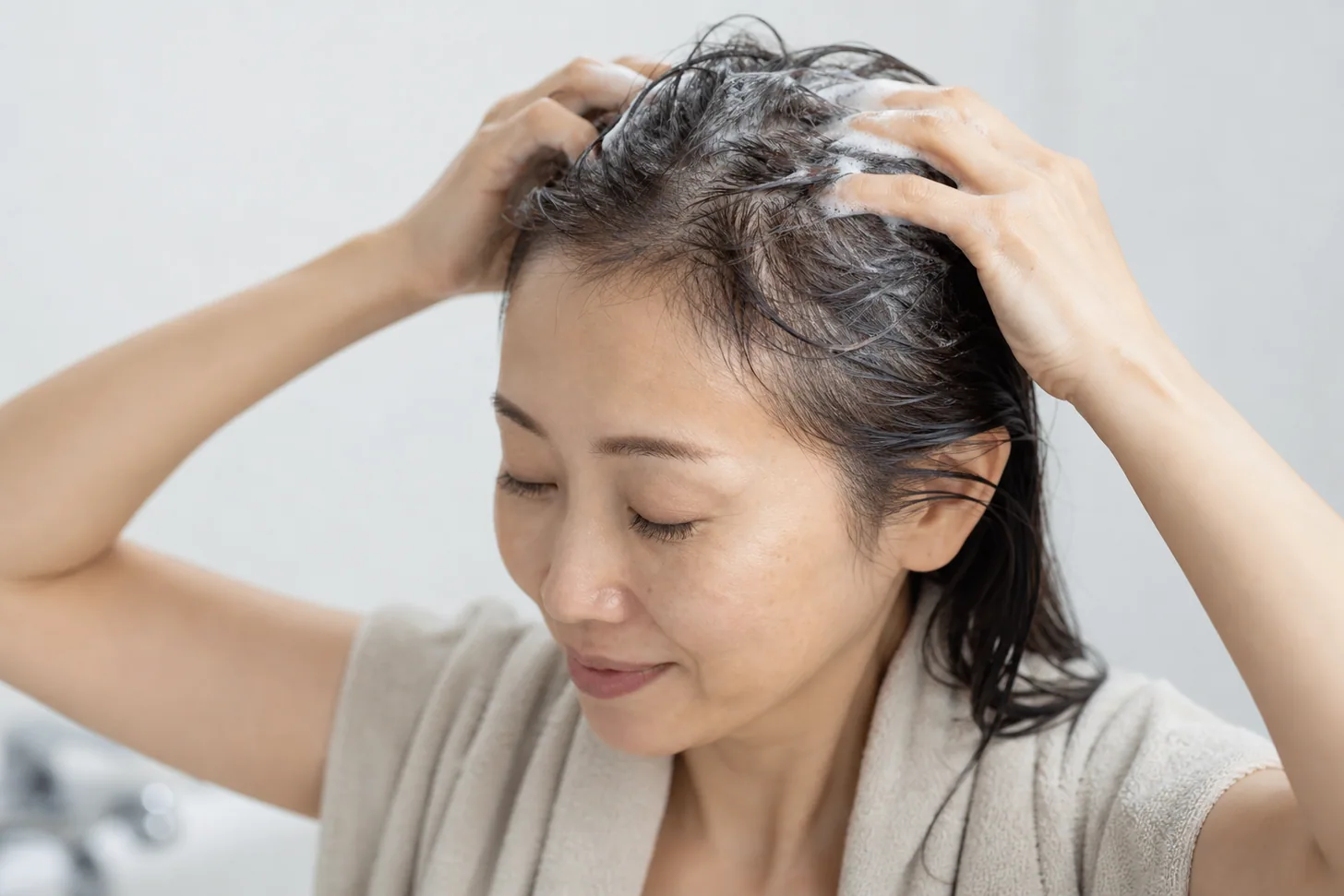
- Part the hair into four or five sections and apply the medicated shampoo directly to the scalp, working it in with your fingertips. Don't pile the lengths on top of your head — the lengths aren't what you're treating. A scalp brush makes this step easier on longer hair, though not on a scalp that's currently sore or inflamed.
- Leave it on. The AAD notes that some dandruff shampoos need to "sit on your scalp for up to 5-10 minutes before rinsing." The contact time is doing most of the work. Wash your face, do something else, and come back.
- Rinse thoroughly — more thoroughly than feels necessary, and with cool water if your hair is colored, for the reason in the table below.
- Wash the lengths with your normal lightweight shampoo. This clears the medicated residue off the hair while leaving the treatment's work on the scalp intact. It's the step that makes the whole thing survivable on fine hair.
- Condition from mid-length down only. Never at the root, and this matters more here than usual — a conditioning film over a scalp you're treating undoes some of it and flattens the hair on top of that.
Twice a week for the medicated shampoo, plain lightweight washes in between, per the AAD's fine-hair schedule. Once the flaking is under control, drop the medicated shampoo to once a week and keep it there — that maintenance dose is the part people abandon, and it's why dandruff so often returns a month after it cleared.
The active ingredients, and two to watch if you color
The AAD's list to look for is zinc pyrithione, salicylic acid, sulfur, selenium sulfide, ketoconazole and coal tar. They work differently, which is why rotation helps when one stops being effective.
The AAD's rotation advice is worth planning for rather than discovering: if one shampoo stops working, alternate between shampoos with different active ingredients. Two bottles on a rotation is normal practice, not a sign that something's gone wrong.
If you're choosing a lightweight everyday shampoo to pair with a medicated one, our shampoo picks for fine hair and clarifying shampoo guide cover the non-medicated half. For specific bottles rather than active ingredients, our dandruff shampoo picks for fine hair names the ones that treat the scalp without leaving the lengths coated.
The oiling trap
This deserves its own heading because it's the single most common well-intentioned mistake in this category, and the mechanism explains exactly why it fails.
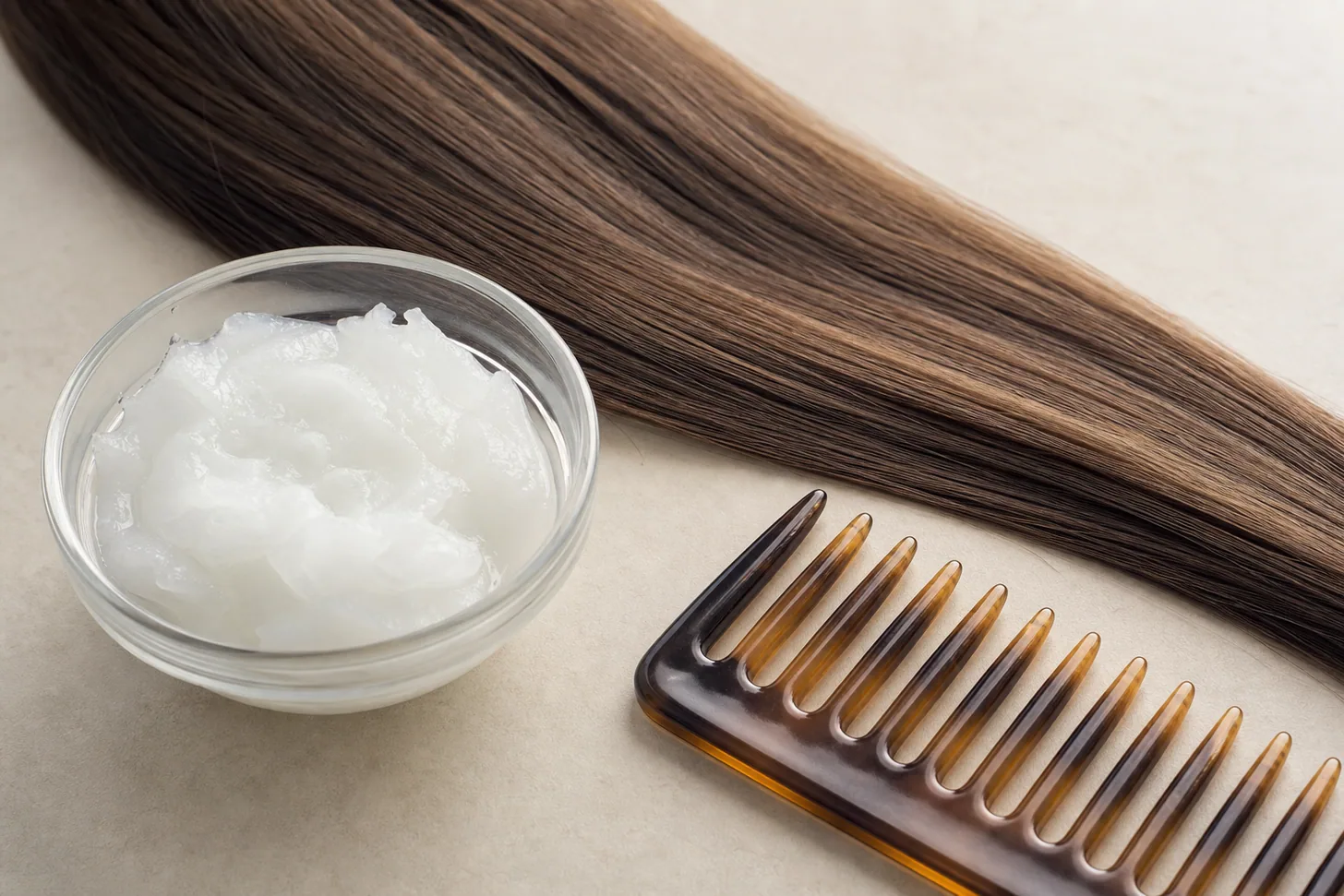
Malassezia is lipid-dependent. It lives on the oils on your skin, and the flaking is your response to what it makes from them. Applying oil to a flaking scalp adds more of the substrate that starts the process. Coconut oil is a particularly poor choice here, though the specific product matters less than the category.
The routines recommending it aren't lying — they're written for a different reader. On dry, coarse or textured hair, scalp oiling does real good and the underlying problem often genuinely is dryness.
On fine hair there's a second cost stacked on the first: the root area holds oil in a way a single shampoo rarely fully clears, so you also start the next day flat. Our guide to oiling fine hair covers the version of that practice that does work, and scalp oiling on an actively flaking scalp isn't it.
The exception, stated plainly: if your scalp is tight and itchy with small dry flakes and no greasiness, that's dryness rather than dandruff, and a light oil or a gentler shampoo may well be the right answer.
What to expect
Visible improvement inside two to three weeks of consistent, correctly-used treatment. Not two days — the flakes you can see now already formed, and what you're changing is the rate at which new ones do.
And then it comes back if you stop. Dandruff is managed, not cured. The AAD's seborrheic dermatitis guidance is explicit that to prevent flare-ups, patients often continue using dandruff shampoo once a week — indefinitely. Plan for the maintenance dose from the start and you'll avoid the cycle where it clears, you stop, and it returns in a month.
If you've used an over-the-counter shampoo properly — including the contact time — for three or four weeks with no improvement at all, stop experimenting and see a dermatologist. That's not a failure of effort; several other conditions flake, and some of them need prescription treatment or a different diagnosis entirely.