Reviewed by Tara Sullivan · Updated August 2026 · 10 min read
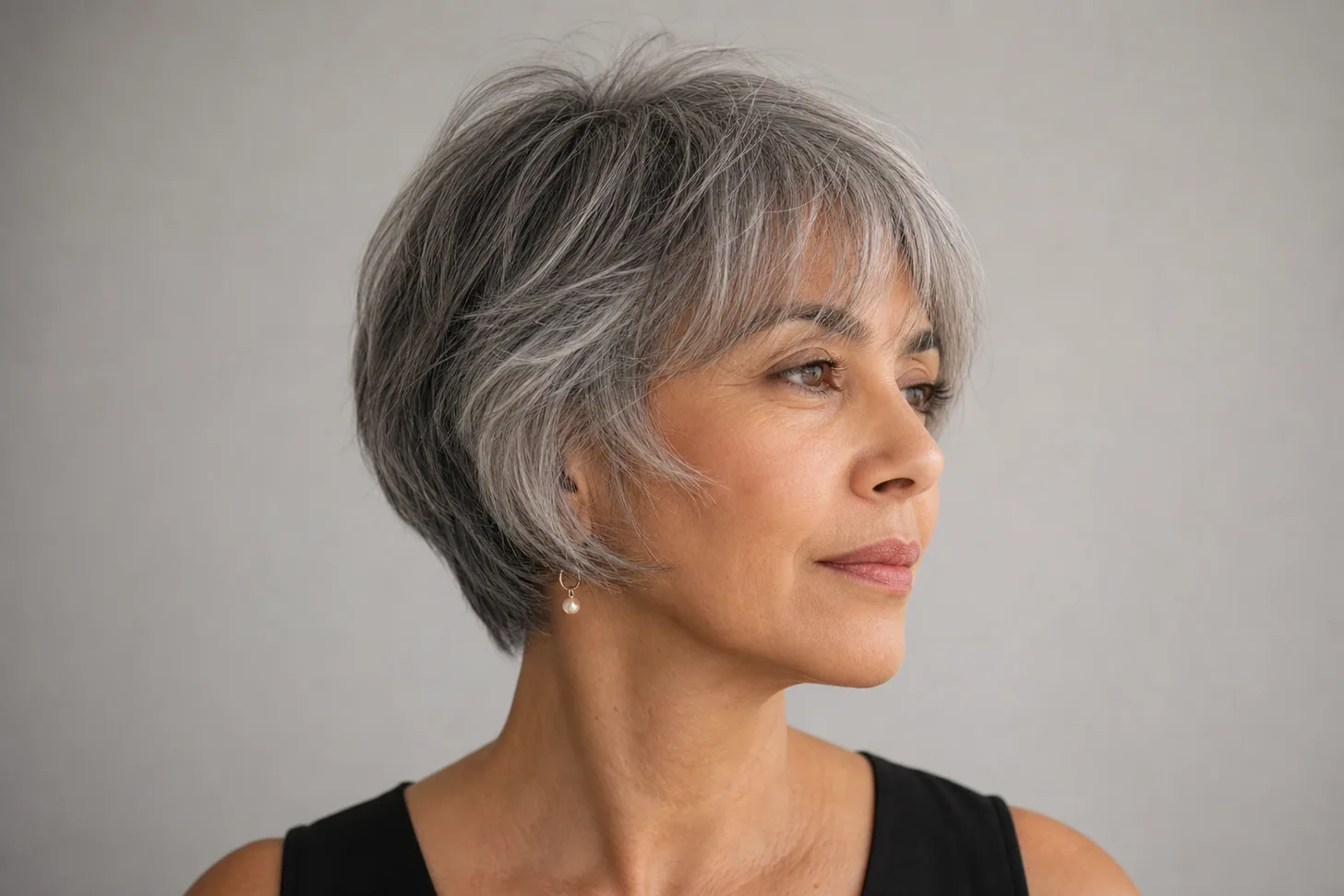
On fine hair, going gray is a contrast decision before it is a coverage decision — and that changes the answer. How full your hair looks in a mirror depends enormously on how sharply it stands out against the scalp underneath it, which is why a dark, fine head of hair shows a widening part long before a light one does at the same density.
Losing pigment closes that gap. So the outcome most people brace for — gray will make my thin hair look thinner — is frequently the opposite of what happens, and I have watched clients see it for the first time in the mirror at the end of a transition.
What gray genuinely does bring is a texture change that is smaller than its reputation, a demarcation line that needs managing, and a coloring schedule that fine hair tolerates worse than any other hair type. Below: what the research actually supports, the four routes out, and how to pick between them.
The demarcation line is the whole problem of a transition — and the one thing a colorist can genuinely soften.
Chair-side note
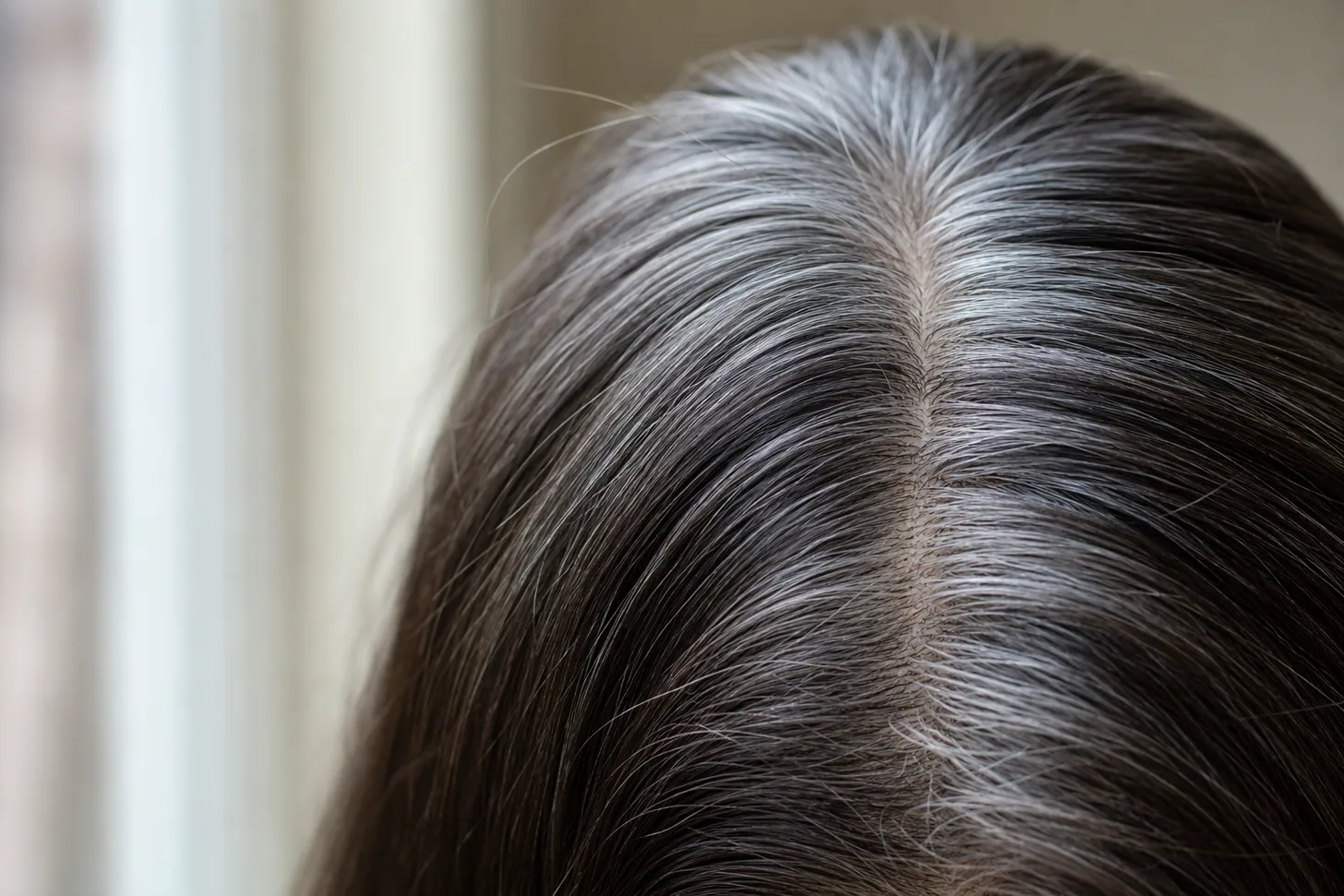
Almost everyone who sits down to talk about going gray opens with the same sentence: I think I'm about half gray now. Then I part the hair and it is nowhere near half — it is a concentrated band at the temples and along the part, which is where gray usually arrives first and where you spend all day looking.
The rest of the head is still mostly pigmented. That mismatch matters, because the plan for 20% gray at the hairline is completely different from the plan for a genuinely salt-and-pepper head, and people routinely book the wrong service for the head they actually have.
If you take one thing into your consultation, take a photo of your own crown, shot from above by somebody else in daylight. It is the least flattering photograph you will ever commission and it is the most useful.
PN
— Priya Nair, Master Colorist
You almost certainly have less gray than you think
The "50/50/50 rule" — that half of people are half gray by 50 — is one of the most repeated lines in hair, and it has been tested.
A worldwide survey of 4,192 volunteers published in the British Journal of Dermatology in 2012 calculated the share of people showing at least 50% gray coverage at age 50 as a global range of 6–23%, depending on ethnic origin and natural hair color — in the study's own words, "well below that expressed by the '50' rule of thumb."
The same survey found that between the ages of 45 and 65, 74% of people had gray hair, at a mean intensity of 27%, and that men gray significantly more than women. A quarter of a head is a very different service from half a head. It is also, usually, the difference between needing coverage and needing blending — which is the fork this whole page turns on.
The texture change is real, but smaller than its reputation
"Gray hair is coarse and wiry" is repeated so consistently that it feels settled. The evidence is thinner than that. The 2018 review "Three Streams for the Mechanism of Hair Graying" in Annals of Dermatology notes that non-pigmented hairs "may grow more rapidly and become thicker than pigmented hairs" — but the cleanest supporting observation in that literature comes from beard hair, where growth rate differed without a large caliber difference. Scalp hair is not so tidy.
What does change, and what you are actually noticing:
The optics change first. Melanin granules sit inside the cortex and absorb light. Take them out and the strand scatters light instead of absorbing it, so a white hair among dark ones is visually loud out of all proportion to its size.
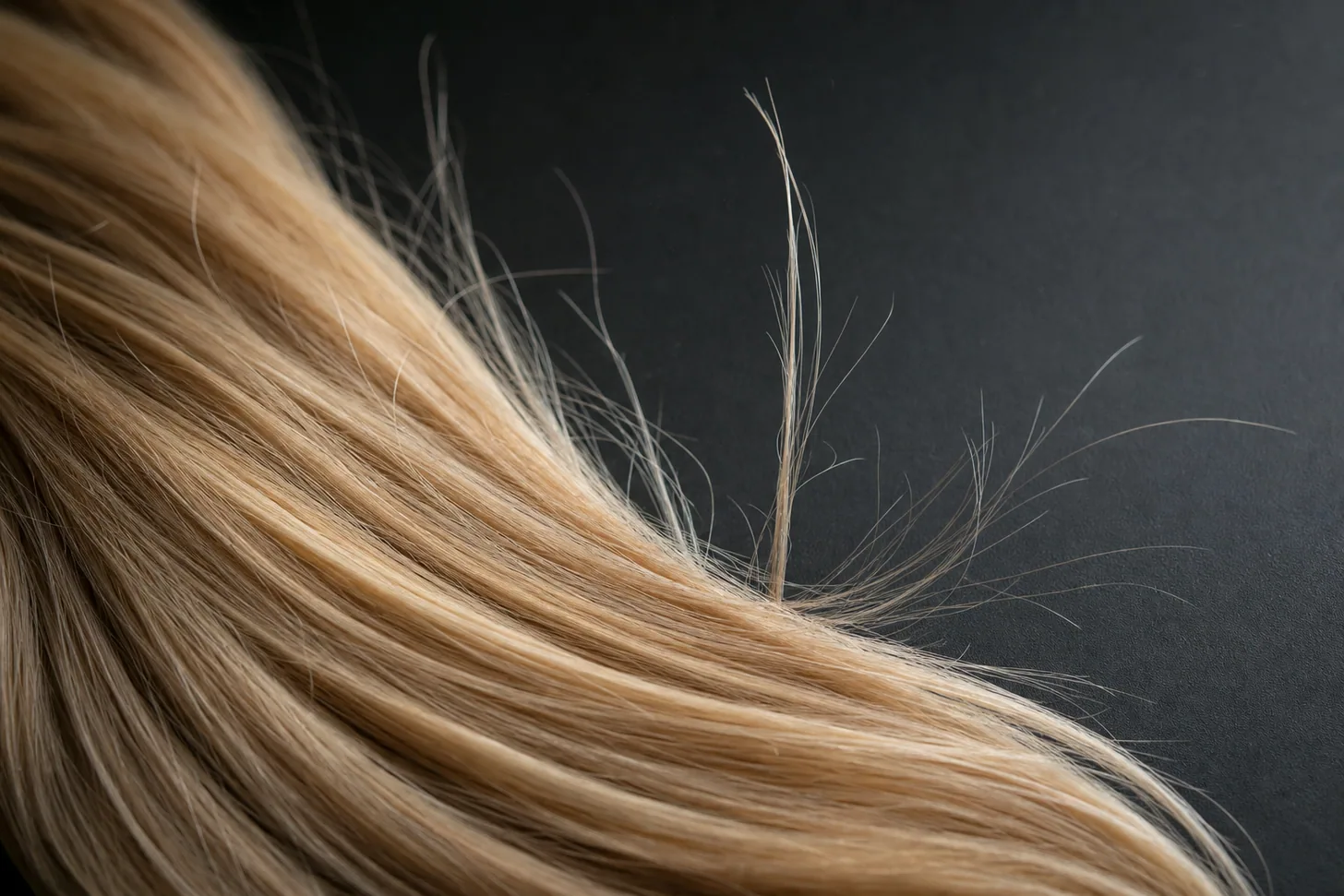
An unpigmented strand behaves like an outlier. One hair standing a few degrees away from its neighbors is invisible in a pigmented head and obvious in a graying one. It reads as wiry because you can see it misbehaving, which is not the same as it being thick.
Sebum output falls with age. The scalp's oil production declines through midlife, and the same graying decades are the decades when less oil is traveling down the shaft. Less lubrication means more friction between strands and a drier hand-feel — an age effect running alongside the pigment loss rather than a property of gray hair.
Diameter and density are also changing, separately. Hair gets finer with age on its own schedule. That is the change people most often blame on gray, and it is the one thing gray isn't doing.
If your hair genuinely feels rougher, treat it as dryness and friction rather than as a new hair type — the sequence in the moisture routine for dry fine hair is the right one, kept light.
Why fine hair often looks fuller as it grays
This is the part almost nobody tells you, and it is the reason I am comfortable recommending the transition to clients with low density.
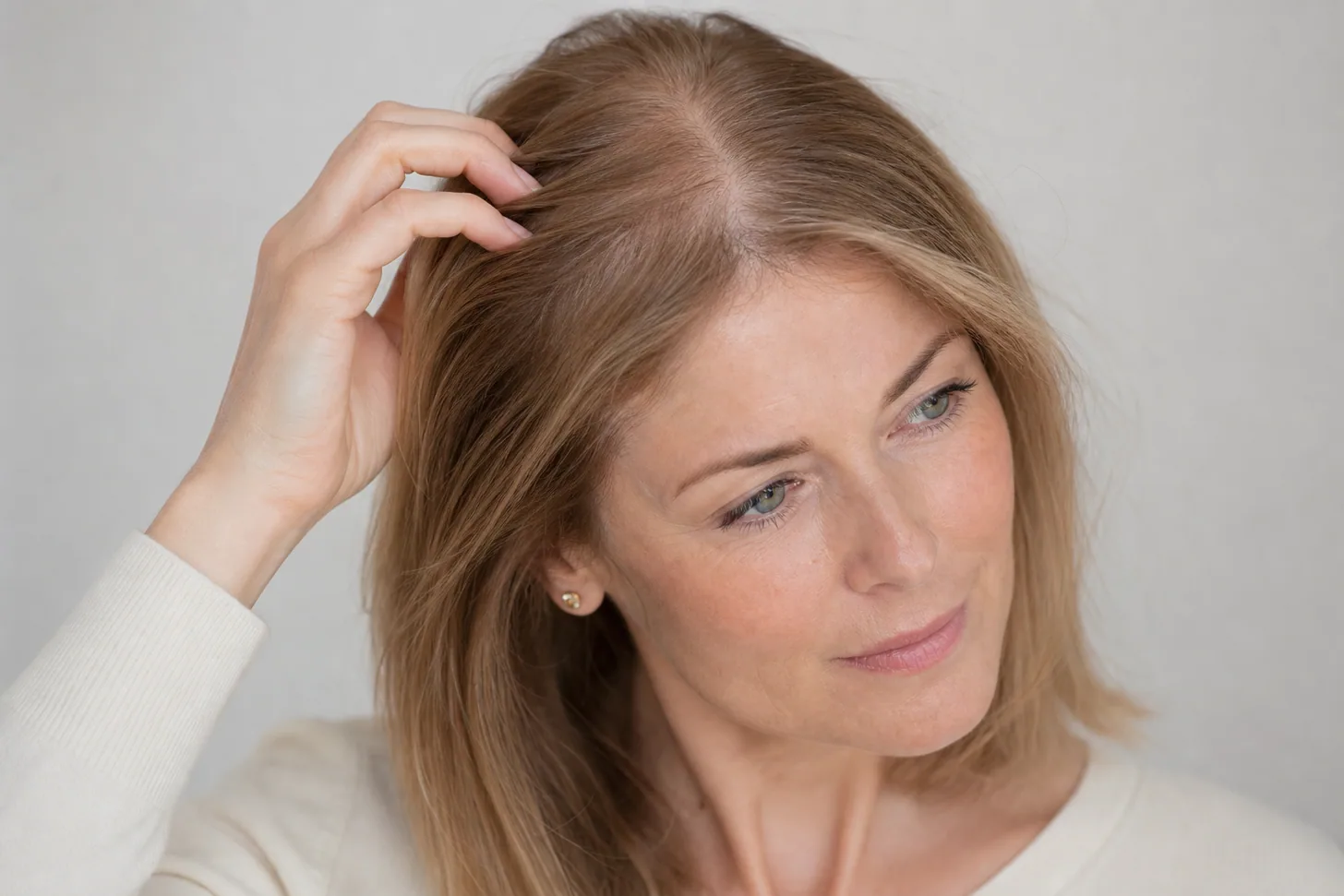
Perceived fullness is a contrast effect. Your eye does not count strands; it reads the difference between hair and the scalp showing through it. Dark hair against a pale scalp is maximum contrast, so every gap in the part becomes a visible line.
That is why two people with identical density — one brunette, one blonde — will describe their hair completely differently, and why lightening the hair immediately around the part is such a reliable trick on thinning brunettes. The full version of that argument is in coverage and styling for thinning-on-top fine hair.
Gray does this for free. As pigment leaves, the hair moves toward the scalp's own value, the gaps stop announcing themselves, and the same density reads denser. Silver and white hair also has a slightly larger apparent volume in the way it stacks — unpigmented strands sit less obediently against each other, which is a nuisance when you want a sleek finish and a gift when you want lift at the root.
There is a real effect pulling the other way, and it deserves naming rather than burying: an unpigmented strand is also more translucent than a pigmented one, so an individual white hair blocks less of what is behind it. On a head that is mostly white, that can partly offset the contrast gain.
Which effect wins depends on your starting color and your skin tone — the contrast gain is largest for dark hair over a pale scalp, and smallest for someone who was already very fair. Anyone going from dark brown to silver on low density is on the favorable side of that trade; anyone going from pale blonde to white has less to gain and should expect roughly a wash.
None of this means gray adds hair. It means the visual penalty fine hair pays for low density usually gets smaller. Set that against the aging-related loss of diameter happening at the same time, and for many people the two roughly cancel.
The four routes, and who each one suits
Two of the four involve color, and the choice between them changes how much of your hair goes through a lightener — balayage on fine hair is the gentlest blending route, and at-home color for fine hair covers the demi-permanent options if you would rather not lift at all.
Every gray plan is one of these. The mistake is drifting between them. Plenty of people are making this choice in their forties rather than later, and the wider context for that decade is fine hair over 40.
Route
Best when
Salon rhythm
Fine-hair verdict
Cover it— permanent color at the root
You are under about 30% gray, want it gone, and are comfortable with a fixed schedule
Every 3–4 weeks, root-only
Works, but it is the most demanding option on fine hair — the schedule, not the chemistry, is what costs you
Blend it— highlights, lowlights, shadow root
You are 20–60% gray and want the maintenance to relax rather than tighten
Every 8–12 weeks
The best fine-hair answer by a distance. Dimension reads as depth, and there is no hard regrowth line to chase
Transition it— managed grow-out
You have decided on gray and can accept 12–36 months of visible in-between
A blending appointment every 10–14 weeks, then stop
Very doable on fine hair, and the demarcation line is less brutal than on thick hair because there is less mass to hold a hard edge
Cut to it— take the colored length off
You want it over with, and short hair either suits you or appeals to you anyway
One appointment, then trims
Fastest route, and short lengths already flatter fine hair. Two changes at once, so decide deliberately
Covering gray is a schedule problem, not a damage problem
Permanent color on fine hair is fine. Permanent color on fine hair every three weeks for a decade is a different proposition, because resistant gray needs full-strength developer and gray coverage does not forgive a late appointment the way a gloss does.
The damage does not come from any single application — it comes from overlap, when the fresh root application is dragged through lengths that have already been colored eight times. On a coarse strand that is a rounding error. On a fine one it is the whole diameter.
If you are covering, two rules do most of the protecting: root-only application with a clean line, and a single refresh through the ends at the end of the service with the mildest formula that will do it. The wider argument on whether color thins hair is in does coloring thin your hair?, and if you are doing this at home the fine-hair-specific method is in at-home color on fine hair.
Blending is what most fine hair should be doing
Blending stops treating gray as a defect to erase and starts treating it as a third tone you already own. Practically, that is some combination of:
Fine, cool-toned highlights placed through the gray-heavy zones — temples, part, front hairline — so incoming white reads as a highlight rather than as regrowth. On fine hair, keep the weave fine and the count low; heavy foils cost you more integrity than the dimension is worth. See highlights on fine hair.
Lowlights to hold depth, because an all-light head loses the shadow that makes hair look solid.
A shadow root — a soft, melted band of deeper color at the base. This is the single most useful technique in a transition: it kills the demarcation line and it puts depth right where fine hair needs to look denser.
Blending's real dividend is the calendar. Nothing about it produces a line, so a missed appointment is invisible instead of urgent — which is why blended clients end up doing less to their hair overall than covering clients do.
The transition is a demarcation-line project
If you are growing it out, the enemy is the horizontal border between colored ends and natural roots. Three things soften it: a shadow root at the start, lowlights or highlights placed across the line rather than up to it, and a couple of length reductions along the way so the oldest, most-colored hair keeps leaving.
The arithmetic is fixed. Scalp hair grows about 0.35 mm per day per the StatPearls hair anatomy reference — roughly half an inch a month, six inches a year. From a chin-length bob you are looking at about a year; from mid-back, closer to three unless you cut. If you are shortening as you go, the stage-by-stage plan in growing out short fine hair runs in the opposite direction but the appointment language is the same.
Cutting to it is underrated on fine hair
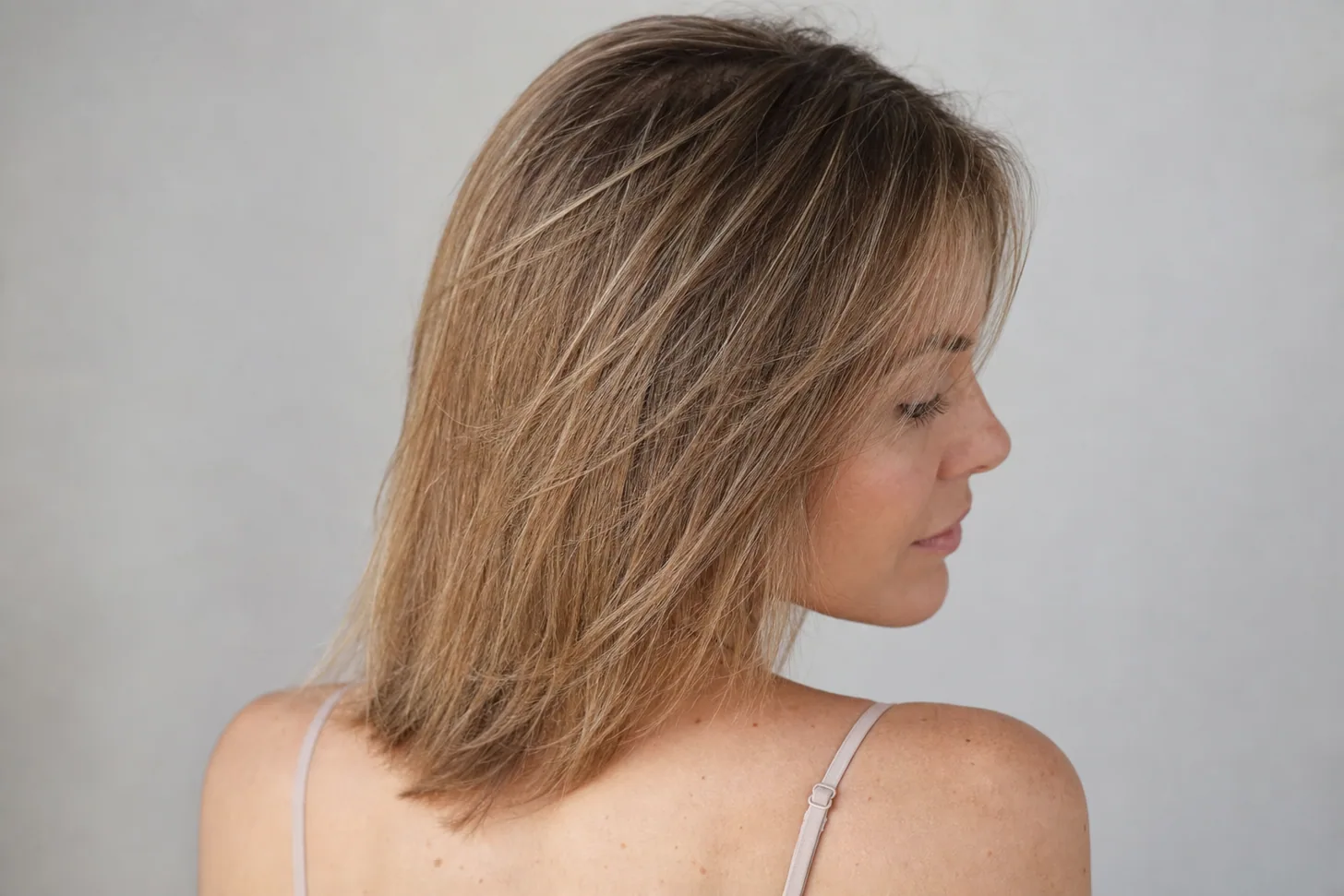
The reason short cuts dominate our haircut coverage for fine hair is that they keep weight at the perimeter instead of asking sparse lengths to hang, and that logic does not change because you are also going gray. Taking off the colored ends converts a three-year project into an afternoon.
The honest caution is that you are changing two variables at once — and if the answer is "I hate this," you cannot tell which one you hate. If that worries you, do it in two moves: a lob first, live with the gray in daylight for a month, then go shorter or don't.
Toning silver hair without turning it lilac
Once you have real white hair, toning becomes a weekly decision rather than a salon one — and fine hair is the hair type most likely to overshoot.
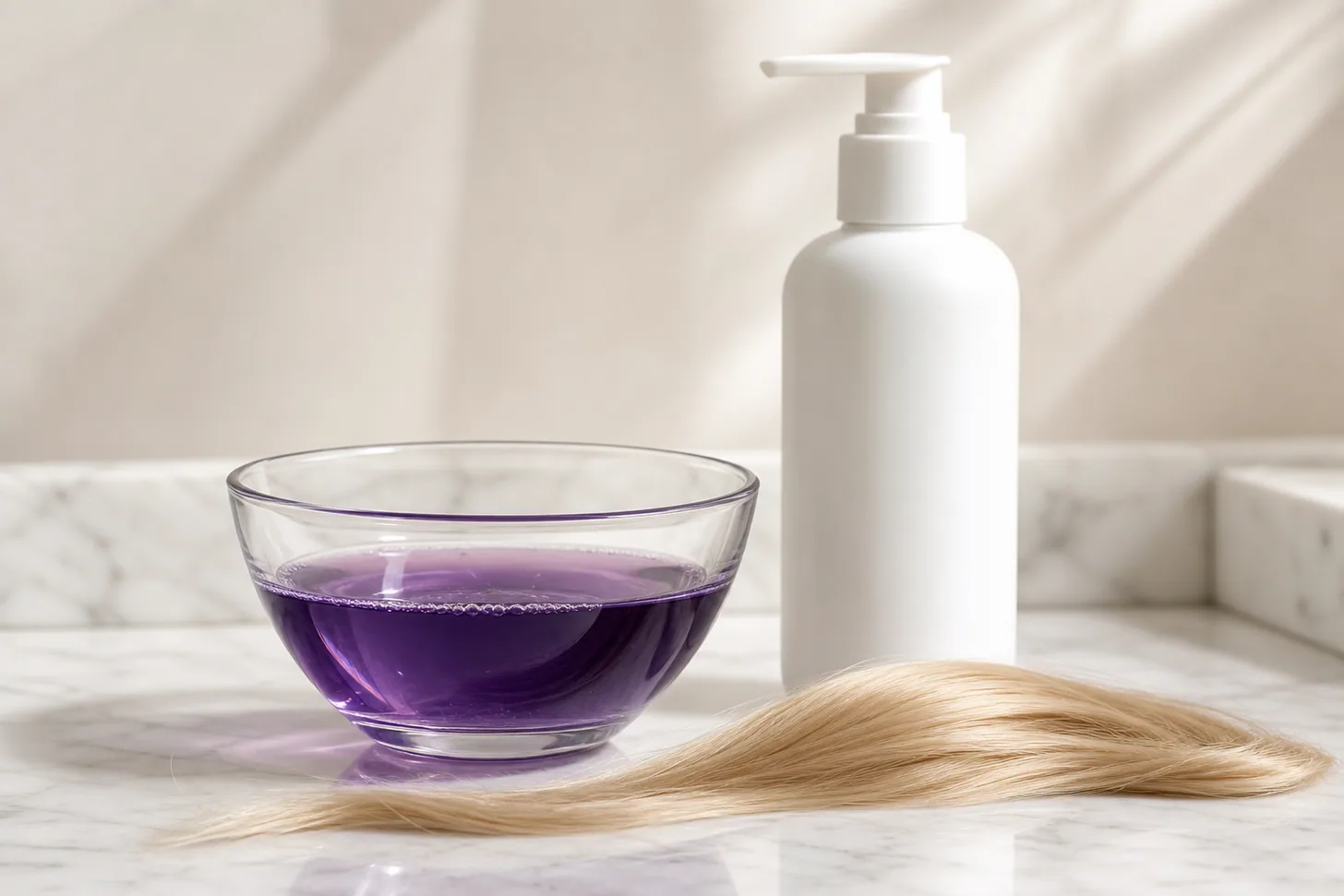
White hair has no competing pigment, and fine, porous strands take up direct dye quickly and let go of it slowly. A purple shampoo is a direct violet dye in a cleanser base: it deposits on contact, with no processing time protecting you — which is why it is a weekly tool rather than the shampoo you wash with, and why a plain color-safe shampoo should be doing the everyday work.
On coarse pigmented blonde it might take five minutes to shift anything. On fine white hair, a minute is sometimes a minute too long — the purple shampoo picks for fine hair include the dilution method that makes this manageable. If your hair is still pigmented and the problem is warmth rather than a lilac cast, the timings are different again — that version is in brassy fine hair.
Dilute it. A small amount mixed into conditioner in the palm, not neat from the bottle.
Start at 30 seconds, once a week, and increase only if nothing happened.
Alternate with a normal wash — violet builds cumulatively, and the day it looks lavender is usually the fourth day in a row, not the first.
Two other things dull silver hair and neither is your toner's fault. Yellowing from environmental deposit and product buildup is common on white hair, and hard water leaves mineral and metal deposit that pulls white toward beige or brass — a chelating wash does more for dingy gray than another purple bottle will.
Styling gray fine hair: two adjustments, not a new routine
Most of your routine stays. Two things change. If you’re pairing the transition with a shorter shape, short cuts for mature fine hair is built for exactly that combination.
Shine has to be built rather than assumed. Pigmented hair gets some of its gloss from the way melanin absorbs and returns light; white hair reflects from the cuticle alone, so a rough cuticle shows immediately. Cool final rinses, a lightweight leave-in on mid-lengths, and a smooth blow-dry earn more on silver hair than on any other color. Our picks are in leave-in conditioners for fine hair — go light, because weight is still the enemy.
Root lift matters more, not less. Silver hair reads soft and low-contrast, which is exactly what makes it flattering — and also what makes a flat root look flatter. This is the point where a root-lift product goes from optional to load-bearing; the technique is in how to get root volume in fine hair.
Four things that go wrong
Going darker to "look younger." It does the opposite on fine hair, and for the reason this whole page is about: darkening raises contrast against the scalp, so a part that was reading fine starts reading wide. Almost every client who asks me to go a shade darker at the part leaves lighter instead.
Boxes marketed for gray coverage, used on the whole head. Gray-coverage formulas are built to be resistant-hair-proof, which means strong. Applied root-to-tip every four weeks on fine hair, they will flatten and roughen the ends long before they fail on coverage.
Abandoning the transition at month five. Month five is the worst it will look, and it is also the month people quit. A single blending appointment at that point changes the whole experience.
Treating gray as a reason to add weight. Rich masks and oils are the standard advice for "coarse gray hair," and on fine hair they buy you a day of softness and a week of flatness. Oiling fine hair covers where the line is.
When going gray may not be your best move right now
You are in the middle of a heavy shed. Do one thing at a time. Sort the shedding first — fine hair or thinning? is the starting point — then make color decisions with a stable head of hair.
Your gray is under about 15% and concentrated at the temples. There is nothing to transition to yet. A shadow root and a few fine highlights will hold this comfortably for years.
You have a very warm skin tone and are attached to a warm hair color. Silver is a cool neutral. It suits far more people than the internet claims, but it is a real change, and makeup usually shifts with it. Try it against your face with a scarf or a wig before you commit three years.
You need it done by a specific date. Transitions do not compress. If there is a wedding in eight months, either cover it until after or cut to it now — see wedding hair for fine hair.
You are relying on stripping the old color out to speed things up. Color removers and lighteners on fine, repeatedly colored hair are how a transition turns into a repair job. If a colorist declines to do it in one session, that is good judgment — the honest version is in color correction on fine hair.
FAQ
Less reliably than the reputation suggests. A 2018 review in Annals of Dermatology notes that non-pigmented hairs may grow more rapidly and become thicker than pigmented ones, but the clearest published evidence for that comes from beard hair rather than scalp hair. What changes for certain is the surface and the optics: an unpigmented strand reflects light differently, sits with less visual weight against its neighbors, and is easier to see when it does its own thing. On fine hair the practical result is usually a strand that reads wiry because it stands away from the others, not one that is measurably thick.
No, and the rule that says so has been tested and found wrong. A worldwide survey of 4,192 volunteers published in the British Journal of Dermatology in 2012 calculated the proportion of people with at least 50% gray coverage at age 50 as a global range of 6–23% depending on ethnic origin and natural hair color — well below the 50/50/50 rule of thumb. Between 45 and 65, 74% of people had some gray, at a mean intensity of 27%. Most people who feel behind schedule are not behind schedule.
It can look fuller, which is not quite the same thing but is what you actually see in the mirror. How dense hair appears depends heavily on the contrast between the hair and the scalp beneath it. Dark fine hair over a pale scalp shows every gap, which is why a widening part is more obvious on a brunette than on a blonde at identical density. As gray comes in, that contrast drops and the same number of strands hides the scalp better. The hair has not gotten thicker — the scalp has just gotten harder to see.
Roughly half an inch a month, so the arithmetic is set by your length rather than by anything you can influence. Scalp hair grows at about 0.35 mm per day per the StatPearls hair anatomy reference, which is about six inches a year. Growing colored hair out to a chin-length bob takes about a year from a short cut and closer to three from mid-back length. Blending shortens the visible transition without shortening the growth — a shadow root and a few lowlights can make month four look deliberate instead of neglected.
Because white hair has no competing pigment and fine, porous strands take up violet dye quickly and hold it. A purple shampoo is a direct dye in a cleanser base, and it deposits on contact — there is no processing time protecting you. On coarse pigmented blonde it takes several minutes to do anything visible; on fine white hair a minute can be a minute too long. Dilute it in the palm with a little conditioner, start at 30 seconds once a week, and keep a clarifying wash on hand to pull it back out if it goes lavender.
Permanent color itself is manageable on fine hair. The problem is the schedule gray coverage demands. Resistant gray typically needs full-strength permanent color every three to four weeks at the root, and the overlap onto already-colored hair accumulates on strands that have very little diameter to spare. If you are coloring for gray, the single most protective habit is root-only application with a careful line, and the best structural decision is to switch from covering to blending before the regrowth schedule outruns your hair's tolerance.
A shadow root is a soft, deliberately smudged band of deeper color applied at the roots and melted down into the lengths, so there is no hard line where one color stops. In a gray transition it does two jobs: it disguises the demarcation line between colored hair and natural regrowth, and it puts a darker base under fine hair at the part, which reads as depth and makes the roots look denser than a flat, uniform color does. It also buys you time — a smudged root grows out invisibly, so appointments move from four weeks to eight or ten.
It is the fastest route and it suits fine hair better than most people expect, but it is a real trade. Cutting off the colored ends ends the transition immediately instead of managing it for one to three years, and short cuts already flatter fine hair because they keep weight at the perimeter rather than asking sparse lengths to hang. The honest caveat is that you are making two changes at once — length and color — and if you dislike the result you are waiting on growth for both. If you are unsure, do it in two stages: a lob first, then shorter once you have seen the gray in daylight for a month.
Twelve years coloring fine and thin hair. Priya's shortcut on this one: photograph your own crown from above in daylight before you book anything — the gray you can see in the mirror is never the gray you actually have.
Results vary with hair type, density, and growth patterns. This guide is educational and not a substitute for an in-person consultation with a licensed stylist.
Hairstyle images in this guide are AI-generated illustrations, not photos of real clients or results. See our image policy.
Get the good hair intel
One honest, stylist-written guide in your inbox each week. No hype.

 PN
PN