Reviewed by Tara Sullivan · Updated July 2026 · 9 min read
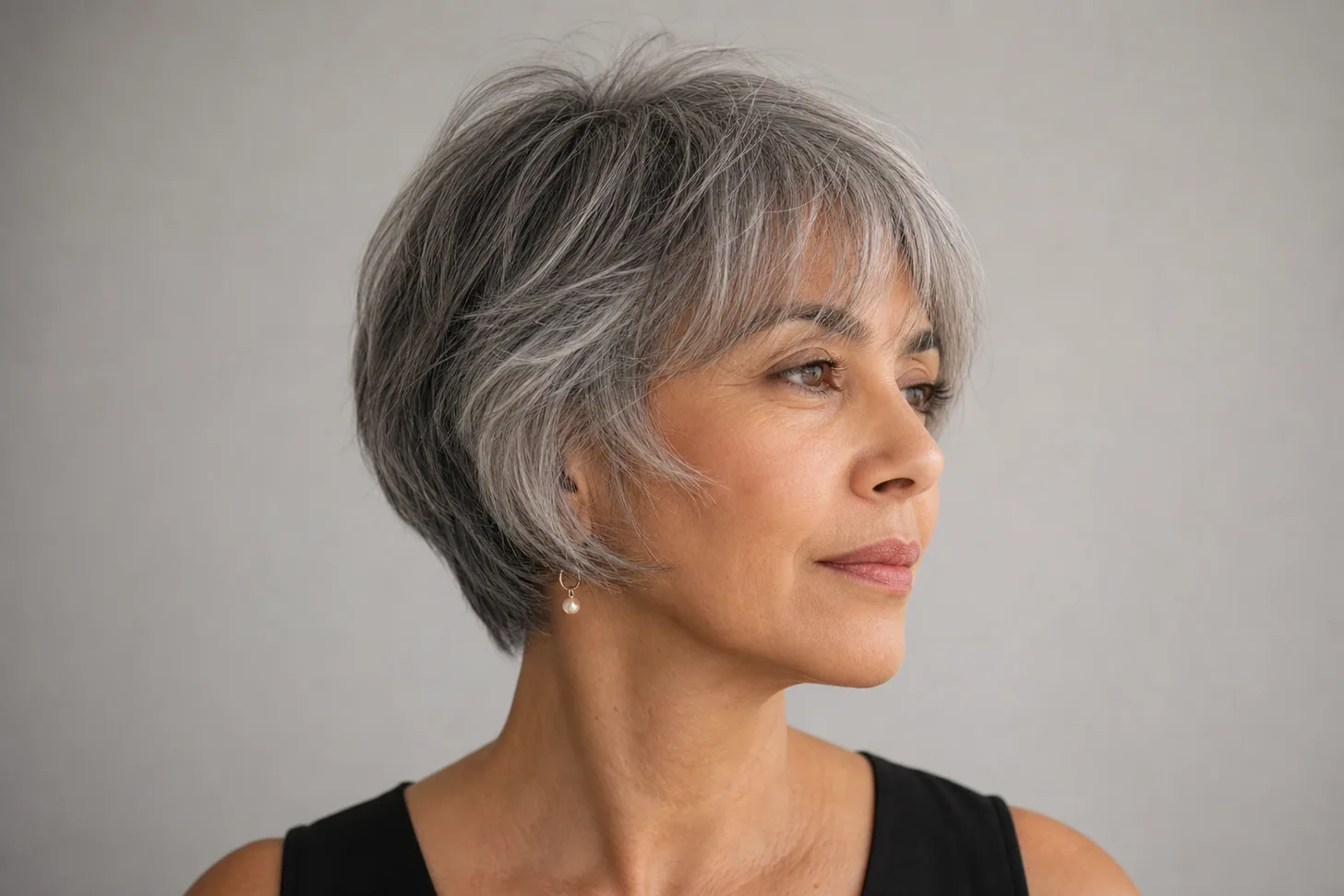
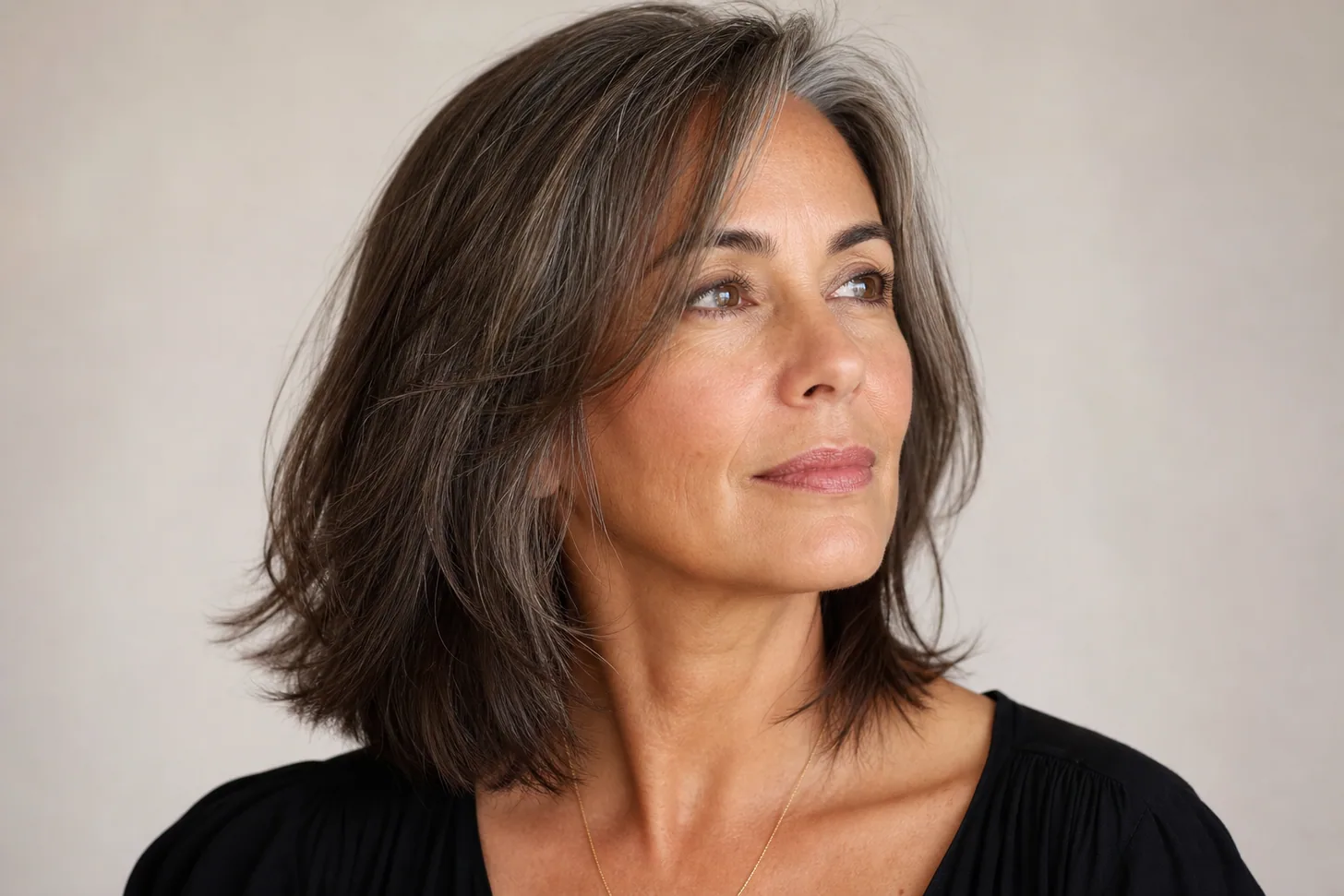
Fine hair usually starts to shift in your 40s — a little finer at the strand, a first dip in density, sometimes a postpartum or perimenopausal shed on top. The cuts that flatter now are the ones that add body without going drastically short: a collarbone lob with a blunt weight line, soft point-cut layers, and light bangs that lift the front.
You are not "mature" yet, and none of this has to read matronly. Below are 16 salon-tested cuts for fine and thin hair in your 40s — short, medium, and long — grouped by what they do, each with who it suits and the exact words to bring your stylist. This is the youngest rung of our age ladder; for the fuller picture, browse all our fine-hair haircut guides.
Chair-side note
The clients I see at 40 almost always say the same thing: "my hair used to do more." Nine times out of ten it isn't that they need to chop it all off — it's that the cut hasn't changed with the hair. A layered length that looked full at 32 goes flat once the density dips a fraction, because there's nothing built into the shape to hold lift.
What I do is add a stronger weight line at the ends and softer, point-cut layers up top, so the cut props itself up. Same length, sometimes, but it suddenly moves again. Please don't let anyone tell you 40 means short — it means shaped.
SB
— Simone Baptiste, Senior Stylist
What changes for fine hair at 40 — and what to cut for
Two things tend to shift for fine hair in your 40s, and the right cut answers both. First, the strands often get a touch finer and the overall density dips slightly, so plain length hangs flatter than it used to — the fix is a strong weight line where the hair is thinnest and soft internal layers up top for lift.
Second, this is when many women hit a postpartum or perimenopausal shed, which reads as more scalp along the part; that's usually a temporary density change rather than permanent loss, but it's worth knowing which you're dealing with before you commit to a cut.
Our guide to telling fine hair from thin hair helps you and your stylist decide how blunt to build the ends, and if the shedding feels fast or patchy rather than gradual, read fine hair or thinning first. The good news at 40 is that your options are still wide open — you can go short, keep it medium, or stay long, as long as the cut is built for body.
The most reliable place to start in your 40s. Bringing the length up to the collarbone or shorter concentrates the hair you have higher on the head, and a blunt perimeter reads as instant density. These four build the most fullness for the least effort.
blunt collarbone lob with a strong one-length weight line on fine straight brunette hair, woman around 42
1
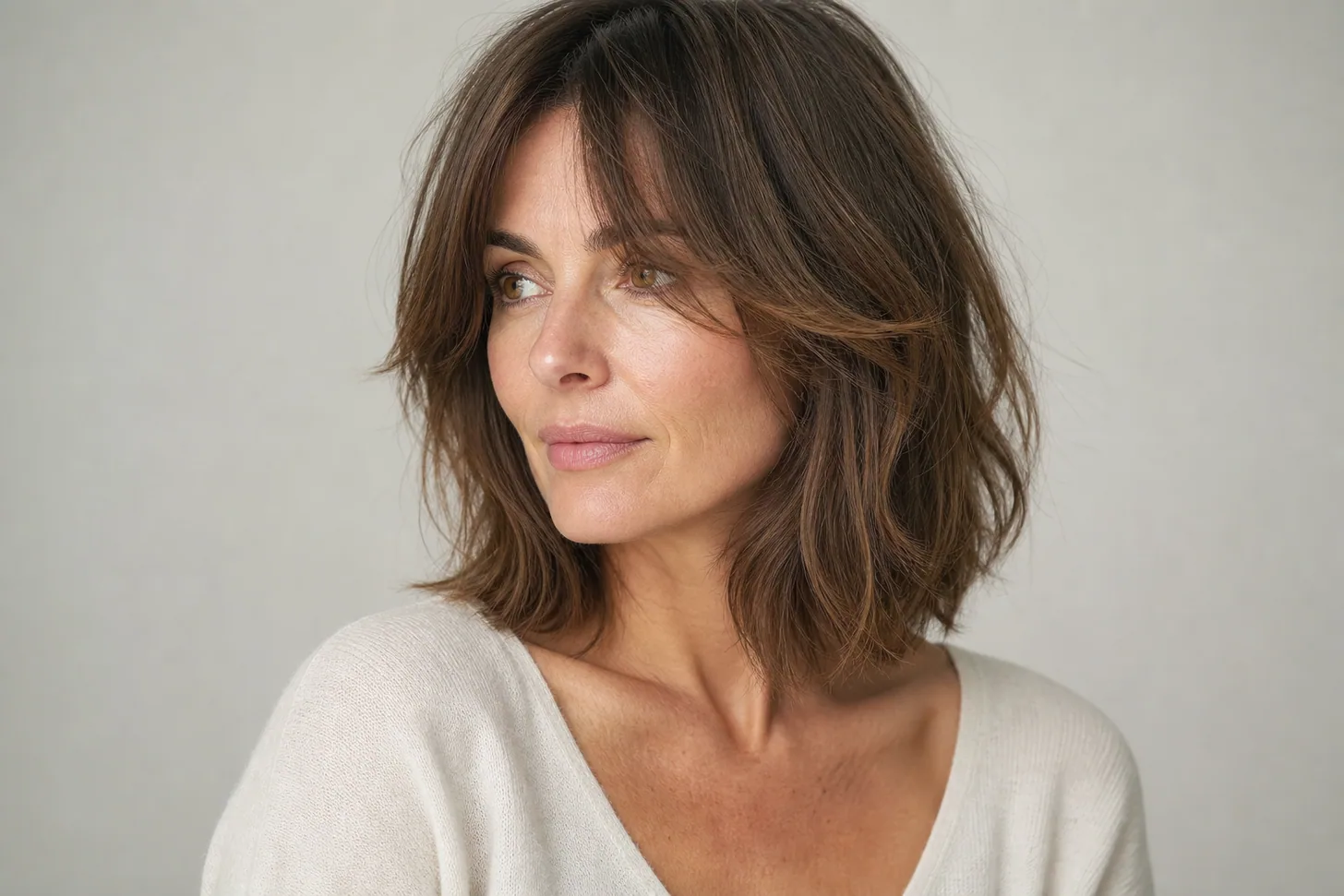
The blunt collarbone lob
The workhorse of fine-hair cuts in your 40s: one clean length at the collarbone with blunt ends. All the weight sits in that bottom line, so the hair looks its densest exactly where fine hair usually looks thinnest. It's long enough to feel current and short enough to hold lift all day. If you want the fuller family of these, our lob guide for fine hair has more.
chin-length blunt bob with a soft inward bend on fine light-brown hair, woman around 44
2
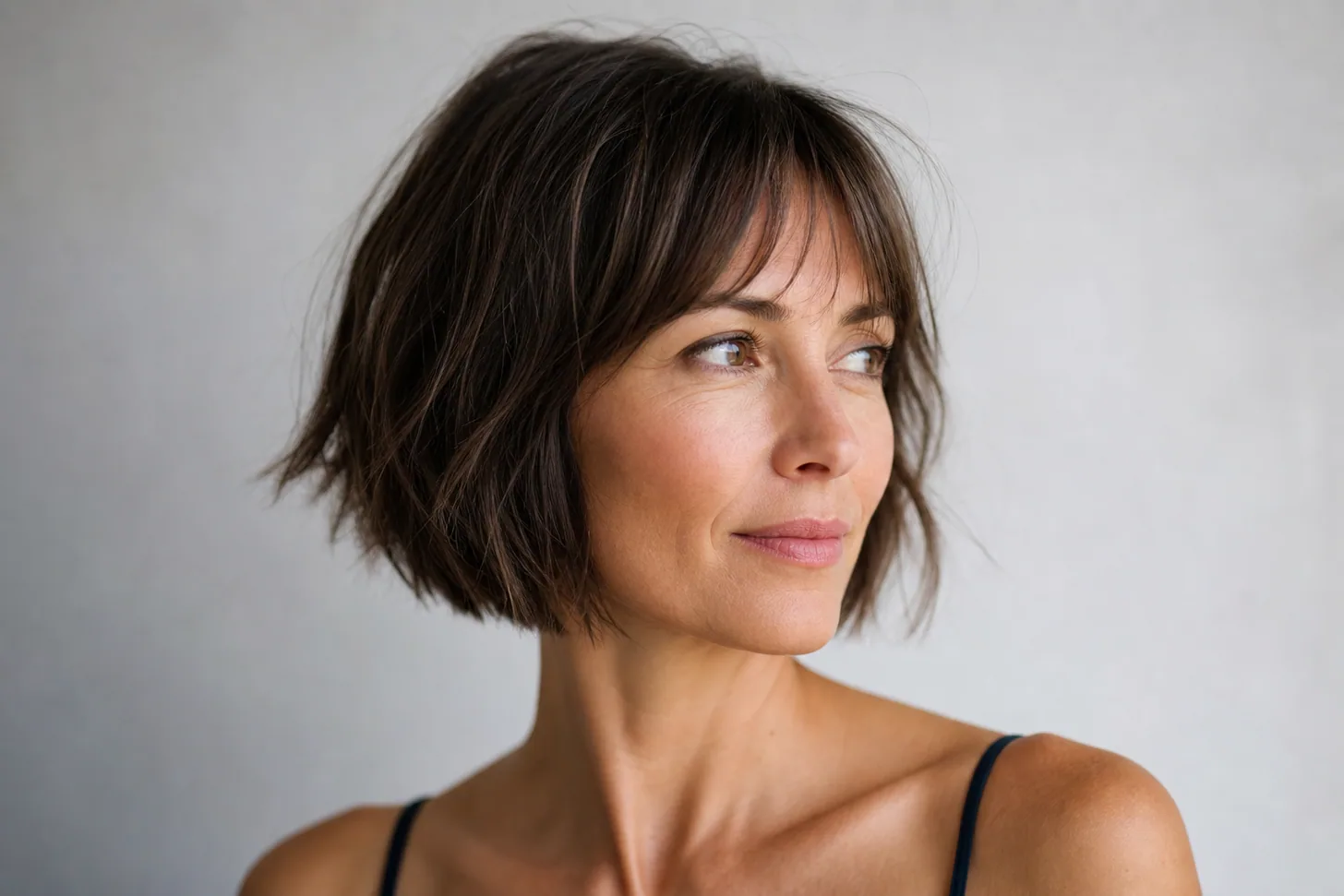
The chin-length blunt bob
A touch shorter and the density illusion gets stronger — a chin-grazing bob with a blunt perimeter puts maximum weight at the jaw, where it frames and lifts a face that's just starting to soften. It suits square and heart shapes especially well. Ask for "one length at the jaw, blunt ends, no thinning shears through the perimeter."
A-line bob slightly longer at the front on fine dark blonde hair, woman around 41
3
The soft A-line bob
Angled a little longer at the front than the back, so there's a whisper of graduation building body at the crown while the front stays long enough to frame. It's a flattering middle ground if a straight-across bob feels too severe for you. The graduation does the volume work, which means less fuss with a round brush in the morning.
collarbone lob worn with a deep side part for crown lift on fine brunette hair, woman around 45
4
The deep-side-part lob
Not a different cut so much as a different part. Taking a collarbone lob and setting a deep side part instantly lifts the roots at the crown, because the hair has to travel over the part to fall — and it sweeps fuller hair across a widening center line. It's the cheapest volume trick there is on fine hair, and it doubles as coverage if your part has started to show.
Soft layers & face-framing
Blunt holds density; the right layers add the movement that keeps a cut from reading heavy. On fine hair the layers must stay soft and point-cut over a strong bottom line — never choppy or razored, which leaves already-fine ends transparent. These four add swing without thinning the ends.
collarbone cut with soft point-cut internal layers over a blunt line on fine chestnut hair, woman around 43
5
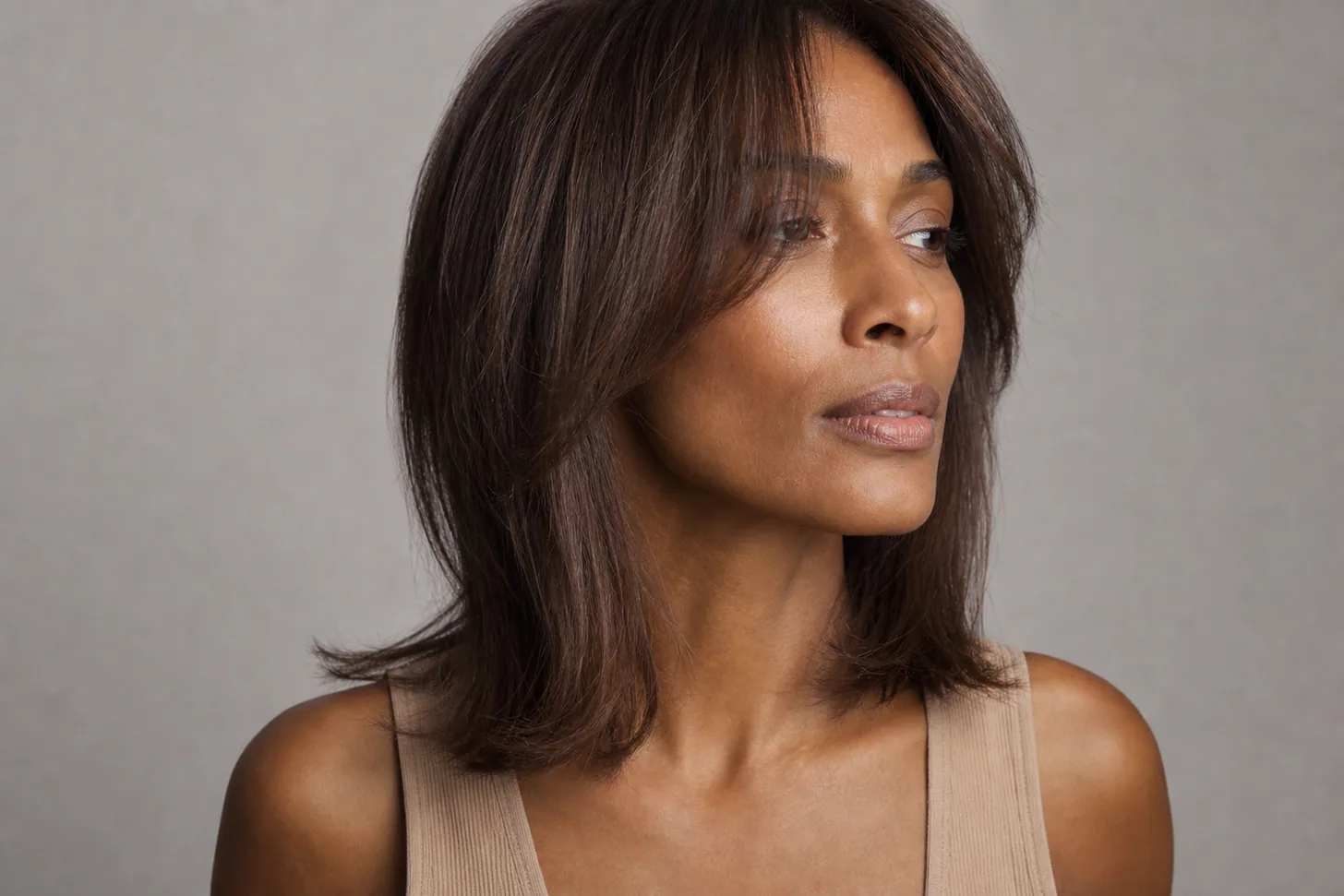
The softly layered mid-length
The everyday all-rounder: a blunt collarbone length with gentle internal layers point-cut into the mid-lengths. You get movement and swing up top while the perimeter stays dense — the balance most fine-haired women in their 40s are actually after. It flatters nearly every face shape and grows out cleanly between appointments.
cut with cheekbone-length face-framing layers lifting the face on fine warm-brown hair, woman around 46
6
The face-framing layered cut
Shorter pieces cut around the face from the cheekbone down, so the front carries extra movement and lift right where it flatters most. Face-framing is the single most flattering detail you can add in your 40s — it draws the eye up and builds fullness where you actually see it. Show your stylist a photo and say "keep my length, frame my face from the cheekbone."
modern shag with piecey textured layers around the crown on fine straight brunette hair, woman around 42
7
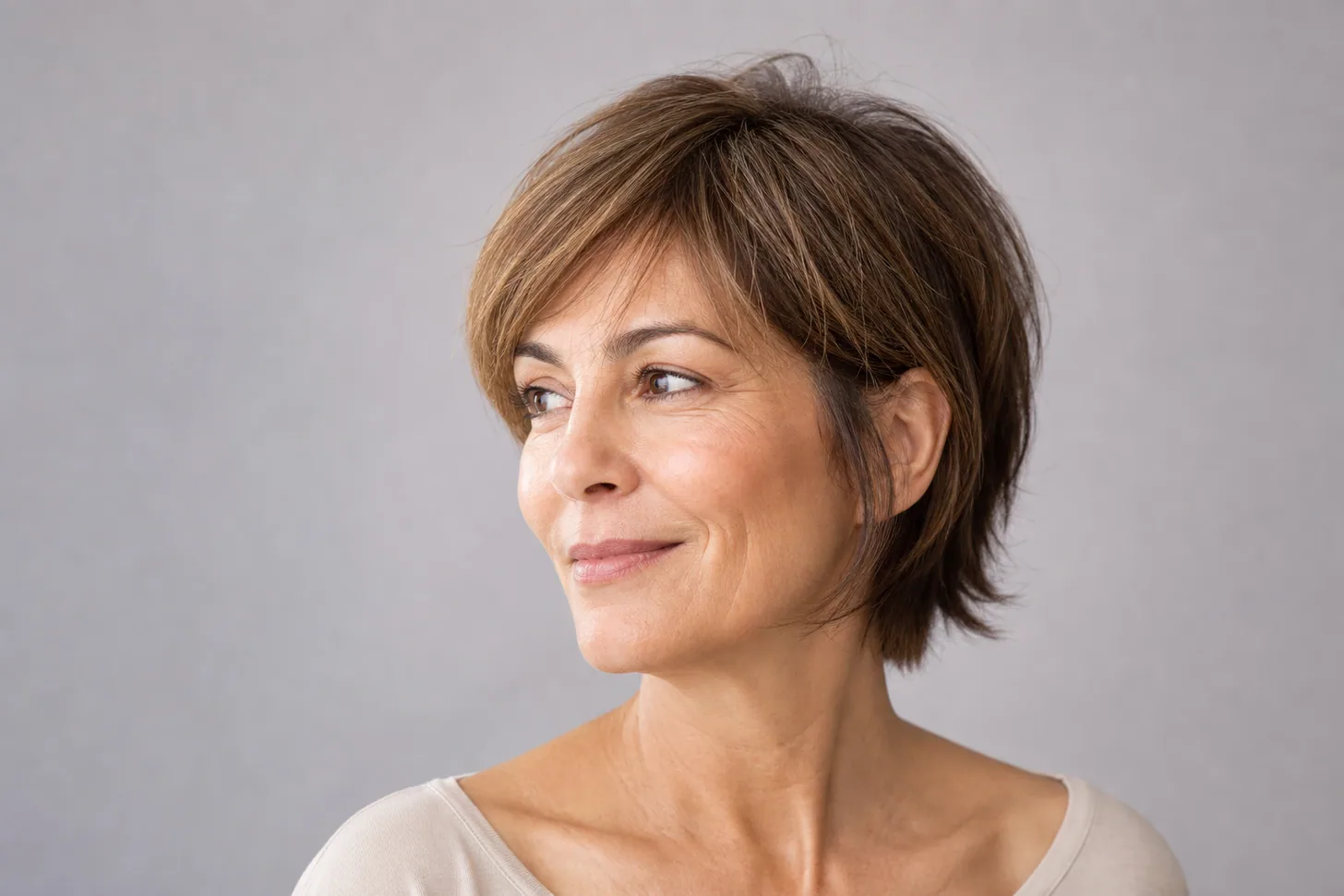
The modern shag
The shag is having a real moment, and it earns it on fine hair: soft, piecey layers build volume around the crown and face and read fuller the more lived-in they get. There's no sleek surface to fall limp, so it hides flatness in plain sight. Ask for the softer, grown-up version — point-cut, kept off the perimeter — so it has movement without looking undone.
collarbone cut with subtle graduation stacking body at the back on fine dark-blonde hair, woman around 44
8
The gently graduated mid-length
A collarbone cut with a little graduation at the back builds rounded body at the crown while the front stays long and face-framing. It puts fullness precisely where fine hair collapses first — the back of the head, by mid-afternoon. If your main frustration is a crown that goes flat before lunch, this shape holds its lift with the least styling.
Bangs & fringe for your 40s
A fringe puts movement right at the face and modernizes a plain cut in one appointment. On fine hair the rule is light: soft, see-through, point-cut styles that add the look of fullness at the hairline without borrowing the density a heavy blunt fringe demands.
mid-length cut with soft center-parted curtain bangs framing the face on fine brunette hair, woman around 41
9
The cut with curtain bangs
The most flattering and forgiving pairing in the whole guide. Soft, center-parted curtain bangs flow into the length and add a cushion of fullness at the front, drawing the eye up and breaking the "flat and plain" trap. They grow out without a hard line, so they're the easiest fringe to live with if you're new to bangs at 40.
cut with a light see-through wispy fringe on fine light-brown hair, woman around 45
10
The wispy fringe
A light, see-through fringe that never borrows the density fine hair can't spare. Point-cut so it stays feathery, it softens the forehead without the commitment of a full bang — the antidote to the heavy blunt fringe that flattens fine tops. A good pick if you want a little something at the face but not a whole new look.
cut with a long side-swept fringe blending into face-framing layers on fine chestnut hair, woman around 47
11
The side-swept fringe
A longer fringe swept to one side, blending straight into the face-framing layers — the lowest-maintenance bang here. It's long enough to tuck behind an ear on the days you can't be bothered, and it grows out without an awkward stage. The natural gateway if you've never had bangs and aren't sure they'll suit you.
bob with a soft rounded French-girl fringe on fine dark-brown hair, youthful woman around 40
12
The bob with a soft French fringe
For those who want a proper bang, a soft, rounded fringe on a blunt bob — enough fringe to feel fresh and a little French, kept light and point-cut so it works on fine hair. It's a genuinely youthful pairing that takes years off, but it does need a trim every few weeks to stay soft. Best if your density at the front is still fairly even.
Long & low-maintenance options
You don't have to lose length at 40 — you just have to shape it. These four keep hair long or wash-and-go easy while still building body, proof that "fine hair over 40" doesn't have to mean a short cut and a blow-dry every morning.
long hair with soft point-cut long layers and movement through the mid-lengths on fine brunette hair, woman around 42
13
The long layered cut
Long hair works beautifully on fine hair in your 40s as long as it's cut for shape, not left to hang. Soft long layers point-cut through the mid-lengths keep the length moving and stop it pulling flat, while a strong perimeter keeps the ends dense. If your density is still good and you love your length, this is your cut — shaped to work with the fineness, not against it.
long hair with long curtain bangs and face-framing layers on fine warm-brown hair, woman around 43
14
The long cut with curtain bangs
Keeping your length but adding long curtain bangs and cheekbone face-framing is the update that makes long hair over 40 feel intentional rather than grown-out. The front pieces carry the movement and lift, so the length reads current instead of dragging the face down. A small change at the front that transforms how the whole shape reads.
air-dried textured mid-length with natural bend, wash-and-go finish on fine wavy brunette hair, woman around 46
15
The wash-and-go air-dry cut
If you want a flattering shape without a long routine, this is it — a soft mid-length built to air-dry, with just enough layering that a scrunch of mousse and no heat gives you body. Fine, wavy hair especially looks fuller undone than blown out. See our low-maintenance cuts for fine hair for the full shortlist if minimal effort is the priority.
polished shoulder-length cut set on velcro rollers for soft all-over body on fine straight brunette hair, woman around 44
16
The roller-set soft-body cut
A blunt shoulder-length cut given all-over body from a few large velcro rollers dropped in while you get ready — no heat, no skill, just soft lift and a gentle bend at the ends. It's the modern, five-minute version of a set, and it suits fine hair perfectly. Ideal for the days you want a done, polished look without committing to a full blow-dry.
The five-minute routine that keeps it full
A good cut does most of the work, but a few quick habits keep fine hair over 40 at its fullest all day. Start in the shower with volume in mind: shampoo at the scalp, and keep conditioner strictly on the mid-lengths and ends so the crown stays lifted.
On damp hair, work a little root lifter or a lightweight mousse into the roots at the crown, then scrunch and air-dry, blow-dry with your head tipped forward, or set the crown on a couple of velcro rollers while you get ready. Skip heavy oils, rich creams and silicone serums — they flatten fine hair fast — and if you want more height, the quick tricks in our guide to adding volume to fine hair each take under a minute.
When the afternoon flattens things out, a light pass of dry shampoo at the roots revives the lift without a wash, and there's more finishing detail in our walk-through on how to style fine hair. Plan a trim every eight to ten weeks so the weight line stays strong and the ends stay fresh.
Some links in this section are affiliate links. If you buy through them we may earn a small commission, at no cost to you. We only recommend products we'd genuinely hand a fine-haired client in the chair.
Chair-side note
If you had a baby in your late 30s or early 40s, or you're heading into perimenopause, the shed around your hairline and part can be alarming — I've had clients in tears about it in my chair. Here's what I tell them: postpartum and hormonal sheds are usually a density change, not the strands themselves getting finer, and much of it grows back.
Don't make a panic decision and hack it all off. What actually helps in the meantime is a cut that lifts at the root and a soft, blended part, plus honest patience. If it's still shedding hard after six months, that's a conversation for your doctor, not your stylist.
SB
— Simone Baptiste, Senior Stylist
What to ask your stylist
Bring the mechanics, not just a photo — and if a stylist tells you 40 means you "have to" go short, that's a reason to find a different chair. Say: "My hair is fine and it's started to lose a little body — I want a cut that adds volume without going drastically short. Please keep a strong, blunt-ish weight line at the ends, point-cut some soft internal layers rather than razoring them, and frame my face from the cheekbone."
If your crown runs flat, name it: "My part is widening and my crown goes flat by the afternoon — please cut for lift there and set me up with a deeper side part." And if you've had a recent shed, say so, so they build the part and the layers to blend it. Those constraints are what turn a generic cut into one that works for the hair you have now.
When keeping your length may not be your best move
Your part is very wide and the scalp shows clearly through the length. The weight of longer hair can expose it further — a shorter shape lifts the roots and gives more coverage. Our short cuts for fine hair over 40 stay modern, not matronly.
Your hair goes flat and lifeless the moment it passes your shoulders. A lob or bob concentrates density higher up and holds more volume with far less effort.
Your ends are dry, wispy, or splitting. Length shows worn ends more than a short cut; trim and treat them first, or the whole length will look thinner than it is.
You're noticing rapid or patchy shedding, not gradual fineness. A cut helps the look, but check the cause first — see our honest guide to fine hair versus thinning and speak to your doctor.
FAQ
The best cuts for fine hair in your 40s add body without asking you to go drastically short. A collarbone lob with a blunt weight line, a soft point-cut shag, and any cut paired with curtain bangs are the reliable all-rounders — they build fullness where fine hair thins first and still read modern rather than matronly. The rule at 40 is body over length: keep a strong perimeter where your density is lowest, add soft internal layers rather than heavy or razored ones, and let a little face-framing lift the front. Whether you go short, medium, or long matters less than whether the cut is built for lift at the root and weight at the ends.
Not necessarily — going short is a choice, not a requirement, in your 40s. Short cuts do concentrate density higher up and can look wonderfully full on fine hair, but a well-built lob or long layered cut holds plenty of body too, as long as it has a strong weight line and soft layers. The deciding factor is your density and your styling patience, not a birthday. If your part is widening or the scalp shows clearly, a shorter shape will lift the roots more easily. If your fineness is gradual and your density is still decent, you can keep length that flatters you. Cut for body first and decide length second.
Build volume at the root while the hair is damp, and keep weight off the roots. Work a lightweight root lifter or mousse into the roots at the crown, then blow-dry with your head tipped forward or set the crown on a couple of velcro rollers while you get ready. Keep conditioner and any oils strictly on the mid-lengths and ends so the roots stay lifted, and skip heavy creams and silicone serums that flatten fine hair. A deeper side part instantly props up a flat crown, and a light mist of dry shampoo at the roots revives the lift through the day. The cut carries most of the load — a shape with layered lift and a blunt perimeter looks fuller before you touch a product.
Yes, as long as they stay light. Curtain bangs and soft, wispy fringes are some of the most flattering things you can add to fine hair in your 40s — they put movement right at the face, draw the eye up, and soften a forehead without needing the density a thick blunt fringe demands. They also modernize a plain cut instantly and grow out without a hard line. Skip a heavy, straight-across blunt fringe on fine hair, because it borrows weight from an already-fine top and can look sparse. If you're new to bangs, start with a long, side-swept or curtain style you can tuck away.
Long hair is absolutely fine in your 40s as long as it's cut for shape, not left to hang. What drags fine hair down isn't the length itself, it's length with no layers and no weight line — plain, flat, one-length hair that pulls the eye down and shows every thin patch. Long layers point-cut through the mid-lengths, a little face-framing, and a trim every eight to ten weeks keep long hair moving and full. If your density is still good, keeping the length you love is a completely valid choice — just have it shaped so it works with your fineness instead of against it.
Every eight to ten weeks keeps a fine-hair cut looking its fullest. Fine hair shows dry, splitting, or wispy ends more than coarse hair, and a fresh perimeter is what makes the ends read dense instead of stringy. Layered and face-framing cuts benefit from staying on schedule so the shape doesn't grow heavy and flat, and if you have a fringe you'll want a quick fringe trim in between to keep it soft. If you wear a very blunt lob or bob, you can sometimes stretch to ten or twelve weeks, but the crisp line is doing the work, so don't let it grow out too far.
Eleven years behind the chair, specializing in short shapes and fine-hair texture. Simone believes the best haircut is the one you can style yourself in ten minutes.
Results vary with hair type, density, and growth patterns. This guide is educational and not a substitute for an in-person consultation with a licensed stylist.
Hairstyle images in this guide are AI-generated illustrations, not photos of real clients or results. See our image policy.
Get the good hair intel
One honest, stylist-written guide in your inbox each week. No hype.

 SB
SB