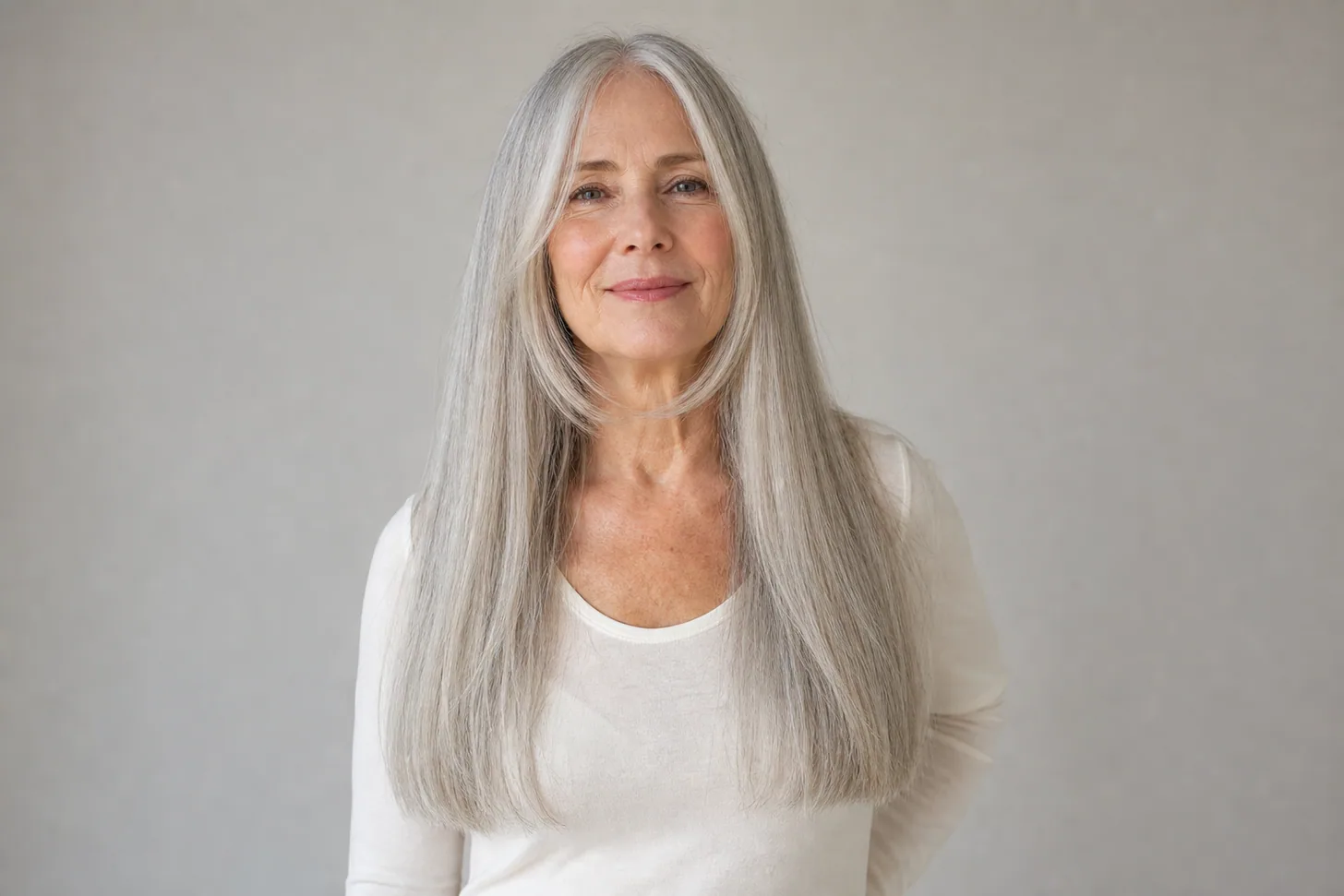
What's actually in a gloss
Most salon glosses are demi-permanent color, and the distinction from permanent color is the whole reason this service suits fine hair.
Permanent color has to reach the cortex, and reaching it requires force. As the International Journal of Trichology's review of hair cosmetics puts it, "to overcome the cuticle and reach the cortex, the product must have an alkaline pH able to open the scales" — usually with ammonia, and in the process "both substances remove the natural cuticle lipid, the 18-metil eicosanoic acid."
That lipid is part of what makes hair feel smooth and behave itself. It doesn't come back.
A demi skips most of that. The same review: demi-permanent dyes "do not contain ammonia or ethanolamine and for this reason are gentler on the hair than the permanent colors," with hydrogen peroxide "lower (2%) as compared to permanent hair dyes (6%)." They "do not lighten the hair shade." And they fade "after 10–15 shampoos, or even earlier."
Read that list as a spec sheet for fine hair and it's close to ideal. No lift means nothing is being removed from a cortex that was small to begin with. Low peroxide means minimal oxidative load. No line of demarcation at the roots means no four-week commitment. The cost is that it's temporary — and that number, 10 to 15 shampoos, is the one that runs this whole page.
Gloss, glaze, toner: three words, roughly two chemistries
All three are usually bought for the same underlying reason, which is that color fades faster on fine hair than the salon led you to expect, and balayage is often the technique being refreshed.
Here is the honest version, because the internet's version is a mess and the mess isn't your fault.
There are essentially two things being sold. One is a demi-permanent mixed with a low-volume developer: the dye is oxidative, it settles into the outer cortex, and it survives the 10 to 15 washes above. The other is a direct dye with no developer: pigment sits on and just inside the cuticle, and it's largely gone in a handful of washes.
Everything else is vocabulary. "Toner" is the first thing used for a particular job — killing warmth after lightening. "Gloss" is the salon's word for either. "Glaze" usually means the second but not reliably. So the useful question in the chair isn't what is this called, it's "is there developer in this, and how many washes should I expect?" Any colorist can answer that in a sentence, and the answer tells you what you're buying.
Count it in washes, not weeks
Which makes what you wash with the single biggest variable in how long a gloss lasts — see shampoo for fine color-treated hair for the picks, and the free habits that outperform all of them.
This is the most useful idea on the page and it takes thirty seconds to apply.
The salon's "six to eight weeks" is a real figure built on a hidden assumption: roughly two washes a week. Demi-permanent color goes at 10 to 15 shampoos, so two washes a week is six or seven weeks and the arithmetic works.
Now apply your own number. Fine hair goes flat and looks greasy sooner than any other type, so it gets washed more — four times a week is entirely normal, daily isn't rare, and fine, oily hair is a whole category of this problem. At four washes a week, 12 shampoos is three weeks. At daily, it's under a fortnight. Nobody has misled you; the number was never adjusted for you.
Two consequences follow. First, judge a gloss by wash count and not by the calendar, and tell your colorist how often you actually wash — it changes what they'd choose. Second, the highest-value thing you can do to make a gloss last isn't a product, it's one fewer wash a week and a cooler final rinse. How often to wash fine hair has the honest version of that trade, including when stretching washes is the wrong call.
Chair-side note
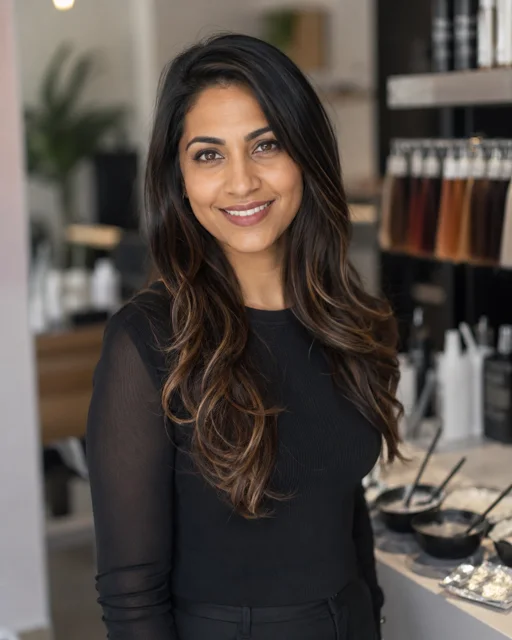
I ask two questions before I mix a gloss and only one of them is about color. The second is "how many times a week does this hair get washed?" — and the answer changes what I do. Someone washing five times a week gets a slightly deeper deposit than her target, because I know it'll be sitting where she wants it by the weekend and it'd be gone by Thursday otherwise.
Someone washing twice a week gets it dead on. Colorists have done this quietly forever; the reason to say it out loud is that clients keep apologising for washing their hair often, as though it were a failing, when it's simply a number I need. Fine hair gets washed. Tell your colorist the truth and you'll get a better gloss.
PN
Why shine reads as more hair
A gloss and a toning shampoo are often confused here, and they are not interchangeable — purple shampoo for fine hair deposits a little violet in a cleanser base, where a gloss deposits tone properly and seals the cuticle.
It's worth being precise about this, because it's the honest version of a claim that's usually oversold.
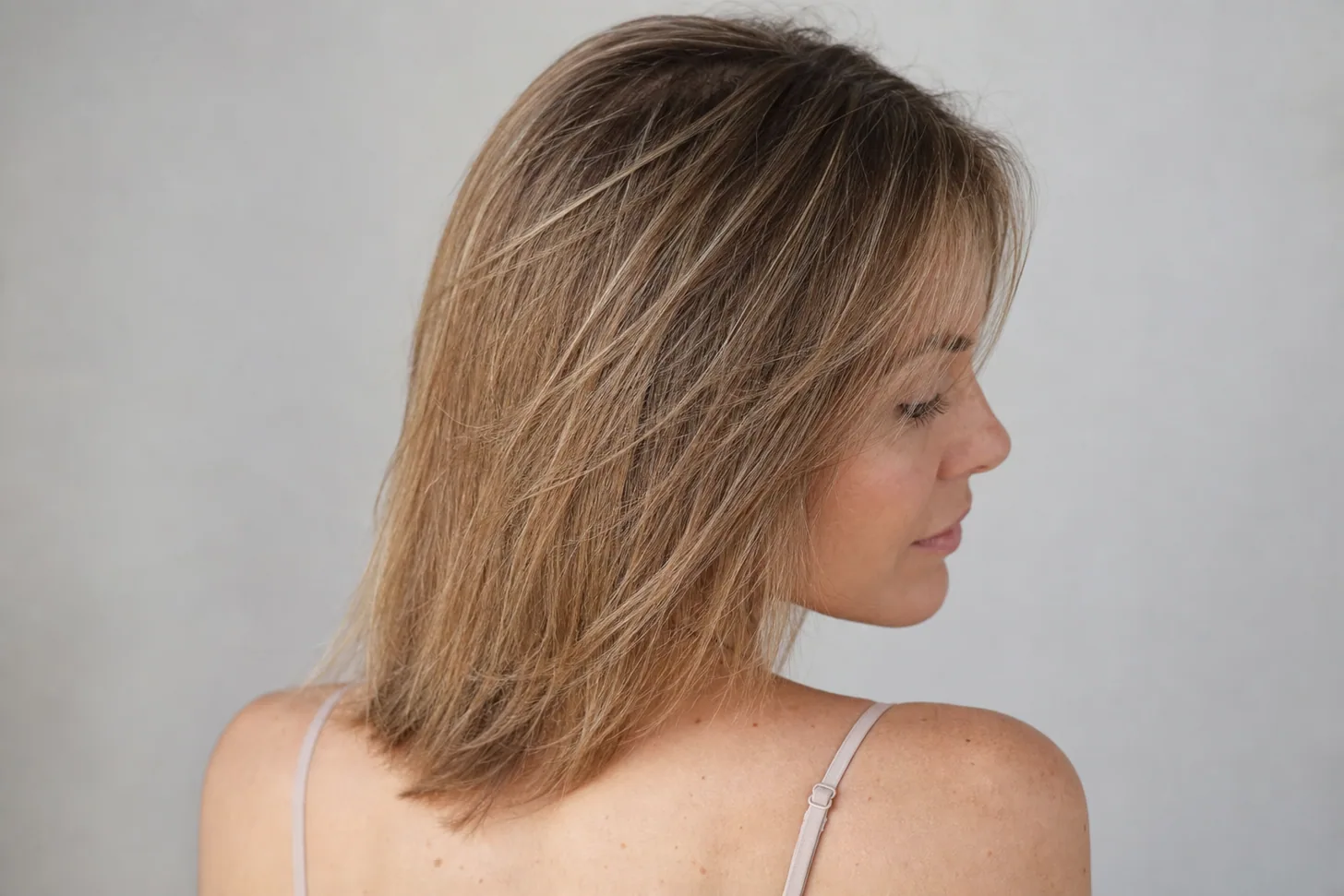
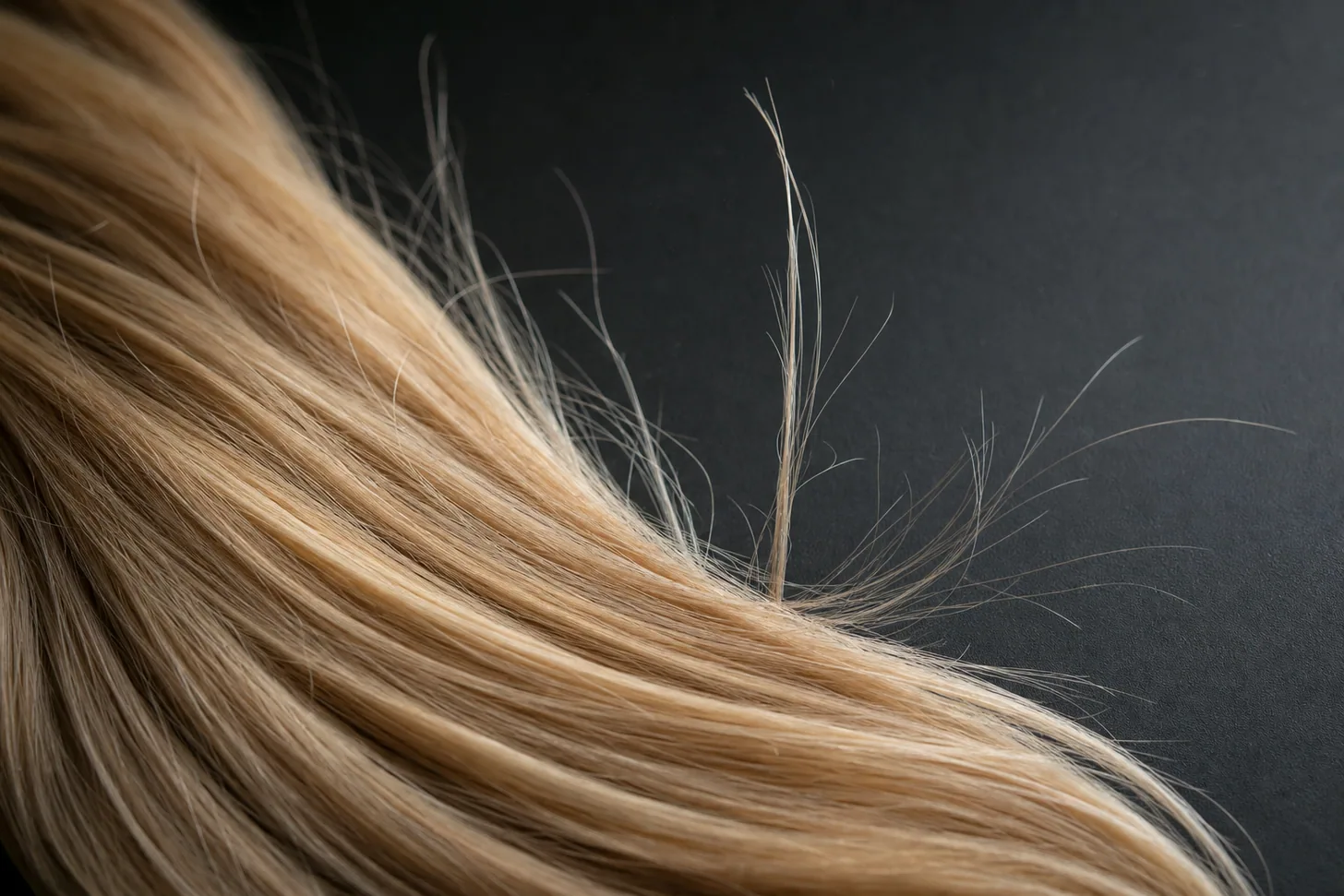
Shine is a property of the surface. A cuticle whose scales lie flat reflects light in one direction, and you see a band of it running along the hair — that's gloss in the optical sense. A cuticle that's lifted or roughened scatters light in every direction, and scattered light reads as dull. A gloss improves shine by smoothing and sealing that surface, not by adding anything to the fiber.
What this does for fine hair is about contrast, not volume. The ends are the least-covered part of any head, and on fine hair they're where the strand count is lowest, so dull, scattered ends read as sparse and wispy. Give the same ends an even sheen and they read as a defined edge. Nothing was added. The hair simply stopped disappearing into the background.
There's a second effect, and it's the one to think about carefully. A tinted gloss that darkens your hair increases the contrast between hair and scalp. Down the lengths that's flattering. Along a part where scalp is already visible it's the opposite — a darker strand against a pale scalp draws the eye straight to the gap.
So the rule for anyone with visible density loss at the crown is that depth belongs in the lengths and not at the part, which is the same logic running through coverage for thinning on top.
The two ways it goes wrong on fine hair
Going too dark, because dark is supposed to look thicker
It's a reasonable instinct and it overshoots on this hair type, for a mechanical reason: porous hair grabs deposit fast. Fine hair that's been colored, heat-styled or lightened is porous almost by definition, and a demi can land a level or more darker than the swatch and considerably flatter than expected. Then, because there's no lift in a demi, you can't take it back out — you wait it out.
The AAD's general guidance on coloring is the sane guardrail here: "choose a dye within three shades of your natural color. Typically dyeing hair darker is better than lighter." Darker is the safer direction structurally. It just isn't a free thickness upgrade, and one level is usually plenty on fine hair. Color ideas for fine hair has the shades that work without flattening it.
Glossing over highlights until the dimension is gone
This is the slow one, and it's the most common regret I hear. A gloss deposits on every strand it touches, and the lightest pieces — being the most porous — take the most. One gloss over highlights refreshes them. Three, over a year, has quietly muted the brightest pieces toward the base tone, and the expensive dimension you paid a colorist to build is flat.
The management is spacing and placement: keep tinted glosses to no more than every six to eight weeks, ask for the gloss to be kept off the brightest pieces where that's practical, and use a clear gloss in between if what you actually want is shine. If your highlights already look muddy rather than brassy, that's a different fix — see why color correction takes more than one visit and balayage for fine hair.
Clear gloss: the honest verdict
It does exactly what it says, which in this category is worth something. Shine, a smoother-feeling cuticle, no tonal change, no commitment, and it can be repeated as often as you like because there's no pigment to accumulate. On fine hair it's the safest thing discussed on this page.
Two honest limits. It is not a treatment. It doesn't strengthen a fiber, doesn't repair damage and doesn't do what a bond builder does — it makes hair look and feel smoother while it's on. And it won't fix dullness that isn't a cuticle problem.
If your hair is dull, rough and slightly heavy all over, and especially if it went that way gradually, the likelier culprit is mineral deposit or product buildup, and a gloss laid over that just seals it in. Clarify or chelate first and then judge — clarifying shampoo for fine hair and hard water cover which one you need.
Salon or at home
Split it by what the product has to decide.
At home is reasonable for a clear gloss, or a barely-tinted one in a tone you've used before and know behaves. The application is forgiving, there's no lift to get wrong, and the downside of a mediocre result is a few weeks rather than a season.
Pay for it when a tone is being corrected. Choosing the right one means reading what's already in the hair — residual warmth from old color, how much more porous the ends are than the mid-lengths, which direction the fade is heading — and getting that wrong on fine, porous hair gives you a result you can neither wash out quickly nor lift back off.
A gloss is also one of the cheaper items on any color menu and usually takes about half an hour, which makes it poor economics to gamble on. If you're going at-home anyway, the best at-home color for fine hair has picks, and at-home color for fine hair covers when to stop and book someone.
Chair-side note
The request I get most often is "just something to make it shinier," and about a third of the time a gloss is the wrong answer. I run a strand between my fingers first. If it's slippery and simply pale, a gloss will do it.
If it feels faintly rough and squeaky, and it's dull from root to tip rather than just at the ends, that's mineral or buildup, and glossing it is like waxing a dusty car — the deposit is trapped under the shine and the result lasts about a week. Those clients get a chelating wash and get told to come back in a fortnight, which is a smaller bill and a better outcome, and it's why I'd rather you knew the difference than booked blind.
PN
What to ask for
- "Is there developer in this, and how many washes should I expect from it?" The one question that cuts through the gloss-versus-glaze confusion.
- "I wash my hair [x] times a week — does that change what you'd use?" It does, and a good colorist will adjust the deposit for it.
- "Can you keep the depth in the lengths and off my part?" If you can see scalp at the crown, this is the single most useful instruction you can give.
- "Can we go one level rather than two?" Porous fine hair overshoots, and a demi can't be lifted back off.
- "Can you leave my brightest pieces out of it?" On highlighted hair, this is what protects the dimension over a year.
- "Would a clear gloss do what I'm asking for?" Often yes, and it's cheaper and repeatable. See all our color guides for fine hair.