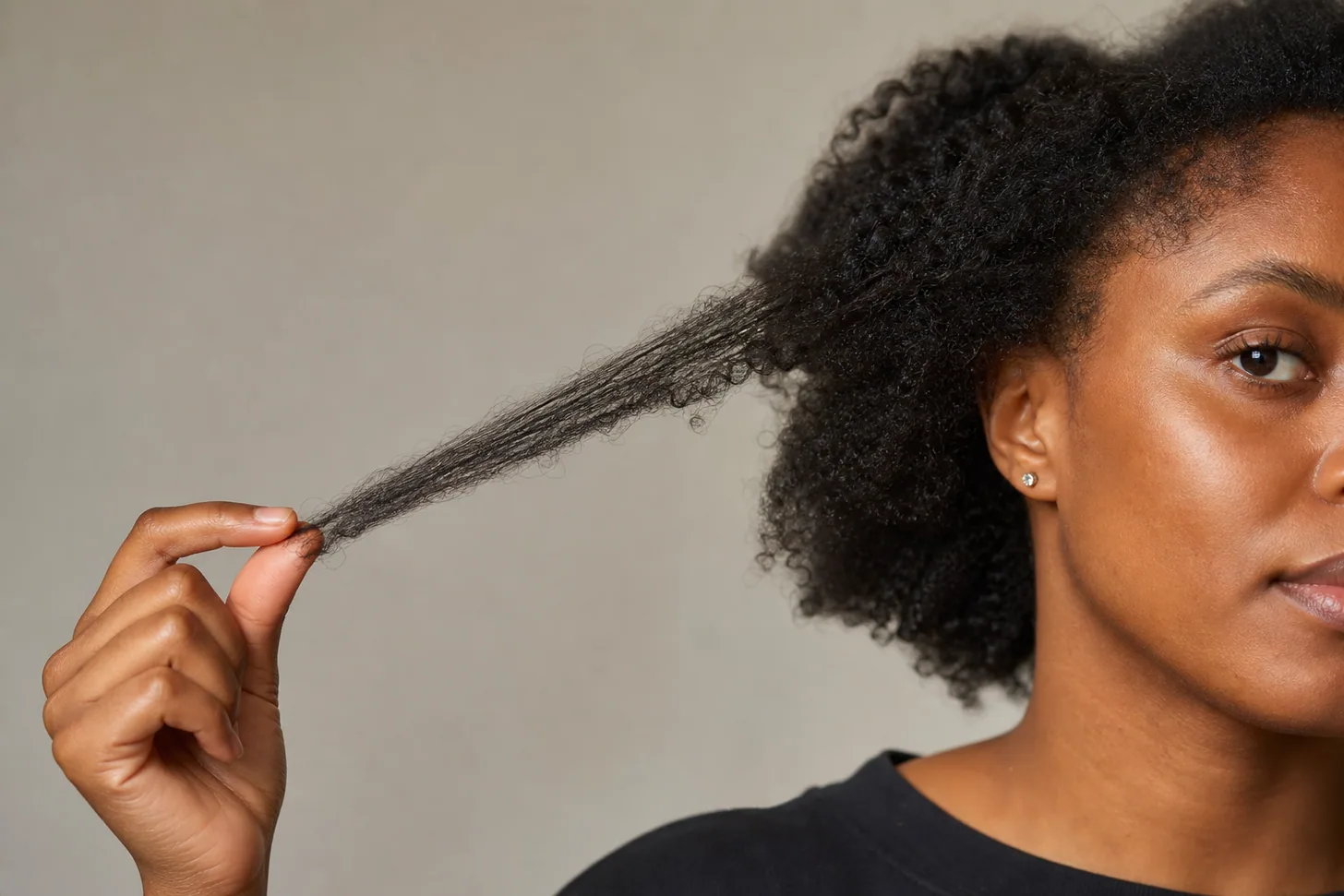
Fine curly hair has two problems that pull in opposite directions
Most bad advice in this category comes from treating one of these and forgetting the other. Both are real, both have mechanisms, and they want opposite things from a bottle.
The dryness is structural, not a failure of your routine. On straight hair, sebum wicks down the shaft and lubricates the length for free. On a curled shaft it does not travel.
The trichology literature on hair cosmetics puts it plainly: distributing sebum along the fibre by combing and brushing is a way of lubricating curly hair precisely because of the natural difficulty the sebum produced at the scalp has in diffusing along the fibre. So the oil stalls near the root — which explains, in one sentence, why the same head of hair can be flat and greasy at the top and parched three inches down.
The weight sensitivity is arithmetic. A fine strand has less surface area per unit of length than a coarse one, so any given quantity of conditioning residue is a much larger fraction of what that strand weighs. The formula that makes a coarse 3C curl supple makes a fine 3B curl lie down. This is the same arithmetic that governs silicone build-up on fine hair and the reason fine curls hit a visible build-up threshold weeks before coarse ones do.
| The symptom | What it actually is | Where the fix belongs |
|---|
| Roots flat and oily by day two | Sebum pooling where it cannot travel, plus residue landing where it should not. | The shampoo — at the scalp, properly, on a schedule. |
| Ends dry, rough, frizzing | Oil that never arrived, on a fibre with an irregular surface. | The conditioner and the styler, from the ears down. |
| Curls "stopped forming" | Build-up, nearly always — not lost pattern. | A clarifying reset, roughly monthly. |
| Snapping during detangling | Mechanical stress from grooming a curved structure. | Slip and technique first; protein only if it persists. |
Why "stop shampooing" is the wrong advice for a fine curl
The curly-hair method's founding instruction is to give up shampoo, and for a lot of people it is transformative. It was designed around a coarse curl: chronically dry, rarely oily at the scalp, and needing every bit of conditioning it can hold in order to be combable at all. Almost none of that describes fine curly hair.
Run the same method on a fine strand and you get a predictable sequence. Week one is wonderful. By week three the roots are flat by the afternoon. By week six the curls are looser, duller and less inclined to clump, and the instinct — reasonably — is to add more product, which accelerates it.
What people report at that point is that their curls have stopped working. What is actually happening is that a fine strand reached its residue threshold in a fraction of the time a coarse one would have, and the conditioning cleanser is adding to the problem it is being asked to solve.
None of this means co-wash is useless. It means it is a between-washes tool for fine curls, not a replacement for cleansing. And it means the step curly routines discourage most — clarifying — is the one fine curls need most.
Chair-side note
When someone tells me her curls have "stopped forming," I ask one question before anything else: when did you last use a clarifying shampoo? Nine times out of ten the answer is some version of "I read you're not supposed to." That advice is not wrong, it is just written for hair with more surface area than hers.
My rule for fine curls is a reset every three to four weeks, and I tell people to judge it by pattern rather than by greasiness — fine hair loaded with product does not necessarily feel dirty, it just stops clumping. If your curls are separating into strands that used to sit together, and adding more cream is making it worse rather than better, you do not have a product problem. You have a subtraction problem.

MH
The wash schedule that works, reset included
Frequency is where fine curly hair diverges most from both of the traditions it gets advice from. Curl guidance says wash rarely; fine-hair guidance says wash often. The honest answer sits between them and depends on which of your two problems is louder.
| Your situation | Cleanse | Clarify | In between |
|---|
| Fine 3A–3B, oily scalp, gel-and-cream routine | Every 2–3 days | Every 3 weeks | Water refresh; dry shampoo at the roots only |
| Fine 3B–3C, normal scalp | Every 3–4 days | Every 4 weeks | Co-wash or water-and-leave-in refresh |
| Fine curls, colour-treated or heat-styled | Every 3–4 days | Every 4–6 weeks | Keep the reset gentler; follow with a deep conditioner |
| Fine curls, minimal product | Every 4–5 days | Every 6 weeks | Water refresh is usually enough |
The reset column is the one to actually diarise, because it is the one that gets skipped. Our guide to clarifying shampoo for fine hair goes deeper on how hard a reset should be, and how often to wash fine hair covers the general case.
Where the slip belongs — and why fine curls actually break
There is a persistent idea that curly hair is inherently fragile, and it is worth correcting because it leads people to the wrong product. A 2019 review of curly-hair mechanics in the Proceedings of the Royal Society A concluded that weakness in natural, untreated curly fibres results from structural damage consistent with the mechanical stress of grooming a complex physical structure — not from structural abnormality or inherent weakness. In plainer terms: your curls are not weak. The combing is.
That reframes the whole question. If breakage comes from handling rather than from a defect, the fix is to reduce the handling and to lubricate whatever handling remains — which means slip belongs at the moment of detangling, in the conditioner, not distributed everywhere by the shampoo.
A shampoo generous enough to detangle with is a shampoo generous enough to flatten your roots, and you will have paid that price on every wash for a benefit you needed for four minutes.
Practically: detangle in the conditioner, on soaking-wet hair, in sections, with fingers before any tool. The technique is worked through in how to keep fine hair from tangling, and the same logic drives the placement rules in our conditioner picks for fine hair.
What to look for on the label
Good signs. Mild surfactants doing the cleaning — cocamidopropyl betaine, sodium cocoyl isethionate, sodium methyl cocoyl taurate, decyl glucoside. Glycerin or panthenol for light hydration. A conditioning agent present but sitting well down the list rather than in the opening five. Low-lather rather than no-lather: you want it to actually clean the scalp.
Warning signs, in order of how often they cause trouble. Shea butter, coconut oil or castor oil near the top of the list — all three are excellent on coarse curls and reliably flatten fine ones. A long-chain quat such as behentrimonium chloride or cetrimonium chloride in the first six ingredients, which means the formula is built to deposit rather than rinse.
Non-water-soluble silicones like dimethicone, which accumulate faster on fine hair for the surface-area reason above. And a note on the phrase itself: sulfate-free is not a synonym for gentle or for light. Plenty of sulfate-free curl shampoos are extremely rich, and richness is the way fine curls get ruined.
The best shampoos for fine, curly hair, by job
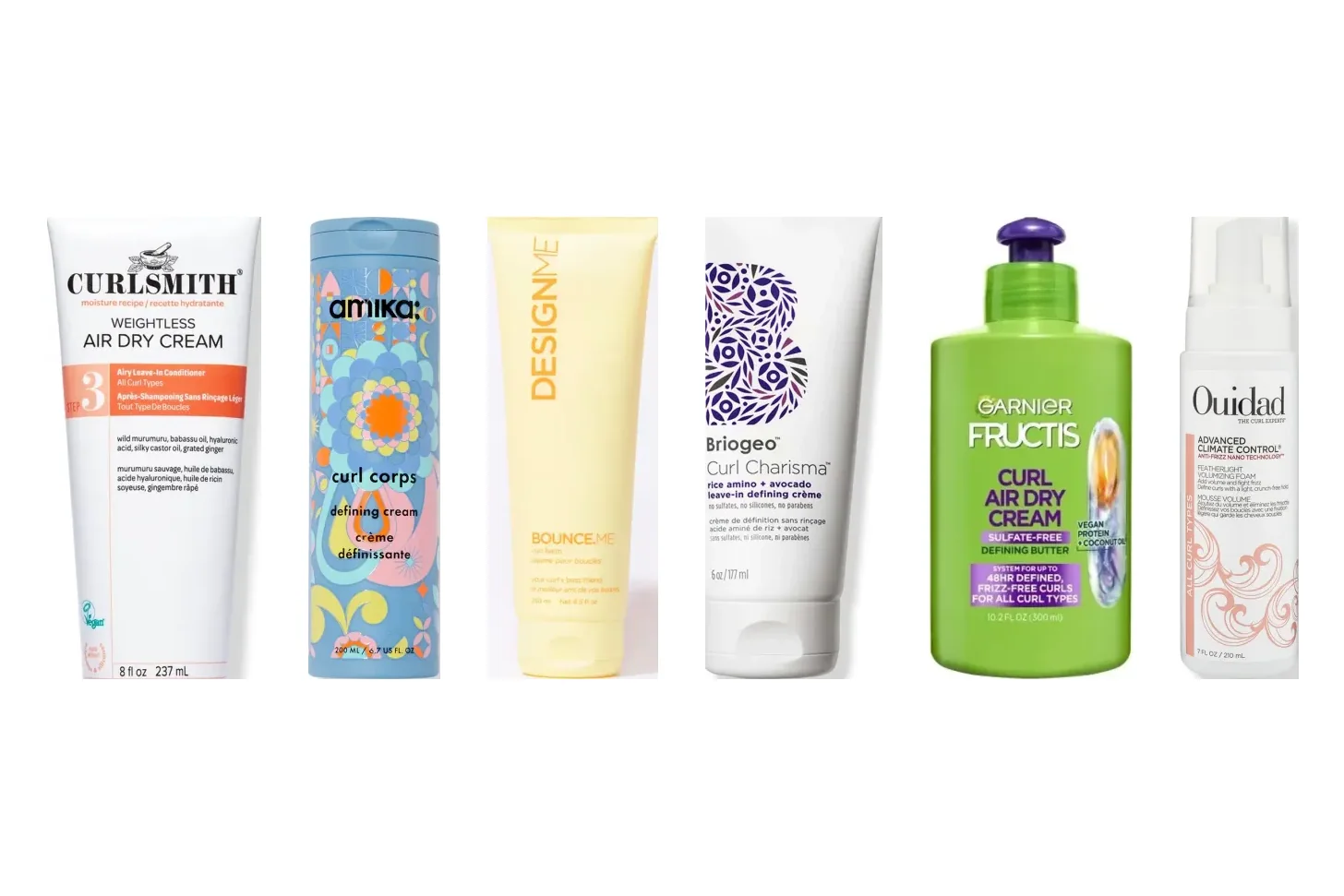
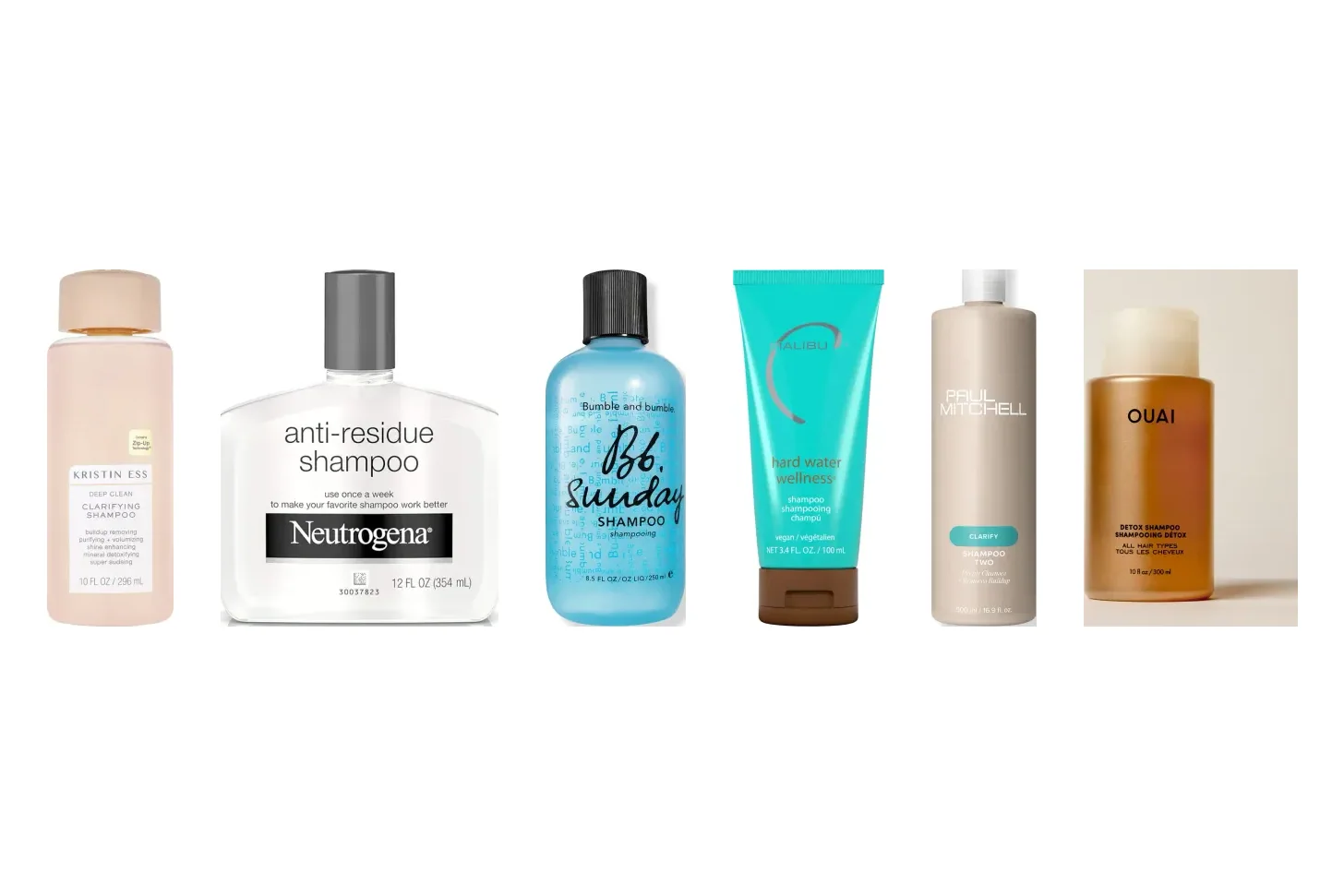
Six picks across six brands, chosen against the rule above: they clean the scalp properly without loading the lengths, and each one is honest about which of the two problems it is solving. Every pick has one real limitation named, because all six are a compromise somewhere.