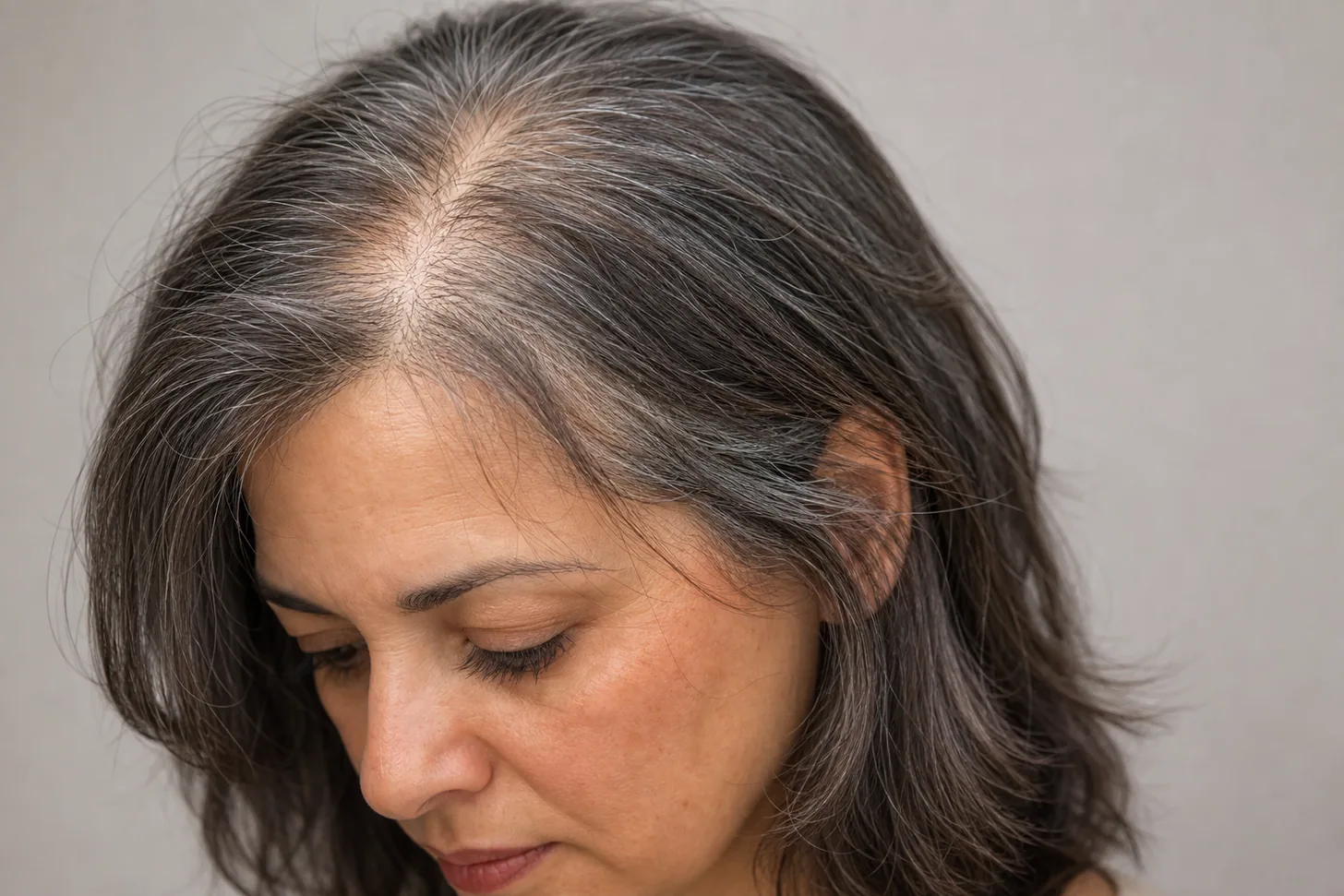
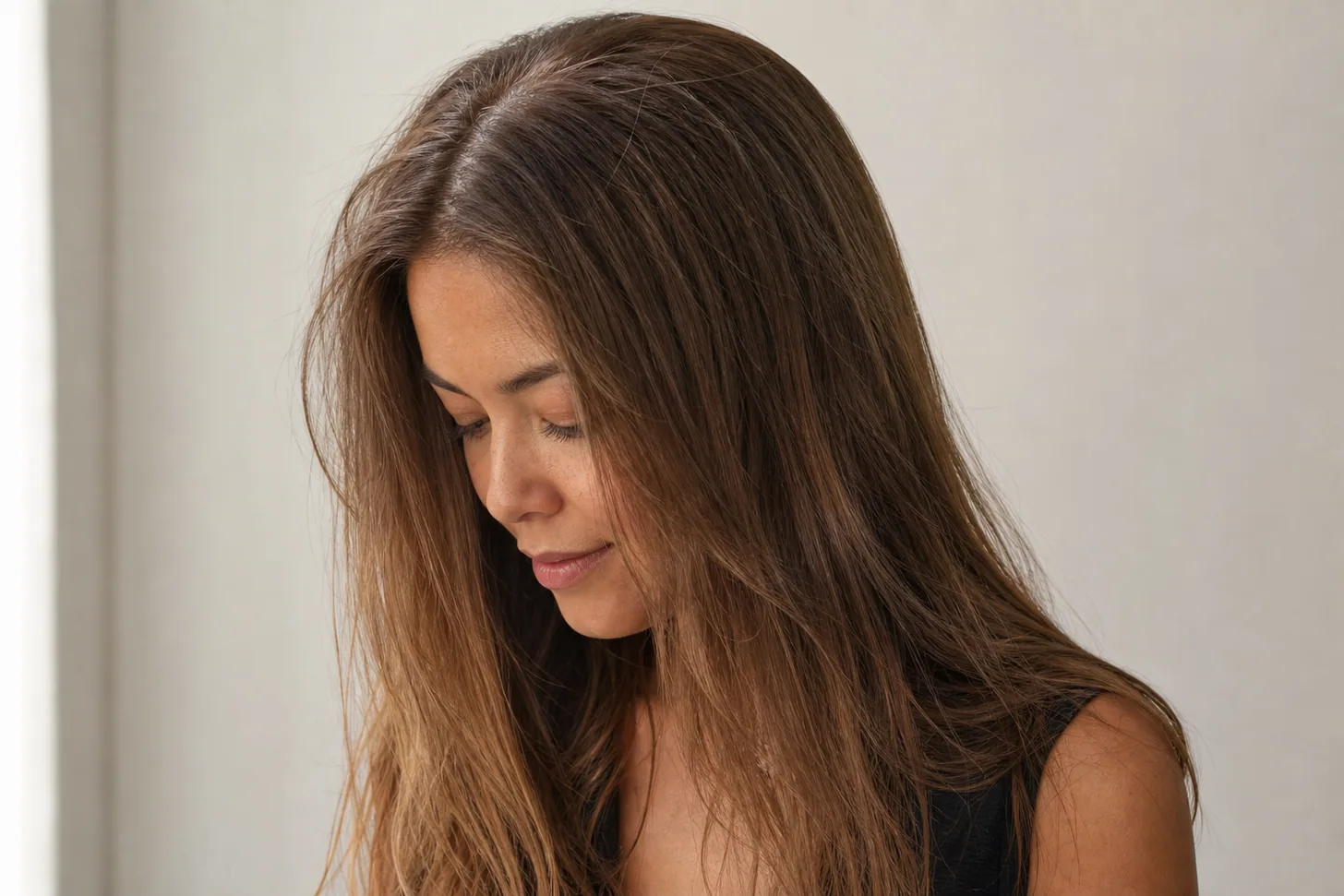
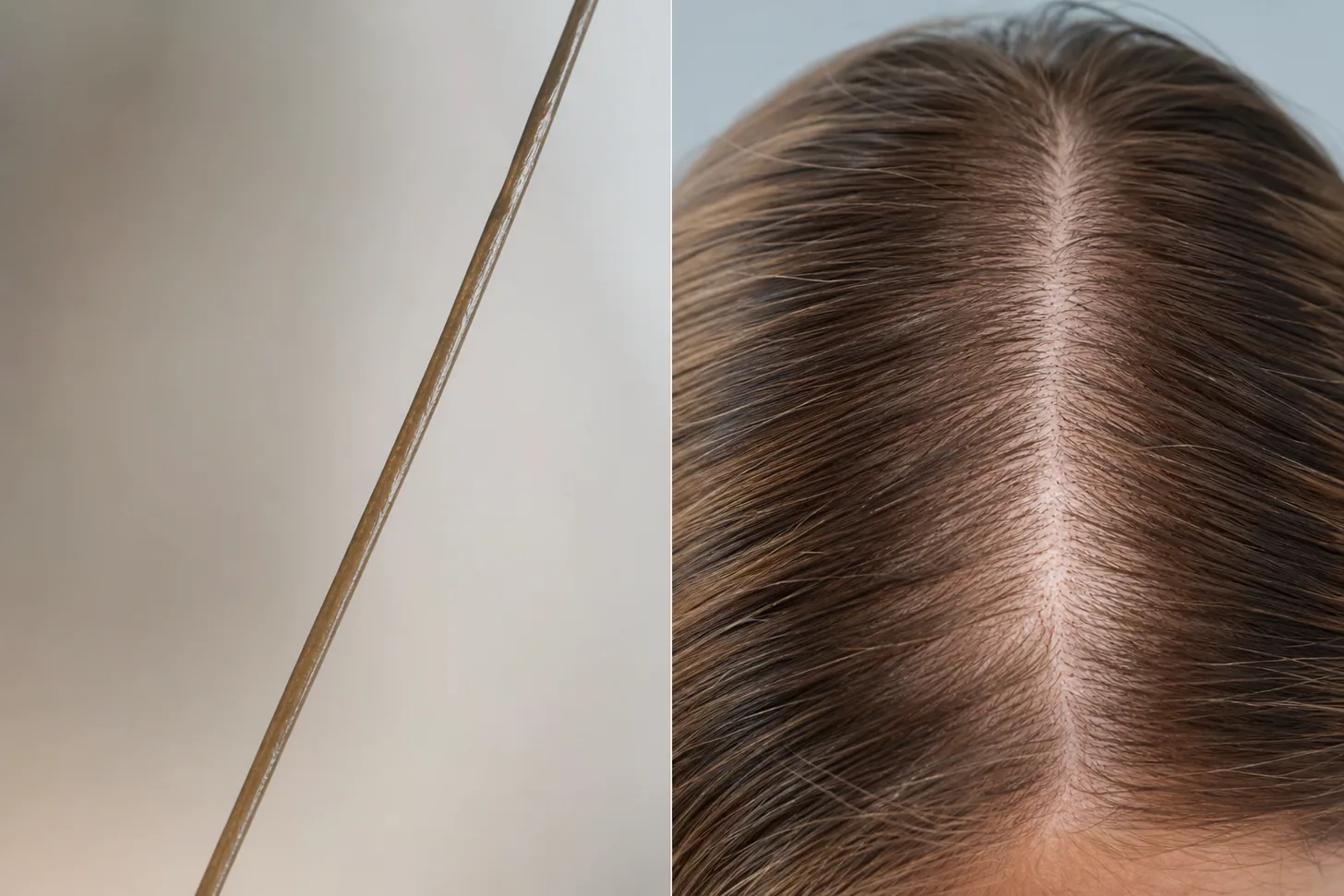
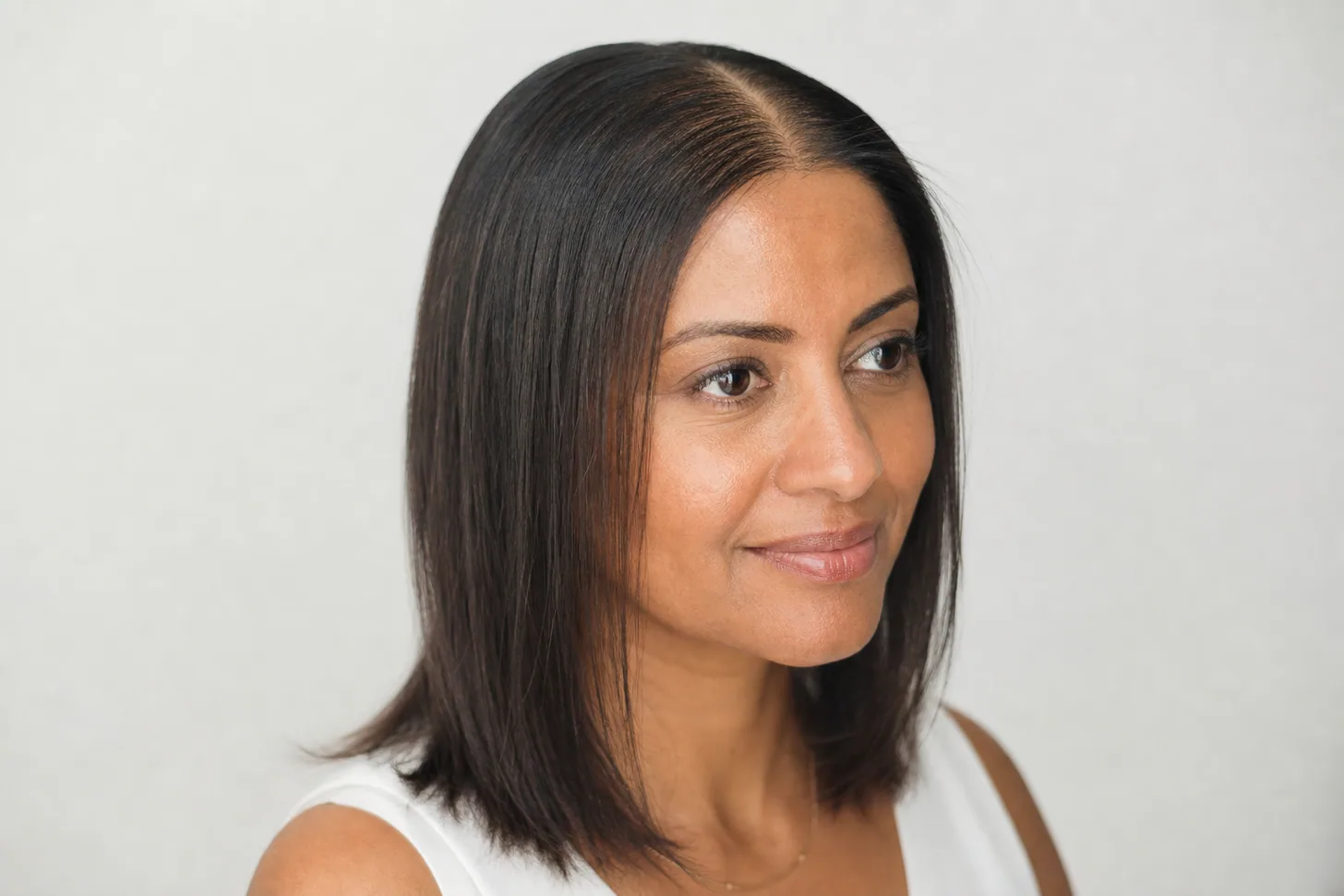
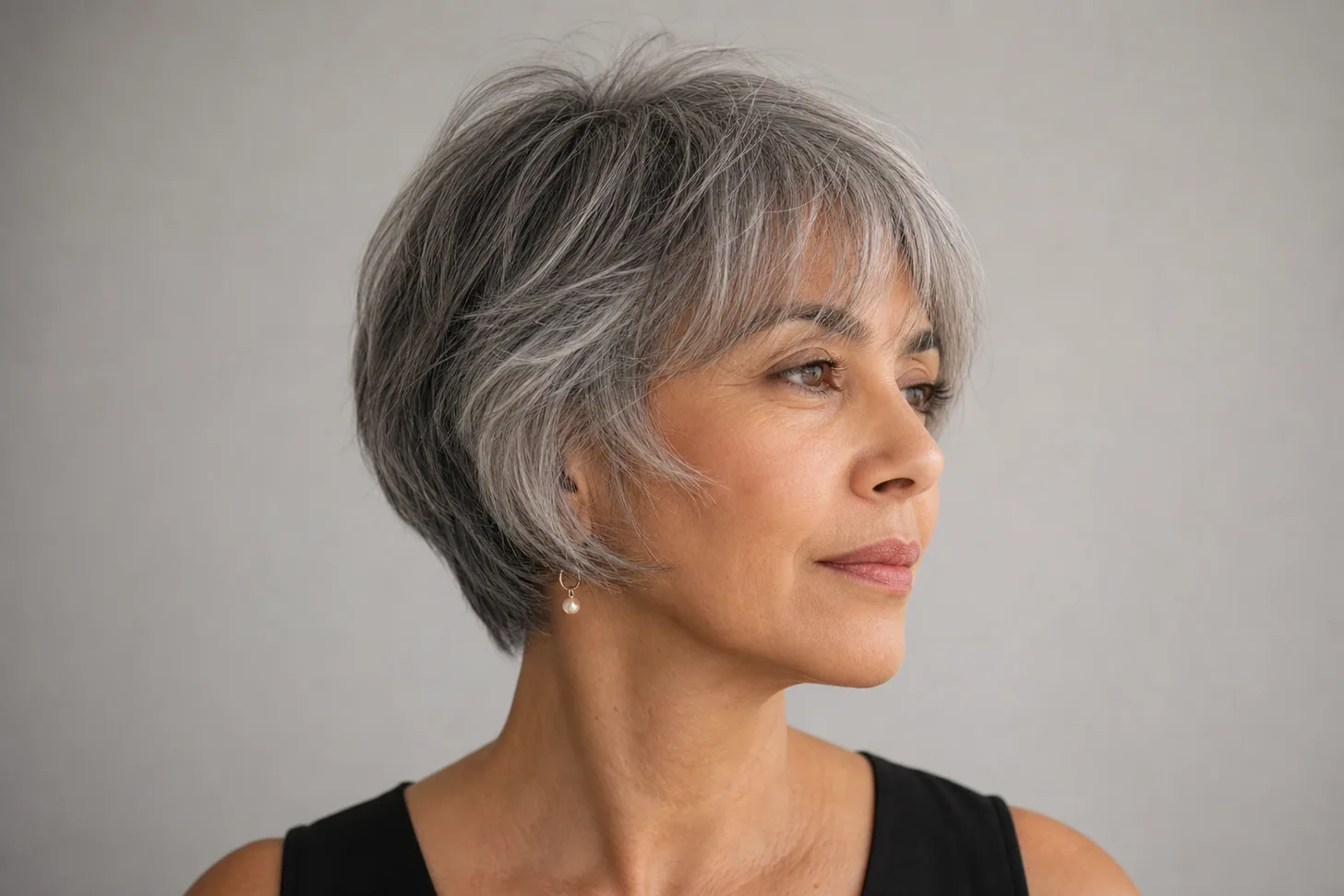
Three of those four rows have somewhere to go on this site. The third didn't until now, and it's the row most often mislabelled, because it's the only one where the hair looks like the first row and behaves like the fourth.
The two-minute check
Do both halves. One without the other is how people end up in the wrong category.
Diameter. Pull a shed strand off your brush — take it from the mid-back of your head, not the temples, which are naturally finer on everyone. Roll it between your finger and thumb with your eyes closed. Barely detectable means fine. A distinct thread with a little spring in it means medium to coarse. Repeat four or five times; a single hair proves nothing.
Density. Part your hair in bright, overhead light and look at how much scalp shows along the line. Then gather it into a ponytail and measure the circumference at the elastic with a tape or a piece of string. Under about two inches around is low density; two to three is average; above that is high. Neither figure is a diagnosis on its own — it's the pair that places you.
If you land on fine after all, the page you want is fine hair and thin hair aren't the same thing, and everything else on this site is written for you. If you land on coarse, keep reading.
Why coarse-and-sparse gets treated as fine
It's a language problem with commercial consequences. In everyday speech "my hair is thin" almost always describes what the mirror shows — you can see scalp, the ponytail has shrunk, the hair doesn't cover. That's a density statement. But the products, the quizzes and the search results attached to "thin hair" are overwhelmingly built for fine hair, because that's the larger market and because the two words are used loosely.
So the coarse-and-sparse reader ends up on a fine-hair routine: lightweight everything, no oils, no rich masks, volumizing shampoo, clarify often, skip the layers. Every one of those instructions is designed to stop a fragile strand collapsing under weight.
A coarse strand doesn't collapse. What it does instead, deprived of moisture and slip, is roughen, frizz and stick out — so the hair ends up looking worse covered than it did, and none of the sparseness has been addressed, because none of those products were ever aimed at density.
What graying actually changes
A large share of people reading this arrived at the combination rather than being born with it: density drifted down through their forties and fifties while the texture went wiry. That isn't imagination, and it isn't two unrelated stories.
A review of hair graying in the International Journal of Trichology reports that the growth rate, the diameter of the medulla and the average diameter of nonpigmented hair are all higher than in its pigmented counterpart, and states directly that gray hair is "coarser, stiffer, and harder to manage than darker hair." The medulla is the hollow core running down the middle of some strands; a wider one makes the fibre both thicker and stiffer to bend.
Put that alongside an age-related decline in density and the picture is complete: fewer hairs, each of them wider, stiffer and growing faster than the ones they replaced. Your routine didn't stop working because you got worse at it. The fibre changed underneath it.
The other changes happening at the same stage — and how to tell which one you're seeing — are in menopause and fine hair. If the density side of that shift is what's worrying you, fine hair or thinning and coverage for thinning on top take it seriously; this page is about living well with the texture half.
Six rules that invert
Put the weight back on the lengths
The fine-hair commandment — as little product as possible, nothing heavy, no oils — exists to stop a narrow strand being flattened. Yours won't be. A coarse strand has more cortex, more surface and a thicker cuticle to get moisture through, and it will take a proper conditioner, a weekly mask and a few drops of oil on the ends without going limp.
The rule that survives is placement, not quantity: ears down, nothing above. A richer weekly mask is worth more to you than any volumizer.
Your daily enemy is frizz, not flatness
Fine hair's failure mode is collapse; yours is a halo. Stiff strands at low density have nothing packed around them to hold them in line, so any raised cuticle stands proud and reads as flyaway — and flyaway on a sparse head is doubly unwelcome, because it draws the eye to exactly the scalp you're trying to cover.
Humidity management and cuticle-smoothing do more for how your hair looks than volume products ever will. How to tame frizz covers the light-touch version; you can afford a slightly heavier hand than it assumes.
Layers are available to you
Fine hair fears layering because each strand tapers toward its end and a layered fine head goes transparent at the edges. Coarse strands don't do that. Layering gives coarse hair somewhere to go instead of sitting in a stiff pyramid, and internal or graduated layers genuinely help — with the caveat that the perimeter should stay reasonably solid, since a blunt edge still reads as more hair.
Do layers help or hurt fine hair is the fine-hair version of this argument; read it knowing that the "razor and thinning shears" warning still applies to you, but the rest is more permissive than you need.
Coverage is a color decision before it's a product decision
The single most effective thing for visible scalp isn't a powder or a fibre — it's reducing the contrast between your hair and the skin underneath it. A root shadow, a few lowlights, or simply going a shade darker at the base makes a wide part far less obvious, because the eye stops registering a bright line. This is the highest-leverage move available at low density and it's completely independent of texture. Shades that add depth works through the options.
Long doesn't help you
Past the shoulders, weight pulls hair into a narrower column and the silhouette gets thinner, not fuller. That's true for everyone at low density, and coarse hair adds its own version: length also means more of the strand's life spent away from the scalp's oil supply, so the ends get drier and coarser still.
A shape that finishes between the jaw and the collarbone covers more scalp and stays in better condition. Options at that length are in medium-length cuts and the lob.
You can take more heat — but you have fewer hairs to lose
Coarse hair genuinely tolerates hot tools and chemical processing better than fine hair, which is why your stylist reaches for higher settings on you. Both halves of that sentence matter. There's more cortex to lose before a strand fails, and there are fewer strands, so each one you break is a larger share of what you have.
The sensible position is to use the heat you need and to protect it properly — a heat protectant and the habits in the American Academy of Dermatology's list of damaging hair habits aren't optional just because your fibre is tough.

 MH
MH