Reviewed by Tara Sullivan · Updated July 2026 · 9 min read
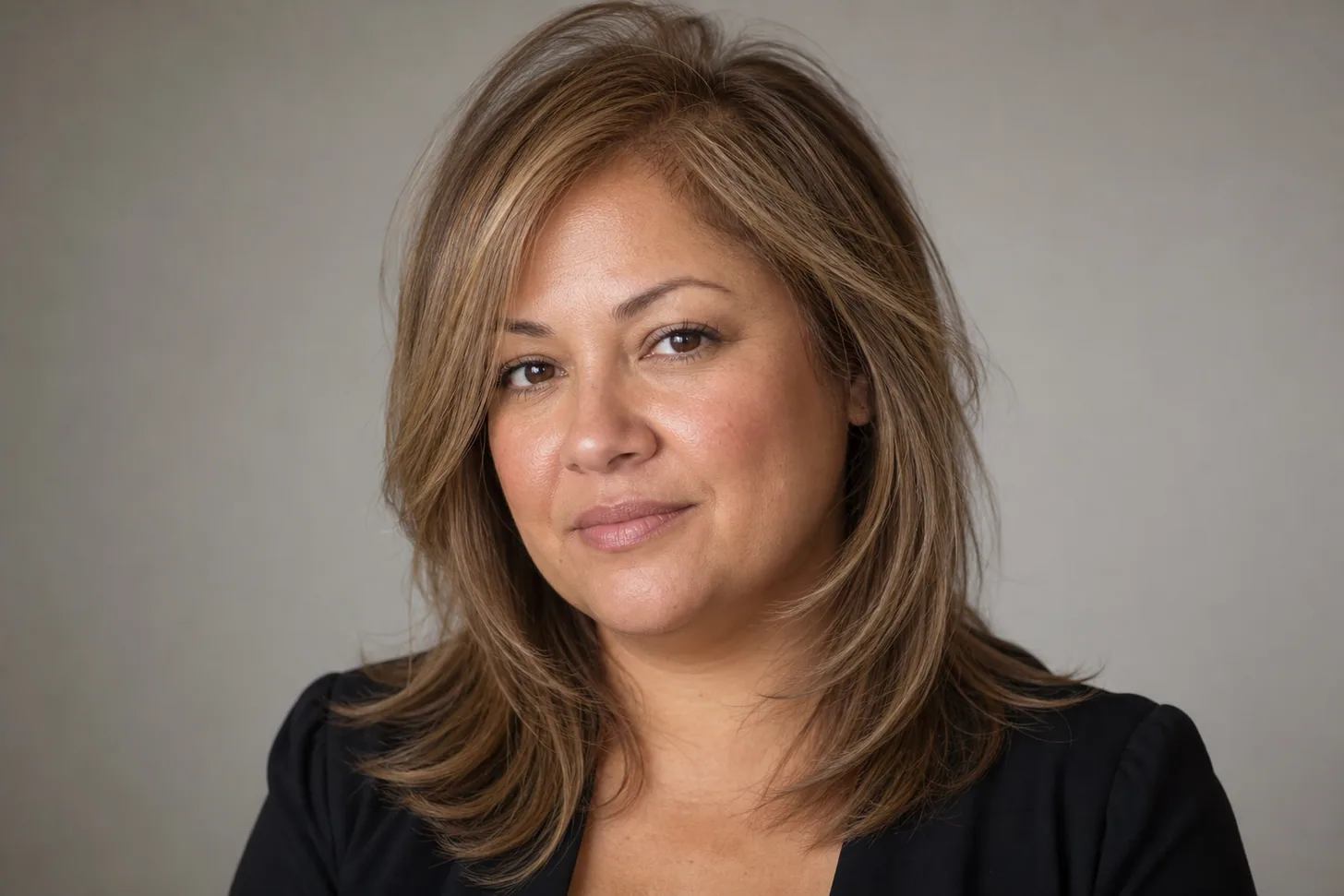
A round or fuller face and fine hair is a double brief, and one cut has to answer both. The cuts that flatter here add vertical length and crown height while keeping the ends dense — length that falls past the chin, an off-center or deep side part, soft face-framing layers, and lift built into the roots. That verticality lengthens and slims the face; the density keeps fine hair from going flat and stringy.
What works against you is the opposite set — chin-length blunt bobs that stop at the widest point, straight-across blunt bangs, and volume that puffs out at the cheeks. Below are 16 salon-tested cuts for a round face on fine hair, grouped from the longest lengthening shapes to short cuts with height on top, each with who it suits and the exact words to bring your stylist.
If you're not certain a round shape is what you're working with, our face-shape decision guide is the place to start — and if the answer turns out to be a defined jaw rather than a soft one, the advice reverses in cuts for a square face and fine hair.
Chair-side note
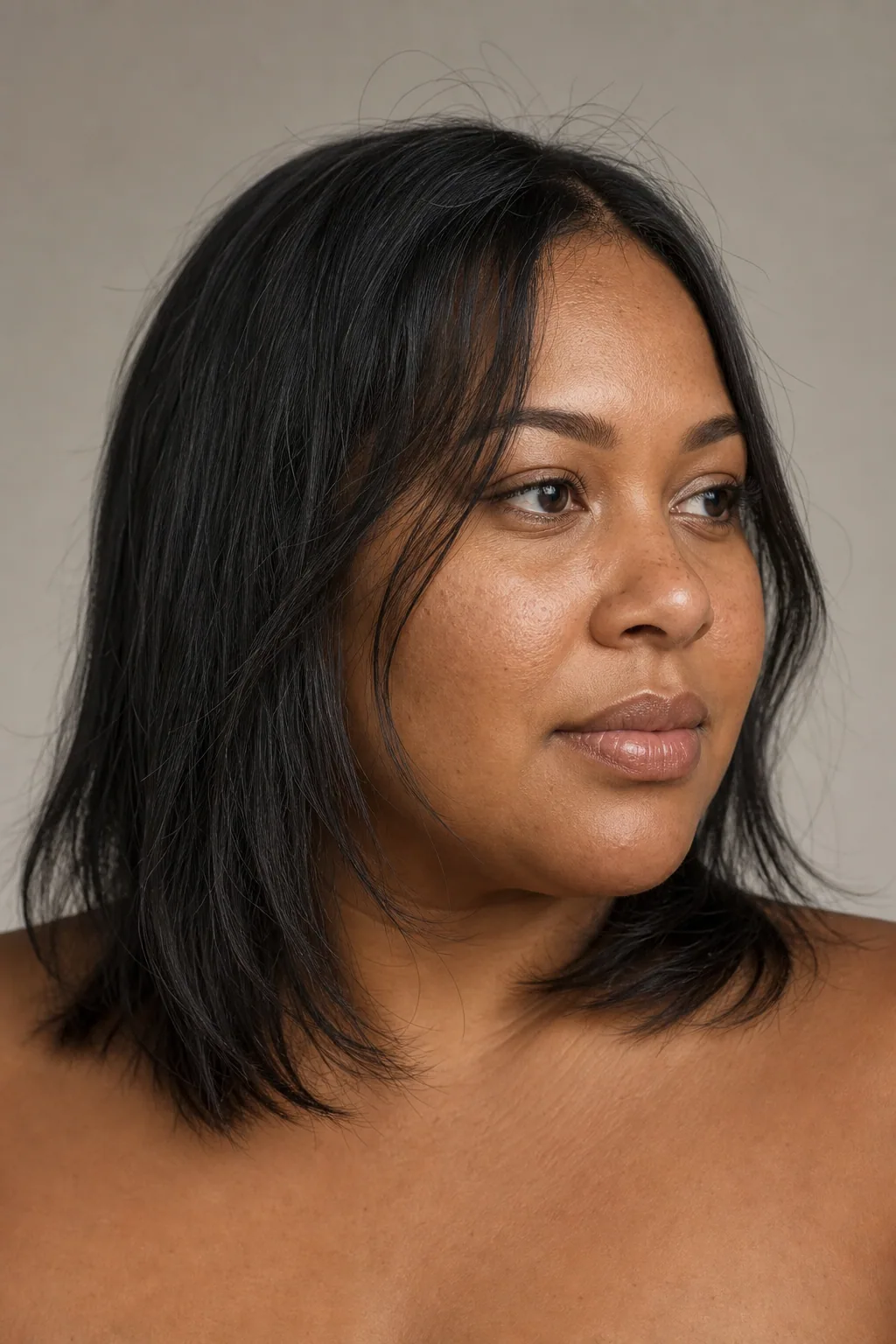
The single change that does the most for a round face on fine hair costs nothing: move the part. A deep side part pulls the whole shape off-center, which breaks up the roundness with a strong diagonal and makes the face read longer. But it does double duty — because the hair now has to travel up and over the part to fall, it lifts the roots at the crown, and crown height is exactly what fine hair lacks and a round face needs.
I set a lot of clients up with nothing more than a deeper part and point-cut face-framing and watch the face lengthen in the mirror. A center part on a round face does the reverse: it draws a straight line down the middle and reinforces the circle. If you take one thing from this page, take the part.
SB
— Simone Baptiste, Senior Stylist
Why round-face rules and fine-hair rules pull together, not apart
It's tempting to think slimming a round face and building fullness on fine hair are competing goals — one wants less width, the other wants more volume. They aren't, as long as you put the volume in the right place. A round face is softened by vertical lines and height at the crown while width at the cheeks and jaw is kept down; fine hair is rescued by root lift and a dense perimeter.
Both of those want volume up top and length below — not width out at the sides. So the cut that flatters a round face is usually the same cut that flatters fine hair: length past the chin, an off-center part, point-cut face-framing, and a lifted crown.
The one place they seem to argue is layering. A round face loves movement, but heavy or razored layers thin fine ends until they go transparent — so the layers have to be soft and point-cut over a strong bottom line, never chopped.
If you're unsure whether you're working with finer strands or genuinely lower density, our guide to telling fine hair from thin hair helps you and your stylist decide how blunt to keep the ends, and if the change has been fast rather than gradual, read fine hair or thinning first.
A heart-shaped face has the opposite proportion problem — width at the top rather than through the middle — and is covered in cuts for a heart-shaped face on fine hair. If your shape turns out to be balanced rather than full, none of this correction is needed and the cut should be chosen on density instead — see oval face shape hairstyles for fine hair.
Long & mid-length cuts that lengthen and slim
Length is the most direct way to slim a round face — hair that falls past the chin draws the eye down and stretches the proportions. On fine hair the trick is keeping that length dense at the ends and lifted at the roots, so it lengthens the face without hanging flat. These four are the lengtheners.
1
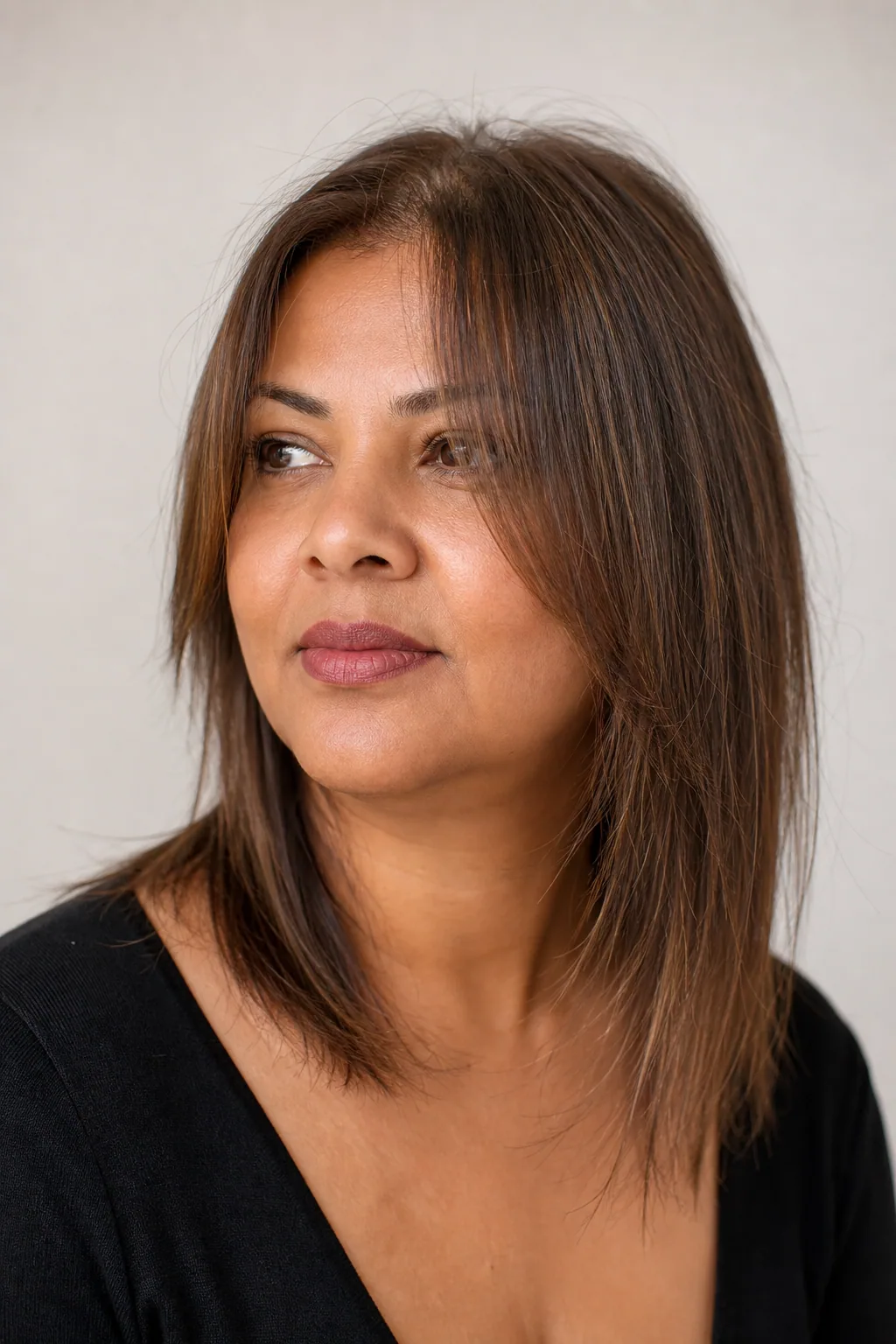
The long side-parted cut with face-framing
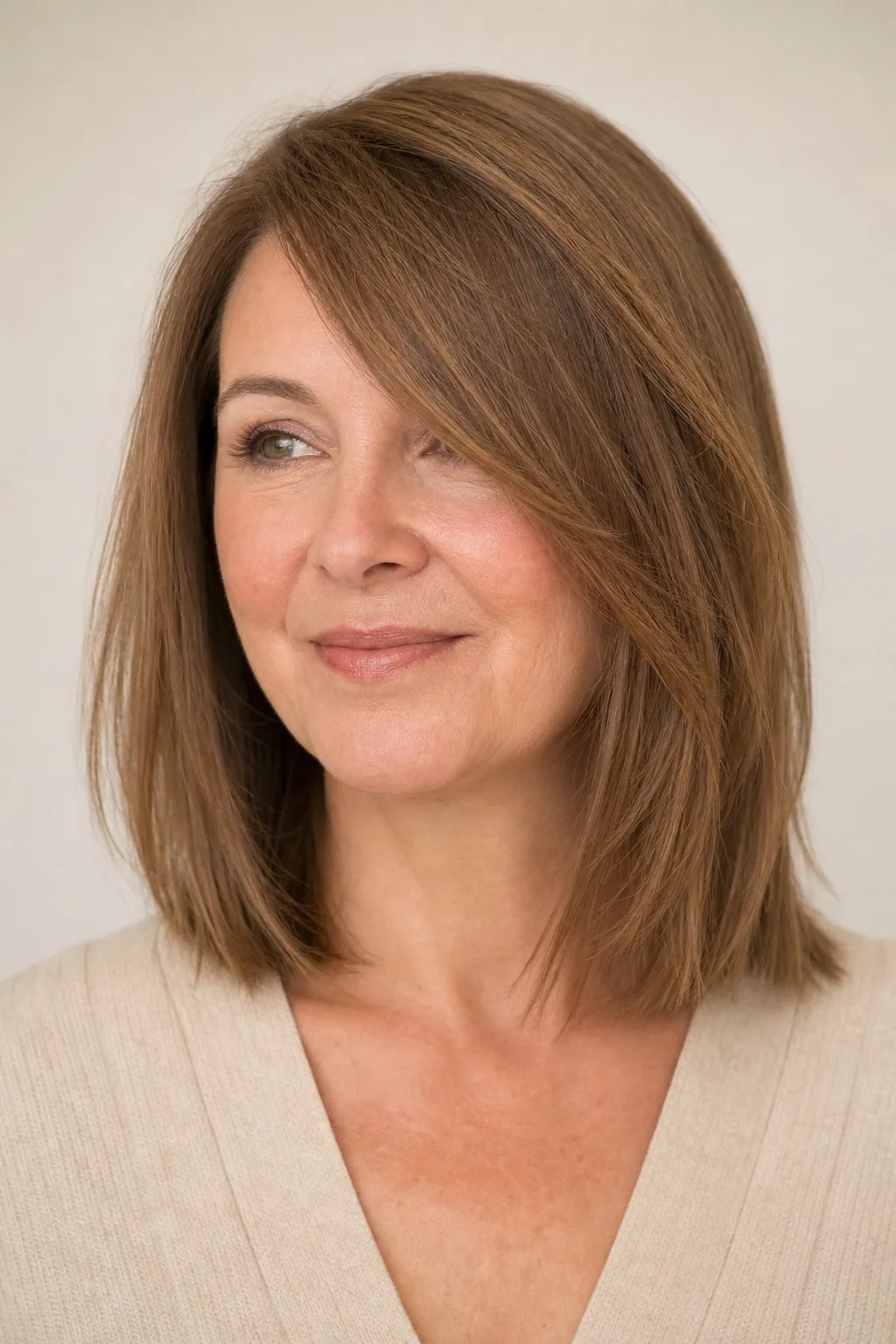
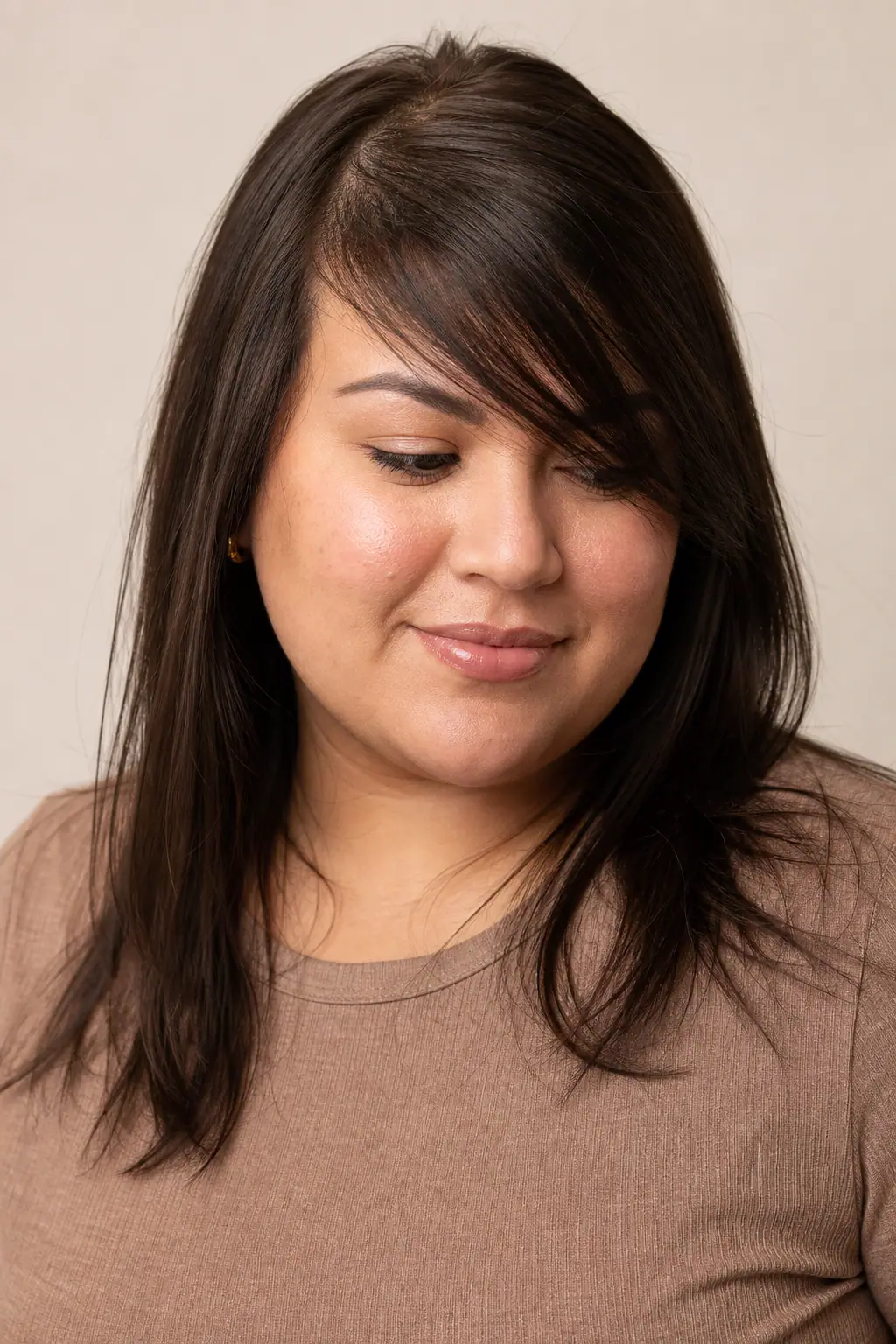
The most reliable lengthener for a round face: hair kept well past the collarbone, worn on a deep side part, with long layers that start at the jaw and fall to the ends. The vertical line of the length and the diagonal of the framing do the slimming, while a blunt-ish perimeter keeps fine ends dense. See more length ideas in our guide to long hairstyles for fine hair.
2
The cheekbone-start face-framing lob
Face-framing is the single most slimming detail for a round face, and where it starts is everything. Layers cut from the cheekbone down carve a long diagonal along the widest part of the face, narrowing it visually. On fine hair, ask for those pieces point-cut so they stay soft and don't thin out — "frame from my cheekbones, keep the ends dense."
3
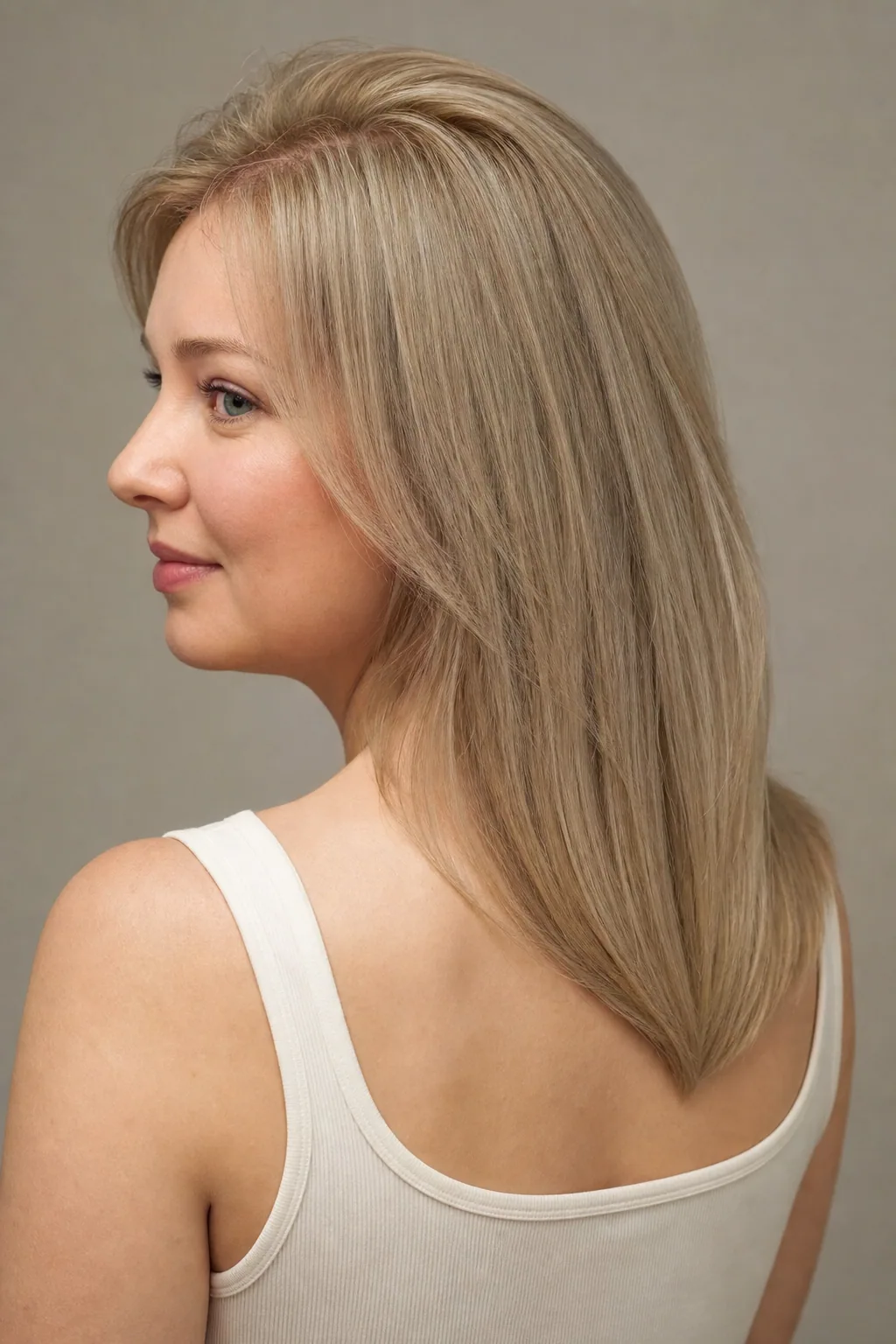
The soft V-length cut
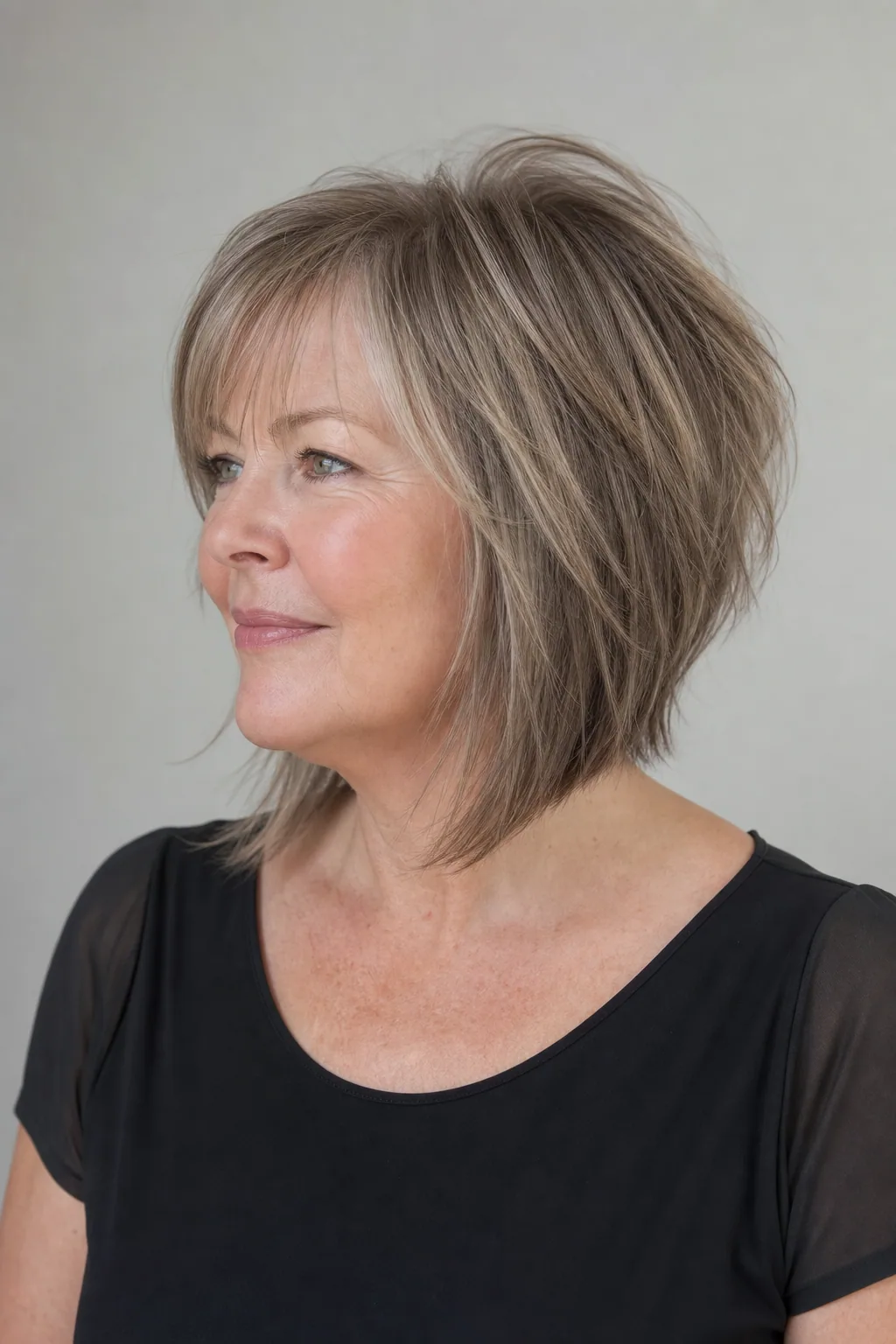
A mid-length cut finished in a gentle V rather than a straight blunt line pulls the eye to a point below the chin, adding vertical pull that a round face benefits from. Keep the V subtle so the ends still read dense — a hard, whittled point thins fine hair. Pair it with a lifted crown so the shape has height up top and length down the middle.
4
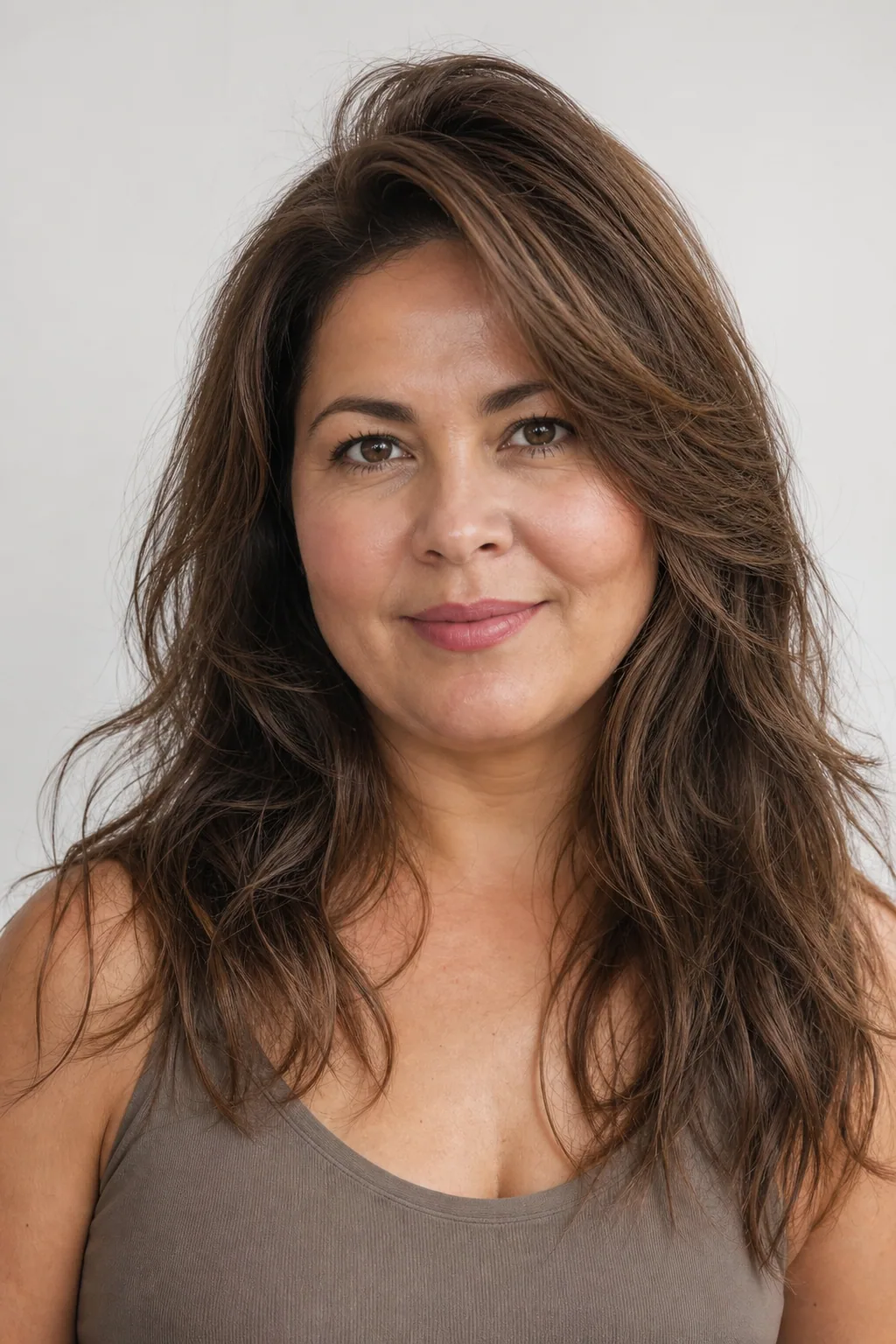
The crown-lifted long layers
Long layers are flattering on a round face only if the volume sits high — height at the crown lengthens the face, but movement out at the cheeks widens it. Ask your stylist to keep the layers long and the lift concentrated at the top of the head, then style with a round brush or velcro rollers at the crown. It's the difference between long hair that slims and long hair that rounds.
Bobs & lobs cut to slim, not widen
A round face and a bob can absolutely work — but length and part decide it. The rule is simple: keep it below the jaw, never at the chin, and break the symmetry with a side part or an angle. These four are shaped to slim rather than widen.
5
The below-the-jaw lob
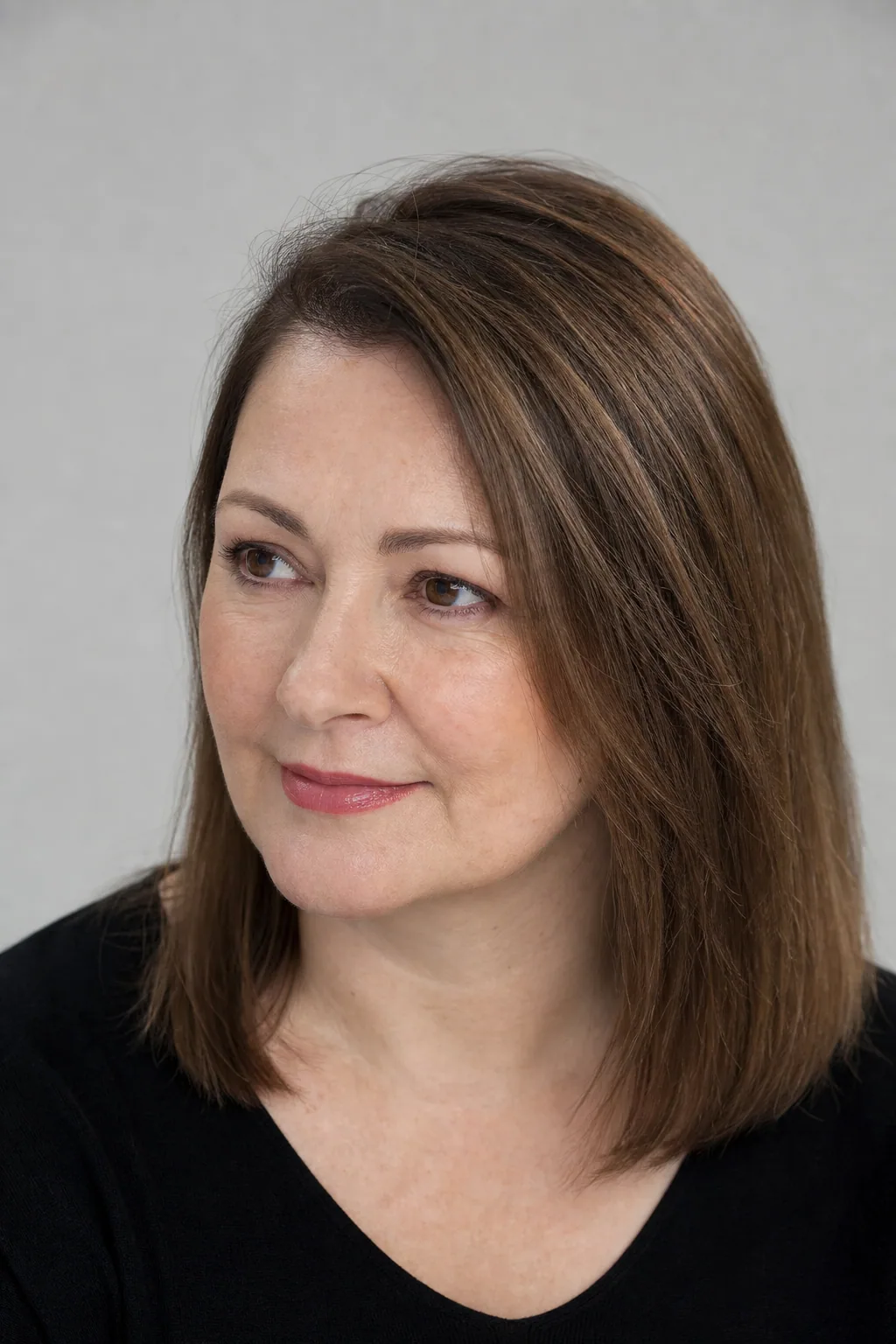
The safest bob-family choice for a round face: a lob kept at or below the collarbone, well clear of the chin, on a deep side part. The extra length past the jaw pulls the eye down and avoids piling width at the cheeks, while a strong perimeter keeps fine hair dense. Ask for it "collarbone length, side part, soft internal layers — not a blunt chin bob."
6
The angled A-line bob
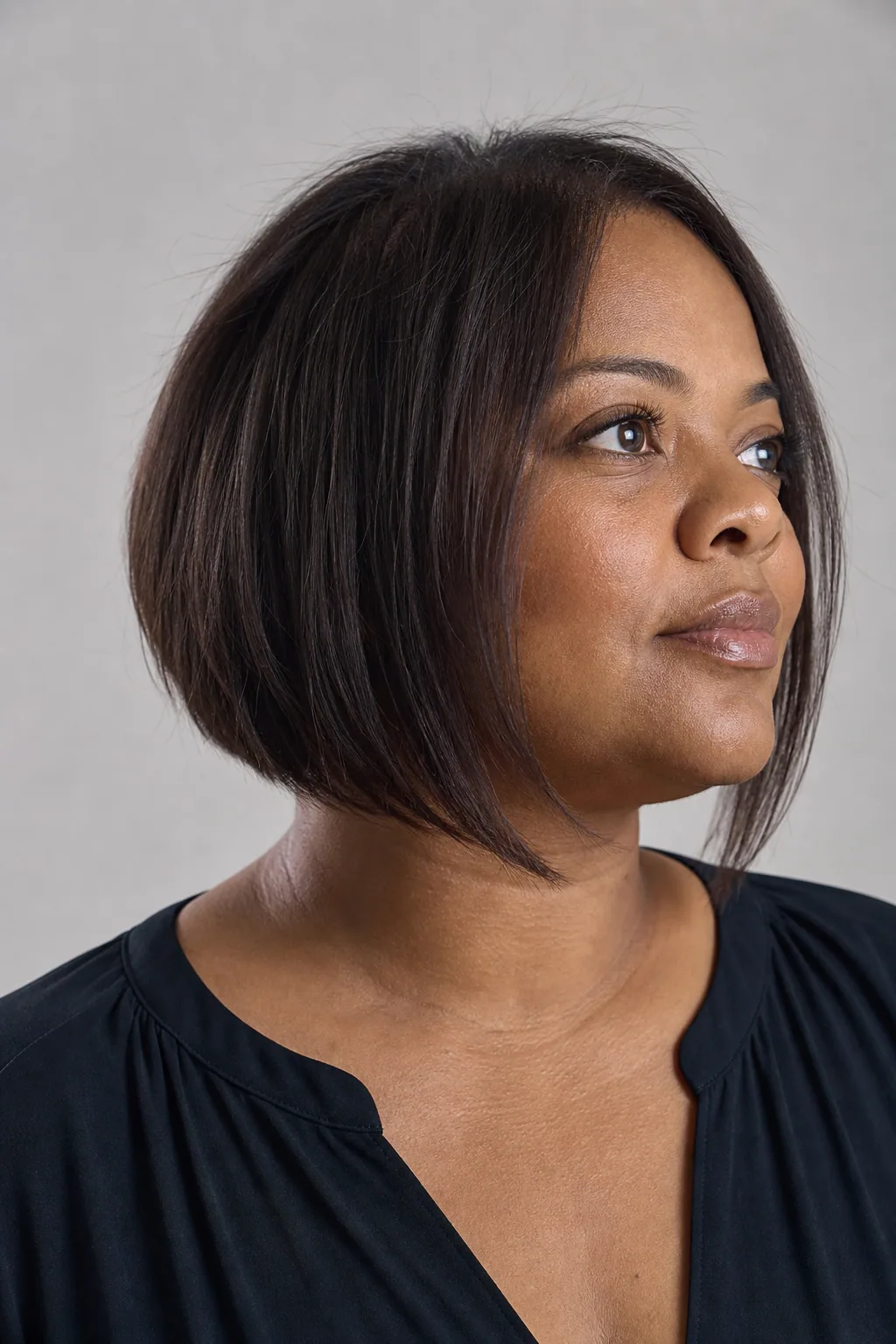
An A-line bob that's shorter at the back and longer at the front sends two long vertical lines down past the jaw on either side of the face — exactly the diagonal a round face wants. Those front lengths skim the cheeks and narrow them. It's the one bob shape that slims rather than rounds, and it keeps density in the forward pieces where fine hair shows most.
7
The chin-length blunt bob — and how to fix it
The one to be careful with. A one-length blunt bob that stops right at the chin ends at the widest part of a round face and adds width exactly where you don't want it. If you love the crispness of a blunt bob, drop the length below the jaw, add a deep side part, and let a few face-framing pieces fall longer — small changes that turn a widening shape into a slimming one.
8
The layered lob with a lifted back
A little graduation at the back builds rounded height at the crown while the front stays long and face-framing — height up top plus length at the sides, which is the round-face formula in a single cut. It's the same back-volume principle as a layered bob, kept long enough to clear the jaw. Ideal if your crown goes flat by afternoon and your face reads full.
Pixies & short cuts with height on top
Short doesn't mean off-limits for a round face — it means all the height goes on top and the sides stay close. A rounded, puffy short cut mirrors the face; a cut with lift at the crown and tapered sides lengthens it. Fine hair suits these well, because short hair carries its own root lift.
9
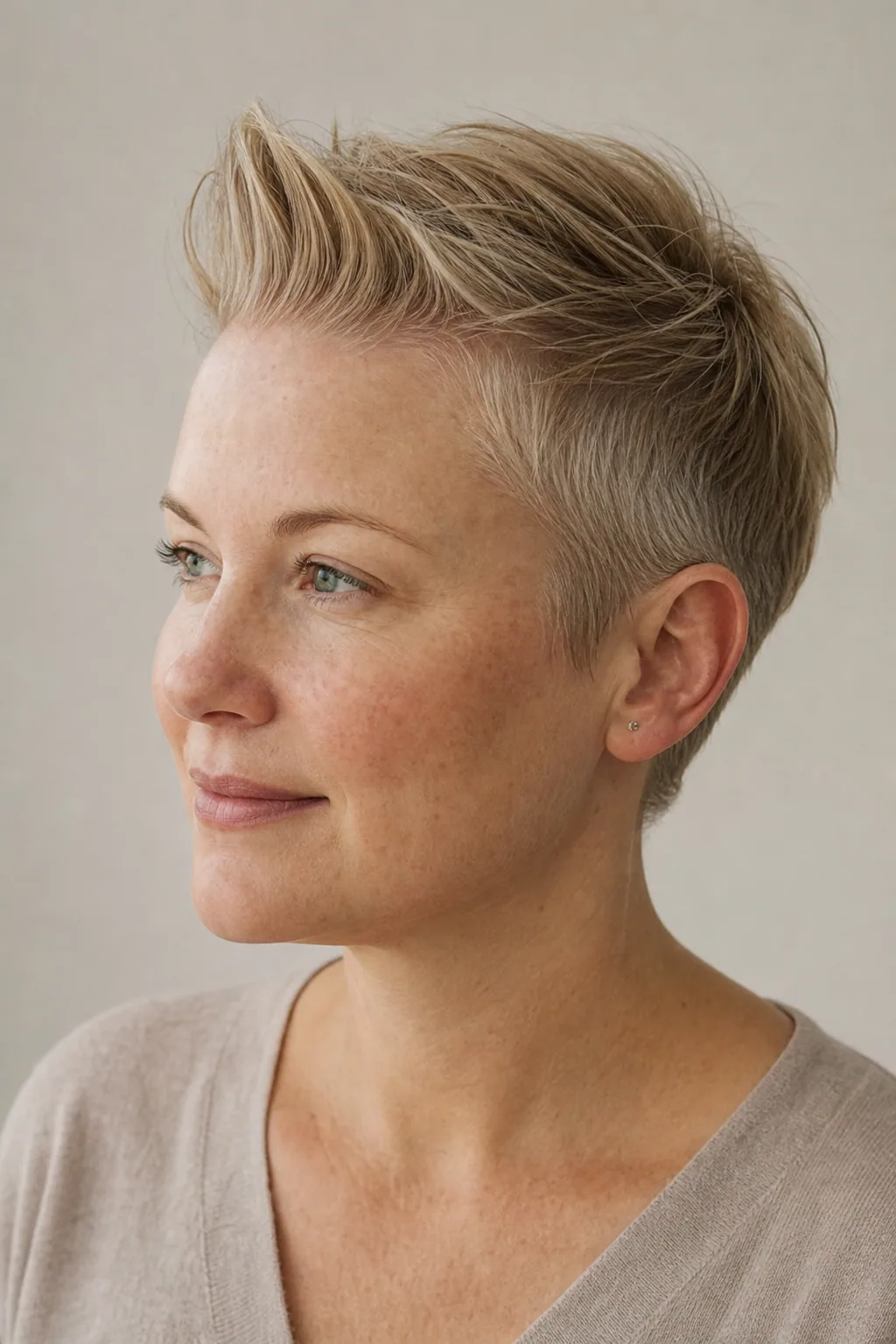
The high-top textured pixie
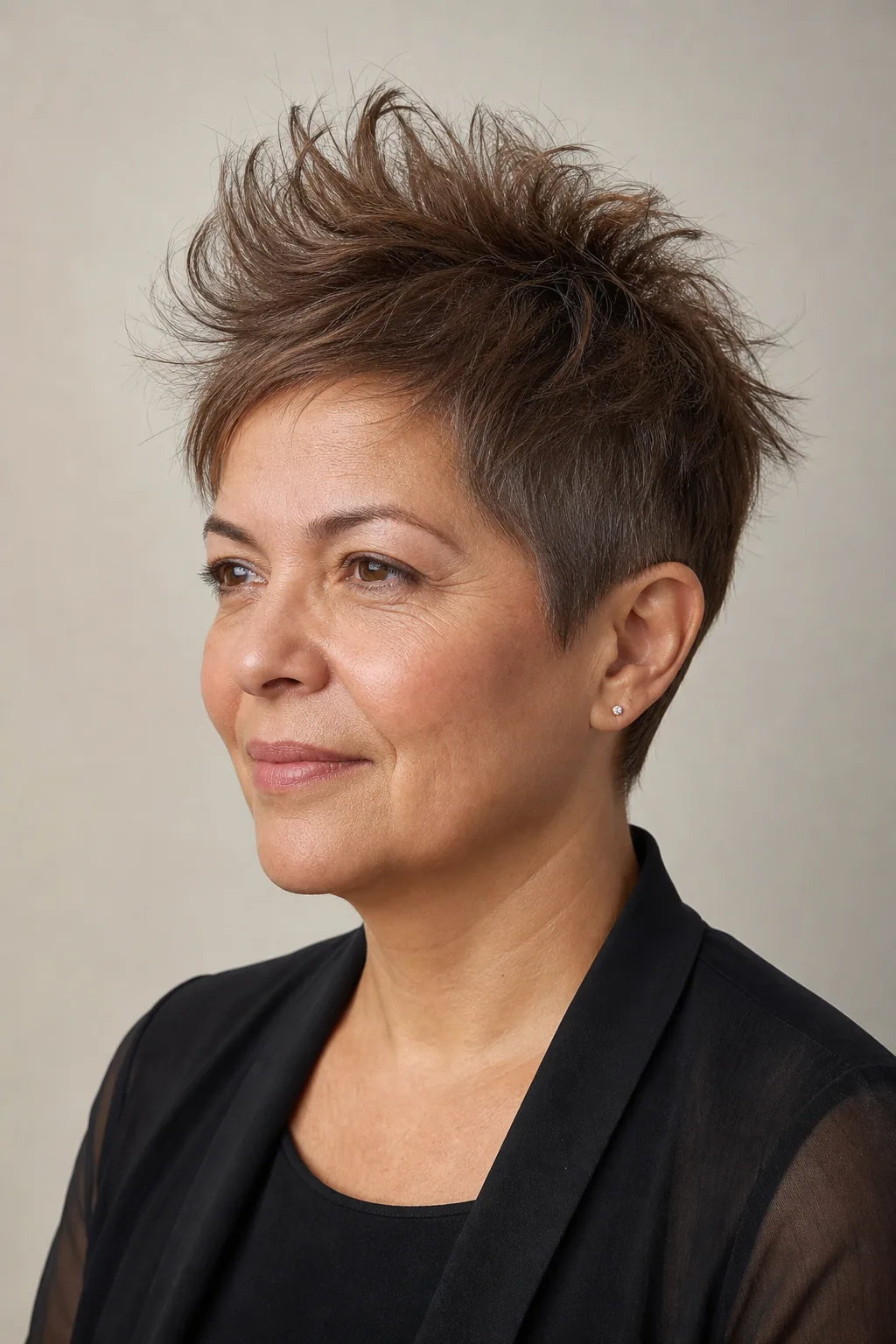
A pixie built for a round face keeps length and lift on top and through the crown, tapered short at the sides and nape. That vertical height stretches the face while the close sides keep width down — the exact opposite of a rounded, ear-length puff. Style the top up and back; fine hair takes to this because short lengths hold root lift with almost no product.
10
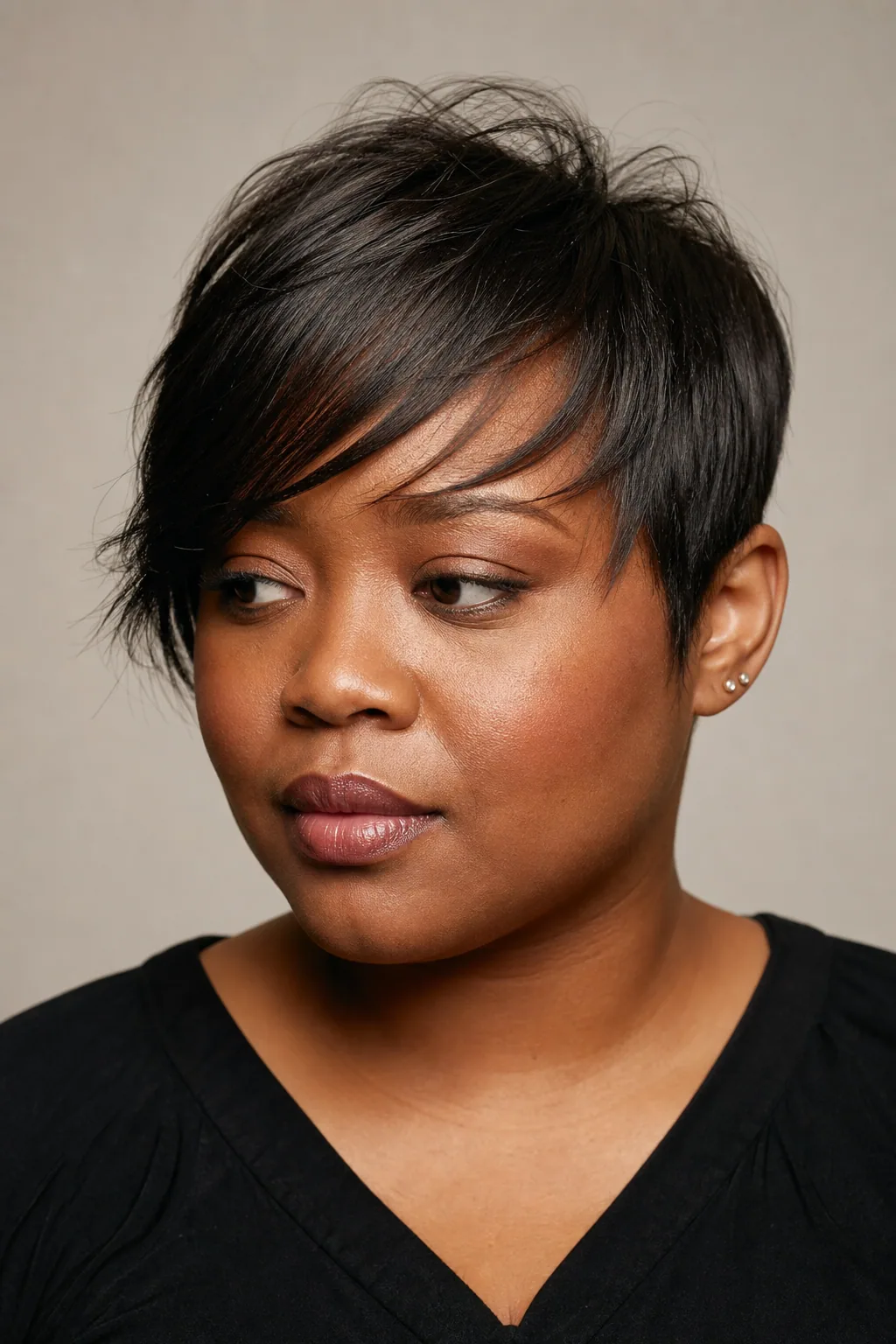
The long pixie with a side-swept fringe
A longer pixie with a fringe swept hard to one side draws a diagonal line across the forehead and down toward the cheek, cutting the roundness with an angle. It's softer and more grown-out than a cropped pixie, and the sweep gives you a slimming line without any length at the sides. A good bridge if you want short but not severe.
11
The lifted-front short crop
Height at the front hairline — a soft quiff or a lifted forward piece — adds vertical lift right where a round face reads shortest, top to bottom. Keep the sides tapered so nothing balances that height out sideways. Ask for "length left at the front to lift up and back," and use a touch of root lifter at the hairline to hold it on fine hair.
12
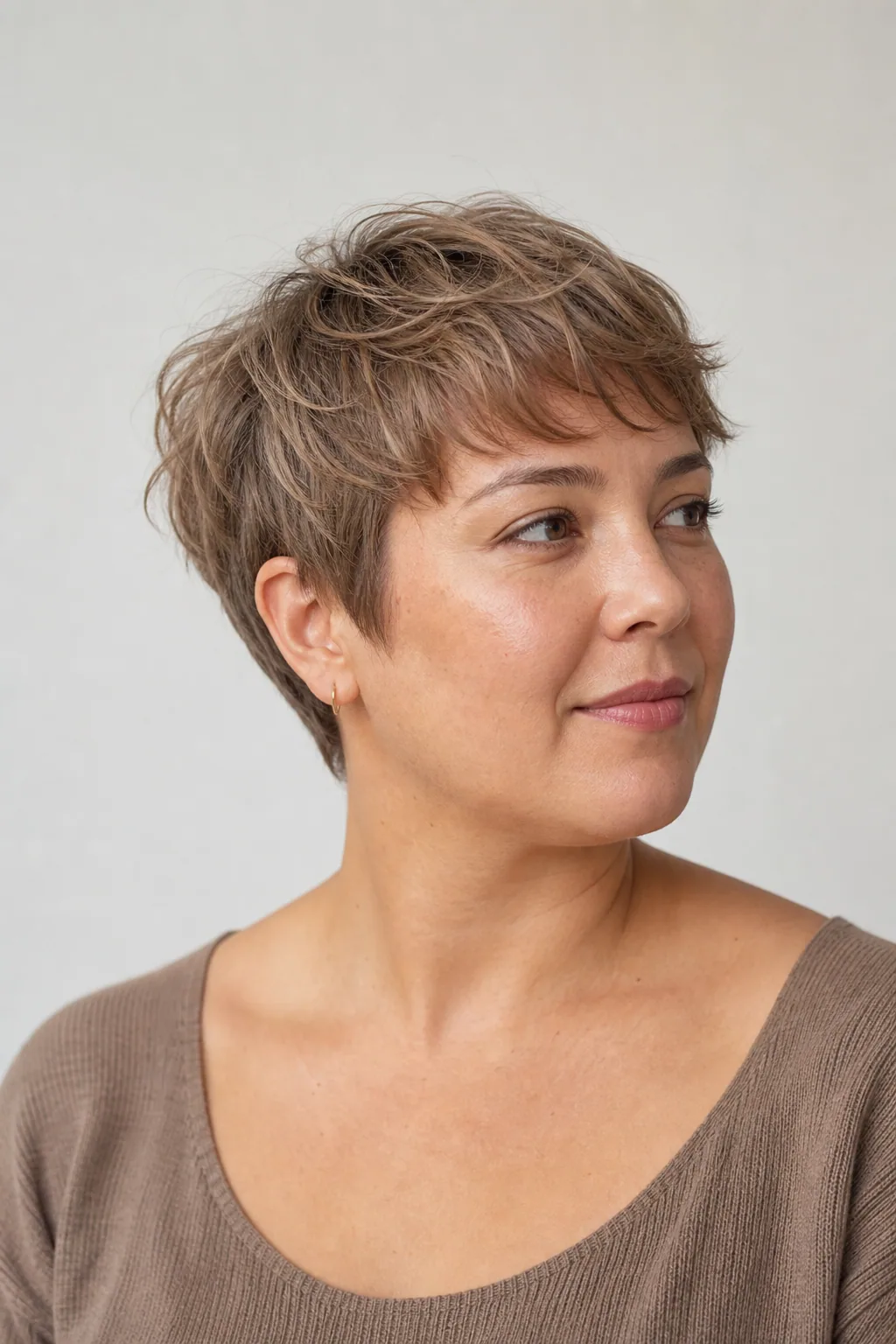
The piecey short cut with close sides
Short, piecey texture on top and close-cropped sides gives you height and separation without adding a scrap of width — the texture itself reads as fullness on fine hair, so you get volume up top and a slim silhouette at the same time. Keep it lived-in and finger-styled. It's the low-effort short option for a round face that still slims.
Bangs & parting tricks for a round face
Fringes and parts are the fastest way to reshape a round face without changing your length. The rule for both: go diagonal, not horizontal. Side-swept and curtain fringes create long lines down the face; off-center parts break the circle. These four add slimming lines and, done softly, fullness at the front.
13
The long curtain bangs
The most flattering fringe for a round face on fine hair. Soft curtain bangs part in the middle and sweep out along the cheekbones, laying two long diagonals down the sides of the face that slim and lengthen it. They add a cushion of fullness at the front without a hard line, and they grow out cleanly. Ask for them point-cut and long enough to blend into your face-framing.
14
The long side-swept fringe
A longer fringe swept across the forehead on a deep side part creates one strong diagonal — the most direct line you can draw against a round face. It's low-maintenance, blends into the length, and never cuts a hard horizontal across the face the way a blunt fringe does. A good first fringe if you've never had one and aren't sure it'll suit you.
15
The deep side part for height and asymmetry
Not a cut so much as the setting that makes every cut here work. A deep side part throws the shape off-center, breaking the roundness with a diagonal, and lifts the roots at the crown as the hair travels over the part. It's the cheapest slimming and volume trick there is on fine hair — more on getting height that lasts in our guide to adding volume to fine hair.
16
The blunt straight-across fringe — the one to skip
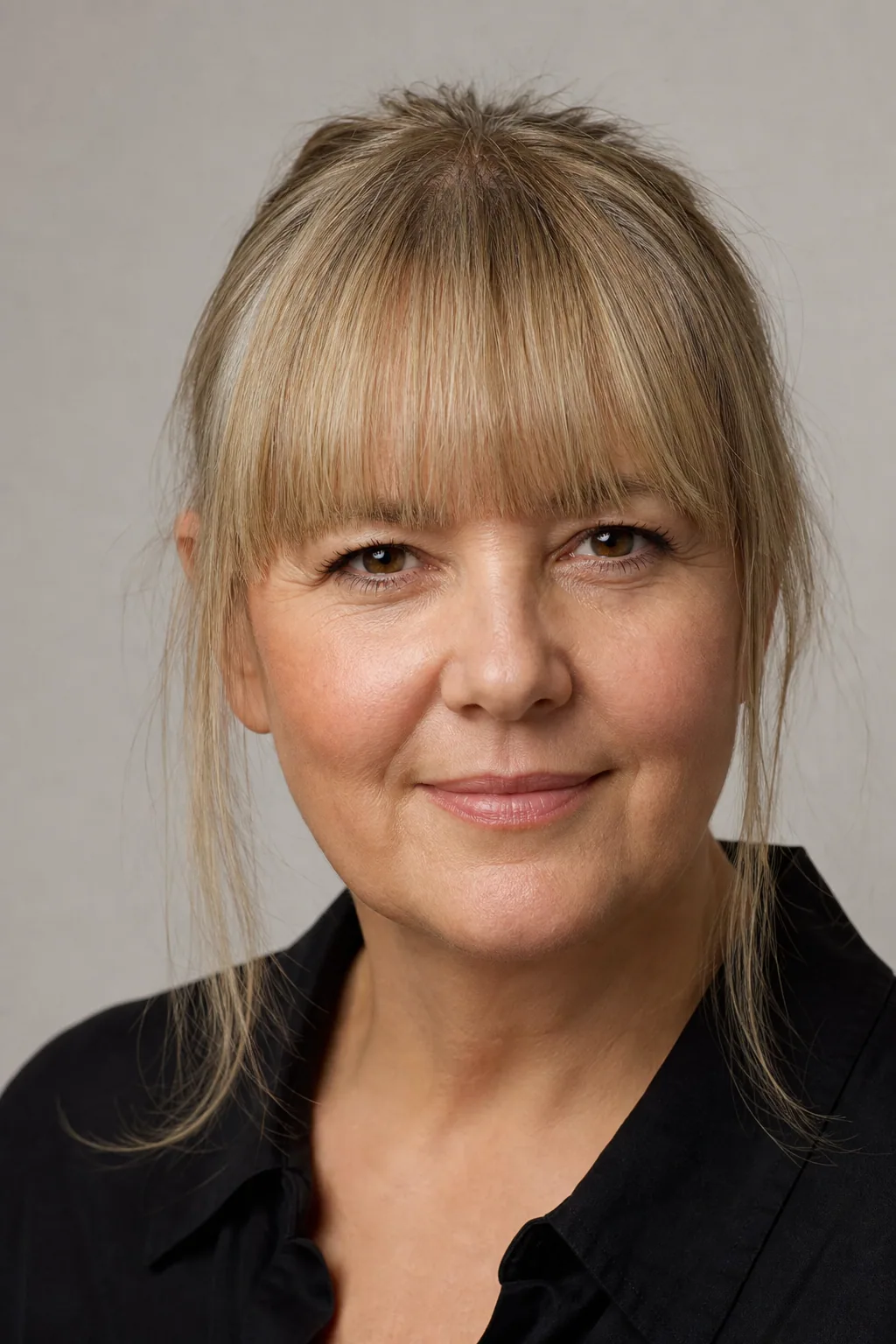
Worth including so you know what to avoid. A heavy, straight-across blunt fringe draws a hard horizontal line across the face, which widens a round shape, and it borrows density a fine top can't spare, so it often looks sparse. If you want a full fringe, ask for it soft, point-cut, and slightly parted or sweeping — anything that turns the line from horizontal to diagonal.
Chubby face haircuts for thin hair: shape and fullness are two different problems
A large share of the people who land here searched chubby face haircuts for thin hair, so it is worth saying plainly what the search results almost never separate: a round face is a proportion — width and length close to equal, with soft corners — and a full face is a volume, which is about softness through the cheeks and under the jaw.
They overlap often enough that the same advice gets sold for both, but they are not the same problem, and the cut that fixes one can make the other worse.
The difference is where the cut has to work. A round proportion is corrected vertically: you want length running past the jaw, height at the crown, and an off-centre part, so the eye travels up and down instead of side to side.
Fullness is corrected at one specific line — the jaw and the space just under it — which is why a chin-length blunt bob is the classic mistake here. It lands a hard horizontal edge across the widest, softest part of the face and points straight at it. Nothing about that cut is wrong on a round face with a defined jaw; it is wrong on a full one.
You can have either without the other. A long, oval face can carry real fullness under the jaw, and a round face can have a sharp jawline.
So work out which one you are actually solving for before you pick from the sixteen cuts above — and if it is both, the cuts in the long and mid-length section do the most work, because vertical length and a lifted crown answer the proportion while length past the jaw answers the fullness.
If a soft jawline or a double chin is the main thing
Four adjustments, in order of how much they do. Keep the perimeter below the jaw — not at it. Anything that stops exactly at the jawline draws a line across the fullest point; length that falls past it, even by an inch, softens the edge instead of marking it. Angle the face-framing inward so the front pieces travel toward the neck rather than flicking out; that reads as a taper.
Put the height at the crown, because balance is a ratio — volume up top makes everything below it read narrower without a single change to the length. And avoid the chin-length blunt bob and the tight, flat, tucked-behind-both-ears finish: the first draws the line and the second removes every bit of softening on the way to it.
One honest caveat, because it is the kind this site exists to give: none of this is a fix for how much hair you have. It is a set of choices about where the eye goes. If low density at the crown is what makes the crown height hard to build, that is a different job — start with haircuts for a thinning crown and root volume on fine hair, then come back to the shape.
Styling that slims: height up top, length down the middle
The cut sets you up, but a few habits keep a round face slim and fine hair full all day. Build the volume at the crown, not the sides: on damp hair, work a light root lifter or mousse into the roots at the top of the head, then blow-dry with your head tipped forward, or set the crown on a couple of velcro rollers while you get ready.
Keep conditioner and any oils strictly on the mid-lengths and ends so the roots stay lifted — a flat crown rounds the face as much as any bad cut. When you style your length, aim the volume up and back rather than out at the cheeks, and let your face-framing fall in clean diagonals.
Skip heavy creams and silicone serums that flatten fine hair and drag the crown down. A deep side part props up the height and adds the off-center line for free, and a light mist of dry shampoo at the roots revives the lift by afternoon without a wash. For more height that actually lasts on fine hair, the gentle tricks in our volume guide each take under a minute.
Chair-side note
Clients with a round face often come in asking for a chin-length blunt bob because they've seen it look sharp on someone else — and I gently talk most of them out of the length, not the bob. Here's the mechanics: a blunt line that lands at the chin sits at the widest, fullest part of a round face, so the eye reads the face at its broadest and the ends look like they're framing width instead of cutting it.
Drop that same bob two inches — below the jaw — add a side part, and let a couple of front pieces fall longer, and suddenly the shape lengthens the face instead of rounding it. The cut barely changed. The length and the part did all the work. If you adore a blunt bob, you can keep it; just keep it long enough to clear your jaw.
SB
— Simone Baptiste, Senior Stylist
What to ask your stylist
Bring the mechanics, not just a photo — a round face on fine hair needs the stylist to solve two things at once, so name both. Say: "I have a round, fuller face and fine hair, and I want a cut that lengthens and slims my face while keeping the ends looking dense. Please keep the length below my jaw, cut long point-cut face-framing layers starting around my cheekbones, build a little height at my crown, and set me up on a deep side part — not a chin-length blunt bob or a straight-across fringe."
If a double chin is your main concern, add: "Keep length past my jaw and angle the front pieces in toward my neck." Those constraints are what turn a generic cut into one that flatters both your face shape and your hair.
When these round-face rules bend
Your density is very low and the scalp shows clearly through the length. Prioritize coverage over slimming lines — a shorter cut with root lift gives more fullness, and you can still slim with a side part and height on top. Coverage comes first; slimming lines come second.
You love a bob and don't want to grow it out. You can absolutely keep it — just keep it below the chin with a deep side part and a few longer front pieces, rather than a one-length blunt line at the jaw.
A double chin is your main concern. Favor length past the jaw and lifted crown volume over a chin-length cut; hair that stops at the jaw draws a line across the fullest point instead of past it.
The change in your hair has been fast or patchy, not gradual. A flattering cut helps the look, but check the cause first — read our honest guide to fine hair or thinning and speak to your doctor.
FAQ
The best all-rounder is a cut that falls below the chin with soft, point-cut face-framing layers, a deep or off-center part, and a little lift built into the crown. That combination does two jobs at once: the length and the vertical framing lengthen and slim a round or fuller face, while the blunt-ish perimeter and root lift keep fine hair from going flat and stringy. In practice that means a collarbone lob, a below-the-jaw layered cut, or a longer style with curtain bangs — not a chin-length blunt bob, which stops at the widest part of a round face and adds width exactly where you don't want it. Ask your stylist to keep the weight vertical and the ends dense.
Yes, as long as they're the right kind. Curtain bangs and long side-swept fringes are the most flattering choice for a round face on fine hair, because they part in the middle or sweep to the side and create long diagonal lines down the cheeks — that verticality slims the face. Skip a heavy, straight-across blunt fringe: it draws a hard horizontal line across the face, emphasizes width, and borrows density a fine top can't spare. Keep any fringe soft and point-cut so it stays feathery rather than solid, and long enough to blend into face-framing pieces.
A bob can look great on a round face with thin hair — but the length and the shape matter more than usual. Avoid a chin-length, one-length blunt bob: it ends at the widest point of a round face and reads as extra width. Instead, keep the bob below the jaw (a lob or an angled bob that's longer at the front), add a deep side part, and ask for soft internal layers rather than a solid helmet. Those tweaks pull the eye downward and keep the density fine hair needs at the ends while still slimming the face.
Any cut that adds vertical lines and height and reduces width at the cheeks and jaw makes a round face look slimmer. The levers are: length that falls past the chin, height or volume at the crown, an off-center or deep side part, and face-framing layers that create long diagonals beside the face. On fine hair you get that height from root lift and point-cut layers rather than heavy thinning. What to avoid is the opposite set: chin-length blunt bobs, one-length curtain-of-hair styles with a flat crown, straight-across blunt bangs, and volume that sits out at the cheeks instead of up at the roots.
A pixie can be very flattering on a round face with fine hair, but it has to have height on top and be kept close at the sides. The mistake is a rounded, uniformly short cut that puffs out at the ears — that mirrors and widens a round face. Ask for length and lift left on top and through the crown, tapered short at the sides and nape, and a longer, side-swept fringe for a diagonal line. Built that way, a pixie adds vertical height, slims the face, and actually suits fine hair well because short hair carries its own root lift.
Keep length below the jaw and add height up top rather than cutting short and blunt at the chin. Hair that stops right at the jawline draws a horizontal line across the widest, fullest part and calls attention to a double chin; length that falls past it, plus long face-framing layers that angle in toward the neck, softens and disguises it. Height at the crown also helps by rebalancing the proportions and drawing the eye up. On fine hair, get that height from root lift and a deep part, not from teasing that thins the ends — and skip chin-length blunt bobs and straight-across fringes.
Length past the jaw, height at the crown, and an off-centre part — in that order. Those three do most of the work, because a fuller face is balanced by a vertical line and a lifted top, not by hiding anything. The cuts that deliver all three on fine hair are the long side-parted cut with face-framing, the below-the-jaw lob, and the long pixie with a side-swept fringe. Two to be careful with: the chin-length blunt bob, which lands a hard horizontal edge across the widest part of the face, and a blunt straight-across fringe, which shortens the face and widens it at the same time. And separate the two questions before you book — a round proportion and a full face are not the same thing, and only the first is really about face shape.
Eleven years behind the chair, specializing in short shapes and fine-hair texture. Simone believes the best haircut is the one you can style yourself in ten minutes.
Results vary with hair type, density, and growth patterns. This guide is educational and not a substitute for an in-person consultation with a licensed stylist.
Hairstyle images in this guide are AI-generated illustrations, not photos of real clients or results. See our image policy.
Get the good hair intel
One honest, stylist-written guide in your inbox each week. No hype.

 SB
SB