Two facts sit either side of this question, and almost nobody prints both. The first is that most women with PCOS never lose scalp hair at all — DermNet puts it flatly: "the majority of women with PCOS do not experience hair loss", and the largest recent count found it in "91 (20.3%)" of 447 patients.
The second is that thinning hair, on its own, is poor evidence of PCOS: the 2023 international guideline asks clinicians to "recognize that female pattern hair loss and acne in isolation (without hirsutism) are relatively weak predictors of biochemical hyperandrogenism." Put together, those two sentences dismantle the most common version of this worry — hair fell out, therefore PCOS — while leaving the real version standing: for the minority whose follicles are androgen-sensitive, PCOS is a genuine, treatable driver of pattern thinning, and on fine hair it becomes visible far earlier than it would on anyone else.
Below: why chin hair and a widening part come from the same hormone, what your hair is and isn't evidence for, and what actually moves the needle, ranked honestly and with the timelines attached.
Reviewed by a board-certified dermatologist. This page is educational and does not replace assessment by your own doctor.
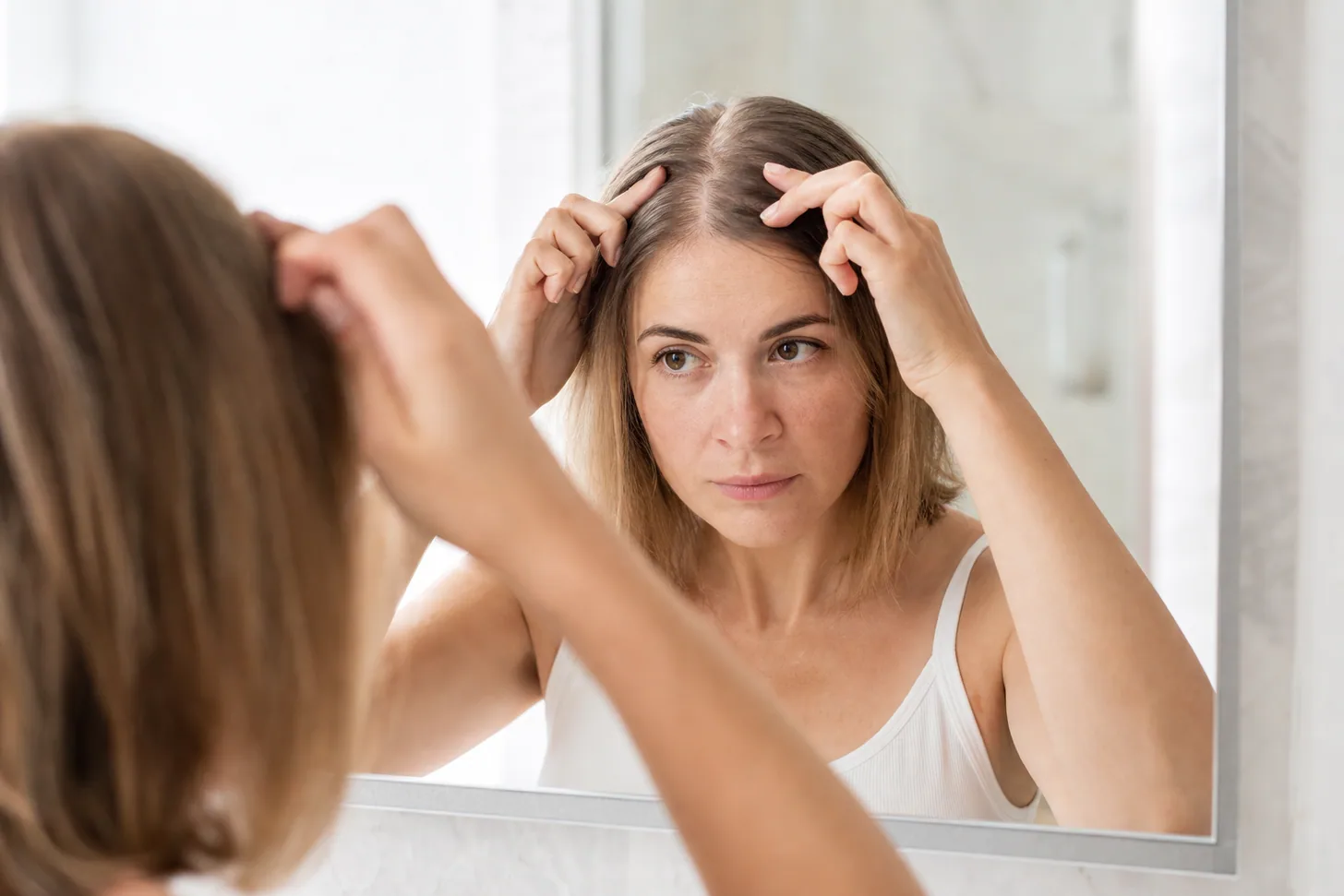
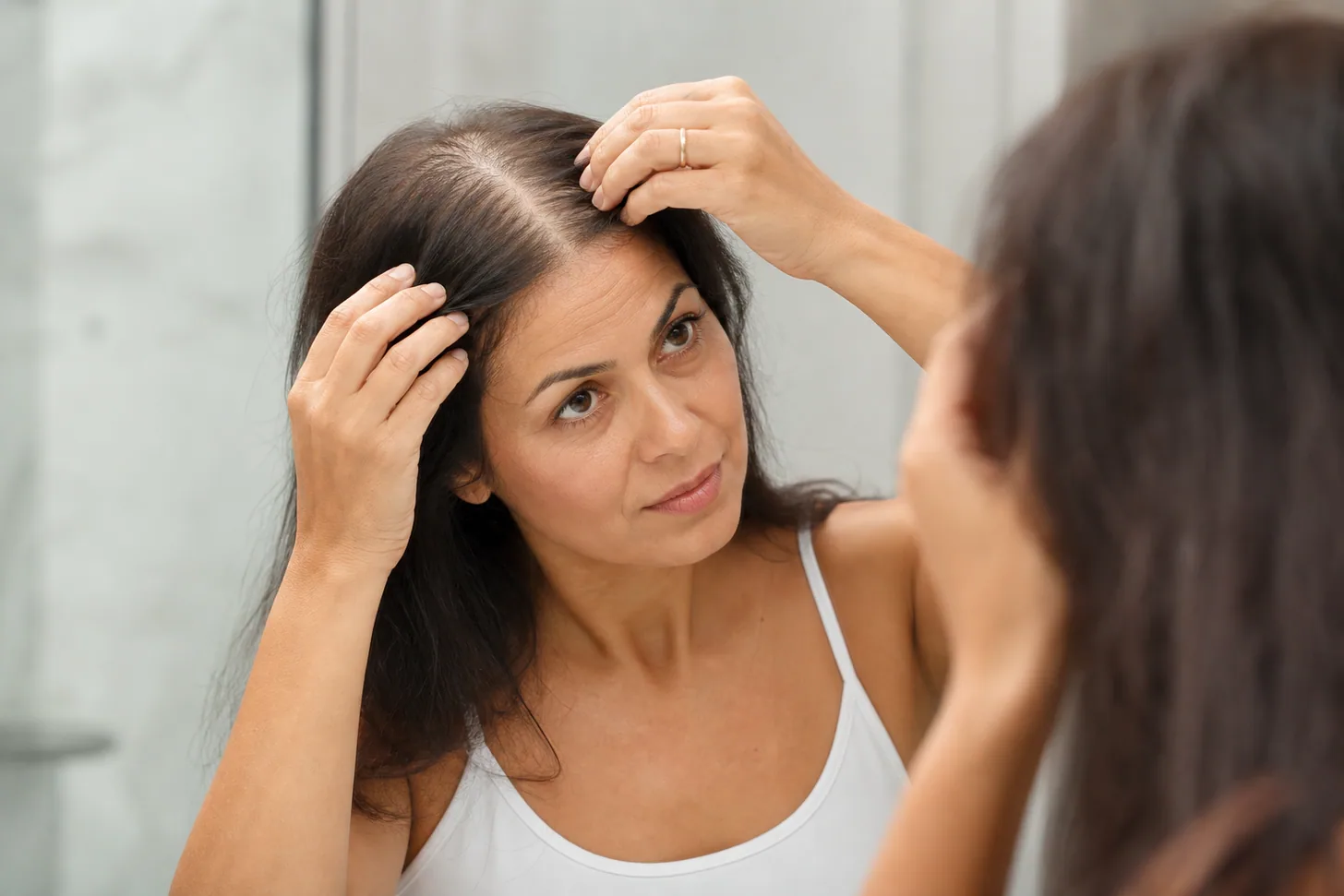
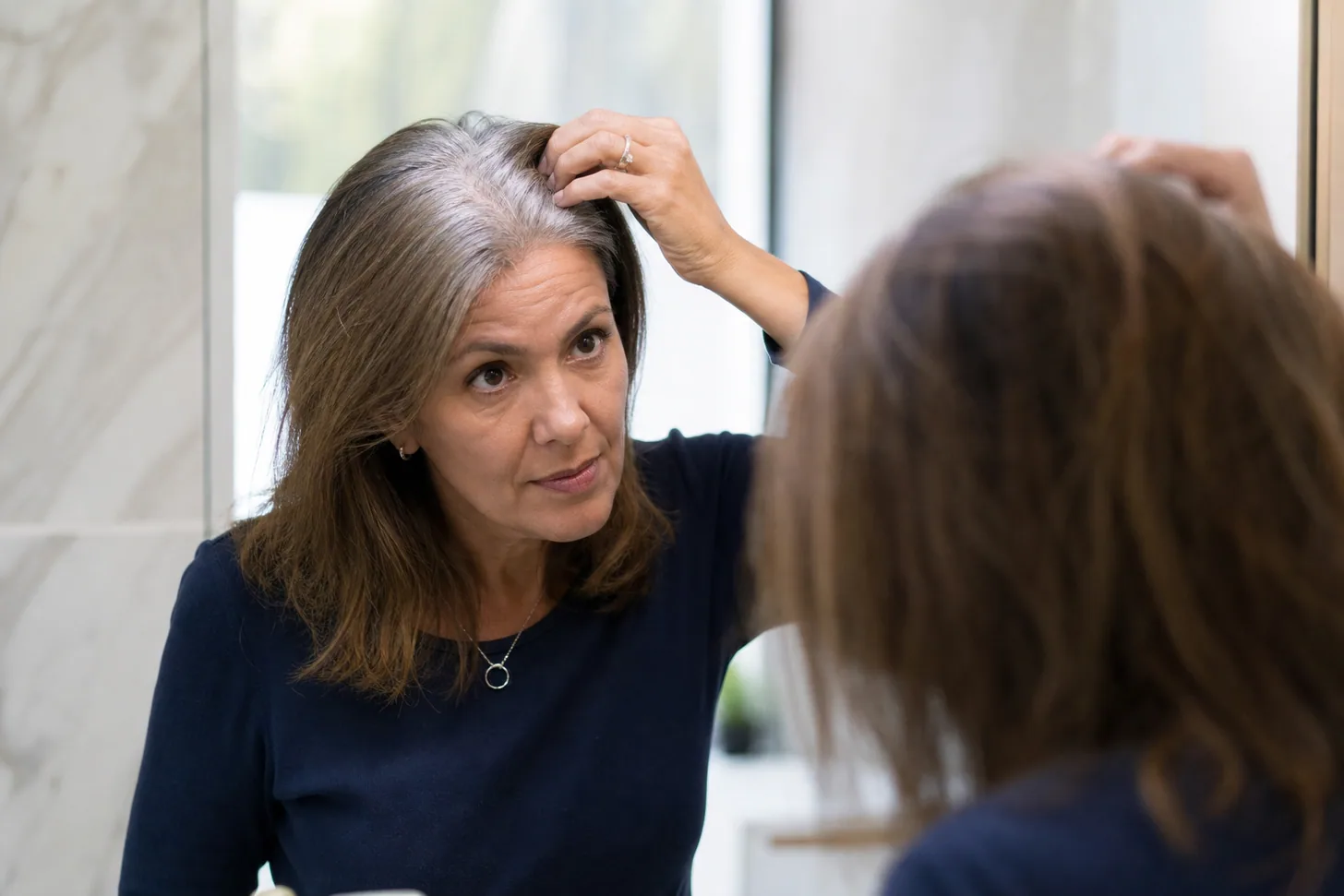
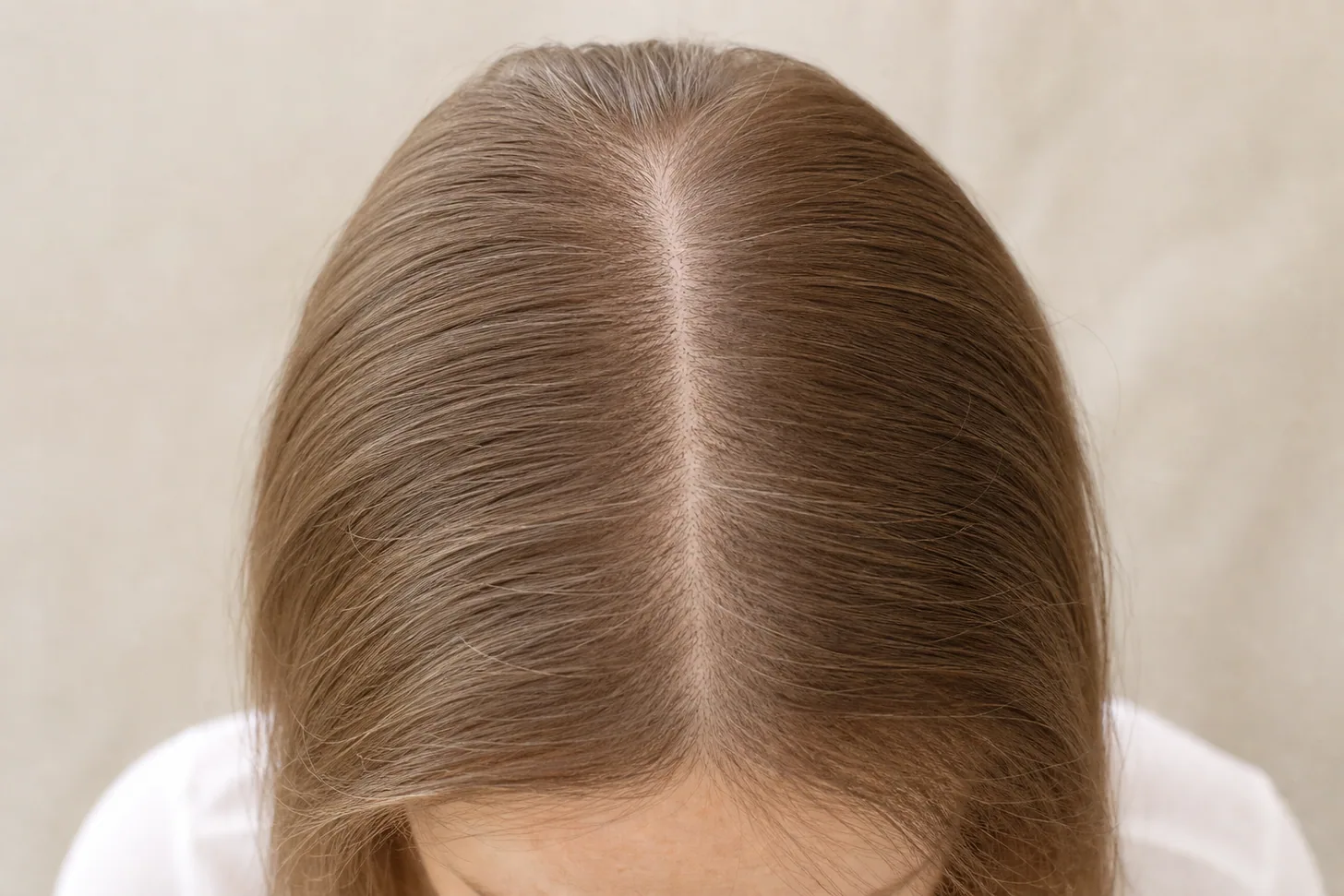
The part, photographed in the same light every few months, is the measurement that settles this — not the drain.
Your hair is not a PCOS test, and PCOS is not a hair diagnosis
Both mistakes are made constantly, in opposite directions, and both cause real harm.
The first mistake is reading hair loss as a PCOS result. A widening part sends a lot of women down a diagnostic path they don't belong on, because pattern thinning is common and mostly not hormonal in the PCOS sense.
The second mistake is reading a PCOS diagnosis as a hair sentence. Plenty of women are told they have PCOS and immediately start watching the shower drain, waiting for something that, for four out of five of them, is not coming. In the Cureus review of 447 patients, androgenic alopecia was the least common of the three visible signs: "91 (20.3%)" against hirsutism at "212 (47.3%)" and acne at "182 (40.6%)".
What survives both corrections is the honest middle: if you have PCOS and androgen-sensitive scalp follicles, you have a real, identifiable, partly treatable cause of thinning — which is more than most women with pattern loss get. The rest of this page is written for that reader, and for the reader still trying to work out whether she is one.
Chin hair and a widening part are the same hormone, read differently
This is the part that makes PCOS thinning feel like a cruel joke, and it has a clean biological explanation. Androgens don't have one instruction for hair. They have a different instruction depending on where the follicle sits.
Researchers have a name for this contradiction — the hair follicle has been described in the endocrinology literature as a paradoxical androgen target organ — and it matters practically for two reasons. It explains why the two symptoms travel together often enough that clinicians look for one when they see the other. And it explains why anything that reduces androgen activity works on both, in the same slow, follicle-cycle timeframe, rather than on one and not the other.
Why fine hair shows this first — and why that isn't the same as having it worse
Miniaturization is, at bottom, a loss of diameter. That single fact is why fine-haired women so often arrive at this conversation months or years before anyone else with the same underlying process.
Take a follicle whose output shrinks by a third. On coarse hair that's a strand going from thick to medium — a change you could photograph and still not see. On fine hair, the same proportional loss takes a strand from fine to barely present. The starting margin is smaller, so the same biology crosses the visibility line sooner.
Low density does the same thing from the other direction. Scalp coverage depends on strands overlapping each other; when there are fewer of them per square centimeter, there's less overlap to spare, so the part widens on a smaller loss. If you're not sure which of the two you're working with, fine hair versus thin hair separates diameter from density properly, and is it fine hair or thinning? is the at-home version of the question.
Here is the correction that goes with it, because it gets misread constantly: fine hair is not more androgen-sensitive. Sensitivity is genetic, follicle by follicle, and has nothing to do with how thick your strands were to begin with. Fine hair just has less room between normal and noticeable. That's worth knowing in an appointment, where the temptation is to describe your hair as unusually vulnerable. It isn't. It's unusually legible.
Chair-side note
The women who come in convinced it's PCOS and the women who genuinely have it rarely describe the same thing. The first group describes a shed — hair on the pillow, hair in the sink, a fistful in the shower, and it started three weeks ago.
The second group usually can't tell me when it started. They tell me their ponytail used to need three wraps and now it needs four, or that they've been parting their hair further over for about two years without deciding to. That difference — an event versus a drift — is the single most useful thing you can bring to a doctor, and it costs nothing to work out.
My other standing advice: take one photo of your part, in the same bathroom, in the same light, with your hair dry and parted the way you always part it. Do it again in three months. A photo settles arguments that six months of anxious daily mirror-checking cannot, because the mirror resets your baseline every morning and the photograph doesn't.
MH
— Megan Holloway, Editor-in-Chief
What PCOS is assessed against — and where hair sits in it
Read that list again and notice what isn't in it. Scalp hair loss is not one of the criteria. It can appear as evidence of clinical hyperandrogenism, which is one of the three — but as the guideline says, it is weak evidence when it turns up alone. This is the table worth carrying into an appointment.
What you've noticed
What it is evidence of
How much weight it carries
Coarse dark hair on chin, lip, chest, abdomen
Clinical hyperandrogenism
The strongest single sign — the guideline says hirsutism alone is predictive of biochemical hyperandrogenism and PCOS in adults
Irregular or absent periods
Oligo-anovulation — one of the three criteria in its own right
High. Two criteria out of three make a diagnosis, and this is the one most women can report accurately
Adult acne, jawline pattern
Possible clinical hyperandrogenism
Weak on its own, per the 2023 guideline
Widening part, thinning over the top
Female pattern hair loss — which may or may not be androgen-driven
Weak on its own. Most women with pattern loss have normal androgen levels
Sudden heavy shedding all over
Telogen effluvium — a different mechanism entirely
Not evidence of PCOS. Look three months back for the trigger
The shed that isn't this
Pattern loss and shedding are different events, and confusing them wastes months. Pattern loss is slow, sits over the top of the head, spares the hairline in most women, and shows as width rather than volume. A shed is fast, comes from everywhere, and is a delayed reaction to something that happened roughly three months earlier.
If the change is at your temples and front hairline specifically rather than over the crown, a thinning hairline covers tension and traction, which is a mechanical cause that mimics a hormonal one convincingly.
One honest complication: these coexist constantly. A shed is often what makes someone finally see thinning that had been drifting for years. The shed ends; the drift doesn't. That's not two diagnoses fighting — it's one background process being briefly illuminated by another. Perimenopause produces a similar androgen-driven pattern at a different life stage — see perimenopause and fine hair.
What actually helps, and how long each thing takes
Three separate levers, and it's worth knowing which one a given treatment is pulling — because the standard PCOS prescription is aimed at a different symptom than the one you're here about.
The guideline's hair recommendations are about unwanted hair, not scalp density. Anti-androgens such as spironolactone are used for pattern hair loss too, but that is an off-label extension your doctor makes, not something the PCOS guideline instructs. Ask for it specifically rather than assuming your pill is already covering it.
2. Treating the pattern loss as pattern loss. Whatever set it off, miniaturization is managed the same way in everyone, and topical minoxidil is the usual first move. What a dermatologist can add beyond that — PRP, microneedling, laser devices, low-dose oral minoxidil — is laid out with the evidence and the honest costs in what a dermatologist can actually do, and the wider "does anything really thicken hair" question is in can you grow fine hair thicker?
3. Treating the metabolic side. Insulin resistance is close to the center of PCOS — StatPearls describes it as "independent of adiposity" and affecting roughly 70% of patients — and lifestyle change is first-line management for the condition overall.
Do it for the condition. Don't do it for your hair, and specifically don't do it fast: rapid weight loss is one of the most reliable triggers of a telogen shed, so an aggressive diet started to save your hair is a well-documented way to lose more of it three months later.
The timeline underneath all three is the hair cycle, and it is not negotiable. A follicle that stops miniaturizing still has to grow a visible length of hair from the skin outward. Nothing you start this month is visible before roughly six months, and twelve is the fair point to judge it. Any product promising less is selling you the calendar back.
The half of this that nobody covers at the endocrinology appointment
Medical management works on a six-to-twelve-month clock. You have to leave the house tomorrow. These are the levers that work immediately, and they are not a consolation prize — for most women they change the day-to-day experience more than anything in the paragraph above.
Move your part. A part that's been in one place for years lies flat and reads wide. Switching it is free and buys visible coverage instantly — the mechanics are in where to part fine hair.
Cut for weight distribution, not for length. Blunt perimeters read denser than thinned ends; heavy layering on already-fine hair makes the tips transparent. Layers on fine hair and what to ask your stylist cover the exact language.
Shade the scalp, don't try to cover it. The contrast between dark hair and pale skin is what makes a part look wide; reducing the contrast does more than adding volume. See scalp concealers.
Stop borrowing tension. Tight ponytails and repeated tight buns add a mechanical loss on top of a hormonal one, right where it shows most. The hairline page covers what's reversible and when.
When this page isn't your answer
Your hair is coming out in patches, not thinning evenly.Round or coin-shaped bald patches are a different condition and need a dermatologist promptly, not a hormone hypothesis.
Your scalp is painful, burning, itching or scarring.Pattern loss doesn't hurt. Pain with hair loss is a reason to be seen quickly, because some scarring conditions are only reversible early.
You're over 45 and your cycles are changing.The androgen shift of perimenopause produces the same pattern for a different reason — menopause and fine hair.
You want to start a supplement instead of getting tested.Correcting a real deficiency helps; taking something when your levels are normal doesn't. The honest accounting.
FAQ
No, and the gap between the fear and the figures is large. DermNet states plainly that the majority of women with PCOS do not experience hair loss, and a 2021 review of 447 PCOS patients at a tertiary center found androgenic alopecia in 91 of them, or 20.3 percent — against hirsutism in 47.3 percent and acne in 40.6 percent. So scalp thinning is a real feature of PCOS, but it's a minority feature, and it's the least common of the three skin and hair signs. If you've been diagnosed with PCOS, the honest expectation is that your hair may be affected, not that it will be. And if your hair hasn't changed, that isn't evidence that you're managing the condition especially well; it mostly reflects how androgen-sensitive your scalp follicles happen to be.
It can, but it's weak evidence on its own, and the 2023 international guideline says so explicitly: healthcare professionals could recognize that female pattern hair loss and acne in isolation, without hirsutism, are relatively weak predictors of biochemical hyperandrogenism. Hirsutism is the sign that carries diagnostic weight — the guideline says the presence of hirsutism alone should be considered predictive of biochemical hyperandrogenism and PCOS in adults. The other half of this is just as important: most women with female pattern hair loss have normal androgen levels in their bloodstream. So thinning hair with regular cycles, no excess facial or body hair and no acne is much more likely to be ordinary pattern loss than undiagnosed PCOS. It's still worth raising with a doctor. It isn't a reason to assume PCOS.
Because the same hormone gives opposite instructions depending on where the follicle sits. Androgens push follicles on the chin, upper lip and body from fine vellus hair toward coarse terminal hair, while in genetically susceptible follicles on the top of the scalp they do the reverse: local and systemic androgens transform large terminal follicles into smaller vellus-like ones, which is the process called miniaturization and the histological hallmark of androgenetic alopecia. Researchers have called the hair follicle a paradoxical androgen target organ for exactly this reason. It isn't two problems and it isn't bad luck twice over. It's one hormonal signal being read by follicles with different instructions, which is also why treatments aimed at lowering androgen activity can improve both at once — slowly.
Because miniaturization is a loss of strand diameter, and fine hair starts with less diameter to lose. A follicle that shrinks its output by a third takes a coarse strand from thick to medium, where nothing looks different in a mirror. The same proportional change on a fine strand takes it from fine to barely there. Low density compounds it: when there are fewer hairs per square centimeter to begin with, there's less overlap covering the scalp, so the part widens visibly on a smaller loss. None of this means fine hair is more androgen-sensitive — sensitivity is genetic and unrelated to strand diameter. It means fine hair has a smaller margin between normal and noticeable, which is why fine-haired women often raise it at an appointment months earlier than anyone else would.
PCOS is diagnosed against the Rotterdam criteria, which require two of three features: chronic oligo-anovulation, clinical or biological hyperandrogenism, and polycystic ovarian morphology in the absence of any other pathology. The 2023 guideline also allows an elevated anti-Müllerian hormone level as an alternative to ultrasound in adults. That usually means a cycle history, blood work for androgens, and imaging or AMH — ordered and interpreted by a doctor, not assembled from a home test kit. Bring a dated timeline of your cycles, any facial or body hair changes, acne, weight changes and when your hair started shedding. Ask separately about iron, ferritin, thyroid and vitamin D, because those are the common non-hormonal causes of shedding and they get missed when everyone is focused on one hypothesis.
Sometimes, partially, and slowly — and it's worth knowing that scalp hair isn't what most PCOS treatment is aimed at. The 2023 guideline positions combined oral contraceptive pills for hirsutism and irregular cycles, and says anti-androgens could be considered to treat hirsutism in women with PCOS if there is a suboptimal response after a minimum of 6 months of COCP and cosmetic therapy. The wording is about hirsutism, not scalp density. Pattern thinning is generally managed the way female pattern hair loss is managed in anyone, which usually starts with topical minoxidil. Add the hair cycle to that: a follicle that stops miniaturizing still has to grow a visible length of hair, so nothing you start this month shows in a mirror before roughly six months, and twelve is a fairer point to judge it.
Probably not, because the two behave differently. PCOS-related loss is pattern loss: gradual, concentrated over the top of the head, and visible as a part that widens over months or years while the hairline stays put. A sudden heavy shed — handfuls in the shower, hair everywhere, all over the head rather than on top — is the pattern of telogen effluvium, which is a response to a change roughly three months earlier: an illness, a new or stopped medication, rapid weight loss, childbirth, low iron. Those two can coexist, and often do, which is why a shed can be the moment someone finally notices thinning that had been creeping for years. But if what changed is the volume of hair coming out rather than the width of your part, start with the effluvium causes.
Lifestyle change is first-line management for PCOS overall, and insulin resistance is central enough to the condition that it affects roughly 70 percent of patients independent of body weight. Improving it is worth doing for reasons that have nothing to do with hair. But two cautions matter here. There's no good evidence that weight loss regrows scalp hair specifically, so treat any hair improvement as a bonus rather than the goal. And rapid weight loss is itself one of the most reliable triggers of telogen effluvium — a hard diet started to help your hair can cost you visible hair three months later, which is a genuinely common and demoralizing sequence. Steady change, adequate protein and iron, and patience with the timeline.
This article is for general education and is not medical advice. PCOS is a medical diagnosis that requires assessment by a doctor, and nothing here should be used to diagnose yourself or to start, stop or change any treatment. If you are experiencing sudden, patchy or prolonged hair loss, scalp pain, or other concerning symptoms, see a board-certified dermatologist.
Images in this article are AI-generated illustrations, not photographs of real clients or results. See our image policy.
Results vary with hair type, density, and growth patterns. This guide is educational and not a substitute for an in-person consultation with a licensed stylist or physician.
Get the good hair intel
One honest, stylist-written guide in your inbox each week. No hype.

 MH
MH