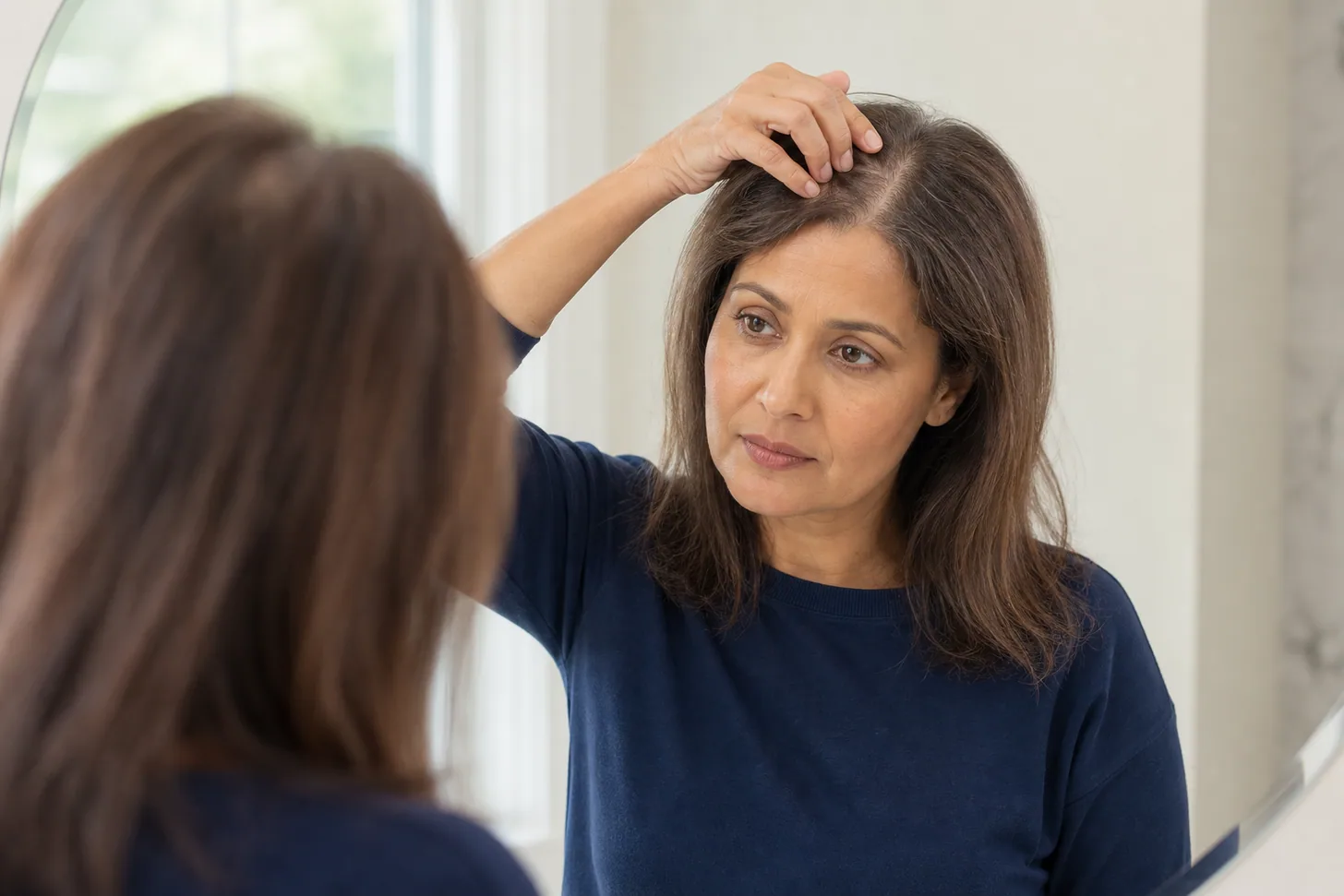
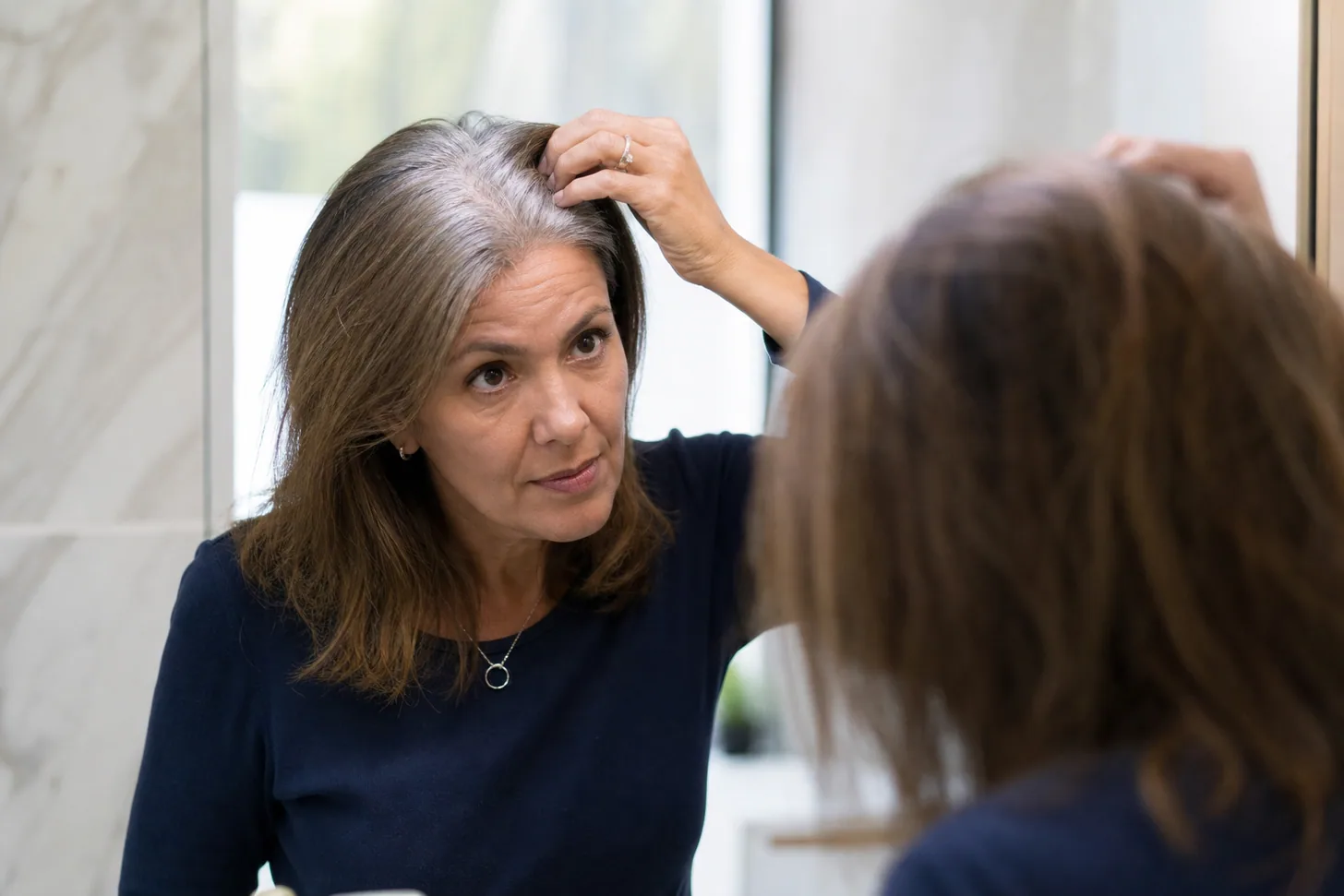
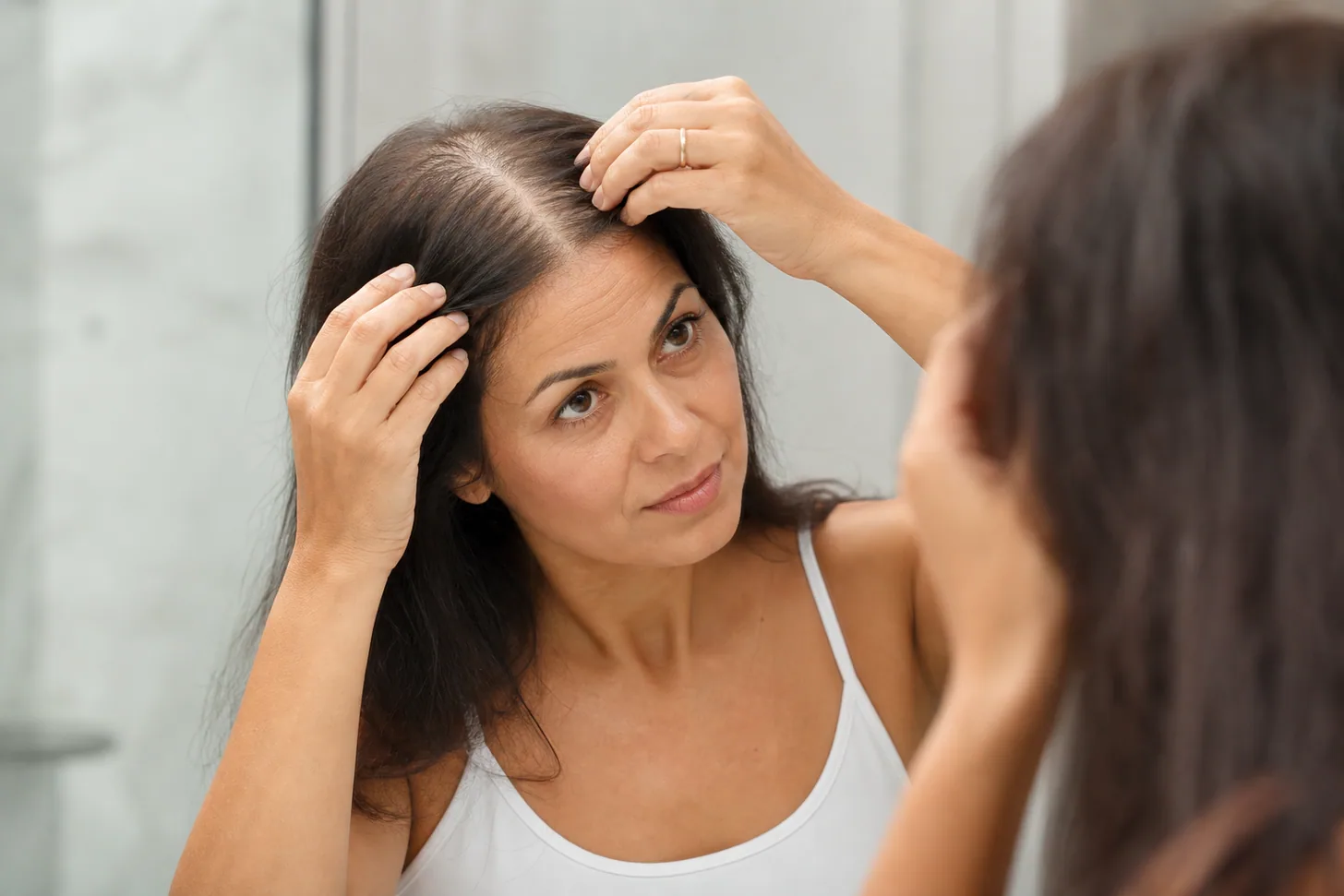
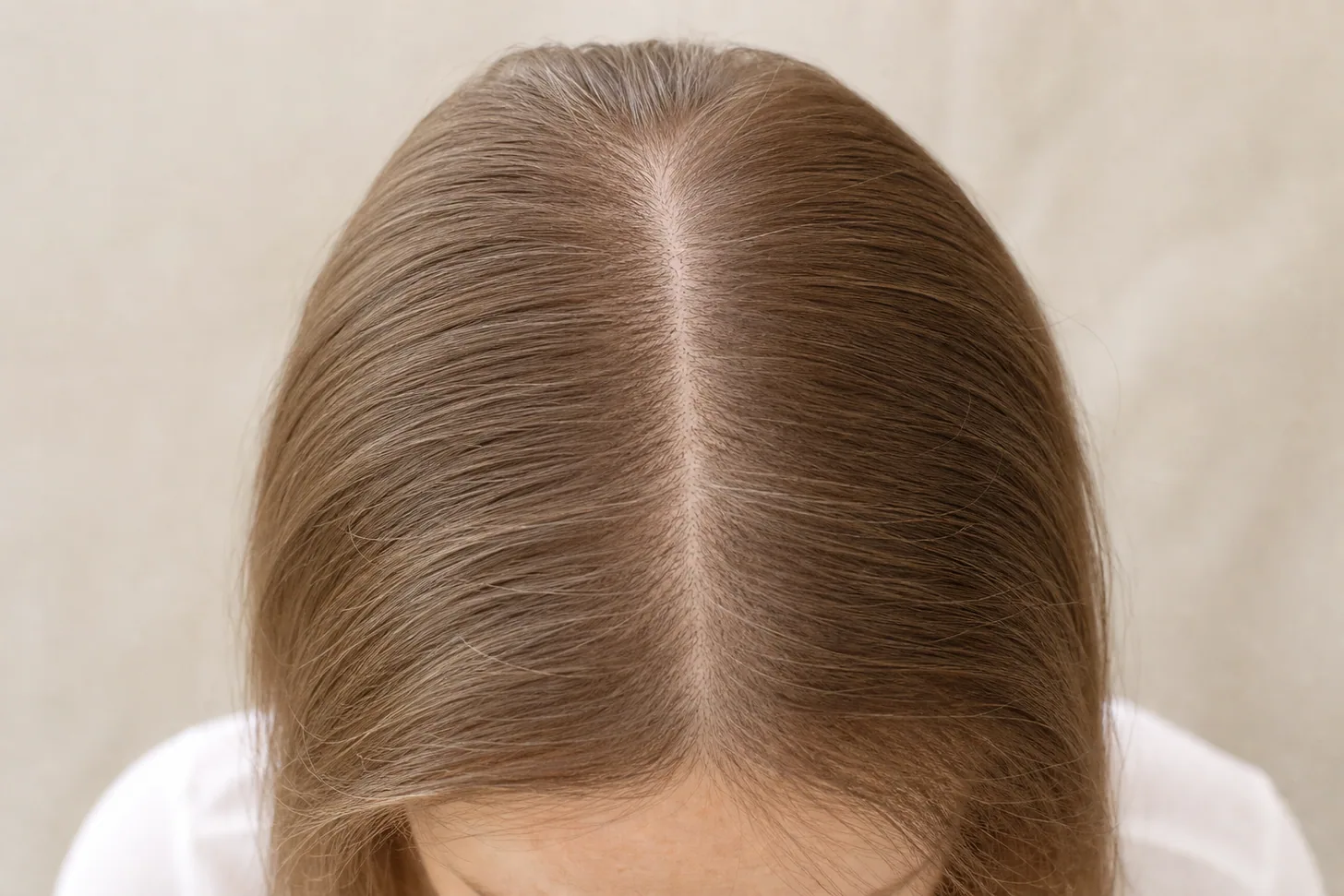
The sentence most women in their forties get is "you're too young for that," and it is wrong on the facts. Hair changes are one of the earlier things to show up in the menopause transition, often while periods are still arriving and nothing else looks different.
The explanation you'll be given — that your estrogen is dropping — is also wrong for a large share of this window. Estrogen doesn't glide downward through perimenopause; it swings, and in about a third of women it rises for several years before it falls at all. That distinction is not academic. A follicle responds to a sharp change, not to an absolute number, which is why shedding in perimenopause tends to arrive in episodes rather than as a steady decline.
This page separates the two things happening to your hair, gives you a self-check that tells them apart in about a minute, covers the two indirect routes almost nobody connects to perimenopause, and is specific about which treatments have evidence behind them and which do not. Menopause and fine hair is the page for what happens after this stage; this one is about the years before it.
The check that matters most costs nothing: compare the hair at your part with the hair at your nape.
Almost every article on this subject opens by saying estrogen declines and hair suffers. That is a reasonable description of post-menopause. It is a poor description of the transition itself, and the difference explains why perimenopausal hair changes feel so erratic.
The Study of Women's Health Across the Nation, which has followed a multi-ethnic cohort of more than three thousand women through the transition, found that estradiol does not follow one path.
It identified several distinct trajectories: in roughly a third of women estradiol rose beginning about five and a half years before the final period and then fell steeply only in the final year, and in a further group it rose and then declined slowly over the two years after the final period. Others showed a slow decline with no rise, or a flat, limited one.
So for much of perimenopause a large share of women are not low in estrogen. They are swinging — high, then abruptly lower, then high again, cycle to cycle. Two consequences follow, and both match what women actually report:
Shedding arrives in episodes, not as a slope.A follicle is pushed out of its growing phase by a change in its hormonal environment, not by a number on a lab report. A steep drop from a high level does that as effectively as a sustained low level. Hence: three bad months, then a quiet year, then three more bad months.
Your bloodwork can look normal and mean nothing.A single estradiol measurement in perimenopause tells you about one day. Drawn on a high day it looks reassuring; drawn on a low day it looks post-menopausal. This is why clinicians generally stage the transition by cycle pattern rather than by hormone levels.
The staging itself is useful to know, because it is what defines "perimenopause" rather than your age. Early perimenopause is marked by a persistent difference of seven or more days between consecutive cycle lengths — your cycles stop being predictable.
Late perimenopause begins with stretches of sixty days or more without a period. The whole transition commonly runs about four years and can run closer to ten, which means a woman noticing hair changes at forty-two may still be years from her final period.
Two different things are happening, and they need different responses
"My hair is thinning" covers a shed and a thinning, which behave differently, resolve differently and are told apart in about a minute. Sorting yours out is genuinely the most useful thing on this page.
The shed
The thinning
What you notice first
Hair everywhere — drain, brush, pillow, the shower floor
Your part looks wider in a photograph than it used to
Where on the head
Diffuse, all over, including the back and sides
Top and front. The back and sides look untouched
Onset
Fairly sudden, over a few weeks. Often 2–3 months after a trigger
No start date you can name. Visible only in old photos
Hair at the part vs. at the nape
The same thickness as each other
Part hair is visibly finer than nape hair
Ponytail circumference
Drops, then comes back
Drops and stays down
Course
Usually resolves in 6–9 months once the trigger passes
Progressive unless treated
What to do about it
Find the trigger — iron, thyroid, illness, a crash diet
Start treatment early; follicles respond while still producing hair
The part-versus-nape comparison is the check worth doing. In female pattern hair loss the sensitive follicles are on the top and front of the head and the ones at the nape are spared, so the two areas diverge — take a strand from each between your fingers and the difference is usually obvious.
In a diffuse shed nothing has changed about the strands themselves; there are simply fewer of them for a while. Fine hair or thinning? works through the wider version of this question, and how to track hair progress has the photo method, which is far more reliable than the mirror.
Plenty of women get both, at different times, which is the honest and slightly unsatisfying answer. An episode of shedding on top of underlying pattern thinning is what produces the experience of hair that seems to fall off a cliff and then only partly return.
Chair-side note
The clients I worry about least are the ones who arrive frightened at the first big shed, because that one usually resolves and I can often point at what caused it. The ones I worry about are the women who tell me, almost in passing, that their ponytail has needed an extra wrap for about two years. That is the change with no start date, and it is the one where the two years mattered.
I have had the same conversation enough times to be blunt about it now: if your part is wider in this year's photos than in the ones from three years ago, that is worth a doctor's appointment this month rather than after the summer. Not because it is an emergency — it isn't — but because every treatment for this works better on a follicle that is still growing something than on one that has already stopped.
MH
— Megan Holloway, Editor-in-Chief
The two routes nobody connects to perimenopause
Both of these are common, both are treatable, and both get missed because the hair change is attributed to hormones on the strength of your age alone.
Heavy periods take iron out, and iron stores fall before a blood count looks abnormal
Cycles in perimenopause frequently become anovulatory, and bleeding often becomes heavier and less predictable as a result. Heavy menstrual bleeding is the most common cause of iron deficiency in women of reproductive age, and the loss accumulates quietly: ferritin, which reflects stored iron, falls long before hemoglobin does. That produces a specific and very common situation — being told your blood count is normal while your iron stores are genuinely depleted.
Low ferritin has a documented association with telogen effluvium, the diffuse shedding pattern. A 2025 case-control study in Cureus found mean ferritin of 24.3 ng/mL in women with telogen effluvium against 44.8 ng/mL in controls. Worth being honest about the limits of that: an association is not proof of cause, iron is one of several triggers that produce identical shedding, and whether correcting iron regrows hair in women who are not anemic is considerably less settled than the supplement aisle implies.
What follows from it is modest and practical — ask for ferritin specifically, not just a full blood count, and do not start iron on your own, because excess iron is genuinely harmful and the only way to know is to test.
Thyroid disease peaks in the same decade and looks almost identical
Thyroid disorders become substantially more common in women in their forties and fifties, and the symptom list overlaps with perimenopause almost point for point: fatigue, weight change, low mood, feeling cold, disrupted sleep, and thinning hair.
The confusion runs in one direction far more often than the other — symptoms get filed under hormones because the age fits, and a treatable thyroid problem goes unlooked-for. It is a simple blood test and it belongs on the same form as the ferritin. Which blood tests are worth asking for has the full list and what each one is actually for.
What actually helps — ranked by how much evidence sits behind it
This is a medical topic and the section below is an orientation for a conversation with a doctor, not a treatment plan. But it is worth knowing what has evidence and what doesn't before you spend money on it.
Topical minoxidil.The best-evidenced over-the-counter option for female pattern hair loss, and the one dermatologists reach for first. It works while you use it and stops working when you stop, it takes three to six months to show anything, and it commonly causes a temporary increase in shedding in the first weeks. Hair loss treatments for fine hair covers what to expect properly.
Correcting a genuine deficiency.If ferritin or thyroid function is actually abnormal, treating it is worthwhile on its own merits and hair may improve alongside. If they are normal, treating them anyway does nothing for your hair.
Prescription anti-androgens.Spironolactone and related options are used for female pattern hair loss and are a reasonable thing to raise. They are prescription-only, not suitable for everyone, and require a doctor who knows your history.
Hormone therapy — but not for your hair.HRT is prescribed for vasomotor symptoms and sleep, and the evidence that it improves hair is weak and inconsistent. If erratic swings were driving a shed, steadier hormones may settle it, but that is a plausible side effect rather than an indication. One thing genuinely worth raising if you are already on it: progestogens differ in how androgenic they are.
Supplements, with a hard caveat.There is no supplement with good evidence for perimenopausal hair thinning in a woman who is not deficient, and some — high-dose vitamin A, selenium — cause hair loss in excess. Hair supplements for fine hair goes through the evidence ingredient by ingredient, including who funded which trial.
And one thing that will not help, so you can stop looking for it: nothing on the market lengthens the growing phase. If your hair has stopped reaching the length it used to reach, that is anagen shortening, it is not breakage, and no trim schedule or repair mask changes it. Why fine hair won't grow long explains the mechanism; the practical answer is a shape built for the length you have.
What the hair itself needs meanwhile
Whatever is happening underneath, the hair on your head today is finer than it was and there are things that genuinely make it read fuller. None of these treat the cause and all of them work.
Stop fighting for length.Weight at the ends drags the roots flat, and roots are where fine hair reads full. Medium-length cuts for fine hair over 40 is built around this exact trade.
Move the part.A part that has sat in one place for years has trained the roots flat and exposes the widest possible strip of scalp. How to part fine hair covers moving one that won't move.
Coverage while you wait.A scalp concealer at the part is the fastest honest fix there is, and it costs nothing in follicle terms. If the thinning is diffuse rather than a clean line at the part, building fibers are the version that works on hair rather than on skin.
Protect what you have.Tight styles pull on a hairline that is already under pressure — the thinning hairline covers the tension mechanism and the reversible window.
When this isn't perimenopause
Your hair is coming out in patches, not diffusely.Round, smooth bald patches are not a hormonal pattern. That needs a dermatologist, not a hair routine.
There's scalp pain, burning, itching or visible scaling.Hormonal thinning doesn't hurt. Symptoms plus loss need assessment promptly, because some scarring conditions have a narrow window.
You're under 40 and your cycles have changed markedly.Worth a proper workup rather than assuming an early transition. If your cycles were irregular long before this, PCOS and hair loss may be the better-fitting page.
The shed started 2–3 months after a specific event.Surgery, illness, a significant weight loss, or stopping a medication all cause telogen effluvium on that timeline, and it resolves. Weight-loss shedding covers the commonest one.
You had a baby in the last year.That is a different and well-defined shed with its own timeline — postpartum hair loss.
Your hair is fine but the amount hasn't changed.Fine strands and thinning are different things and get confused constantly. Fine vs thin hair sorts it in two minutes.
FAQ
Yes, and it commonly starts before anything else about your cycle looks obviously different. Two separate things happen and they're worth telling apart. Some women get episodes of increased shedding — more hair in the drain and on the brush, diffusely over the whole head, arriving over a few weeks. Others get gradual thinning at the part and the front, which is female pattern hair loss becoming visible during the transition rather than a new disease. Plenty of women get both, at different times. The shed usually recovers on its own once whatever set it off has passed; the thinning doesn't, and it responds best to treatment started early — which is the main practical reason to work out which one you're looking at.
Not in the simple way it's usually described, and this is the most common misunderstanding about the whole transition. Estrogen doesn't glide steadily downward through perimenopause. SWAN tracked estradiol across the transition and found several distinct patterns: in about a third of women estradiol actually rose several years before the final period and only fell steeply in the last year, and in others it rose and then declined slowly afterwards. So for a large share of the window estrogen isn't low — it's erratic. That matters because follicles respond to change, and a sharp fall from a high level pushes hair into shedding just as effectively as a sustained low level does.
Most often the early to mid forties, though it can begin in the late thirties. The transition is defined by cycle changes rather than by age: early perimenopause is marked by a persistent difference of seven or more days between consecutive cycle lengths, and late perimenopause by stretches of sixty days or more without a period. Hair changes frequently arrive in that early window, when periods are still coming and most people wouldn't describe themselves as menopausal at all. That's why so many women in their forties are told they're too young for this. They aren't — they're early in a transition that commonly runs four years and can run closer to ten.
Compare the hair at your part with the hair at the nape of your neck. In female pattern hair loss the follicles at the top and front are the sensitive ones and the nape is spared, so the strands at your part will feel and look noticeably finer than the strands underneath at the back. In a diffuse shed everything is affected equally, so the two feel the same and what's changed is the amount of hair rather than its thickness. The other tells: a shed has a start date you can roughly name and puts visible hair in the drain, while pattern thinning has no start date and shows up as a wider part in photographs. Take a same-lighting photo of your part every three months rather than judging it in the mirror.
Indirectly, and it's the route most often missed. Cycles in perimenopause frequently become anovulatory, which can make bleeding heavier and less predictable, and heavy menstrual bleeding is the most common cause of iron deficiency in women of reproductive age. Iron stores fall long before a blood count looks anemic, so it's entirely possible to be told your hemoglobin is normal while your ferritin is low. Low ferritin has a documented association with the diffuse shedding pattern — although whether correcting iron regrows hair in women who aren't anemic is much less settled than the supplement aisle suggests. If your periods have become heavy, ask for ferritin specifically rather than a standard blood count, and don't start iron unprompted.
It isn't a hair treatment and shouldn't be started as one. Hormone therapy is prescribed for symptoms such as hot flushes, night sweats and sleep disruption, and the evidence that it improves hair is weak and inconsistent. Some women do notice their hair settles once their hormones are steadier, which is plausible if erratic swings were driving a shed, but that's not the same as a treatment with a demonstrated effect on hair. One detail worth raising with your doctor if you're already on it: progestogens differ in how androgenic they are, and if hair is a concern that's a reasonable thing to discuss when a formulation is chosen.
Yes, because thyroid disease becomes more common in women in exactly this age range and its symptoms overlap almost perfectly with perimenopause — fatigue, weight change, low mood, feeling cold, thinning hair. The two are routinely confused, and the mistake runs in one direction more than the other: symptoms get attributed to hormones because the age fits, and a treatable thyroid problem goes unlooked-for for years. It's a simple blood test. Ask for thyroid function alongside ferritin, and take the results to a doctor rather than reading them off a reference range yourself — the ranges are wide and interpretation depends on your other symptoms.
The shedding part usually does. A telogen effluvium resolves once the trigger passes and density typically returns over six to nine months, though the regrowth arrives as short new hairs that stick up around your part for a while before they blend. The pattern thinning generally doesn't reverse on its own, because miniaturized follicles keep producing a finer hair each cycle unless something interrupts that. There's also a third change that's neither: the growing phase itself shortens, so hair stops reaching the length it used to. That one is permanent and no product lengthens it — the practical response is a cut built for the length you have now. Menopause and fine hair follows this stage through.
Fourteen years across the chair and the desk. Megan's rule for this decade of a woman's life: test before you treat, and never let "you're the right age for it" stand in for a diagnosis.
Images in this article are AI-generated illustrations, not photographs of real clients or results. See our image policy.
This article is for general education and is not medical advice. If you are experiencing sudden or patchy hair loss, scalp pain, or other concerning symptoms, see a board-certified dermatologist.
Results vary with hair type, density, and growth patterns. This guide is educational and not a substitute for an in-person consultation with a licensed stylist.
Get the good hair intel
One honest, stylist-written guide in your inbox each week. No hype.

 MH
MH