Reviewed by Tara Sullivan · Updated September 2026 · 12 min read
Fine coils get advice written for two other kinds of hair, and neither one fits. A fine 4a–4c coil shrinks to roughly a quarter of its stretched length, which means the shape you wear is a sphere rather than a hanging line — so it has to be cut dry and shrunken, sculpted with scissors rather than thinned from the inside, and built with weight kept high at the crown and length taken off the sides.
That is the opposite of the mainstream curly-hair brief, which assumes too much hair and reaches for thinning shears, and it is a different question from the care routine, which assumes the shape is already decided. Below are 18 shapes and styles for fine coily hair — sculpted short cuts, mid-length shapes with a real perimeter, protective styles sized to a fine strand, and stretched styles that add apparent volume — plus what to say in the chair and the tension rules that keep a style from costing you your edges.
If your pattern is looser than a coil, our gallery for thin, curly hair is the closer fit, and if you have not yet settled whether you are working with fine strands or low density, do that first — it changes the cut.
Chair-side note
The conversation I have most often at this chair starts with a client apologizing for her hair. She has been told it is dry, or damaged, or that she is not doing enough — when what is actually true is that she has fine strands and moderate density, and she has been following a routine and a cut brief built for someone with three times the hair.
Fine coils are not underperforming thick coils. They behave differently, and they want less: less product, less manipulation, and a cut that removes hair from the places where sparseness shows instead of thinning the places where it does not.
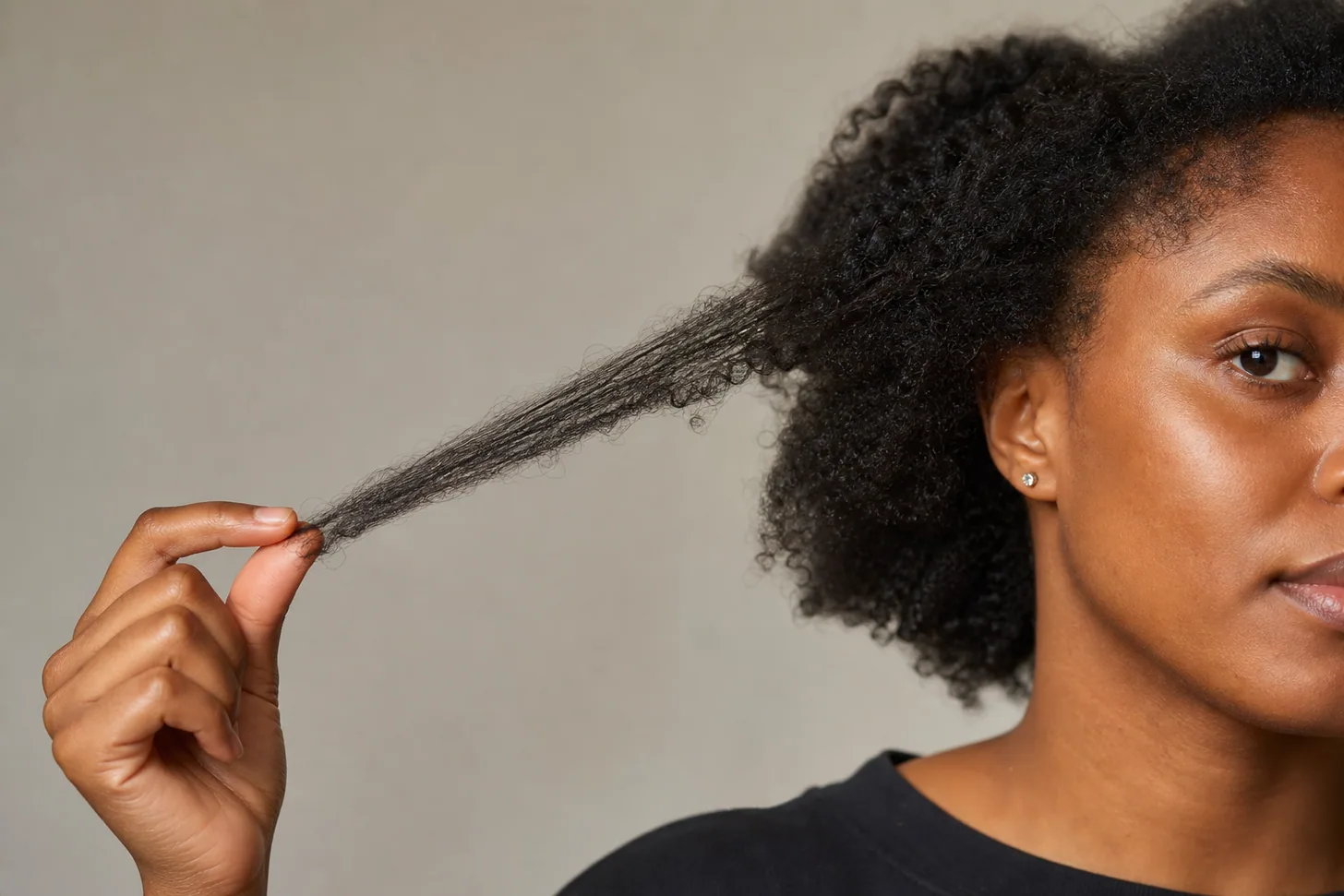
When I stretch a section between two fingers and it disappears against my skin, that tells me the diameter. When I part in four places and look at the scalp, that tells me the density. I need both numbers before I pick up shears, and they are not the same number.
SB
— Simone Baptiste, Senior Stylist
Why fine coils need their own cut brief
Two measurements get collapsed into one word and they should not be. Fine is the diameter of a single strand — how wide one hair is between your fingers. Thin is density — how many hairs are growing on your head.
Coily hair is routinely assumed to be thick on both counts because it occupies so much visual space, and that assumption is why a person with fine 4c hair gets handed a routine full of butters and a cut full of thinning shears.
Plenty of coily hair is fine. Some of it is fine and dense, which reads as soft and cloud-like. Some is fine and sparse, which shows scalp through the pattern. The two need different things, and neither needs bulk removed.
The mechanical fact that drives everything on this page is shrinkage. A tight coil can wear at a quarter or less of its stretched length — pull a strand straight and it may measure ten inches; released, it sits at two or three. That single property decouples the silhouette from the length in a way no other hair type experiences.
On straight or wavy hair, cutting two inches shortens the outline by two inches. On a fine 4c coil, cutting two inches of stretched length might move the visible outline by half an inch, or by nothing at all if it comes out of the interior.
It also means a line cut on wet, elongated hair lands somewhere you did not agree to once it springs up, and on fine hair there is no weight to pull it back down. This is why coily cuts are sculpted rather than layered, and why the hair should be washed, dried, stretched, released and picked out before a single section is shaped.
There is a second reason to leave the interior alone, and it is structural rather than aesthetic. Tightly coiled hair changes direction constantly along the shaft, and each turn is a point where the fiber is thinner and the cuticle lifts.
Read that as a design instruction. Every extra comb-through, every extra separation, every extra week under tension is a chance for a fine coil to snag on itself and snap. A shape that needs less handling is not a lazy choice; it is the structurally correct one.
Which leads to the third rule, the one that quietly matters most: tension is a styling variable, not a fixed cost. Protective styles genuinely reduce daily manipulation, but they are the highest-risk item in the whole routine on fine hair, because the load is carried by strands with less tensile reserve and it lands first at the hairline, where hair is finest on nearly everyone.
The American Academy of Dermatology is unambiguous that tightly pulled buns, ponytails, cornrows and braids can cause traction alopecia, and that once pulling continues long enough, the hair can stop growing back. Nothing in the protective section below is worth a hairline, so every entry there is sized and weighted for fine strands rather than for the picture.
One scope note before the gallery. This page is about shape — what to cut, what to wear, and how to build a silhouette when the density is not doing it for you. It is not the wash-day routine.
Product weight, detangling method, porosity, and the honest version of the moisture conversation all live on fine natural hair: the honest care routine, which is the companion to this page rather than a competitor to it. Read that one for what goes on the hair; read this one for what the hair is cut into.
Sculpted short shapes that put the height on top
Short is the most direct answer to low density in coils, for a reason that is specific to shrinkage: when the outline is a sphere, making the sphere smaller and more deliberate makes it read denser, because the same amount of hair is filling less space. All five of these keep length through the top and take it off at the sides, so the fullness sits where the eye looks first.
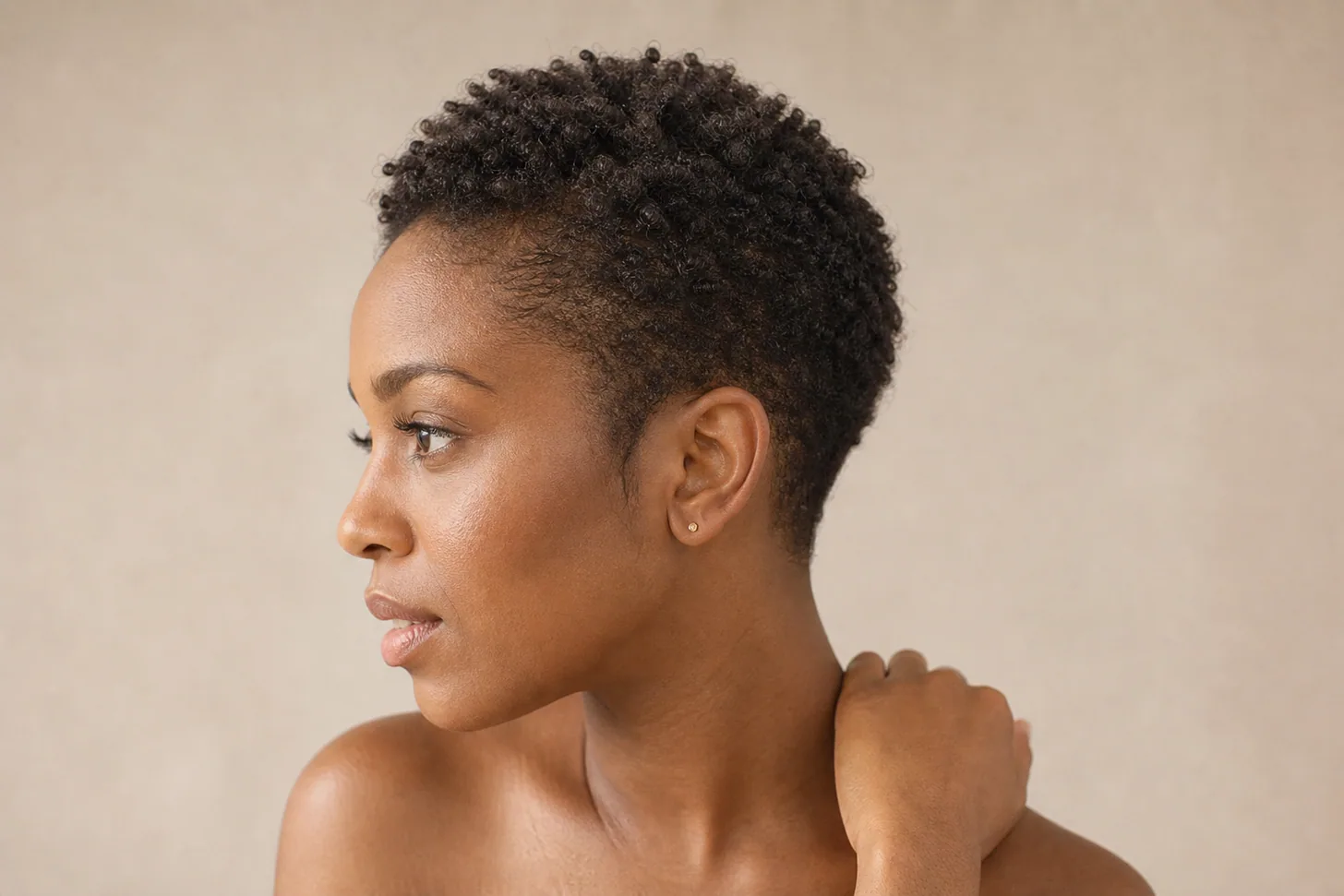
sculpted TWA on fine 4c coils, rounded evenly through the crown and close at the temples, on a Black woman with low-density hair
1
The Sculpted TWA
A teeny weeny afro stops looking like a grow-out stage the moment somebody rounds it properly — even at an inch, the difference between shaped and simply short is visible from across a room. On fine coils the shaping matters more than the length, because an uneven outline reads as patchiness rather than as texture. Ask for it picked out fully and then cut into a true round, with the temples taken slightly closer than the crown.
low taper cut on fine 4c hair with a fuller rounded top and closely faded sides and nape, on a Black woman
2
The Low Taper
The sides and nape graduate down close while the top stays full, which turns a density problem into a design line. It works because the temples and the nape are where fine coily hair is finest and sparsest on most people — removing that zone from the silhouette entirely is more flattering than trying to fill it. This is the shape I recommend most often to clients who tell me their hair looks thin "everywhere but the middle."
tapered coily pixie with defined coil clumps on top and short tapered sides, on fine low-density 4b hair, Black woman
3
The Tapered Coily Pixie
Longer than a TWA and shorter than a fro, with enough length on top for a coil clump to actually form and show its pattern. The trick with fine hair is to leave the top long enough that the coils group together — too short and each strand stands alone, which is what makes sparse hair look sparser. Two to three inches on top is usually the floor.
short relaxed or silk-pressed pixie on fine thin Black hair, smooth with a side part and soft volume at the crown
4
The Relaxed or Pressed Pixie
If your hair is relaxed or you wear it pressed, the same architecture applies but the risks change: smooth fine hair has nowhere to hide a thin spot, so the cut has to carry the volume. Ask for weight kept at the crown and a soft, slightly undercut nape rather than layers through the interior. Keep the iron at the bottom of its temperature range and treat pressing as an occasional event — the flat iron guide for fine hair covers why the low end of the dial is the spec that matters. If the hair is relaxed rather than pressed, the chemistry changes the brief again, because the strand has permanently lost strength rather than temporarily lost its curl — the shapes and the touch-up schedule for that case are in short relaxed hairstyles for thin hair.
rounded afro with a crisp shape-up at the hairline on fine 4c hair, clean edges, Black woman
5
The Shape-Up and Rounded Crown
A clean line at the front edge does something disproportionate for fine coils: it gives the eye a crisp boundary to read, so the softness behind it registers as intentional texture instead of as thinness. Have the line placed just inside your natural hairline rather than carved back into it, and go easy on the frequency — a shape-up every visit on an already-fine hairline is its own kind of tension.
Mid-length shapes that keep a real perimeter
Going longer with fine coils is entirely possible; it just requires a decision about where the outline lives. Without a defined perimeter, mid-length coily hair diffuses at the edges and reads thin. These four all keep a deliberate boundary somewhere.
chin-length coily bob cut dry on shrunken fine 4b coils with a solid blunt perimeter, Black woman
6
The Shrunken Coily Bob
A bob measured and cut in the shrunken state, so the chin-length line you agreed to is the chin-length line you get. Cut it wet and you will walk out with an ear-length cut you did not ask for. The perimeter stays blunt and unthinned, which is what gives a fine coil an edge dense enough to define the shape.
rounded afro shaped to a level even perimeter on fine 4c hair, medium length, Black woman
7
The Levelled Round Afro
Picked out and then trimmed into a true sphere, with the outline levelled all the way around rather than left to fall where it lands. On dense hair this is a formality; on fine hair it is the entire difference between a shape and a cloud. Expect to have it evened every eight to ten weeks, because a sphere shows an uneven edge immediately.
coily fringe cut into the front of a fine 4b shape, soft coil bangs sitting at brow level, Black woman
8
The Coil Fringe
A front section cut shorter so it sits at brow level once it springs, which brings density forward to the part of the head everyone looks at. This is the highest-leverage two inches on a fine coily head — and also the riskiest, because a fringe cut from a receded or fragile hairline makes the sparseness the focal point. Check the front density honestly before committing.
crown-weighted layered coily shape on fine 4a hair, fuller through the top with shorter sides, Black woman
9
The Crown-Weighted Shape
The one place layering genuinely helps fine coils is high on the head, where a few shorter pieces let the crown stand up instead of lying under the weight of everything above it. The rule is a small number of placed layers, all above the occipital bone, and none through the mid-lengths. Say "placed at the crown" in the chair — "layers" on its own invites the scattered version.
Protective styles sized to a fine strand
These are the styles where getting the size wrong has a permanent cost, so each one below is specified by section size and weight rather than by look.
The working rule throughout: added hair no more than about twice the thickness of the natural section it is anchored to, keep it short, keep it light, and take it down at six to eight weeks. If it hurts while it is being installed, it is too tight — that is a stop-and-redo, not a tolerate-it.
chunky flat twists on fine 4c hair in wide sections running back from the hairline, low tension, Black woman
10
Chunky Flat Twists
Flat twists in wide sections are the gentlest scalp style on this list, because two strands crossing over each other exert far less pull than three strands braided down. Chunky sections also mean fewer parts, and fewer parts mean less exposed scalp on hair that cannot spare the coverage. Keep them going straight back or to the side rather than in intricate patterns; every extra direction change is another tension point.
medium two-strand twists on fine 4b hair without extensions, shoulder length, soft and light, Black woman
11
Two-Strand Twists, Sized to Your Own Hair
Done on your own hair with no added length, these carry almost no weight at all, which makes them the default protective style for genuinely fine coils. Medium sections hold better than small ones here — a twist made from too little fine hair unravels within a day and you end up re-twisting, which is more manipulation, not less. They also double as a set: take them down after three or four days for the twist-out at number 15.
short jumbo box braids in large sections on fine thin Black hair, bob length, lightweight
12
Short Jumbo Box Braids
If you want braids with extensions, this is the version that is defensible on fine hair: large sections, so the load spreads, and bob or shoulder length, so there is less of it pulling. Long jumbo braids are heavy and short micro braids are concentrated — the safe combination is large and short. For the everyday braided looks that don't involve extensions at all, our braids for fine hair gallery covers the styling side.
pencil-width medium locs on fine 4c hair, shoulder length, even grid, Black woman
13
Medium, Pencil-Width Locs
Locs suit fine coils well over the long run because they end the daily detangling that causes most of the breakage — but the starting size decides whether that holds. Pencil-width is the sweet spot: microlocs multiply the number of anchor points on a scalp that cannot support them, and very large locs grow heavy. Ask a loctician to assess your density at four or five partings before they set the grid, and expect to combine sections later if an area thins.
flat twist halo updo on fine 4c hair, twists wrapped around the crown into a soft raised shape, Black woman
14
The Flat-Twist Halo
Flat twists taken around the head and tucked into each other at the crown, which hides the ends and puts the visual bulk up high where it flatters. It reads as a finished, occasion-ready style while being one of the lowest-tension things you can do, provided the twists start loose at the hairline. A good option for the stretch between wash days when the roots have flattened.
Stretched styles that add apparent volume
These four all work on the same principle, and it is the opposite of what most tutorials optimize for. Definition and volume are in tension on fine coils. Tight definition separates the hair into discrete clumps and shows scalp between them; volume comes from letting pieces stay wide and overlap. When density is low, choose volume and accept less definition.
chunky twist-out on fine 4b hair with wide soft waves and high volume rather than tight definition, Black woman
15
The Chunky Twist-Out
Fewer, larger twists unravel into wide waves that overlap and fill space; many small twists unravel into narrow ribbons with scalp visible between them. Twist on stretched, nearly dry hair with a light foam rather than a butter, and separate each twist two or three times at most — over-separating is what turns a fine twist-out into frizz. Expect softer definition than the tutorials show, and take that as the trade you wanted.
banded stretched high puff on fine 4c hair, full rounded shape at the crown with smooth sides, Black woman
16
The Banded High Puff
Band the hair in sections while it dries to stretch it without heat, then gather high and let the stretched coils expand into a round puff. Stretching first is what makes this work on fine hair — unstretched coils gathered into a puff shrink into a small dense knot, while stretched ones fill a much larger silhouette with the same number of strands. Use a fabric band over a smooth section rather than an elastic dragged across the hairline.
roll and tuck updo on blown-out fine 4a hair, soft rolled sections pinned to create width, Black woman
17
The Roll and Tuck
Sections of blown-out hair rolled loosely and pinned, which creates volume architecturally rather than asking the hair to produce it. The lighter the hold and the looser the roll, the fuller the result — pull it tight and you have compressed exactly the hair you were trying to make look like more. Blow out on cool with a light tension only, and pin into the roll rather than through it.
banana clip high bun on stretched fine 4c hair creating a full rounded crown shape, Black woman
18
The Banana-Clip Bun
An old trick that deserves its reputation: the clip fans the hair out across its width instead of gathering it to a single point, so a modest amount of hair spreads into a full-looking shape. It is also gentler than a tight elastic, since the tension is spread along a comb rather than concentrated in a loop. Where you put the part underneath changes how full the front reads — our guide to parting fine hair covers the logic.
What to ask your stylist
Coily cutting is a specialism, and the vocabulary is the part most people get stuck on. These are the sentences that change the outcome:
"Please cut it dry and shrunken, not wet." The single highest-value sentence on this page. Wet coily hair is a different length from the hair you wear.
"Sculpt the outline — please don't thin the interior." Thinning shears and razors are standard on dense coils and wrong on fine ones. Say it before the gown goes on, not when you see them come out.
"Any layers placed at the crown only, above the occipital bone." This gives you lift without hollowing out the mid-lengths.
"Can you check my density at a few partings first?" A stylist who does this before deciding how much to take is the one you want. It is the check that separates a fine-hair cut from a generic one.
"How will this grow out over three months?" Sculpted shapes lose their outline before they lose their length, which is a different grow-out pattern from layered cuts.
The honest upkeep picture
Sculpted short shapes are the highest-maintenance option here in salon terms and the lowest in daily terms: a TWA or taper needs re-shaping every four to six weeks to keep its outline, but takes about two minutes a day.
The levelled afro and the coily bob stretch to eight or ten weeks between trims. Protective styles run six to eight weeks per install with a real break in between — back-to-back installs with no recovery time is the pattern that produces hairline damage, more than any single style does.
Daily time is genuinely low across the board, which is one of the honest advantages of this hair type: most of these styles are set once and worn for days. Where the time actually goes is wash day, and that is a care question rather than a shape question — the fine-coil care routine has the realistic version.
One thing worth saying plainly here: if you are noticing more scalp at the crown or a hairline that has moved back, no cut on this page fixes that, and the sooner it is looked at the more of it is reversible. Start with what a receding fine hairline actually means.
When these rules bend
Your coils are fine but your density is high. Then a genuinely bulky shape is possible, and a little interior weight removal will stop it reading wide rather than tall. Still no razors — but the "never thin anything" rule relaxes.
Your pattern is looser than a coil — defined curls rather than tight zigzags. The shrinkage math changes and the shorter-reads-fuller rule applies differently. Our gallery for thin, curly hair is written for that range.
You wear your hair pressed or relaxed most of the time. Then heat and chemical history, not coil pattern, is the limiting factor on what a cut can do. Build the shape around the healthiest length you have rather than the length you want — the relaxed version of that brief has its own gallery, short relaxed hairstyles for thin hair.
You are already seeing thinning at the temples or along the part. Skip every extension-based style here until it has been assessed. Tension on an already-thinning hairline is the one mistake on this page that does not grow back.
The change has been fast, patchy, or came with itching, tenderness or flaking. That is not a haircut question. See a board-certified dermatologist before booking the salon.
FAQ
A sculpted shape with a low or mid taper is the most reliable choice. Because a fine 4C coil shrinks to a quarter or less of its stretched length, the silhouette you see is a sphere rather than a hanging line, and the cut has to be designed in that shrunken sphere. Tapering the sides and nape while leaving length through the top concentrates the hair you have where the eye reads height, and it keeps the outline deliberate instead of soft. Ask for the cut to be done on dry, stretched-then-released hair so your stylist is shaping what you will actually wear, and ask them to sculpt with scissors rather than thin the interior.
No, and mixing them up is the single most common reason a routine or a cut goes wrong. Fine describes the width of one strand. Thin describes how many strands are growing per square inch. Fine 4C hair with high density fills a large afro and feels soft and cloud-like; thin 4C hair at any strand width shows scalp through the coil pattern. Most people who search for one of these actually have both, but the fixes differ: fineness is a weight problem, solved by using less product and lighter product, while low density is a coverage and shape problem, solved by cut and placement.
Match the section to your own hair, not to the look you saw. The working rule is that any added hair should be no more than about twice the thickness of the natural section it is anchored to, and the section itself should be large enough that the load spreads across many strands rather than a few dozen. That points to medium and chunky sizes rather than micro. Micro braids and micro twists concentrate weight and tension onto tiny bundles of fine hair, which is exactly the mechanism behind traction alopecia. Keep them short, keep them light, and take them down at six to eight weeks.
Medium locs, roughly pencil-width, are the safest starting point for fine strands. Microlocs look appealing because they seem lighter, but each one is anchored to a very small section of scalp, and hundreds of small anchor points on fine hair is more total tension at the root, not less. Very large locs go the other way and become heavy as they grow. Pencil-width locs distribute weight across enough strands to hold, stay light for years, and can be combined later if a section thins. Start with a loctician who will look at your scalp density at several partings before deciding the grid.
Stop trying to define it and start trying to expand it. Definition compresses coils into separated clumps and shows the scalp between them; volume comes from the opposite move. Stretch the hair first with banding or a blow-out on cool, then separate a twist-out into chunky pieces rather than fine ones. Keep conditioner and butter off the roots so the base stands up. Build the shape at the crown and taper the sides so the outline reads round. And use a shaped style such as a puff or a roll-and-tuck, where the silhouette does the work that density is not doing.
Yes, and it is one of the better volume styles available, as long as you twist chunky rather than small. A large number of small twists gives crisp definition and a flat, sparse result on fine hair, because each thin twist unravels into a narrow ribbon and the scalp shows between them. Fewer, larger twists unravel into wide, soft waves that overlap and fill space. Twist on stretched, nearly dry hair rather than soaking wet, use a light foam instead of a butter, and separate each twist two or three times at most. Over-separating is what turns a fine-hair twist-out into frizz.
Dry, in the state you wear it. Wet coily hair can be four times longer than dry coily hair, so a line cut wet lands somewhere completely different once it springs up, and on fine hair there is no weight to pull it back down. The exception is a straight-across perimeter on stretched or pressed hair, which is cut stretched on purpose so the line is even. For everything else, ask for the hair to be washed, dried, picked out and then shaped, so the stylist is cutting the sphere you will walk around in.
They work particularly well, because a taper solves a low-density problem rather than hiding it. When density is low all over, length at the sides hangs sparse and lets light through at the temples, which is where fine hair is finest on almost everyone. Cutting the sides close removes that sparse zone from the silhouette entirely and leaves a clean, deliberate line, while the length kept on top gathers into a fuller-reading mass. The result looks like a decision rather than a shortage. Have your stylist check your density at the crown first, because a taper concentrates attention there.
Eleven years behind the chair, specializing in short shapes and fine-hair texture. Simone checks scalp density at three partings before cutting a curl, because the number of hairs on the head decides the cut far more than the curl pattern does.
Results vary with hair type, density, and growth patterns. This guide is educational and not a substitute for an in-person consultation with a licensed stylist.
Hairstyle images in this guide are AI-generated illustrations, not photos of real clients or results. See our image policy.
Get the good hair intel
One honest, stylist-written guide in your inbox each week. No hype.

 SB
SB