Reviewed by Tara Sullivan · Updated August 2026 · 11 min read
Most updo guides are sorted by occasion — everyday, work, wedding — which is useless if the problem is that none of them stay up. On fine hair the styles do not fail randomly. They fail in exactly three ways, and every fine-haired person reading this already knows which one is hers. It slides out within the hour. It goes up but looks short and stubby. Or it holds fine and is simply too small to look like anything.
Those are three different faults with three different fixes, and lumping them together is why the advice never lands. So this page is sorted by failure mode. There is one non-negotiable change first — stop leading with bobby pins, because pins hold by friction and fine hair does not have any — and then ten styles, grouped by the problem each one solves.
For the occasion-led versions, buns, half-ups and wedding styles each own their own ground and this page hands off to them rather than repeating them — as does bridesmaid hair for fine hair, which is the version written around a brief you did not choose.
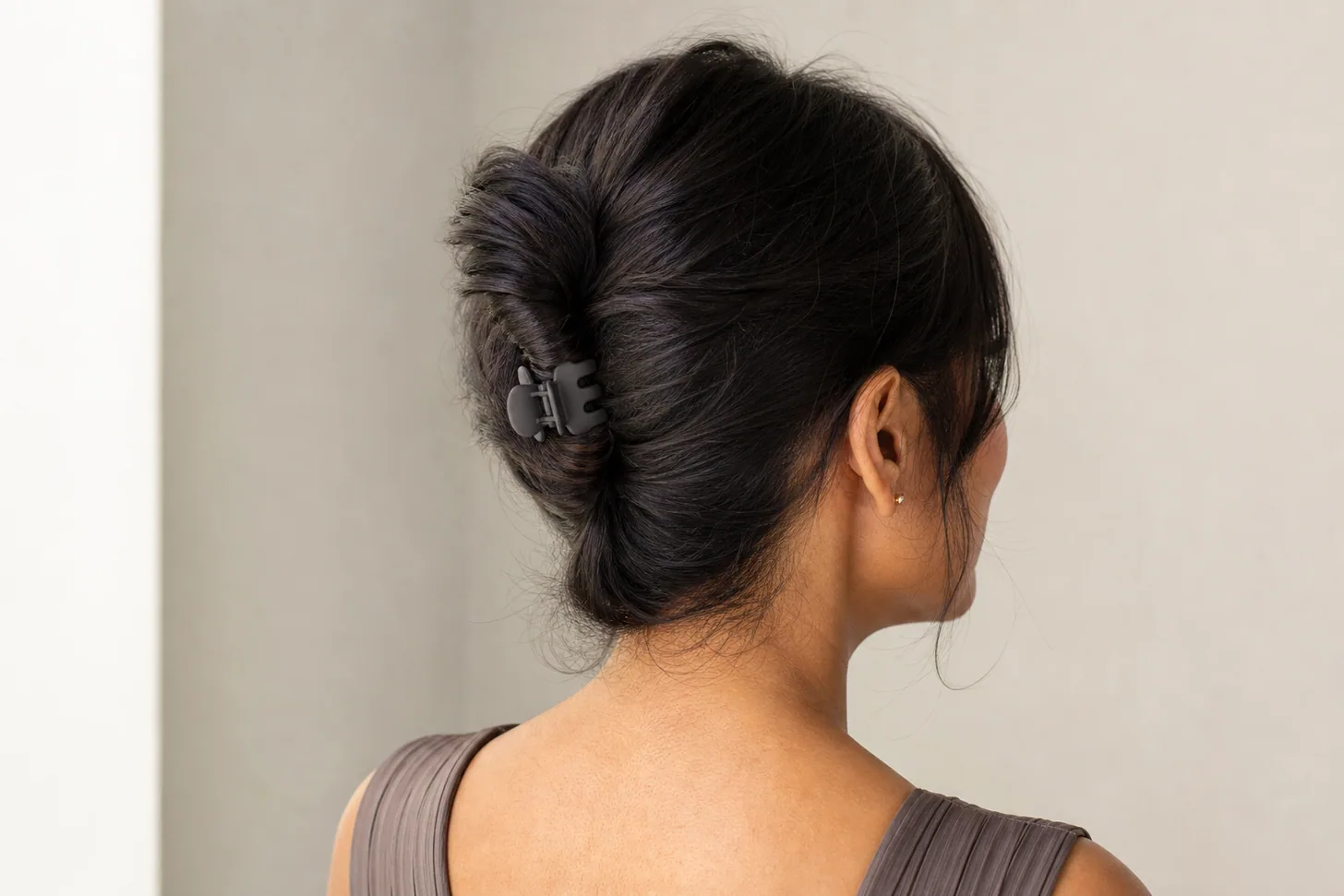
One clip, one twist, no pins. The fastener change is most of the fix.
Why updos for fine hair fail — three faults, not one
Work out which of these is yours before you scroll, because the fixes do not transfer. Plenty of people have two.
It slides out.The style is fine when you finish it and gone by lunchtime. The whole hold is coming loose, usually at once rather than gradually. This is a fastener problem and it is the most fixable of the three.
It looks stubby.It holds perfectly well but reads short, blunt and slightly stiff — the ponytail that juts out at the nape rather than falling. This is a shape problem, and it is caused by where the base sits and how the ends taper.
It's too small.Nothing is wrong with it. There simply is not enough hair in it for the style to register, so it looks like a knot rather than a bun. This is a volume problem and it is solved by building around something.
The reason this matters is that the standard response to all three is "use more product and more pins", and that is the wrong answer to two of them and actively counterproductive on the first. If your hair is sliding out, more pins slide out faster, because each pin is now holding an even thinner section.
Fix the grip first: clips and combs before pins
This is the section to read even if you read nothing else, because it changes the success rate of every style below.
A bobby pin holds by friction. It pinches a section between two arms and relies on the hair to grip back against the metal. A fine section is too slim to fill the pin properly and too smooth to resist it, so the pin gradually walks out — which is why "not even bobby pins stay in" is the universal fine-hair complaint. It is not a technique failure. The tool is asking your hair for something it does not have.
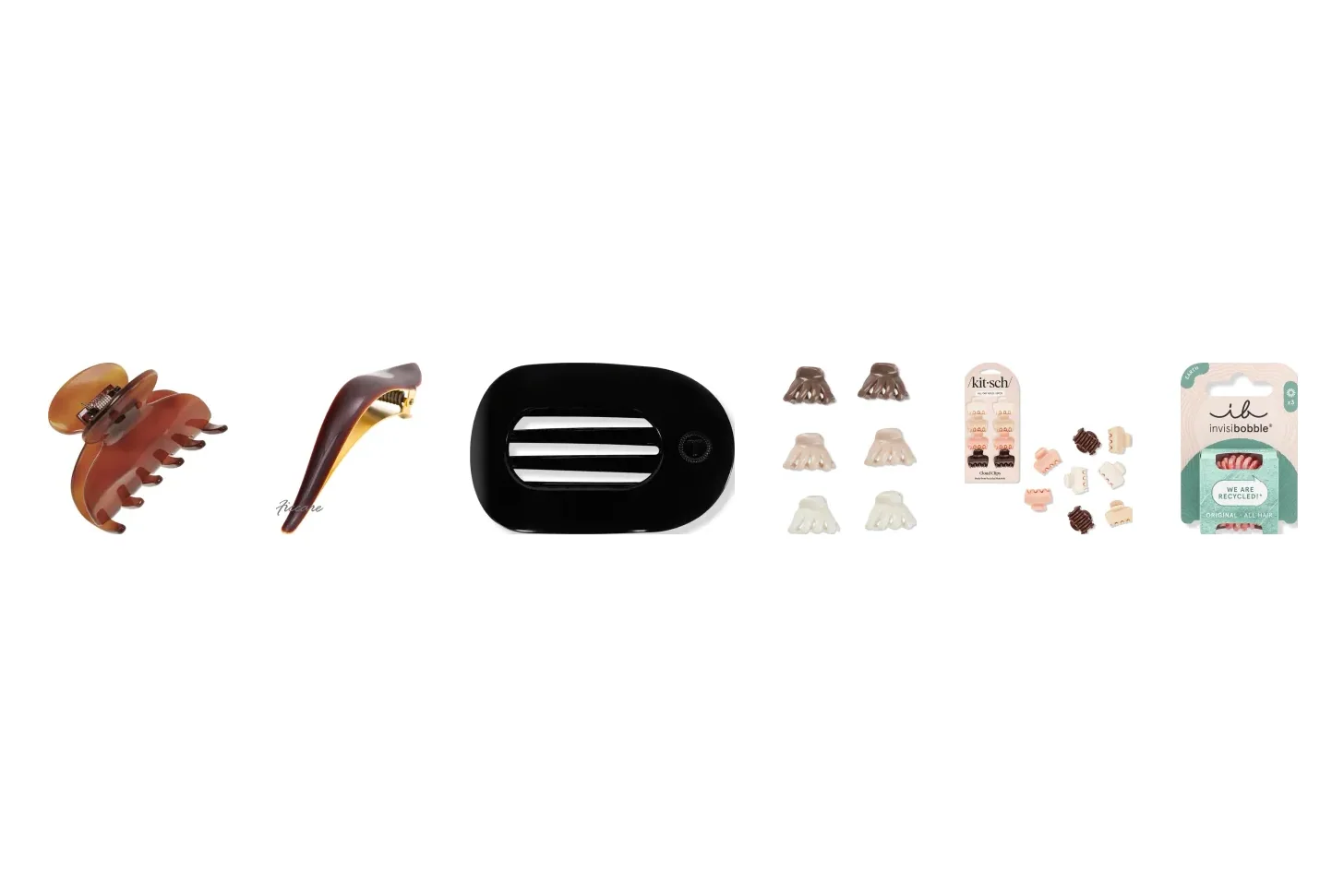
A claw clip holds mechanically. Its teeth close around a twisted section and hold it against the head; the grip comes from the spring, not from the hair. That works identically on fine and thick hair, which is why so many people quietly abandon ponytails altogether in favour of clips.
The size caveat matters: an oversized claw clip on a small amount of hair has nothing to close on and pops straight off. What works is the small, flat-to-the-head kind — the ones sold as baby claw clips or low-profile clips. Hair clips for fine hair covers which shapes hold and which are decoration.
A French comb holds by leverage. The teeth slide under a base of hair, then the comb rotates back against the head and locks. It is the single most underused fastener for fine hair and it holds an entire half-up with one piece of plastic. Combs for fine hair has the shapes.
Two supporting changes. Use spiral or fabric-covered elastics rather than ordinary ones, and buy them small — a standard elastic on fine hair needs four wraps, grips too tight in one narrow band, and leaves a dent.
Keep the bobby pins, and keep the one pin technique that does work: a crossed anchor pin, where the pin is pushed through a little of the hair growing at your scalp before it goes into the style, and a second pin crosses it.
That grips mechanically, the same way a clip does, because the pin is hooked around anchored hair rather than pressed against loose hair — which is exactly why it holds when a fistful of ordinary pins does not. Buns for fine hair has the step-by-step. For everything else, use pins to tack down one loose piece near the hairline, not to carry structure.
Chair-side note
When someone tells me updos do not work on her hair, I ask her to show me how she puts one up, and about eight times out of ten the answer is a fistful of bobby pins going in radially like a hedgehog. That is the technique everyone learns from photographs, and it is built for hair with grip.
On fine hair the whole structure is being held by friction that does not exist, so it comes apart all at once — usually not gradually, which is why it feels so sudden and so personal.
The change I make in the chair takes thirty seconds: I take every pin out, twist the section, and close one clip over it. It holds all day. People are often a bit annoyed about this, which is fair, because nobody ever told them the tool was the problem.
SB
— Simone Baptiste, Senior Stylist
Fault one: it slides out
This is the fault that ruins an occasion style, which is why wedding hair for fine hair spends most of its length on anchoring rather than on shapes.
Four styles built entirely around mechanical hold. None of them uses a bobby pin to carry weight, and all four survive a full working day on genuinely fine hair.
Fine hair twisted up the back of the head and held vertically with a small flat claw clip
1
The twist-and-clip
The one to learn first, and the fastest style on this page at about fifteen seconds. Gather everything at the back, twist the whole length upward against your head until the rope wants to sit flat, fold the ends down inside the twist, and close a small claw clip over it vertically. It holds because the clip is gripping a twisted rope rather than a smooth section — there is nothing for the hair to slide against. Works from collarbone length down, needs no product on second-day hair, and survives being slept on badly.
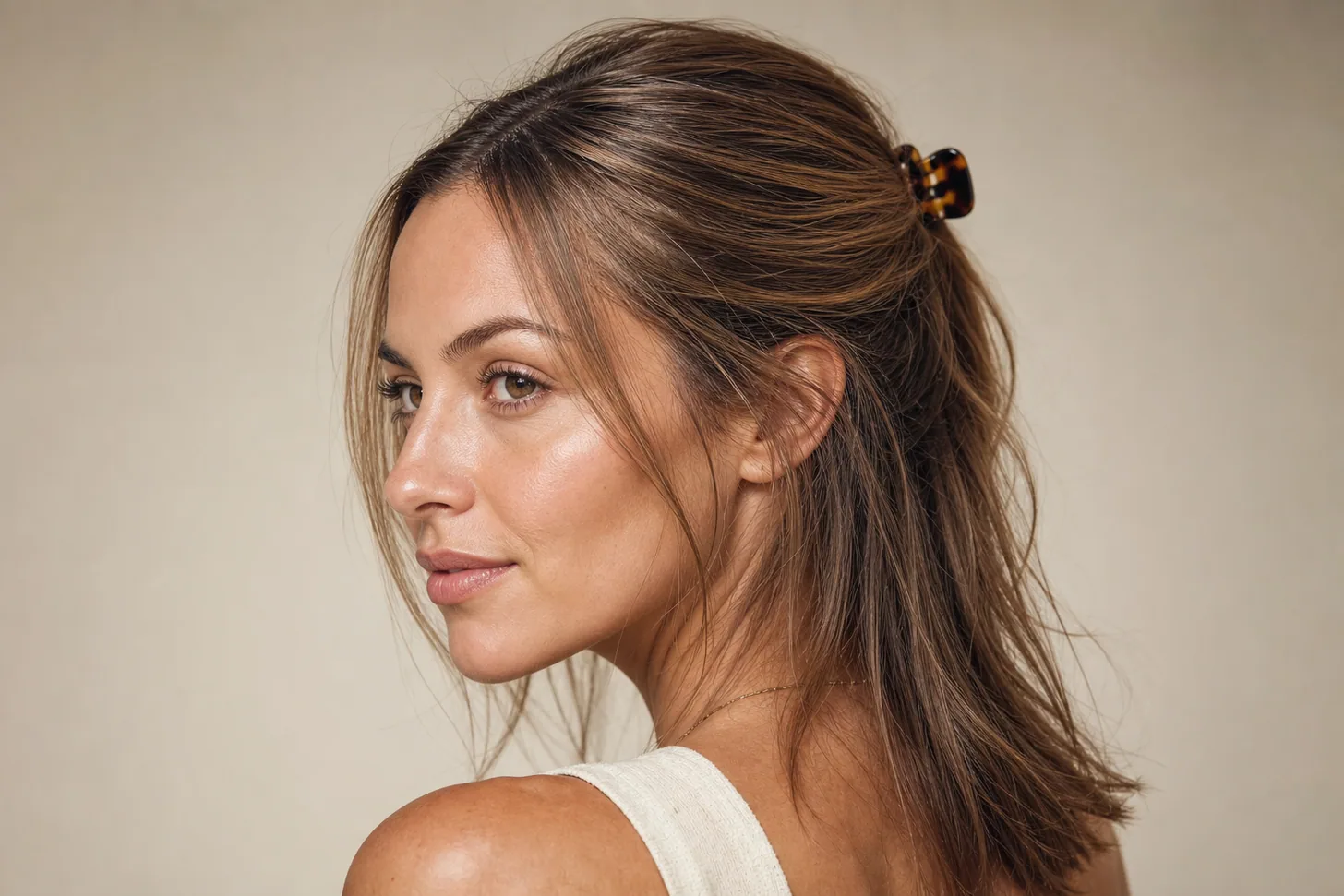
A French comb holding a half-up section of fine hair at the back of the crown
2
The French-comb half-up
The technique that fine-haired people rediscover and then never stop using. Take the top and side sections back, hold them flat against the crown, then slide the comb in upward from below the base of that section, and rotate it back and down so the teeth lock against the head. That rotation is the whole trick and it is what makes the comb grip; pushed straight in, it falls out immediately. One comb, no pins, and it holds the front off your face without touching the length. Half-up styles for fine hair has more variations on the shape.
A low ponytail on fine hair flipped through itself into a topsy-tail twist
3
The topsy tail, which deserves its revival
Tie a low ponytail, loosen the elastic half an inch, split the hair above it into two, and pull the tail up and through the gap from underneath. The hair now wraps around itself, which does two useful things: it hides the elastic completely, and it holds the base far more securely than the elastic alone because the tension is distributed through a fold rather than a single band. Do it twice for a rope effect. Genuinely nostalgic, genuinely effective, and almost free.
Two small twisted sections of fine hair pinned back behind the ears into a low knot
4
Two twists, knotted rather than pinned
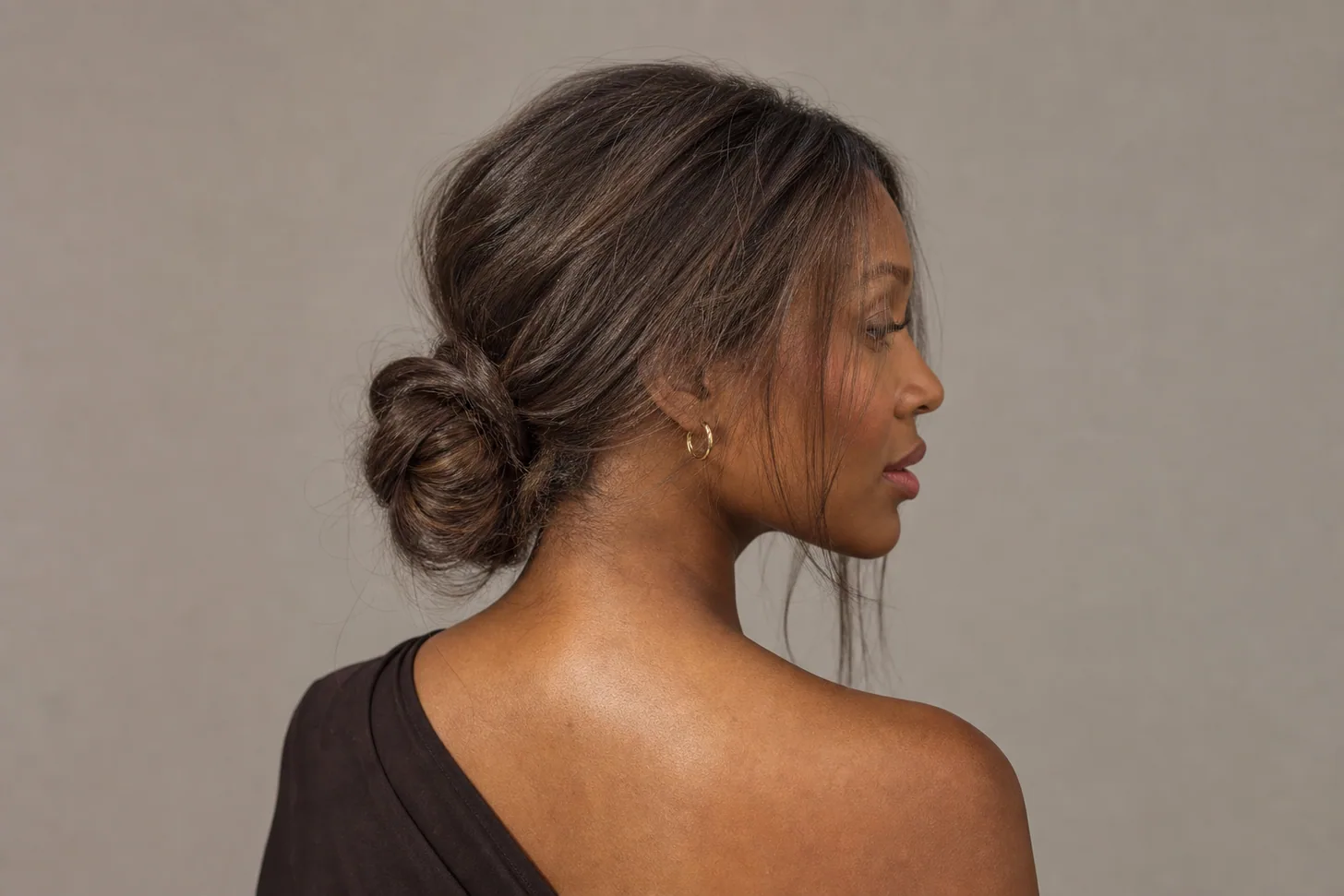
Take a section from each side, twist each one back toward the centre, then tie the two twists in a single overhand knot at the nape and secure only the tails. The knot itself carries the hold, so the fastener is doing almost no work and cannot slide out of anything. Add a second knot below the first for a longer shape. This is the most reliable structure available on hair that is both fine and slippery, and it looks considerably more complicated than it is.
Fault two: it looks stubby — the founding father pony, solved
It holds, but it reads short and stiff: a stubby tail sticking out at the nape, tapering to a point, sitting rather than falling. The community's own name for it is the founding father pony, which is both funny and diagnostically precise. There are two causes and they are separable.
The taper. Fine hair narrows toward the ends, so a ponytail is thinnest exactly where everyone is looking. Two fixes: a blunt trim, which stops the tail finishing in a point at all — see blunt cuts for thin hair — or hide the last two inches by folding them inside the style so the tapered part never shows.
The height. A ponytail at nape level has no length below it to hang from, so it juts backward instead of falling. Moving the base up two inches usually fixes the whole silhouette on its own, and costs nothing.
A low looped chignon on fine hair with the tapered ends folded up and hidden inside
5
The folded loop — the direct fix
The founding father pony's actual solution, and it takes one extra step. Tie the ponytail as usual, then instead of leaving the tail out, fold it up underneath itself into a loop and clip the fold. The tapered ends disappear inside, the shape is now a rounded loop rather than a point, and it falls against the neck instead of jutting away from it. If your hair is too short to fold fully, fold it halfway and let the ends fan — that still hides the taper, which is the part doing the damage.
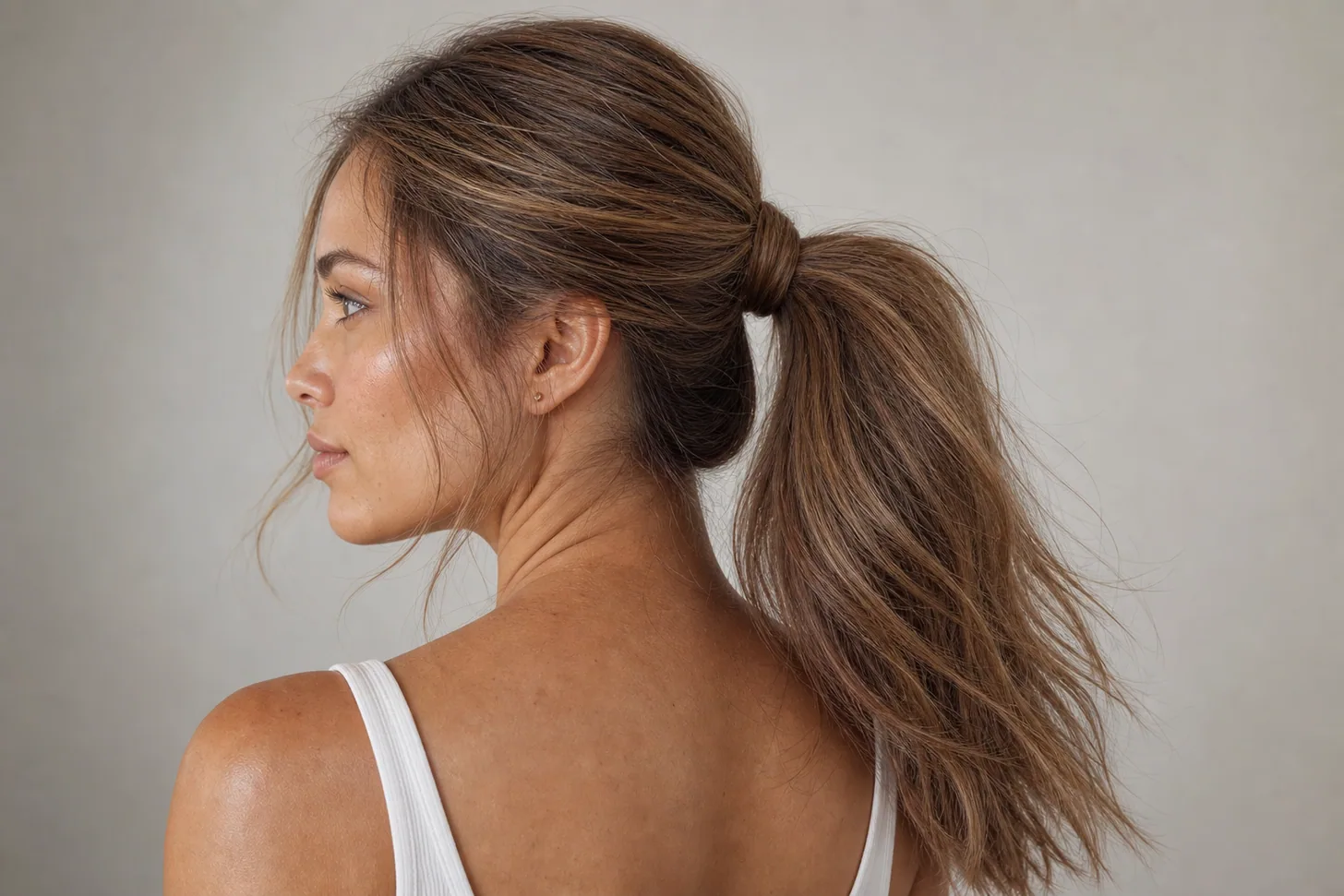
A mid-height ponytail on fine hair with a section of hair wrapped around the base
6
Raised base, wrapped elastic
Two small changes that together transform a flat pony. Set the base at the level of the top of your ears rather than at the nape, so the tail has somewhere to fall. Then take a half-inch section from underneath the tail, wrap it around the elastic, and tuck the end up under the band with one pin. Hiding the elastic removes the pinched, banded look that makes fine ponytails read as thin, and raising the base restores the movement. Ponytails for fine hair covers the volume side in more detail.
A soft low chignon on fine hair with loose face-framing pieces left down at the front
7
The deliberately undone chignon
The counterintuitive one: stubbiness reads as stiffness, and the cure for stiffness is looseness rather than more control. Build a low twisted chignon, then pull out a piece at each temple and loosen the crown slightly with your fingertips until the outline is soft rather than smooth. Fine hair looks noticeably better slightly undone than perfectly slick, because a smooth surface shows exactly how much hair is there and a soft one does not. It also buys you an inch of apparent height at the crown for free.
Fault three: it's too small
Nothing has gone wrong — there just is not enough hair in the style for it to register as one. The answer is always the same in principle: give the outside of the style something to wrap around, so the size comes from the form rather than from your hair.
A full rounded bun on fine hair built over a hair donut with the strands spread over it
8
The donut bun, spread thin on purpose
The most effective size cheat there is. Pull the ponytail through a foam donut, spread your hair evenly over the outside of it — deliberately thin, so it covers rather than bunches — then tuck the ends under and secure. The bun is now the size of the donut, not the size of your hair, and on fine hair the covering layer only has to be one strand deep to read as solid. Match the donut colour to your hair so the occasional gap does not show. Buns for fine hair has the whole family of shapes.
A wide flattened bun on fine hair with the loops pancaked outward for width
9
The pancaked bun, no extra hair required
If you want the size without buying anything, this is the technique. Build the bun as normal, then work around it pulling gently outward at the edge of every loop, flattening and widening the strands rather than tightening them. Half an inch of extra diameter is realistic and it costs nothing. Tease the section lightly at the base first so the bun starts from a wider footprint — teasing fine hair safely covers how to do that without breakage. Secure with clips at the edges rather than pins through the middle, so the width survives.
A clip-on bun form fastened over a small real bun on fine hair at the nape
10
The clip-on bun, for when you want it settled
Honest about what it is: a ready-made bun of synthetic or real hair that clips over a small real one. It takes about a minute, it is the same size every time, and for an event where you cannot afford a style to be a gamble it is the most reliable option on this page. Buy one shade lighter than you think — hair reads darker in a mass — and clip it over a tight small bun rather than a ponytail so it has a solid base. Hair toppers and pieces for fine hair covers matching and fit.
What to buy, and what to skip
If the occasion is a wedding — yours or anyone else's — the kit list is slightly different, and the timing matters more than the products.
The whole kit for this page costs less than one salon appointment, and half of it you may already own.
Small flat claw clips, three or four.The single highest-value purchase. Low-profile styles that sit close to the head, not oversized statement clips — those have nothing to close on.
One French comb.Holds an entire half-up on its own. Choose one with teeth long enough to reach through the section, which on fine hair is shorter than you would think.
Spiral or fabric-covered elastics.Less dent, less breakage at the band, and no metal join to catch. Ordinary thin elastics are the worst option for fine hair and the most common one.
A donut in your own shade.Under ten pounds and it solves fault three permanently.
Skip: oversized claw clips, thick scrunchies, and bulk bobby pins.All three are designed around having more hair than you have, and all three make the style look smaller by comparison.
The thing I would tell my clients if I could only say one sentence about updos: stop washing your hair on the morning you need it up. Freshly washed fine hair is the slipperiest material you will ever try to build a structure out of, and every style on this page performs noticeably better on day two. Brides do this to themselves constantly — washed that morning, blow-dried smooth, and then genuinely upset when the style will not hold by the time the photographs start.
When someone books a wedding style with me the first thing I say is wash it the day before. It is free, it takes no skill, and it does more than any product I could sell them. Add one or two flat barrettes to that kit — barrettes for thin hair explains why the sprung type slips and the hinged type does not.
SB
— Simone Baptiste, Senior Stylist
When an updo isn't the right move
Your hair is shorter than the jaw.A full updo needs every section to reach the same point and a bob will not. Take up what reaches and leave the rest — styling short fine hair has the half-up versions that actually work.
You wear the same tight style every day.Repeated tension in one position is a real risk on fine strands; the AAD lists tightly pulled hairstyles as a cause of hair loss. Vary the height, and keep it loose enough not to feel it.
Your hairline is thinning at the temples.Pulled-back styles expose exactly that area. A thinning hairline on fine hair covers both the coverage options and when to get it looked at.
You're sleeping in it.Don't, or at least not in anything tight. Sleeping with fine hair covers the loose overnight versions that do not cost you breakage.
FAQ
Because almost every updo technique in circulation was designed around friction, and fine hair doesn't have enough of it. A bobby pin holds by pinching a section between two arms and relying on the hair to grip back; a fine section is too slim to fill the pin and too smooth to resist it, so the pin walks out over an hour. More pins make it worse, not better, because each one is now holding even less. The fix is to switch to a fastener that grips mechanically rather than by friction — a claw clip closing around a twisted section, or a French comb whose teeth slide under a base of hair and lock against it. Change the fastener and most of the styles you'd written off start working.
It's the community's own name for the low ponytail fine hair produces by default: short, stubby, tapering to a point, and sitting stiffly at the nape rather than falling. The joke is affectionate and the diagnosis is accurate. There are two causes, both fixable. Fine hair tapers, so the ponytail is thinnest exactly where everyone looks — fixed by a blunt trim or by folding the last two inches out of sight. And a nape-level base has no length below it to fall, so it juts — fixed by moving the base up two inches, or folding the tail under into a loop. Both fixes are free and either one alone helps.
Claw clips, clearly, and it isn't close. A claw clip grips by closing its teeth around a twisted section and holding it against the head — a mechanical hold that doesn't care how much hair is in it. A bobby pin grips by friction against the hair itself, which is exactly what fine hair doesn't supply. The caveat is size: an oversized claw clip on a small amount of hair has nothing to close on and pops off, so what works is the small flat-to-the-head kind. Keep a few bobby pins for tacking down individual loose pieces near the hairline, which is what they're genuinely good at, and stop asking them to hold structure.
Three things, in order of how much they add. Build the bun around a form rather than around itself — a donut or clip-on bun gives the outside a shape to wrap, and the bun ends up the size of the form. Second, pancake it: once it's secured, pull gently outward at the edges of each loop to flatten and widen the strands, which is worth about half an inch of apparent diameter for free. Third, tease the section lightly at the base before you twist so the bun starts from a wider footprint. All three together take a genuinely small bun to a convincing medium one.
The twist-and-clip. Gather everything at the back, twist the whole length upward against your head until it wants to sit flat, fold the ends down inside the twist, and close a small claw clip over it vertically. Fifteen seconds, one fastener, and it holds better than anything requiring pins because the clip is gripping a twisted rope rather than a smooth section. It's also the most forgiving on second-day hair, which has enough grip to hold a twist with no product at all. If you take one thing from this page, take this and stop reaching for the elastic.
Texture spray or dry shampoo before, hairspray only after — and the order matters more than the products do. Fine hair fails at updos because it's too slippery for anything to grip, so what you need is friction on the raw hair before you start building, and a light dry texture spray at the roots and mid-lengths supplies that in about thirty seconds. Hairspray does the opposite job: it fixes a shape once the shape exists, and used first it makes the hair stiff and harder to manipulate without adding real grip. The best trick is free — do updos on second-day hair rather than freshly washed.
Yes, as long as you stop trying to gather all of it. A full updo needs every section to reach the same point, and on a bob it won't — which is why the attempt ends in a nest of falling pieces. The versions that work take up the parts that reach and deliberately leave the rest: a half-up twisted at the crown and clipped, two small twists pinned back behind the ears, or the bottom section rolled under and clipped while the front stays down. From the front these read as updos; they just aren't, structurally. Once you stop fighting that they become the easiest styles you own.
The style itself doesn't, but the tension and the fasteners can. Fine strands break more easily than thick ones at the same pull, and dermatologists specifically flag repeatedly-worn tight hairstyles as a cause of hair loss over time. The rules are simple: vary the height and position day to day so the same follicles aren't always loaded, use fabric-covered or spiral elastics rather than anything with a metal join, don't pull the hairline tight enough to feel it, and take the style down before you sleep. Loose updos held by clips are gentler than tight ones held by elastics — which is convenient, since they also look better.
Images in this article are AI-generated illustrations, not photographs of real clients or results. See our image policy.
Results vary with hair type, density, and growth patterns. This guide is educational and not a substitute for an in-person consultation with a licensed stylist.
Get the good hair intel
One honest, stylist-written guide in your inbox each week. No hype.

 SB
SB