Chair-side note
The tell that a client's real problem is straightness rather than fineness is what happens on holiday. If she comes back from a week by the sea saying her hair looked amazing and she doesn't know why, she has straight hair that responds to grip — salt and humidity roughened the surface, the strands stopped sliding past each other, and the whole head sat up.
That's not a moisture story and it isn't a volume-product story. It means the lever for her is texture and friction, not weight and hydration, and she has probably spent years buying the wrong half of the shelf. I ask about holidays before I ask about products now.

MH
Fine and straight are two different measurements
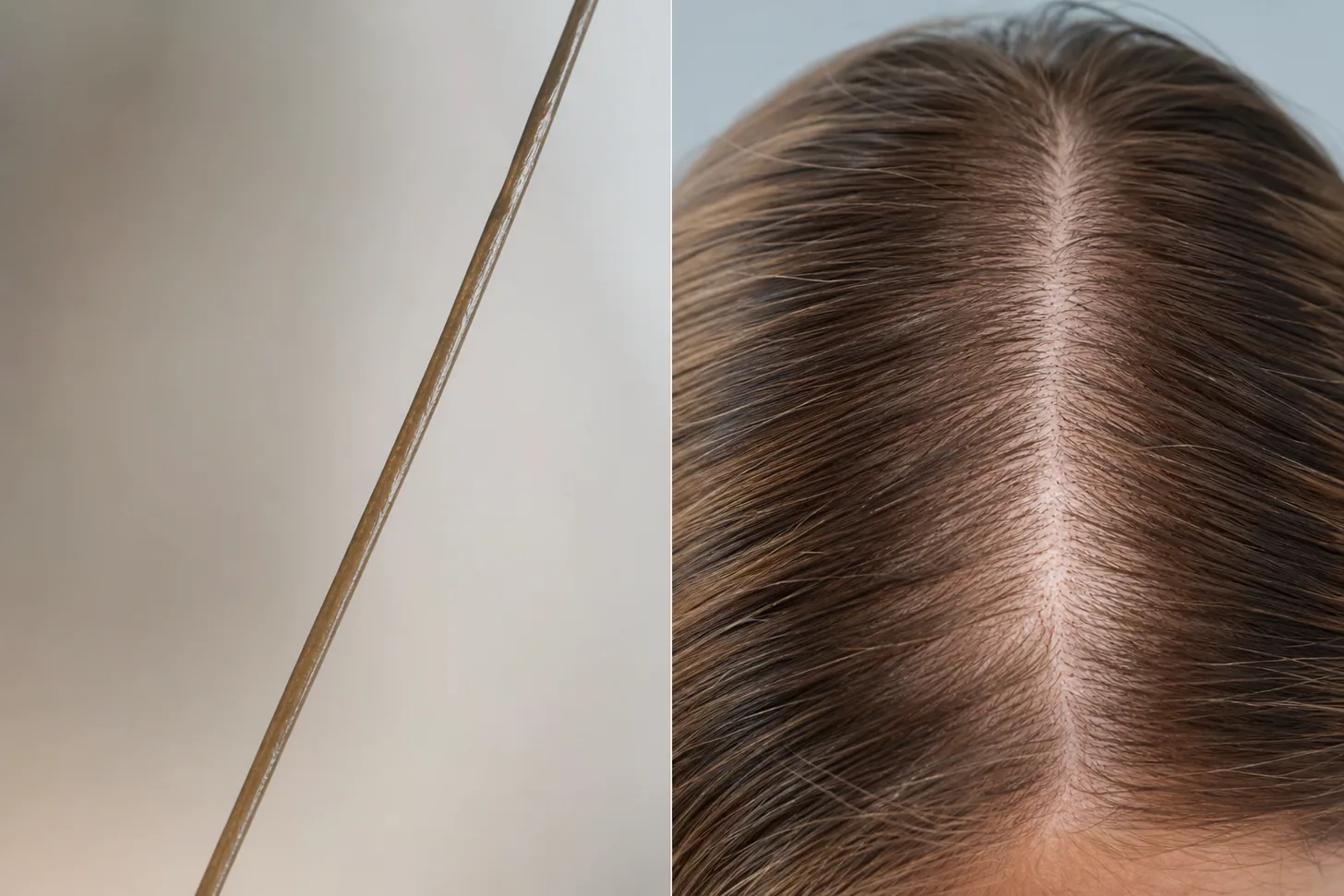
Hair gets described by at least three independent properties, and they get collapsed into one word constantly. Fine is the width of a single strand. Thin is how many strands you have per square inch of scalp — that's density, and it's a different question, covered in fine hair and thin hair aren't the same thing.
Straight is the shape of the fibre, which is set by the shape of the follicle it grew out of: a round follicle produces a round shaft that grows straight, and a progressively more curved, oval follicle produces a wave or a curl.
You can have any combination. Fine and wavy. Coarse and straight. Fine, straight and dense. The reason this matters is that the advice attached to each property is different, and in places contradictory — the fine-hair rulebook says use less product, and the straight-hair problem is often solved by using more of a different kind.
Three reasons straight hair falls flat — and fineness makes each one worse
A straight strand has no bend to hold its neighbours apart
This is the big one. A wave is a series of bends, and bends are structural: they hold each strand off the one beside it, so the hair traps air and occupies more space than the strands themselves account for.
Straight strands have nothing keeping them apart, so they stack. Two heads with an identical number of identical strands will look noticeably different if one is straight and one is wavy, and the straight one will look like it has less hair.
That's also the honest explanation for a complaint we hear constantly: hair that "went thin" in a person's forties when the strand count didn't change much. What often changed is the wave — texture shifts with age, and losing a bend costs you volume without costing you hair. If you're not sure which happened to you, fine hair or thinning walks through the checks.
A straight shaft is an efficient path for scalp oil
Sebum travels down the outside of the hair from the scalp, and the shape of the shaft decides how well.
A review of Black women's hair and scalp dermatoses in Anais Brasileiros de Dermatologia puts it directly: a curled shaft "impairs the normal distribution of natural oils along the hair shaft, from root to tip," while a straight, regular surface "allows a better reflection of light and a homogeneous distribution of sebum." Straight hair is a good wick, so oil reaches the mid-lengths quickly and evenly.
That's genuinely useful for condition — straight hair is rarely dry through the middle — and it's terrible for volume, because oil is weight and weight is what pulls roots down.
It's why fine straight hair is flat on day two rather than dry on day two, and it's why the fix is a wash-and-weight problem rather than a moisture problem. How often to wash fine hair covers the schedule; fine, oily hair covers it when the scalp is genuinely overproducing.
There is no built-in curve for a set to reinforce
Any curl you put in with heat is held by hydrogen bonds, which break when hair is wet or hot and re-form as it cools and dries.
They re-form in whatever shape the hair is in at that moment — but they're fighting the fibre's own resting shape, and for straight hair the resting shape is a straight line. Wavy hair sets easily because the set and the fibre agree. Straight hair is being asked to hold a shape it's actively relaxing out of.
Which is why the two things that matter most for curling fine straight hair are cooling and time, not temperature — the full method is in how to curl fine hair so it actually holds.
If you got here from "Asian thin hair", read this first
This is the correction that matters most on this page, because the advice everywhere else is likely to be wrong for you.
Population averages are not individual diagnoses, and plenty of people of East Asian descent do have genuinely fine hair. But the averages run firmly the other way.
A 2020 review in Clinical, Cosmetic and Investigational Dermatology reports Asian hair as having the greatest cross-sectional area of the three hair types studied — 4804 ± 159 µm², against 3857 ± 132 µm² for Caucasian hair — together with the most circular cross-section and the lowest average curvature. Scalp density, meanwhile, averaged 175 ± 54 hairs/cm², below the Caucasian average of 226 ± 73.
Read those two numbers together and a specific picture appears: fewer strands, each of them wide, and all of them dead straight. The hair looks sparse — that's the density figure — and it behaves stiff and slippery, which is the diameter and the round cross-section. It is not fine hair, and the fine-hair playbook actively works against it:
- "Use as little product as possible" — a wide strand can carry more weight before it collapses. Under-dosing is why nothing seems to do anything.
- "Avoid heavy conditioners" — a round, low-porosity, thick-cuticled fibre is hard to get moisture into, and it will take a richer conditioner without going limp.
- "Skip layers" — the blunt-perimeter rule exists to protect fine ends from looking transparent. Wide strands don't go transparent.
If that's your hair, the page you want is thin but coarse hair, which is written for exactly this combination. Come back here for the straightness half — that part still applies.
Which combination do you have?
Roll a single shed strand between your finger and thumb in good light. If you can barely feel it, it's fine; if it registers as a distinct thread, it's medium or coarse. Then look at your part in bright light for density. Those two answers put you in one of these rows.
Five things that actually hold on fine, straight hair
Grip beats hold
A hairspray glues a shape in place from outside; grip changes what the strands do to each other. Because straight strands slide past one another, anything that roughens the surface slightly — a texture spray, a dry shampoo used on clean hair as a styling product rather than a rescue, a light salt-free wave spray — gets you volume that doesn't feel like product.
This is the single biggest shift for straight hair specifically, and it's the reason the sea-air effect happens. Start with a texture spray and use it at the roots and mid-lengths, not the ends.
The roots decide the day, and they're decided while wet
Straight hair dries in the direction gravity puts it in. If it air-dries lying down against the scalp, it stays lying down until it's next wet — no amount of afternoon fluffing changes a set that's already fixed. Ninety seconds of directed heat at the roots, head tipped forward, while the hair is still damp, is worth more than any product applied later. The full sequence is in how to get root volume in fine hair.
Conditioner from the ears down, always
Because a straight shaft distributes oil so well, the mid-lengths and ends are usually in better shape than you think, and the roots need nothing at all. Conditioner on the top third is the most common self-inflicted cause of flat straight hair. Keep it to the lengths and rinse longer than feels necessary — see how much conditioner fine hair actually needs.
Keep the perimeter blunt and put the movement inside
Straight hair displays every cut line honestly, so visible layers show as steps and tapered ends show as transparency. The cut that suits it is a blunt hemline with the layering hidden in the interior — ghost layers exist for this exact problem. And say no to thinning shears and razors out loud; on straight fine hair the result is visible for a year.
Set it cool, and let it cool
Whatever shape you put in, straight hair holds it only from the moment it finishes cooling. Blow-dry a section around a brush and drop it warm and it falls; pin it to your head, let it go cold, then release, and it holds for hours.
The same applies to rollers, which outperform an iron on fine straight hair for precisely this reason — the hair cools in the shape rather than after it. Heatless overnight methods use the same physics and are covered in heatless volume for fine hair.