Reviewed by Tara Sullivan · Updated July 2026 · 9 min read
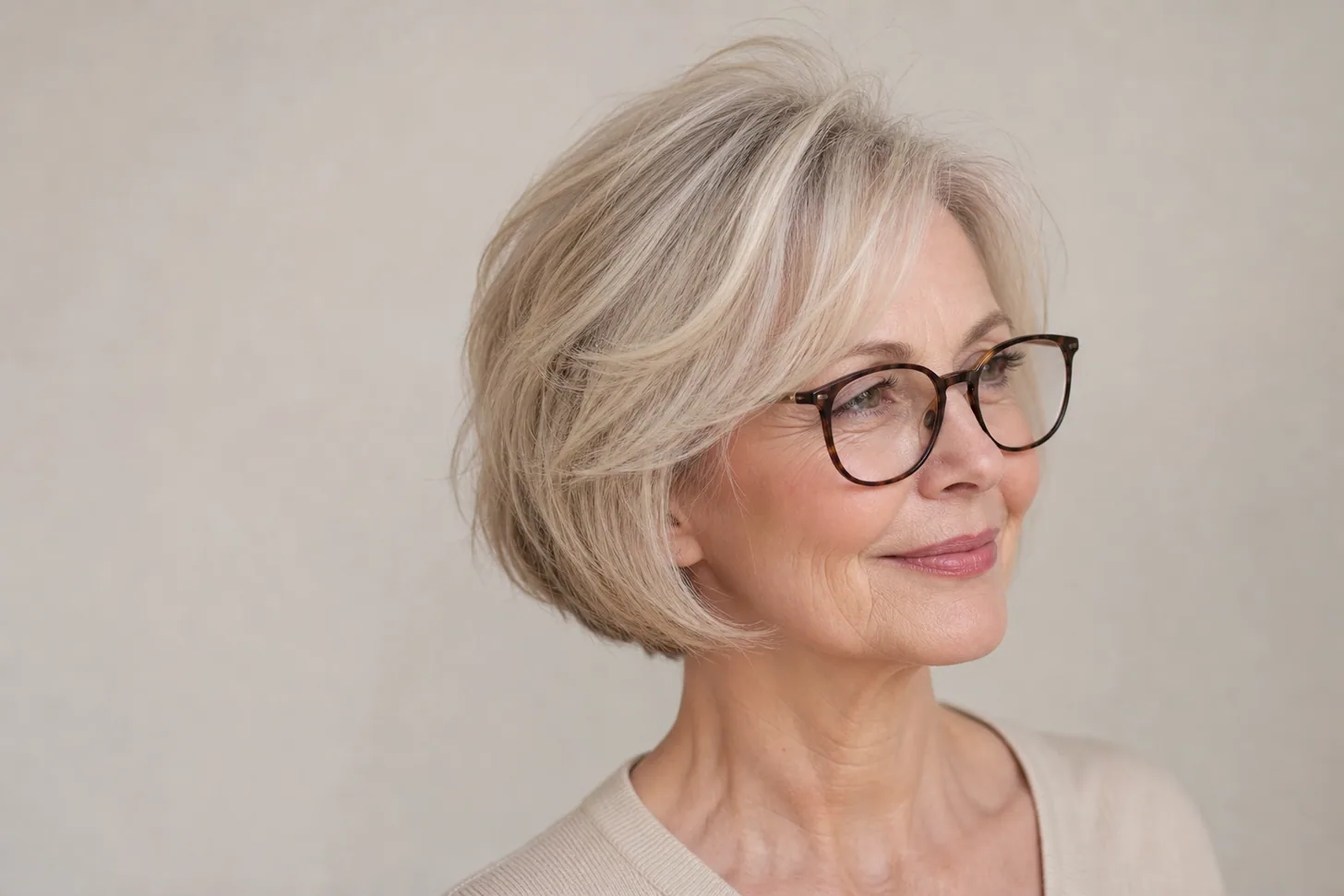
Fine hair usually changes in your 50s — it loses a little density, the texture shifts, and length that looked full at 35 can start to hang. The cuts that flatter it now do three things: keep weight in the ends, build lift at the crown, and soften the face without looking severe.
Below are 16 salon-tested cuts for fine and thin hair over 50, from short textured shapes to bobs, lobs, and softer medium styles, each with who it suits and the exact words to bring your stylist — plus an honest note on length.
Chair-side note
The request I hear most from clients over 50 is "I don't want to look like I've given up, but I don't want to look like I'm trying too hard either." The answer is almost never a shorter, tighter set — it's a modern shape with soft volume and a length that suits your density now.
Two changes do most of the work: go a little shorter than you think, because shorter reads fuller on fine hair, and add soft dimension in the colour so the surface has movement instead of showing scalp. A blunt line plus lived-in colour looks current at any age; a flat, one-length, single-block colour is what actually ages fine hair.
SB
— Simone Baptiste, Senior Stylist
What changes for fine hair over 50
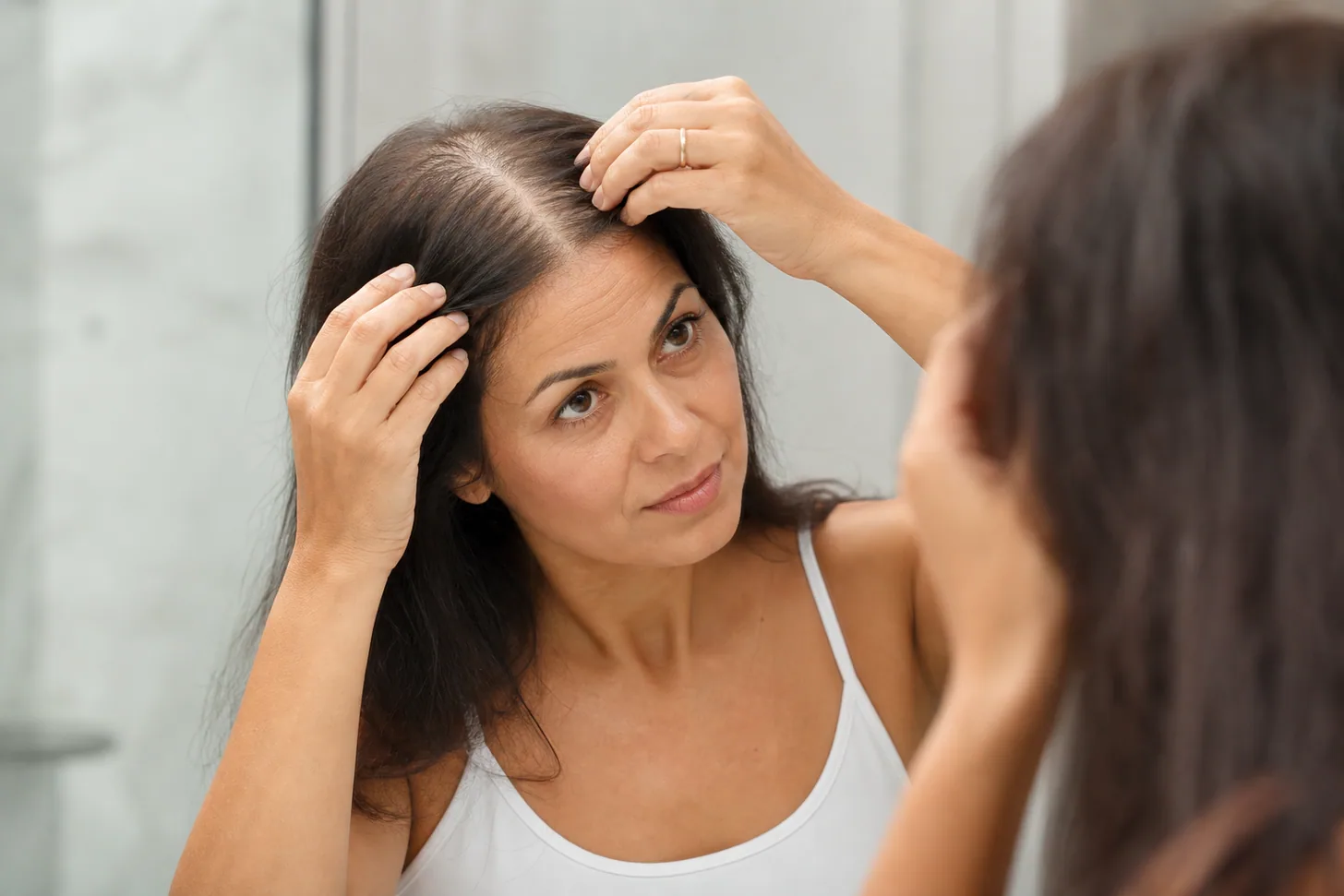
Two things tend to happen at once. Individual strands lose a little diameter, so fine hair feels finer, and overall density often drops — commonly around menopause — so there's simply less hair than there was. That's a normal part of aging, but it means a cut designed for your hair at 35 may not flatter it now.
The good news is that fine hair over 50 responds beautifully to the right shape: shorter lengths look fuller, weight lines fake density, and soft layers add the lift that time takes away. If you're seeing more scalp than you used to, or a widening part, it's worth reading our honest guide to fine hair versus thinning and, if it's sudden or patchy, checking in with a doctor — but for the gradual, all-over fineness most of us notice, the fix is in the cut.
And if you're a decade further on, our dedicated edit of hairstyles for fine hair over 60 carries the same thinking into shorter, lower-upkeep territory. If the change felt like it started a decade earlier, that is usual — perimenopausal hair thinning covers the run-up.
Short cuts that add fullness over 50
Short is where fine hair looks fullest, because there's the least length dragging the roots down. These four build volume up top and take the least effort to style. The full short-length gallery for this decade is short hairstyles for thin hair over 50.
textured pixie cut with piece-y layers and volume on top on fine hair over 50
1
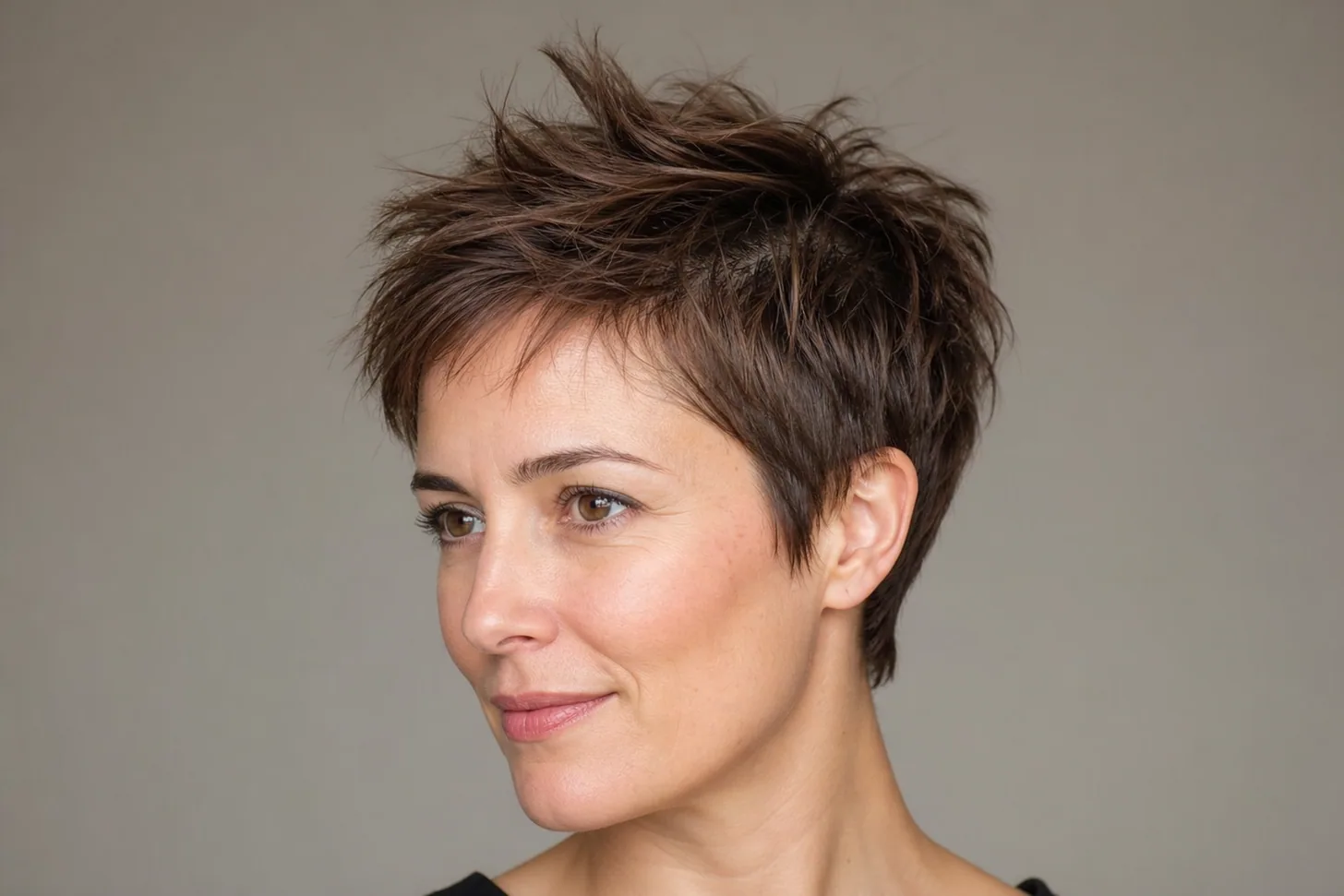
The textured pixie
A pixie cut with piece-y, point-cut layers on top is the fullest-looking cut you can wear on fine hair, because every bit of length works to build height rather than hang. It's modern, low-fuss, and flattering over 50 when kept soft rather than cropped tight. Ask for length and texture through the crown, tapered — not buzzed — at the sides.
graduated stacked bob with volume at the crown on fine thin hair over 50
2
The graduated bob
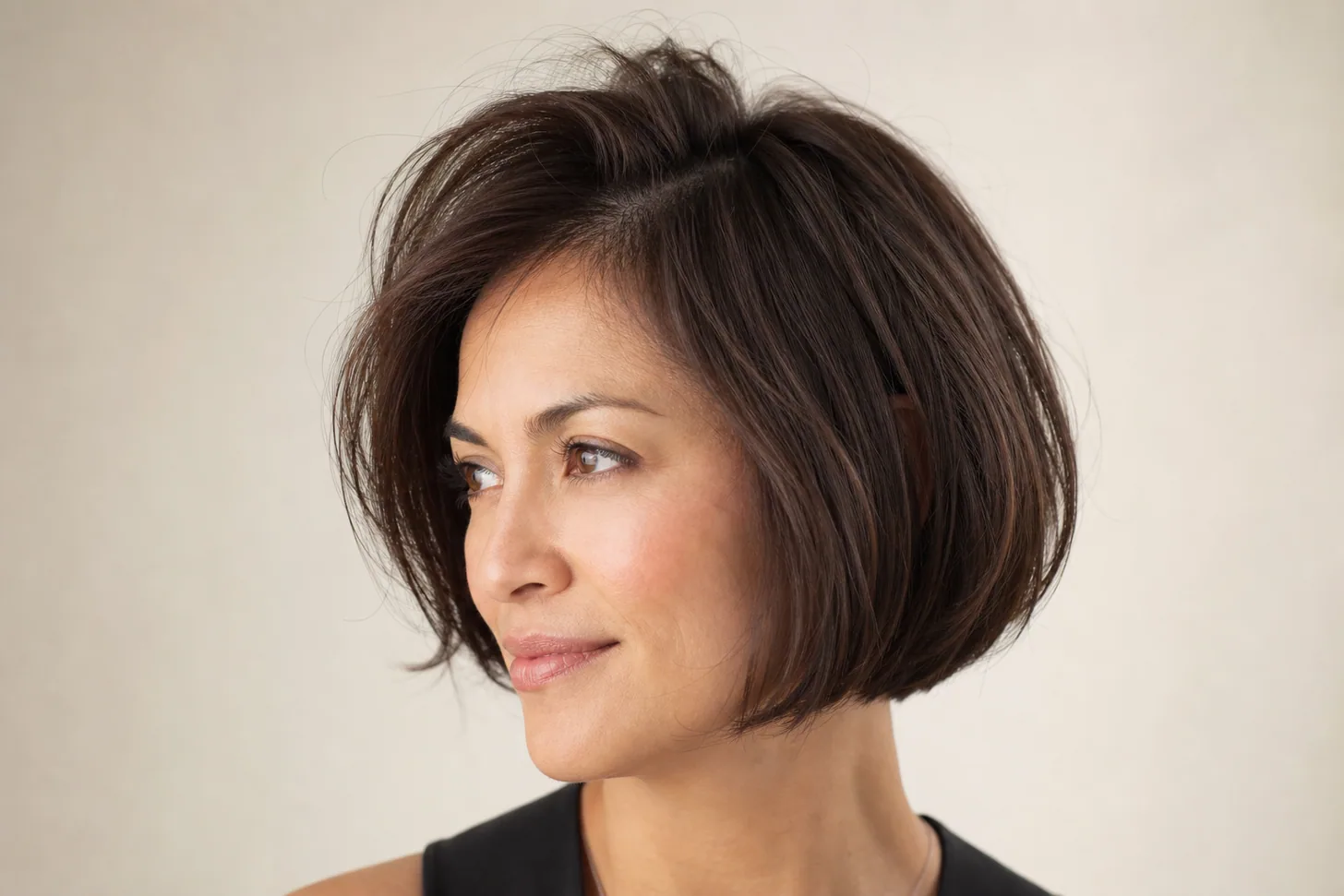
The single most requested cut for fine hair over 50, and for good reason. The internal graduation at the back props up the crown while the blunt perimeter keeps the ends dense — density built two ways at once. It suits nearly every face shape and grows out gracefully. The classic for a reason.
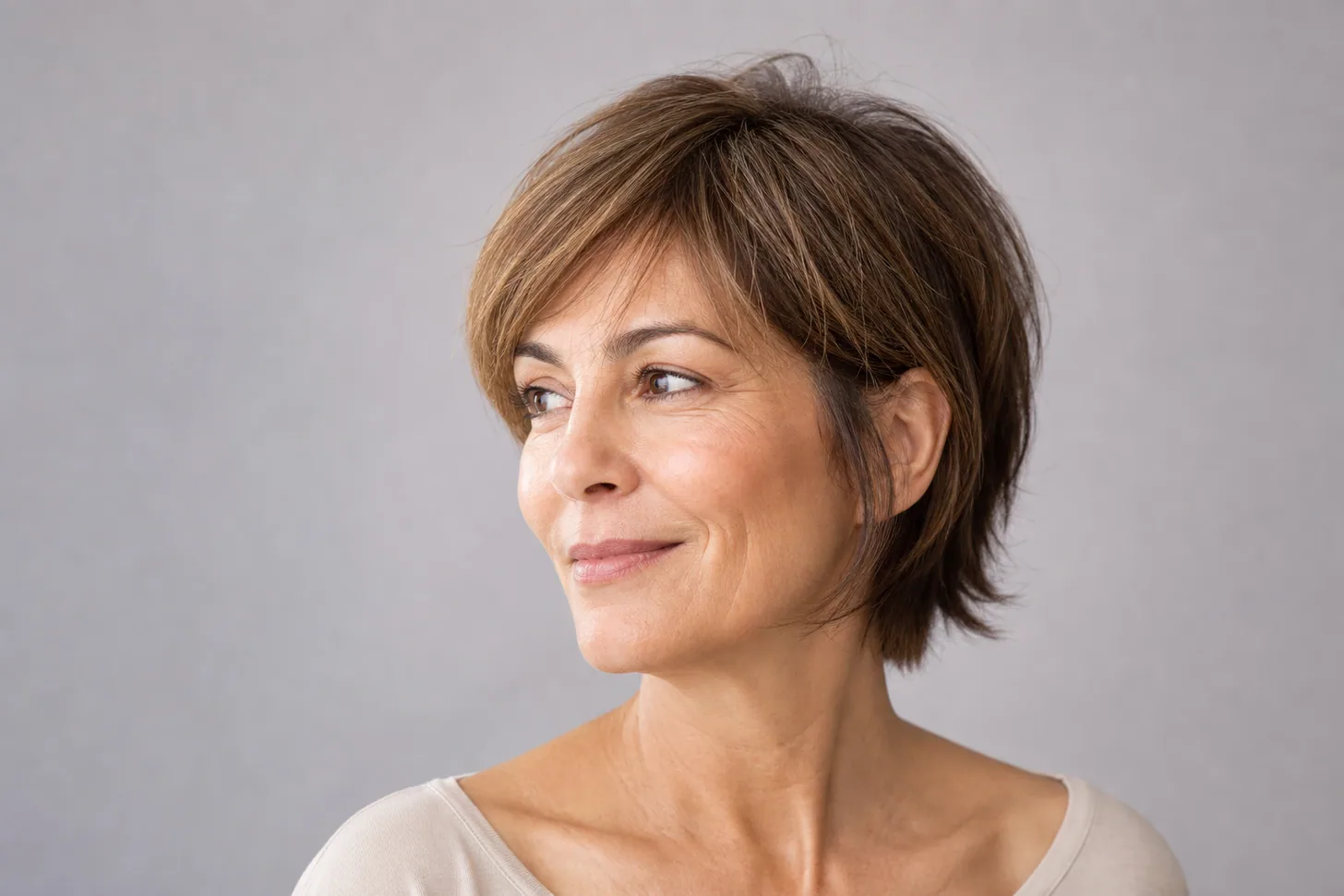
short textured crop with soft layers on fine grey hair over 50
3
The soft textured crop
A little longer and rounder than a pixie, the crop keeps some weight through the sides while texturing the top for lift. It's a gorgeous way to wear emerging grey or silver, because the texture catches the light and shows off the colour. Wash-and-wear with a little product; ideal if you want short but not severe.
long pixie with longer layers on top swept to the side on fine hair over 50
4
The long pixie
The gateway short cut: longer on top and through the fringe, so you can sweep it to the side and still feel like you have length to play with. It gives the crown volume of a pixie with a softer, more feminine finish, and it's the easiest short cut to grow back out. A smart first step if you're nervous about going short.
Bobs & lobs over 50
If a pixie feels too short, the bob-to-lob range is the heart of flattering fine-hair cuts over 50 — enough length to feel like yourself, short enough to hold body.
chin-length blunt bob with a strong weight line on fine straight hair over 50
5
The chin-length blunt bob
A blunt bob at the chin puts all the weight in one clean line right where it frames the jaw, and that solid edge reads as fullness. It's crisp and modern, and it lifts the face by drawing attention to the jawline. Best on straight-to-slightly-wavy fine hair; ask for it blunt, with maybe a hint of internal layering for movement.
angled A-line bob longer at the front on fine hair over 50
6
The angled A-line bob
Shorter at the back, longer at the front — the angle stacks weight behind the crown for lift while the longer front pieces flatter and elongate the face. It's especially good on round and heart shapes over 50, where the front length slims and the back volume fills. A little more styled than a blunt bob, and worth it.
layered lob at the collarbone with soft movement on fine hair over 50
7
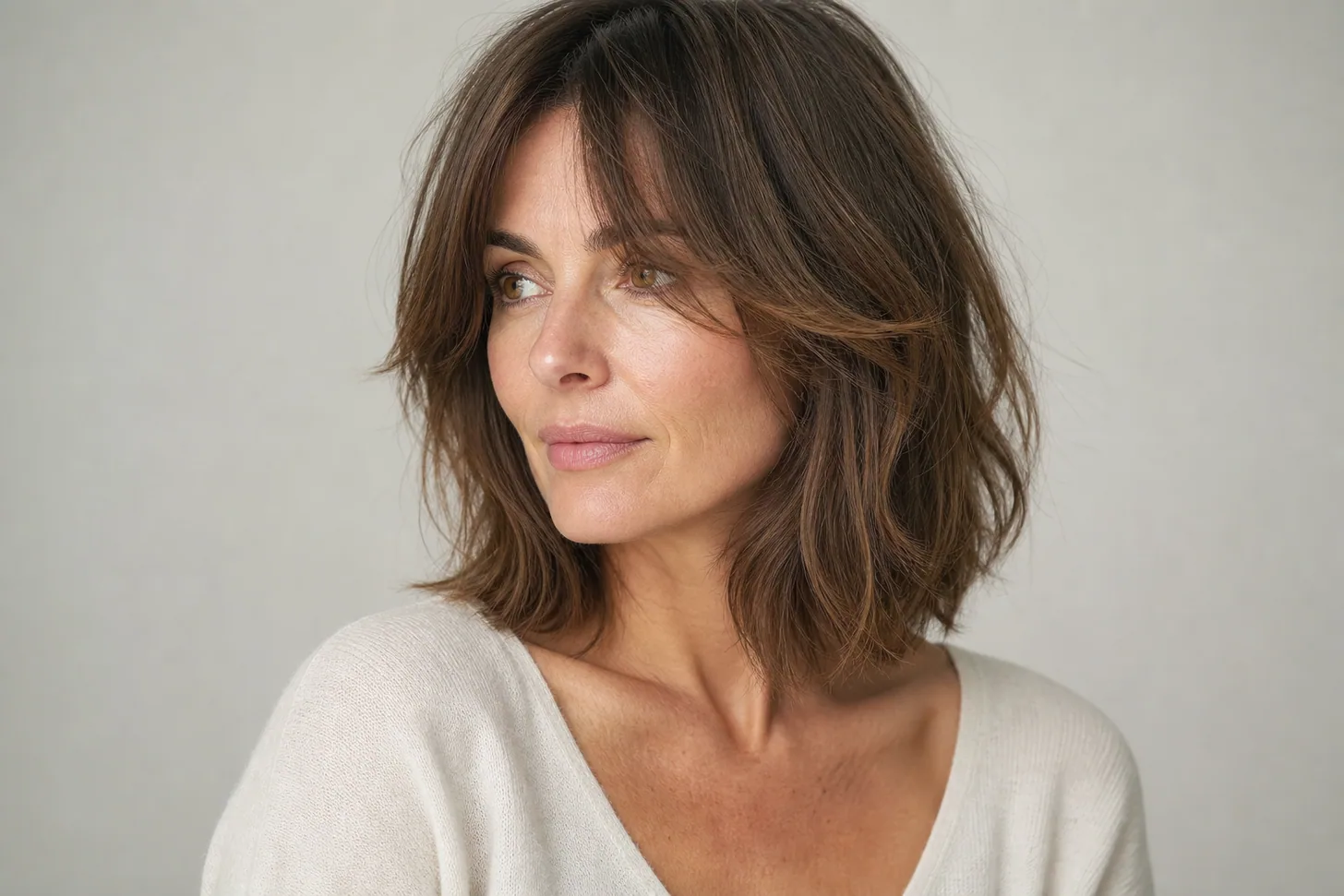
The layered lob
The lob is the longest length that reliably holds volume on fine hair, which makes it the go-to for women over 50 who aren't ready to go short. Soft internal layers add movement over a collarbone-length line. It's versatile enough to tuck, tie, or wear down, and it reads younger than long, flat length.
bob with soft curtain bangs framing the face on fine hair over 50
8
The bob with curtain bangs
Adding soft curtain bangs to a bob does two flattering things at once: fullness at the hairline and a softened forehead. The center-parted fringe blends into the length so it never looks heavy, and it draws the eye up to your eyes. One of the most face-flattering combinations over 50 — as long as you'll keep up the trims.
Softer medium styles over 50
Not everyone wants to cut short, and you don't have to. These medium shapes keep length while building in the body and softness that flatter fine hair over 50. The earlier rung on the same ladder is medium length for fine hair over 40; if you want to keep real length instead, long hairstyles for fine hair over 50 is honest about when that works.
collarbone-length cut with soft internal layers on fine hair over 50
9
The soft-layered collarbone cut
A medium collarbone length with gentle internal layers is the longest I'd usually recommend over 50 — any longer and fine hair starts to drag. Kept blunt-ish at the ends with soft layers inside, it has movement without losing density. The compromise cut for anyone who wants to keep real length.
medium shag with textured layers and a fringe on fine hair over 50
10
The medium shag
The shag is having a moment for good reason — its piece-y layers build volume around the face and crown, and the lived-in texture hides fine hair's flatness. On women over 50 it reads modern and a little cool rather than fussy. Lean into a bit of texture spray and skip the perfectly smooth blowout.
medium cut with face-framing layers and a deep side part on fine hair over 50
11
The face-framed side part
A medium length with shorter face-framing pieces and a deep side part — the framing adds movement at the front, and the side part lifts the crown instantly. It's the most restyleable option here: switch the part deeper on flat days for immediate height. Flattering because the framing softens the face while the length stays.
blunt shoulder-length cut worn simple on fine grey hair over 50
12
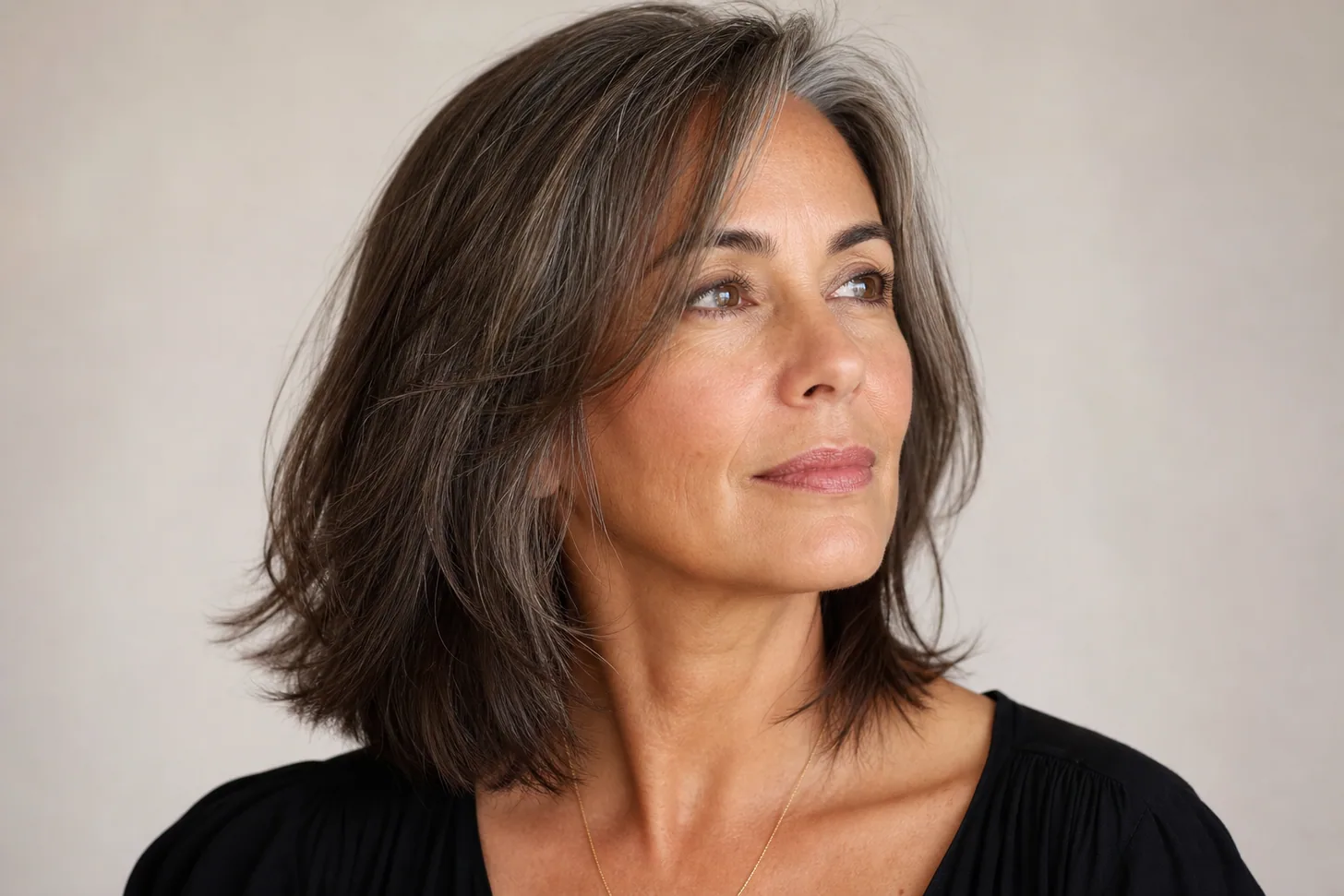
The blunt shoulder length
For those keeping length: a blunt, shoulder-grazing cut with a heavy perimeter and minimal layering. The weight all sits in that bottom line, so even at this length the ends look dense rather than wispy. It's a beautiful canvas for silver hair worn straight and glossy — proof that length can work over 50 if the line is strong.
Flattering details & finishes over 50
Sometimes it's not the length that changes everything but a detail — a fringe, a colour choice, a low-upkeep finish. These four are the tweaks that modernize any of the cuts above.
cut with a soft wispy fringe softening the forehead on fine hair over 50
13
The soft wispy fringe
A light, see-through fringe is one of the most flattering additions over 50 — it softens forehead lines, frames the eyes, and adds fullness at the hairline. Keep it airy and point-cut, never a heavy blunt block, so it flatters fine hair instead of exposing it. Works over a pixie, bob, or medium length alike.
chic silver grey blunt bob worn glossy on fine hair over 50
14
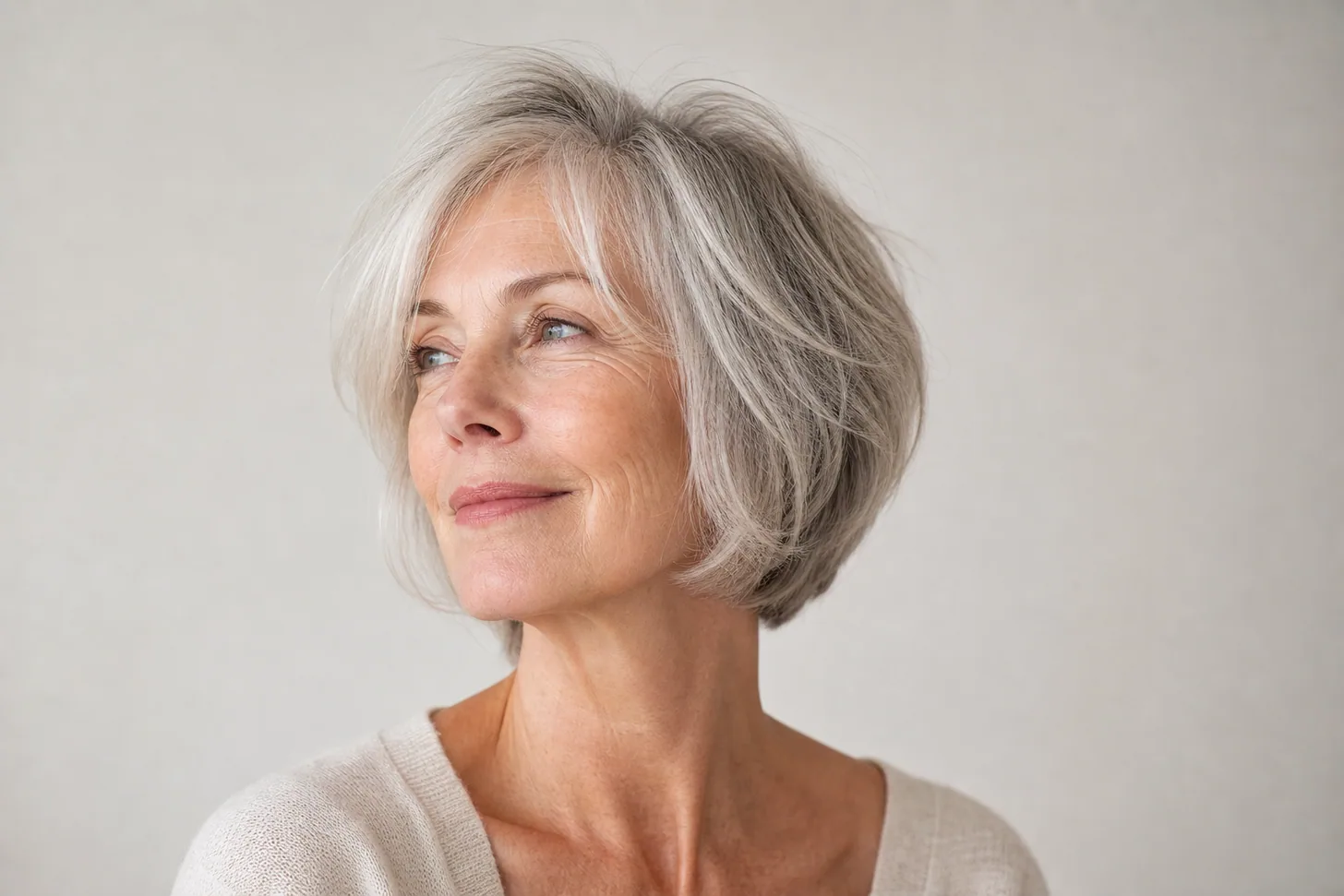
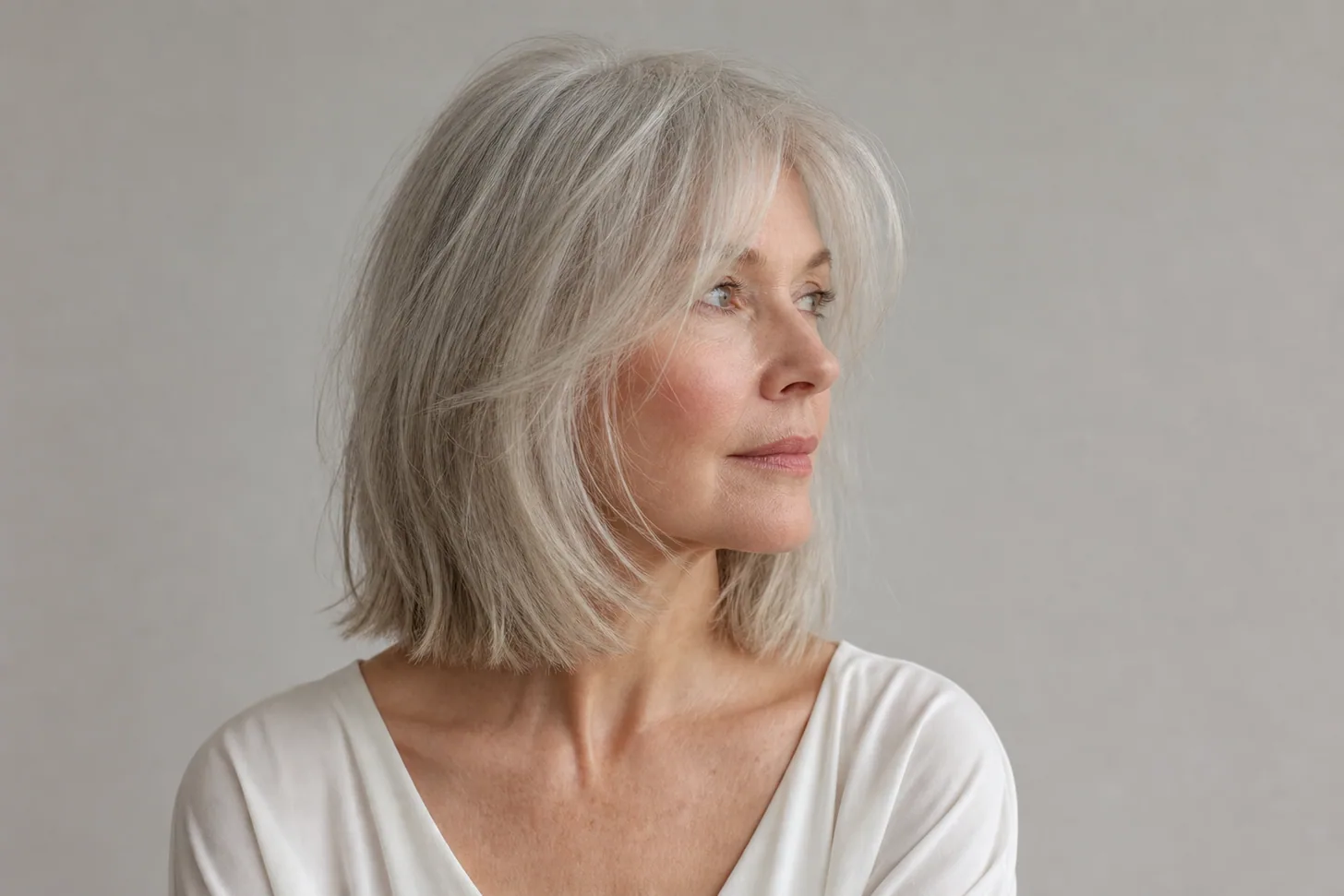
The polished silver
If you're growing out grey, a sharp, blunt shape is your best friend — a crisp line makes silver look deliberate and chic rather than dated. Glossy, well-conditioned grey on a clean blunt bob is one of the most striking looks over 50. The cut does the talking; the colour is the statement.
modern cut styled to sit well with glasses on fine hair over 50
15
The glasses-friendly shape
If you wear glasses, the cut needs to play with the frames, not fight them — a fringe kept above or blended around the temples, and volume built at the crown rather than the sides so the shape doesn't widen behind the arms. A soft side-swept fringe and a lifted crown flatter almost every frame. Bring your glasses to the appointment.
low-maintenance wash-and-wear cut air-dried on fine hair over 50
16
The wash-and-wear
If you'd rather spend zero minutes styling, a low-maintenance cut built around your natural texture is the goal — a shape that air-dries into place and just needs a regular trim to hold its line. Ask your stylist to cut for how your hair actually falls, not for a look that only works with a round brush. Freedom, not fuss.
Choose your cut for your face shape
Face shape matters as much at 50 as it ever did. Use this as a starting point, then confirm with your stylist — the full method is in our guide to finding your face shape.
Balanced proportions carry a pixie, bob, or lob equally well.
Round
Angled bob or long pixie
Height at the crown and length at the front lengthen a rounder face.
Square
Soft layered bob or wispy fringe
Rounded, soft edges balance a strong jaw.
Heart
Chin-length bob with curtain bangs
Width at the jaw and a soft fringe balance a wider forehead.
Long / oblong
Bob or medium with a fringe
A fringe shortens the face; keep width at the sides.
What to ask your stylist
Bring the reasoning, not just a photo of a younger celebrity. Try: "My hair is fine and it's lost some density — I want a modern shape that looks full. Please keep the ends blunt with a strong weight line, build some lift at the crown, and keep the length on the shorter side of what suits my face."
If you're softening the face, add: "A soft, point-cut fringe or face-framing, nothing heavy." And ask about colour dimension — even subtle highlights break up the surface so fine hair reads as texture, not scalp. That conversation gets you a cut built for your hair now.
Chair-side note
The biggest mistake I see over 50 isn't the cut — it's holding onto length out of fear that short will age you. It's almost always the opposite. Long, flat, tapered fine hair is what drags the face down; a shorter shape with lift at the crown lifts the whole face with it.
If you're anxious, don't go from waist-length to a pixie in one appointment — take it to a lob first, live with it, and see how much fuller it looks. You can always go shorter next time. The root-volume basics matter more than ever now, so ask your stylist to show you the blow-dry before you leave.
SB
— Simone Baptiste, Senior Stylist
When these cuts may not be your best move
You're seeing sudden shedding, patchy loss, or a rapidly widening part. That's beyond a styling question — see our guide to fine hair versus thinning and check with a doctor before making big changes.
You genuinely love your long hair and will do the styling. Keep it, but insist on a blunt weight line and soft internal layers — and be honest about the daily blow-dry it needs.
You want zero upkeep but chose a fringe or a graduated bob. Both need regular trims and a little styling; a wash-and-wear shape fits a no-fuss routine better.
Your ends are dry or brittle. Treat and trim them first — over 50, worn ends read as thin, and no cut hides that.
FAQ
For most fine hair over 50, a chin-to-collarbone cut with a strong weight line and soft internal layers is the most flattering all-rounder — a graduated bob, a blunt lob, or a textured pixie, depending on how much upkeep you want. These lengths keep weight in the ends where fine hair reads thin, add lift where it goes flat, and soften the face without looking severe. The one thing to avoid is very long, one-length hair, which drags the roots flat and can look sparse at the ends. Pick the shortest length you're comfortable with — shorter almost always looks fuller on fine hair.
Often, yes. Hair strands naturally lose some diameter with age, and the hormonal shifts around menopause commonly reduce overall density, so fine hair can feel finer and thinner in your 50s than it did in your 30s. That's normal, but it's also worth paying attention to: gradual, all-over thinning is typical, while sudden shedding, patchy loss, or a widening part is worth discussing with a doctor. If you're unsure whether what you're seeing is normal fine hair or genuine thinning, our honest guide to telling the difference walks through the signs — and a good cut is designed around the density you have now, not the density you used to have.
You can, but it's the hardest length to keep looking full. Long fine hair over 50 tends to hang flat at the roots and thin out at the ends, which can read as sparse. If you love your length, the fixes are a blunt or heavy weight line to keep the ends dense, layers kept soft and internal, and a commitment to root-lifting styling. For many women, though, going to a collarbone or shoulder length is the single change that makes fine hair look instantly thicker and more modern. It's less about the number and more about whether the length is working for your hair.
A cut with a blunt or graduated weight line and volume built at the crown. A stacked or graduated bob is the classic — the internal layering at the back props up the crown while the blunt perimeter looks dense. A textured pixie works the same way in short form, concentrating fullness up top. Across every length, the rules are the same: keep the ends blunt rather than razored, add lift at the roots, and keep the length on the shorter side. Colour helps too — soft highlights or dimension break up the surface so the eye reads texture instead of scalp.
They can be very flattering, with the right style. Soft curtain bangs or a wispy fringe add fullness at the hairline, draw the eye up, and soften a forehead — all things that suit fine hair over 50. Keep them light and point-cut, never heavy and blunt, so they don't look like a solid block over thin hair. The trade-off is upkeep: bangs need a trim every few weeks, and fine bangs can separate or go flat, so they reward a quick blow-dry. If you want the softening effect with less commitment, a long side-swept fringe is the easiest place to start.
Volume comes from the cut, the root, and the surface. Start with a shape that has a weight line and crown layers, then build lift by rough-drying the roots and round-brushing the crown up and over, finishing with the cool shot. A lightweight volumizing mousse on damp roots gives fine hair grip without weight, and a deep side part lifts the crown instantly. Soft colour dimension also helps the hair look fuller. Steer clear of heavy oils and rich creams, which flatten fine hair fast — over 50, lightweight products and root-focused styling do more than any single miracle product.
Eleven years behind the chair, specializing in short shapes and fine-hair texture. Simone believes the best haircut is the one you can style yourself in ten minutes.
Results vary with hair type, density, and growth patterns. This guide is educational and not a substitute for an in-person consultation with a licensed stylist.
Hairstyle images in this guide are AI-generated illustrations, not photos of real clients or results. See our image policy.
Get the good hair intel
One honest, stylist-written guide in your inbox each week. No hype.

 SB
SB