Reviewed by Tara Sullivan · Updated August 2026 · 10 min read
A hot air brush is the only styling tool that applies heat and tension at the same moment, to hair that is deliberately still damp — and that combination is either the best trade available to fine hair or the fastest way to lose length, depending entirely on one habit.
Do that, and a hot air brush is usually gentler on fine hair than a dryer plus a round brush, because it's one pass instead of two and it runs far cooler than any iron. Below: why the barrel you're about to buy is too big, what "no heat damage" actually means, and six picks sorted by hair length rather than by price.
Every product here is chosen independently, on the merits — what genuinely suits fine, thin hair. Links go to each brand's official page, and we don't take payment for placement. Price tiers are rough guides because prices change.
The narrow barrel is the one most fine hair needs — and the one most people leave in the shop.
The barrel size is the whole decision, and almost everyone buys too big
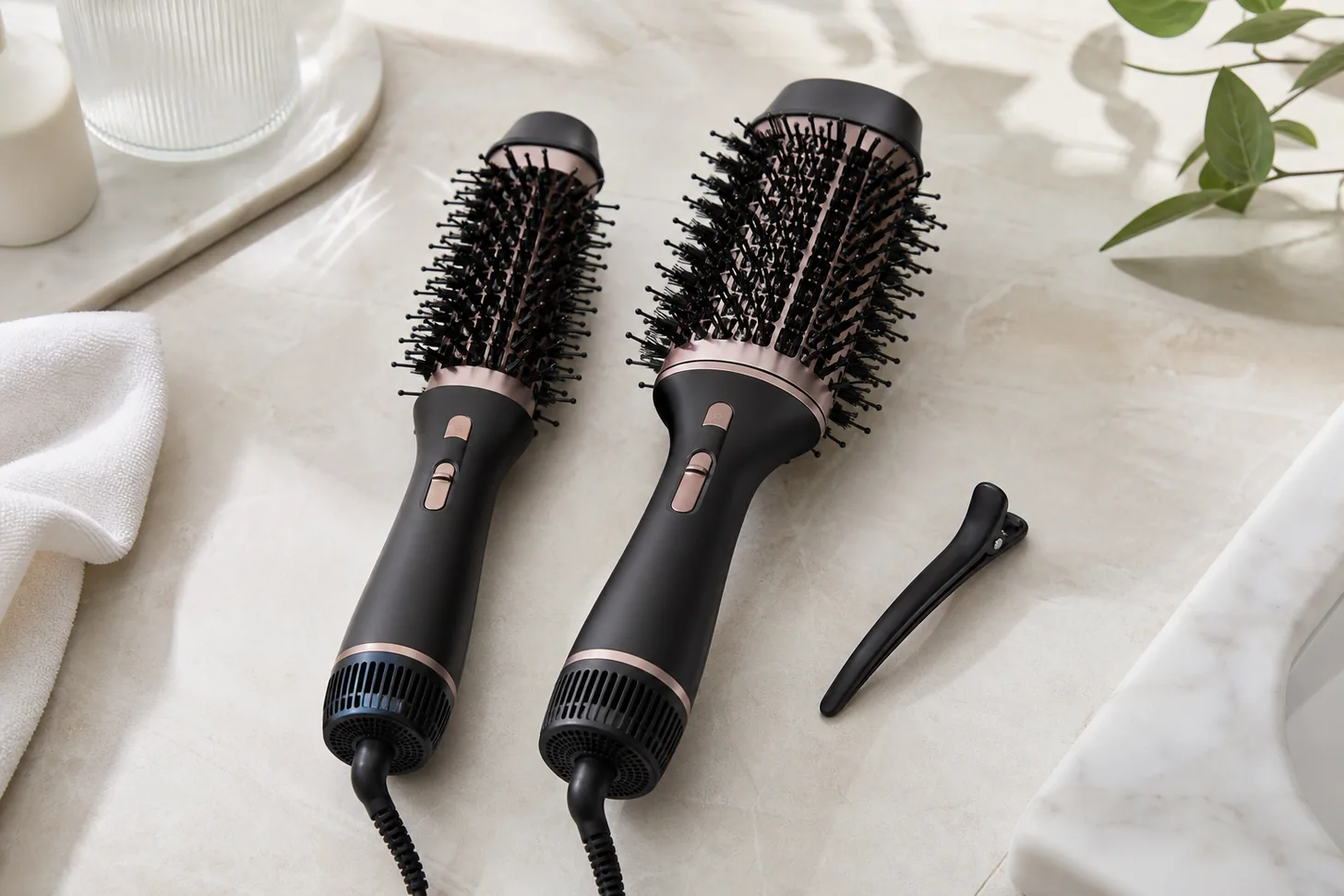
If you take one thing from this page, take this. A hot air brush creates shape by making the hair wrap around the barrel while warm air sets it. If your hair can't complete at least one full turn, you don't get a shape — you get a bend, and the bend falls out by lunchtime.
Fine hair buys the wrong size for a logical-sounding reason: a 3-inch oval looks like it will make more volume, so it goes in the basket. Then shoulder-length hair slides off it, the ends flick outward instead of turning under, and the whole thing gets filed as "hot air brushes don't work on my hair."
There's a second reason to size down that matters more on fine hair than any other type: the root. Volume on fine hair is made in the first inch.
A narrow barrel can sit underneath a section right at the scalp and push it up; a fat one physically can't get in there, so it smooths the mid-lengths and leaves the roots exactly as flat as it found them. That is the difference between a blowout and a very tidy flat head.
Barrel
Suits
What it does on fine hair
Watch for
1.5–2" (38–51mm)
Pixies, bobs, lobs, anything above the collarbone
Real root lift and a proper turn at the ends; can reach the crown
Takes more passes on longer hair — it's a small tool doing a big job
2.4–2.5" (60–63mm)
Collarbone to mid-back — the safe default for most fine hair
The best balance of lift and speed; enough curve to bevel the ends
On a short bob it's already too wide to wrap
3"+ (75mm+)
Long hair, past the collarbone, that mainly wants smoothing
Fast and glossy, mostly straightens rather than lifts
The commonest mis-buy in fine hair. No root access at all
Paddle / flat head
Any length wanting sleek, not bouncy
Smooths and polishes; no volume by design
On flat-prone fine hair this can read limp — use it on the lengths only
"No heat damage" means a ceiling, not an exemption
Every brand in this category now makes a version of the same claim, and it's worth reading precisely, because the engineering behind it is real and the wording around it is generous.
But a regulated tool is still a hot tool, and none of this addresses the other half of the trade, which is tension. What the claims should do is reassure you about a specific fear rather than all of them.
Here's the reassuring number, and it's one this category rarely puts in front of you: BondiBoost states a working range of "122-230°F" for its 51mm brush. Compare that to a flat iron, where the plates commonly run 300–450°F directly against the strand.
A hot air brush is a fundamentally lower-temperature way to shape fine hair than an iron — the heat arrives as moving air rather than as hot metal clamped to the cuticle. If you've been alternating a dryer and a straightener to get a smooth finish, replacing the second step with a brush is a straightforward reduction in heat load. The full picture on protection is in heat protectants for fine hair.
Chair-side note
When someone tells me their hot air brush "does nothing," I ask two questions and one of them is always the answer. First: how wet was your hair when you started? If the honest answer is "straight out of the shower," the brush spent its whole run evaporating water and never got to the styling part — and it did that while dragging bristles through hair at its most fragile.
Second: where did you put the brush? Almost everyone starts halfway down the section, because that's where a hairbrush goes. A hot air brush isn't a hairbrush. It goes under the section at the scalp, lifts, holds for a beat, then travels.
The other thing I'd say to anyone with fine hair: stop after the crown and the front. That's ninety percent of what anyone sees, it takes four minutes, and it leaves you with hair that hasn't had heat dragged through it end to end. A partial blow-dry done well beats a full one done in a hurry, every single time.
MH
— Megan Holloway, Editor-in-Chief
The six worth buying, by job
Sorted by who they suit rather than by price. You want one of these, not three.
T3 AireBrush Duo hot air blow-dry brush with interchangeable round and paddle heads, product shot on white
1
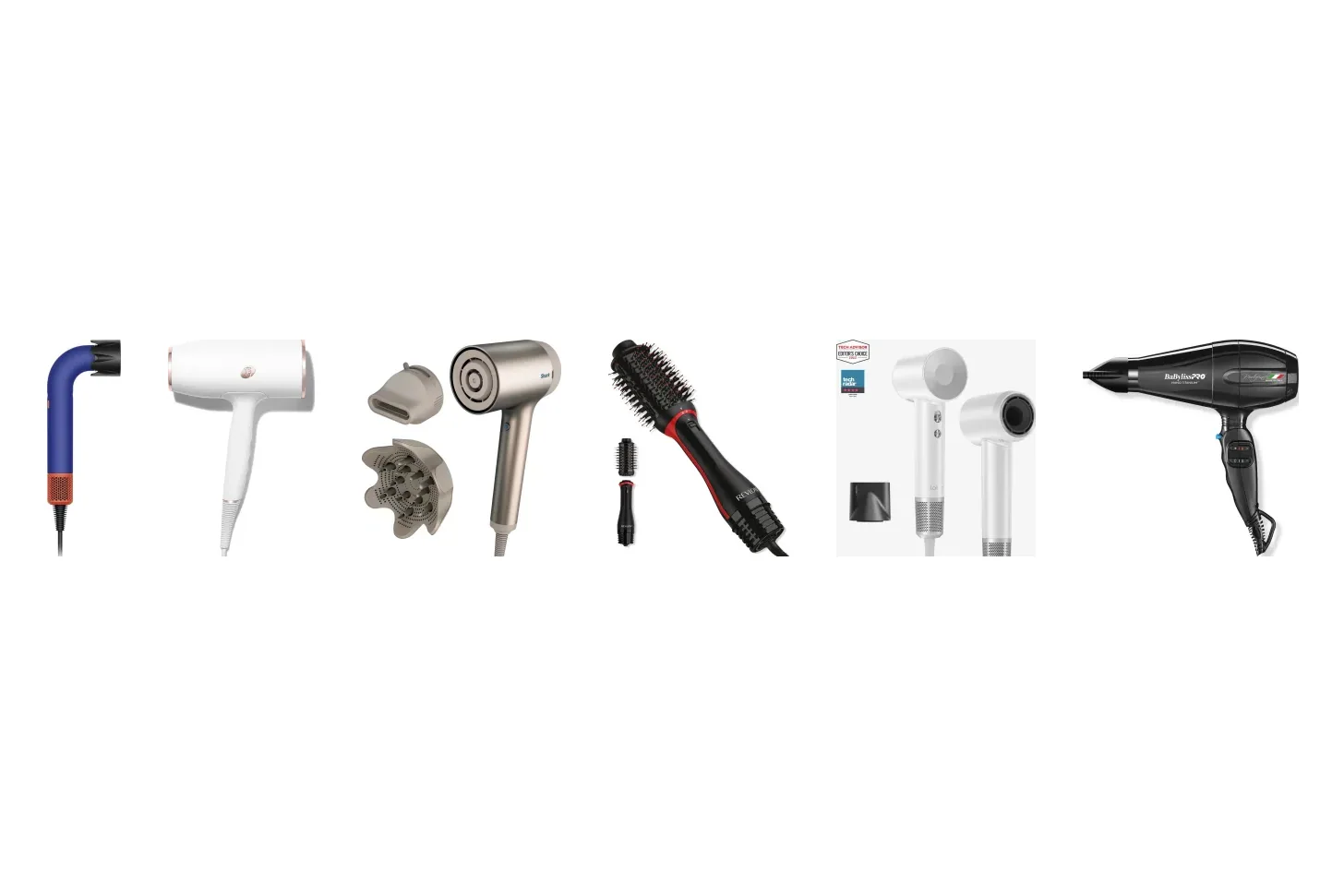
Best overall: T3 AireBrush Duo
The pick if you want the heat decision taken seriously. Most tools in this category give you three settings — low, medium, high — which on fine hair means one that's too weak and one that's too hot. T3 gives "5 Heat Settings" and "3 Speed Settings", and the brand describes its "T3 IonFlow Technology" as delivering "an ion-enriched airstream and precise, digitally controlled heat for polished, frizz-free results." The practical value of five steps is that fine hair can sit two notches below where a three-setting tool would force it. The Duo part earns its name too: a "2.5" Round Brush" for lift and a "3" Paddle Brush" for smoothing — and 2.5 inches is the single most useful barrel width for shoulder-length fine hair. The "SmoothGrip Bristles" are firm enough to hold a section without needing you to pull. Best for: shoulder-length to mid-back fine hair, and anyone whose current tool only offers "hot" and "hotter". Honest limitation: at a listed "16.4 oz" it's genuinely heavy — if you have wrist or shoulder issues, work in two sittings — and it's a premium price for a category where cheap tools work.
BondiBoost Blowout Brush Pro 75mm large oval hot air brush, product shot on white
3
Best for long fine hair: BondiBoost Blowout Brush Pro 75MM
Same brand, same bristle design, twice the barrel — and the reason it's here is that on genuinely long fine hair the small brush becomes a chore, and a chore is a style you stop doing. At 75mm (3 inches) this is a smoothing-first tool that adds body through the mid-lengths, with "Three heat/speed settings: low, medium, and high" and a detachable head so you can rough-dry with the handle first. The brand's own directions are the most fine-hair-relevant thing on the page and I'd follow them exactly: "apply a heat protectant throughout" and "dry to 70-80%" before styling. Best for: fine hair past the collarbone that wants gloss and movement more than root lift. Honest limitation: it cannot give you root volume — the barrel is too wide to sit under a section at the scalp — so if flat roots are your actual complaint, buy the 51mm or add a root product instead. See root lifters and how to get root volume.
Revlon One-Step Volumizer PLUS oval hot air brush, product shot on white
4
Best value: Revlon One-Step Volumizer PLUS
The tool that created this category, and still the sensible way to find out whether you're a hot air brush person before spending real money. It's an oval-headed one-step dryer-brush with a small number of heat and speed settings and a detachable design, and it does the fundamental job — dry and shape in one pass — competently. On fine hair the honest framing is that it's a body tool rather than a precision one: you'll get a soft bend, movement through the lengths, and a finish that reads fuller than air-drying, without the control a five-setting tool gives you. Two habits make it much safer here than its reputation suggests. Keep it on the lower heat setting, which fine hair rarely needs to exceed, and keep it moving — a one-step brush parked on a section is doing exactly what a hot roller does, without the cooling phase that sets it. Best for: a first hot air brush, and anyone unsure whether they'll use one twice a week or twice a year. Honest limitation: the oval head is wide enough that root lift at the crown is difficult, the settings are coarse compared to premium tools, and it's the model most often used on hair that's far too wet — which is where its damage reputation comes from. (Described in our own words: this brand's site declines automated requests, so nothing here is quoted from its product copy.)
Shark FlexStyle air styling system with oval brush and auto-wrap curler attachments, product shot on white
5
Best if you want one tool instead of three: Shark FlexStyle
This is a dryer that converts into a multi-styler, and the case for it on fine hair is the heat regulation plus the fact that it replaces a dryer, a round brush and a curling tool — which matters when every extra tool is another pass of heat. Shark says it "Measures and regulates temperatures 1000x per second, minimizing heat exposure" and that "Rather than getting hotter as it runs, Shark minimizes heat exposure & regulates temperatures." The kit includes "2 Auto-Wrap Curlers (1.25")" plus an oval brush, a paddle brush and a concentrator, and at "Just over 1.5lbs" it's noticeably lighter in the hand than the heaviest brushes here. The 1.25-inch curlers are the fine-hair bonus: a narrow curl barrel is what fine hair needs to hold a wave at all. Best for: anyone replacing several ageing tools at once, and fine hair that wants curls as well as a blowout. Honest limitation: it's a system, not a grab-and-go brush — swapping attachments takes time, and if you only ever want a smooth blowout you're paying for capability you won't use. Coanda-style wrapping also needs the damp level to be right, and fine hair is less forgiving of getting that wrong than thick hair is.
Dyson Airwrap multi-styler with round volumising brush attachment, product shot on white
6
The premium option, and who it's genuinely for: Dyson Airwrap i.d.
The Airwrap belongs on this list, but not for the reason it's usually recommended. Its relevance to fine hair is that it styles largely with airflow and a controlled temperature rather than with a hot surface — Dyson's stated position is that its intelligent heat control holds the airflow below a fixed ceiling, checking it many times a second, precisely to avoid the extremes that damage hair. For someone who would otherwise be reaching for a curling iron on already-fragile fine hair, that's a real reduction in risk. What it isn't is a volume machine: the round volumising brush attachment is the one worth using, and fine hair still needs product at the root to hold anything the tool creates. Best for: fine hair that heat-styles often, has the budget, and wants curls, waves and a blowout from a single low-temperature system. Honest limitation: the price is several times any other pick here and the styling result is not several times better; there's a real learning curve to the wrapping attachments, and very fine, very slippery hair can escape a curler mid-wrap until you get the section size right. (Described in our own words: this brand's site declines automated requests, so nothing here is quoted from its product copy.)
How to use one on fine hair without flattening or breaking it
The tool is half of this. Six habits are the other half, and they're the difference between a blowout that lasts three days and one that's gone by the school run.
Get to 70–80% dry first. Blot with a t-shirt or microfiber towel — don't rub — then rough-dry on medium. Towel-drying fine hair covers why the towel stage matters more than people think.
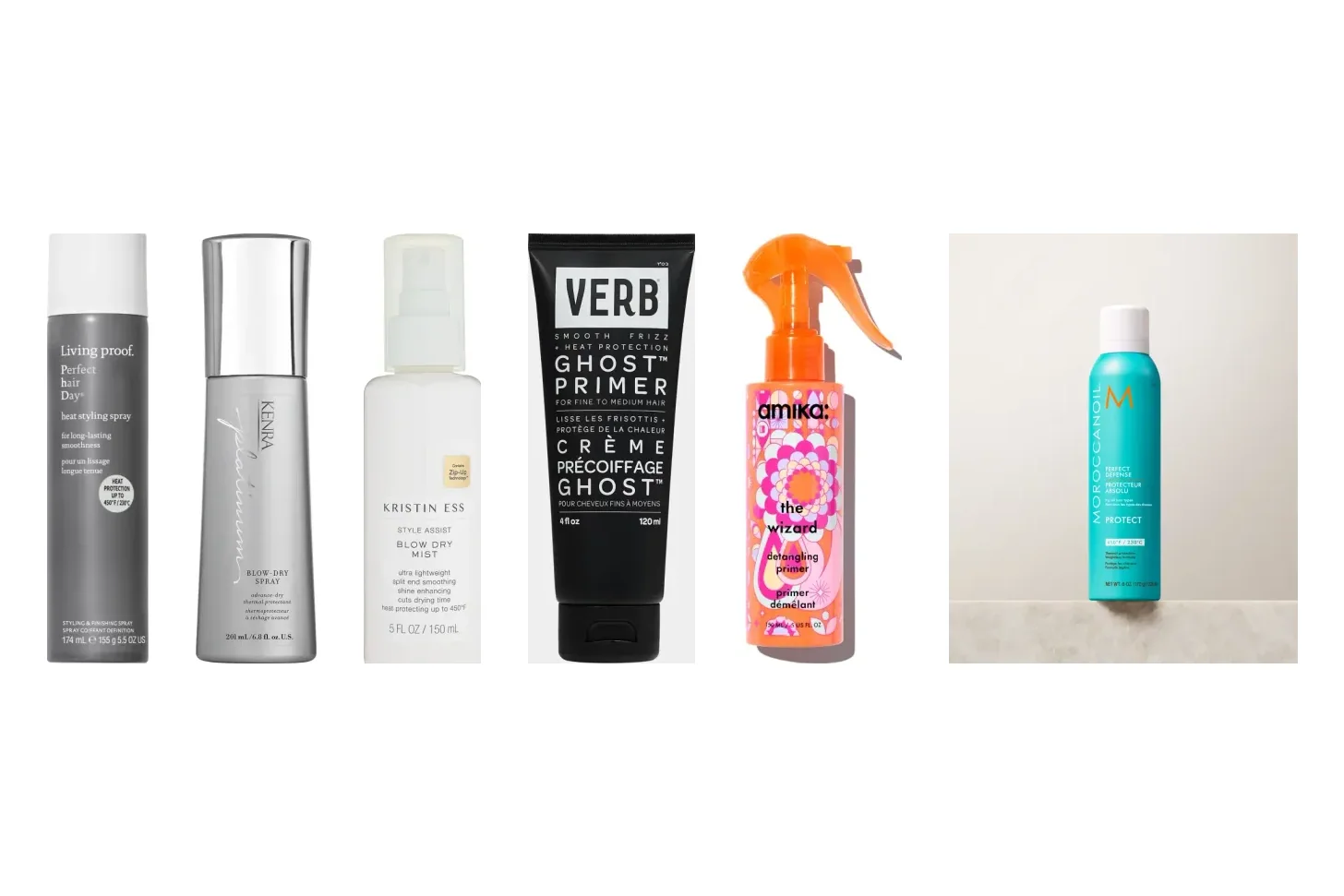
Protect, lightly. A fine mist of heat protectant on the mid-lengths, not the roots. Roots get a root spray or mousse instead — that's where the hold has to live.
Section smaller than feels necessary. Two inches wide, one inch deep. A hot air brush can only shape what its bristles actually reach, and fine hair packed into a fat section just gets warm.
Start under the section, at the scalp. Lift the hair straight up, slide the brush beneath it at the root, hold three or four seconds, then travel down. This is the step that makes volume.
Finish cool, then leave it alone. Hair sets as it cools, so hit the cool button on the last pass and don't touch, brush or check the section until it's cold. Touching warm hair undoes it.
Stop at the crown and the front on rushed days. Those two zones are what anyone sees. Skipping the under-layer saves your hair a heat cycle and nobody will notice.
Your hair is actively breaking.Short, blunt-tipped hairs at the crown or hairline mean heat and tension are already exceeding what your hair can take. Fix that first — breakage on fine hair.
You're mid-shed or recovering.Nothing mechanical helps here. Start with the cause: fine or thinning?
You already blow-dry well with a round brush.You'd be buying convenience, not a better result. Spend it on a better dryer instead.
You have extensions, a topper or bonded pieces.Bristles plus rotating heat plus attachment points is a bad combination. Extensions on fine hair.
FAQ
Not inherently — but they concentrate two risks into one pass, and how you use one decides everything. A hot air brush applies heat and mechanical tension at the same moment, and it's designed to be used on hair that's still damp, which is when hair is weakest and grippiest. A 2015 review of hair cosmetics found that combing dry hair is more related to short segment breaks, while wet combing is related to long segment breaks — in plain terms, dry damage costs you millimeters and wet damage costs you inches. The fix isn't to avoid the tool. It's to rough-dry to about 70 to 80 percent before the brush touches your hair, use a heat protectant, keep the heat on a middle setting, and let the brush travel rather than sit. Used that way, a hot air brush is usually gentler than a dryer plus a round brush, because it's one pass instead of two and it runs cooler than any iron.
Smaller than the one you're about to buy. The barrel has to be small enough that your hair can complete at least one full wrap around it, because the wrap is what creates lift and shape — anything less is a bend. As a working rule: a 2 inch (51mm) barrel suits bobs, lobs and anything to the collarbone; 2.4 to 2.5 inches suits shoulder-length to mid-back; 3 inches only makes sense past the collarbone on hair with enough length to wrap it. Most fine-haired women buy a 3 inch oval because it looks like it will create more volume, then find their hair slides off it. The other reason to size down is control at the root: a smaller barrel can get in under the section at the crown, which is where fine hair needs the lift, and a fat barrel physically cannot.
For most fine-haired women at home, yes — not because the result is better, but because the result is achievable. A dryer and a round brush is a two-handed coordination task that takes practice, and the usual failure is spending so long fighting it that the hair is over-dried and flat before you reach the back. A hot air brush trades some of that finesse for a single tool you can control with one hand, and it dries and shapes in the same pass, which means less total heat exposure. What you give up is airflow power and the ability to direct air precisely at the root, which is why a salon blowout still looks different. If you already blow-dry confidently with a round brush, a hot air brush is a convenience, not an upgrade. If you don't, it's the single biggest improvement available to you.
It means the tool doesn't exceed a set temperature ceiling — not that heat has been removed from the process. Shark, for example, describes the FlexStyle as measuring and regulating temperatures 1000x per second, minimizing heat exposure, and says that rather than getting hotter as it runs, Shark minimizes heat exposure and regulates temperatures. That's a real engineering claim and a meaningful one: uncontrolled tools do climb as they run, and the peak is what damages hair. But a regulated tool is still applying heat, and it's still applying tension, and neither of those is free on fine hair. Read those claims as a ceiling rather than an exemption. The temperature figures are also lower than people expect for this category — BondiBoost lists a range of 122 to 230°F for its 51mm brush, which is well under any flat iron.
No. This is the single rule that separates a tool that helps your hair from one that costs you length. Wet hair is swollen, weaker and grippier, and pulling a bristled brush through it under tension is the highest-risk version of this technique. BondiBoost's own instruction is to dry to 70-80% before styling, and that's the right number: enough water gone that the brush glides, enough left that the hair can be shaped. Rough-dry with your hands or a dryer on medium first, or blot properly with a t-shirt or microfiber towel rather than rubbing. If your brush snags, tugs or squeaks as it moves, your hair is still too wet, and stopping to dry it further will cost you two minutes and save you inches.
They give shape and body reliably; they give root lift only if you use them at the root deliberately. Volume on fine hair is made in the first inch, and the common mistake with a hot air brush is starting mid-length and treating it as a smoothing tool. Lift the section straight up, hold the brush under it at the root, give it heat for a few seconds, then travel down the strand. The second half is the part everyone skips: the shape sets as the hair cools, not while it's hot, so drop the section and leave it alone until it's cool before you touch it. A root spray or mousse at the root before you start does more for durability than any brush feature — the tool creates the shape, the product holds it.
They're the highest-risk format for this hair type, and the reason is simple: a rotating barrel decides how much tension is applied, and you find out afterwards. On fine hair, a strand that catches doesn't slide out of the way — it takes the load, and a motor doesn't notice. The tangles that happen are also worse than a normal one, because the hair wraps around a powered barrel rather than a static one. If you love the format, use the lowest speed, take small sections, never start below the mid-length, and stop the instant anything catches. For most fine hair, a non-rotating brush with a comfortable handle gives you the same result with the tension under your control, and control is the thing fine hair benefits from most.
Two or three times a week is a reasonable ceiling for most fine hair, and the way to make that work is to get more days out of each style rather than restyling daily. Fine hair holds a set for a shorter time than coarse hair does, which is exactly why the temptation to redo it every morning is strong — and daily heat plus daily tension on strands with very little cross-section is how breakage starts at the crown and the hairline. Wash day gets the full pass. Day two gets dry shampoo at the root and a quick lift with the brush on the crown only, on a low setting. Day three is a bun or a clip. If you're heat-styling every day, a heat protectant stops being optional and a lower temperature setting stops being a suggestion.
Fourteen years in fine-hair care, eight of them behind the chair. Megan's rule for hot air brushes: under the section, at the root, and never on soaking hair.
This article is for general education and is not medical advice. Heat tools are cosmetic devices; if your hair is breaking, shedding heavily or your scalp is sore, stop heat styling and see a board-certified dermatologist.
Images in this article are AI-generated illustrations, not photographs of real clients or results. See our image policy.
Results vary with hair type, density, and growth patterns. This guide is educational and not a substitute for an in-person consultation with a licensed stylist or physician.
Get the good hair intel
One honest, stylist-written guide in your inbox each week. No hype.

 MH
MH