Reviewed by Tara Sullivan · Updated August 2026 · 10 min read
A shower filter's job is chlorine. Hard water is calcium and magnesium, and no shower filter removes those — which matters, because most people buy one to fix dullness and film that are caused by exactly the minerals it leaves behind.
None of that makes filters a bad buy — chlorine genuinely roughens fine hair and shortens color, and fine hair registers it before anyone else's does. It means you should buy one for chlorine, and let a chelating wash do the mineral half. Below: five picks, what each actually reduces, the running cost nobody prices in, and how to check whether your water is the problem at all.
Every product here is chosen independently, on the merits — what genuinely suits fine, thin hair. Links go to each brand's official page, and we don't take payment for placement. Price tiers are rough guides because prices change.
The cartridge is the product. The housing is just what holds it.
Chlorine and hardness are two different problems
Almost every disappointed review in this category is someone who bought a filter for the wrong one.
Chlorine is what a filter is for. It's added to municipal supplies as a disinfectant, it's an oxidizer, and in hot shower water it works on the cuticle surface and on color. Carbon and redox media remove it well, which is why every serious filter is built around some combination of activated carbon, a copper-zinc alloy and calcium sulfite. This is the part of the pitch that is straightforwardly true.
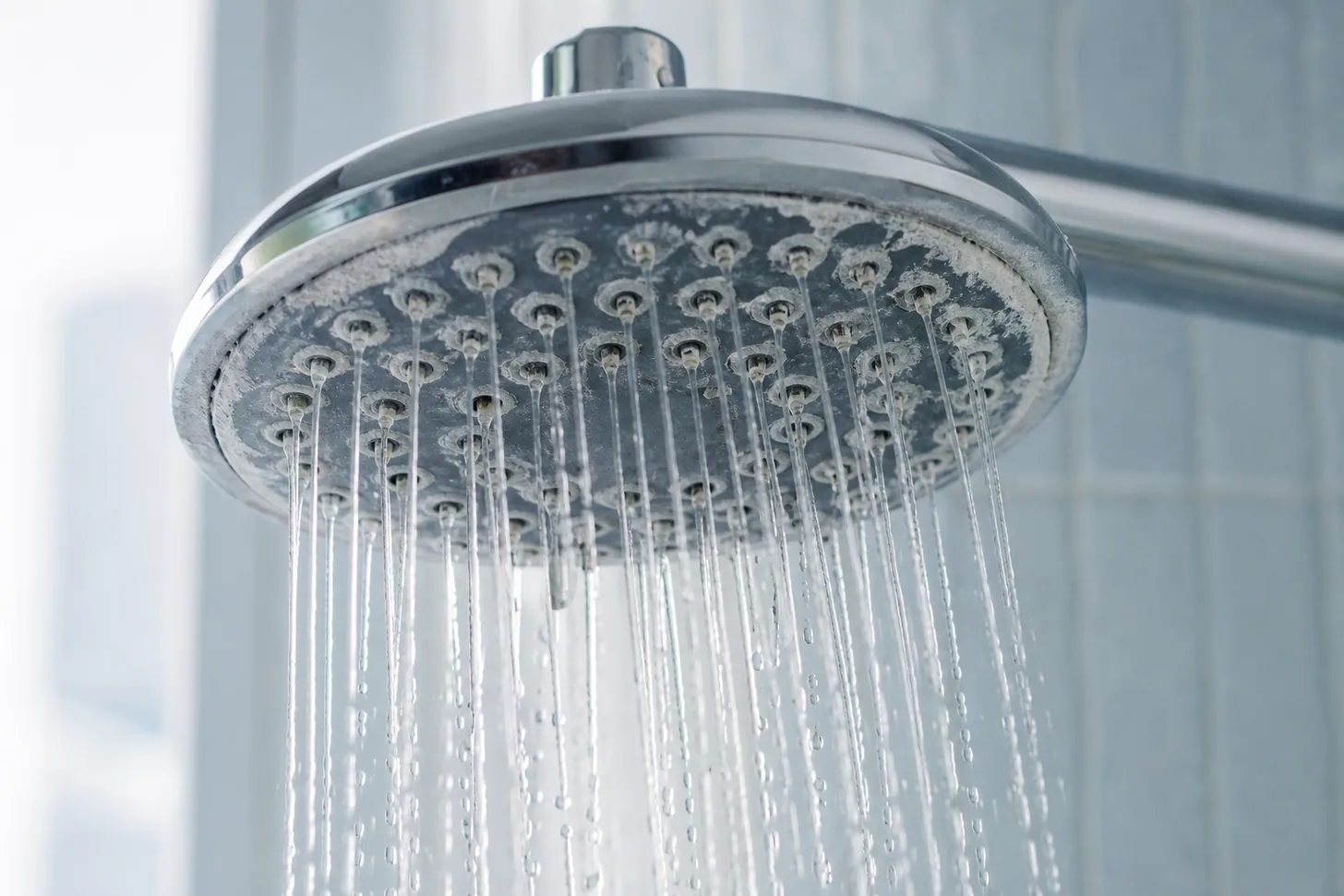
That's the dullness, the film, the squeaky-but-not-clean feeling, and the reason your shampoo doesn't lather properly. Removing the chlorine does not remove the calcium, so it does not remove that.
Why fine hair notices first. A fine strand has less mass and proportionally more surface for a deposit to sit on, so the same water leaves a film that reads as dull and flat on you and as nothing much on someone with coarse, dense hair. It's the same reason fine hair shows product buildup sooner. The full mechanism, and the research on what hard water does to the hair shaft, is in hard water and fine hair.
Chair-side note
I've had two clients this year buy a filtered showerhead, use it for a month, and tell me it did nothing. Both had the same story: dull, flat, slightly rough hair, blonde going warm within a fortnight of a toner. Neither had a chlorine problem worth solving — they had well water and a hardness reading their utility publishes on its own website.
The filter was answering a question they hadn't asked. What actually changed it for both of them was a chelating wash once a week and, for one, a whole-house softener that her partner had been resisting for two years. The filter earns its place afterwards, for the chlorine and for keeping color longer, and both have kept theirs.
But if you buy one thing this month and your water is hard, buy the chelating shampoo. It costs a tenth as much and it addresses the thing you can actually see. Filters address mineral deposit rather than flaking; if your scalp flakes, dandruff shampoo for fine hair is the treatment page.
MH
— Megan Holloway, Editor-in-Chief
Check this before you spend anything
Three checks, none of which cost more than a few dollars, and between them they'll tell you which product you actually need.
Read your utility's water report. Public suppliers publish hardness, usually in grains per gallon or parts per million, along with whether they use chlorine or chloramine. That last detail matters: chloramine is more stubborn than free chlorine and not every filter is built for it.
Use a hardness test strip. A pack costs very little and takes thirty seconds. It's the difference between guessing and knowing.
Ask the location question. Did your hair behave differently in a different house, or on holiday? If yes, that's water. If your hair has been the same everywhere you've ever lived, look at your routine before your plumbing.
If hardness comes back high and chlorine is unremarkable, a filter is the second purchase, not the first. If chlorine is high — especially if you can smell it — a filter is a genuinely good buy, and more so if your hair is highlighted or otherwise lightened.
The five worth considering
Four filters and one thing that isn't a filter. You need one of these, not four.
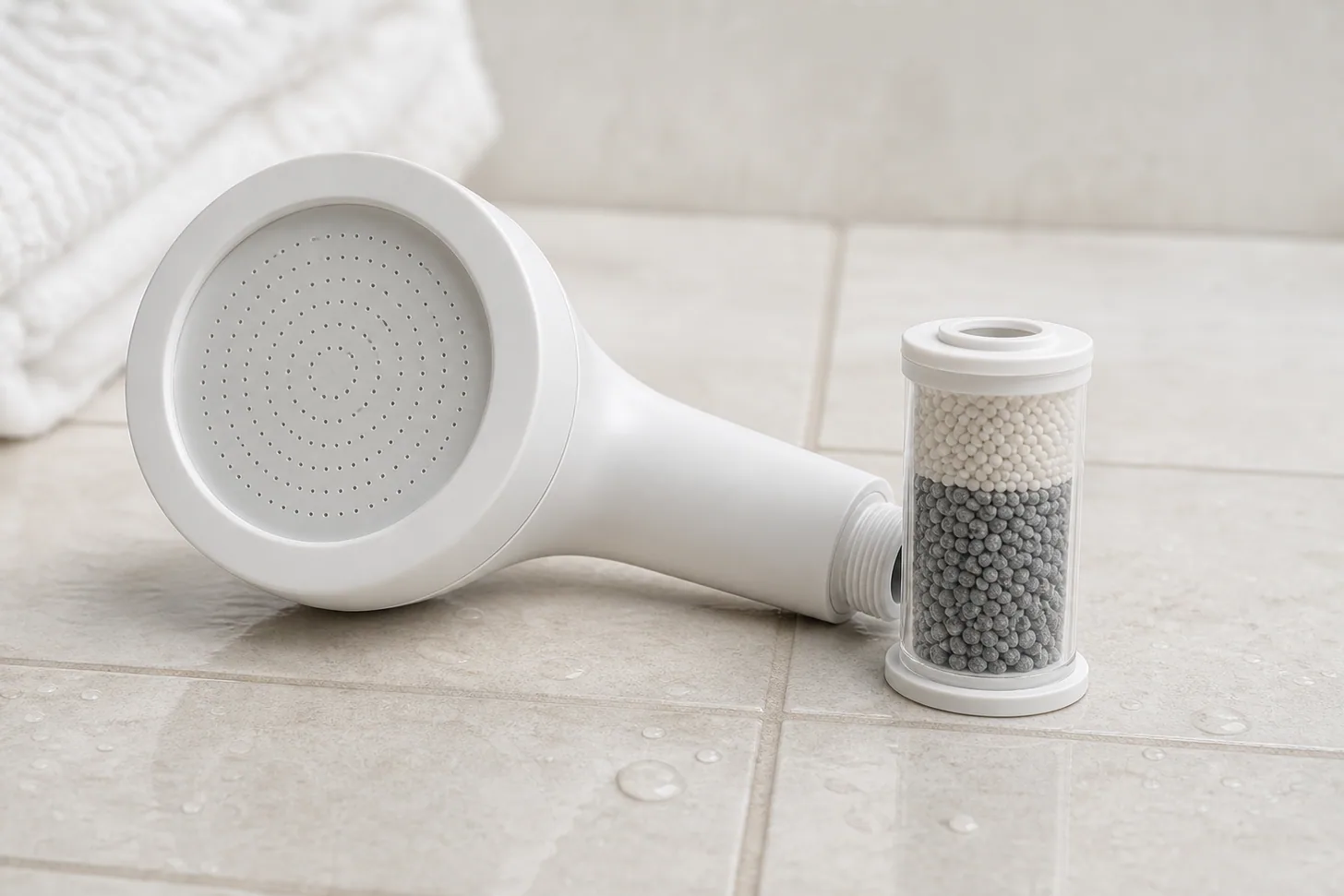
Canopy filtered showerhead, matte white fixed shower head with filter housing, product shot on white
1
Best overall: Canopy Filtered Showerhead
The one I'd buy first, because it's a complete showerhead rather than an add-on and the media stack is the standard three done properly. Canopy describes it as a "Pro-stylist recommended easy-to-install filtered showerhead" that "reduces chlorine and other contaminants for clean water that supports healthy-looking skin and hair", using granular activated carbon from coconut shell, a copper-zinc formulation and calcium sulfite. Their own consumer study reports "91% reported softer hair" and "89% saw less buildup" — self-reported and brand-run, so read it as directional rather than as evidence. Best for: chlorinated municipal water, color-treated fine hair, and anyone who'd rather replace the whole head than stack an adapter. Honest limitation: the replacement interval is short — Canopy says "Replace every 90 days" — so price four cartridges a year before you compare it to anything. And note that the claim list includes magnesium and calcium carbonate, which is a broader statement than the chlorine-only scope the NSF standard certifies.
Hello Klean in-line shower filter, small cylindrical chrome filter unit, product shot on white
2
Best for hard water — and the most honest label in the category: Hello Klean Shower Filter
This is the pick if your problem is hard water, and it earns the slot partly for what it refuses to claim. The product is described as "Protect your hair and skin with better water", and it "Reduces free chlorine by up to ~97% (SGS-tested)" alongside heavy metals, rust and impurities, using coconut-shell activated carbon, calcium sulphite, KDF copper-zinc redox media, ceramic beads and a plant-derived antiscaling agent. That last component is the hard-water play: it inhibits scale rather than removing hardness. And then the FAQ does the thing almost no brand in this category does — it tells you the limit outright: "Not in the same way as a traditional water softener...Our filter doesn't remove those minerals, so your water's hardness level stays the same." A company that volunteers that has earned some trust on everything else it says. Best for: hard-water households that want the chlorine gone and realistic expectations about the rest. Honest limitation: refills run "3-4 months", and an anti-scale agent changes how minerals behave without taking them out — if you want hardness genuinely removed, that's a plumbed-in softener and a different budget.
A bottle of chelating shampoo beside a hardness test strip on a pale bathroom surface
5
Best thing that isn't a filter: a chelating wash, weekly
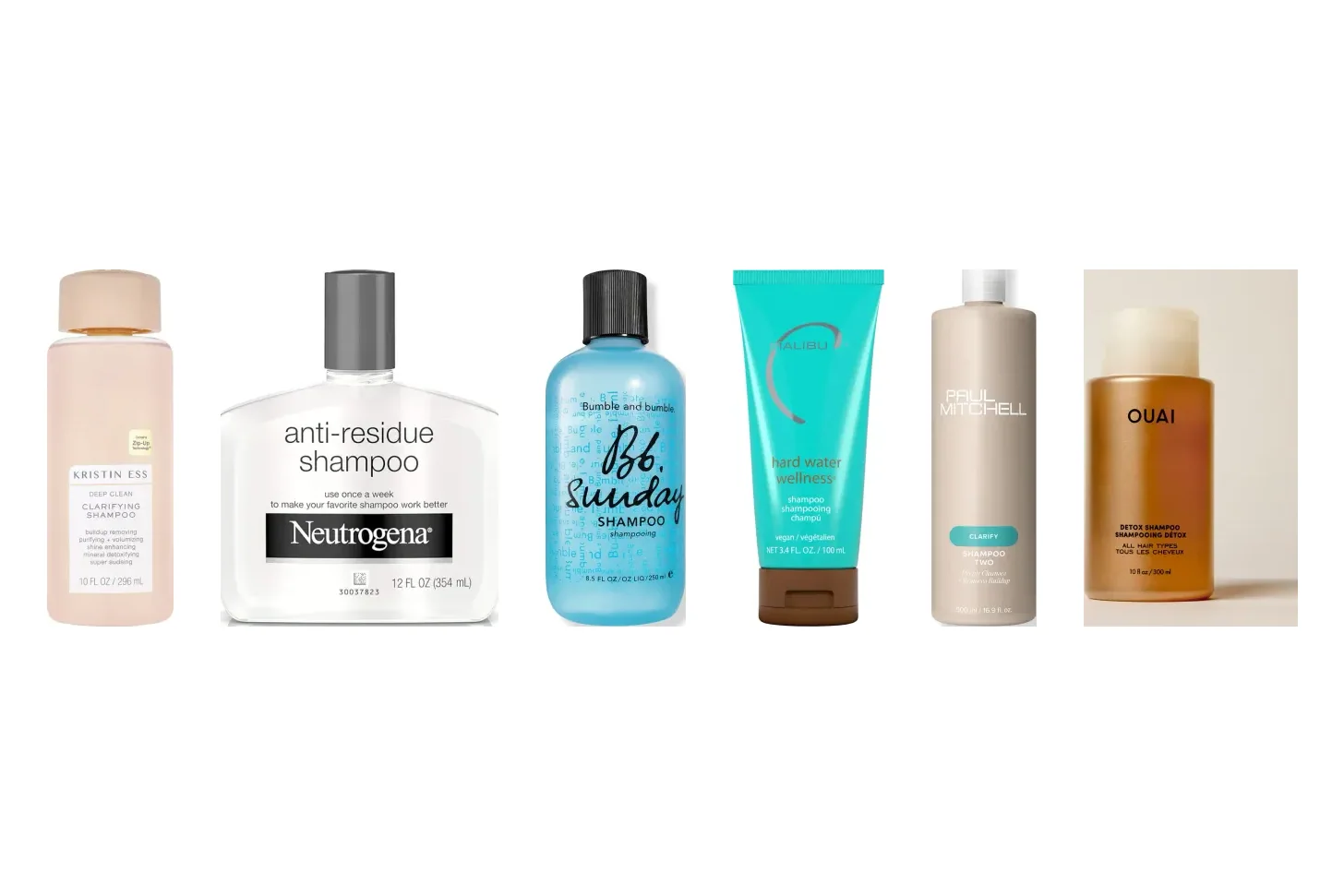
If you have hard water and you buy one thing this month, buy this instead. A chelating shampoo contains agents that bind the metal ions already sitting on your hair and let them rinse away — which is the only thing on this page that actually removes what a filter leaves behind. It costs a fraction of any unit here, it works on the deposit that's already accumulated rather than only on tomorrow's water, and on fine hair the difference in one wash is usually more visible than a month of filtered showers. Used weekly rather than daily, because it's a reset and not a routine. The honest framing is that these two products do opposite halves of the job: the filter reduces what arrives, the chelating wash removes what landed. If your budget only stretches to one and your water is hard, the wash is the better spend. Our clarifying and chelating shampoo picks cover which is which, since the two words are used interchangeably on packaging and mean different things.
The column that decides most purchases is the last one, and it's the one nobody looks at in the shop.
Pick
Type
Best when
Cartridge interval
Canopy
Filtered showerhead
Chlorinated city water, color-treated fine hair
90 days
Hello Klean
In-line filter
Hard water, and you want honest limits stated
3–4 months
T3 Source
Filtered showerhead
Well water with iron; replacing the head anyway
6 months / 10,000 gallons
AquaBliss SF220
In-line filter
Renting, trialling, or keeping your own head
3–6 months
Chelating wash
Not a filter
Hard water, and you want a visible result this week
Weekly use
When a shower filter isn't the answer
Your problem is dullness and film rather than dryness.That's mineral deposit, and no filter removes hardness. Start with a chelating wash and the hard-water routine.
Your water report says chloramine, not chlorine.Chloramine is more stubborn and not every filter handles it. Check the model's own statement before buying.
Your hair has behaved this way in every house you've lived in.That's not your water. Look at the routine — what you're putting on it and in what order is the cheaper thing to fix.
Your roots are flat by lunchtime.Water isn't the cause of that. Why fine hair falls flat works through the five real ones.
You're expecting it to stop hair falling out.Nothing about water quality drives shedding. If that's your worry, fine hair or thinning? is the right place to start.
You won't change the cartridge.Spent media stops working. A filter nobody has changed in a year is a decorative showerhead, and the running cost is the real cost.
FAQ
For chlorine, yes — that's a real benefit with a real mechanism. For hard water, much less than the marketing implies, and that distinction decides whether you should buy one. Chlorine is added to municipal water as a disinfectant, it's aggressive on the hair surface and on color, and carbon and redox media remove it well. Water hardness is a different thing entirely: dissolved calcium and magnesium, which a shower filter isn't designed to remove. The certification says the same — NSF/ANSI 177 covers materials and construction safety, product design and durability, and verified reduction of aesthetic free available chlorine. Chlorine is the certified claim. If your complaint is dullness, film and a squeaky roughness, that's minerals, and a filter helps at the margin while a chelating wash does the actual work.
No — and the most honest confirmation comes from a brand that sells them. Hello Klean's own FAQ says its filter doesn't soften water in the same way as a traditional water softener, that it doesn't remove those minerals, and that your water's hardness level stays the same. That's worth reading twice, because it's the commonest misunderstanding in this category. A water softener uses ion exchange to actually take calcium and magnesium out, it's plumbed into the house rather than screwed onto a shower arm, and it costs a different order of money. A shower filter reduces chlorine and some metals and may include a scale inhibitor, which changes how minerals behave rather than removing them. Both can be worth having; they aren't the same purchase.
It's worth it if you have three specific things, and a poor buy otherwise. Worth it if your water is chlorinated enough that you can smell it, if your hair is lightened or color-treated, and if fine hair means every bit of surface roughness shows on you before it shows on anyone else — a fine strand has less mass and proportionally more surface for a deposit to sit on, which is exactly why it registers water quality first. Not worth it if you're hoping to fix dullness that's actually mineral film, if you're on well water where the issue is iron and hardness rather than chlorine, or if you haven't first checked whether your water is genuinely the problem. Buy it for chlorine and color longevity; anything else is a bonus you didn't pay for.
Timing tells you more than appearance. Water problems arrive gradually, affect all of your hair at once rather than the ends first, and show up as dullness plus a rough or filmy feel rather than dryness alone. The classic colorist tell is a toner that lasts six to eight weeks and fades normally, versus hair that goes warm again within a fortnight and looks dull all over at the same time. The second tell is location: if your hair behaved differently in another house or on holiday, that's water. The cheap confirmation is a hardness test strip, or your utility's published water report, which lists hardness in grains per gallon or parts per million. Do that before you spend anything — see hard water and fine hair.
Every three to six months for most, and the interval is the running cost people forget to price in. Canopy says replace every 90 days. Hello Klean gives three to four months per refill capsule. T3 recommends six months or 10,000 gallons, whichever comes first. AquaBliss says every three to six months depending on water quality. Multiply the cartridge price by three or four a year before deciding which unit is actually cheapest, because a cheap housing with expensive refills can cost more over two years than a pricier one with a longer interval. An expired cartridge isn't neutral either — spent media stops reducing chlorine, so a filter nobody has changed in a year is a decorative showerhead.
Yes, and for renters and anyone who likes their current showerhead it's the sensible route. In-line filters screw between the shower arm and whatever head you already have, using the standard half-inch connection, and install by hand in a couple of minutes without tools. The trade-offs are worth knowing: it adds a few inches of length, which lowers the head slightly and can matter in a low ceiling or small enclosure; some units reduce pressure, though the better ones specifically claim not to; and it's one more joint that can drip, so wrap the threads with plumber's tape if it weeps. The alternative — a filtered showerhead — is a cleaner install and usually a better spray, but you lose the head you have.
It helps with one of the two causes of brassiness and does nothing for the other, which is why people get mixed results. Warmth from inside the fiber, exposed as toner fades, is a color problem and a filter doesn't touch it. Mineral deposit landing on the outside of the hair is what makes blondes go dull, rough and sometimes green, and a filter reduces the chlorine and some of the metals that contribute, but not the hardness minerals themselves. So a filter genuinely helps color longevity, especially on lightened hair, and it isn't a substitute for toning or chelating. If your color goes warm within a fortnight of a salon appointment, deal with the water first — no amount of purple shampoo fixes a mineral film, and brassy fine hair tells the two cases apart.
It can help with the dryness and it won't treat a scalp condition. Chlorine is drying to skin as well as hair, so removing it often makes a tight, itchy scalp more comfortable, and several brands report exactly that in their own consumer surveys. What a filter can't do is treat flaking driven by seborrheic dermatitis or another dermatological cause, which needs the right active ingredient rather than better water. The practical way to tell them apart: dryness from water affects your skin generally and improves within a couple of weeks of filtering, while a scalp condition is localized, tends to be greasy-flaky rather than dry-flaky, and returns regardless of what's coming out of the tap. If flaking persists, see dandruff on fine hair.
Fourteen years in fine-hair care, eight of them behind the chair. Megan's rule for this aisle: buy the filter for chlorine, and buy the chelating wash for everything you can actually see.
Images in this article are AI-generated illustrations, not photographs of real clients or results. See our image policy.
Results vary with hair type, density, and growth patterns. This guide is educational and not a substitute for an in-person consultation with a licensed stylist.
Get the good hair intel
One honest, stylist-written guide in your inbox each week. No hype.

 MH
MH