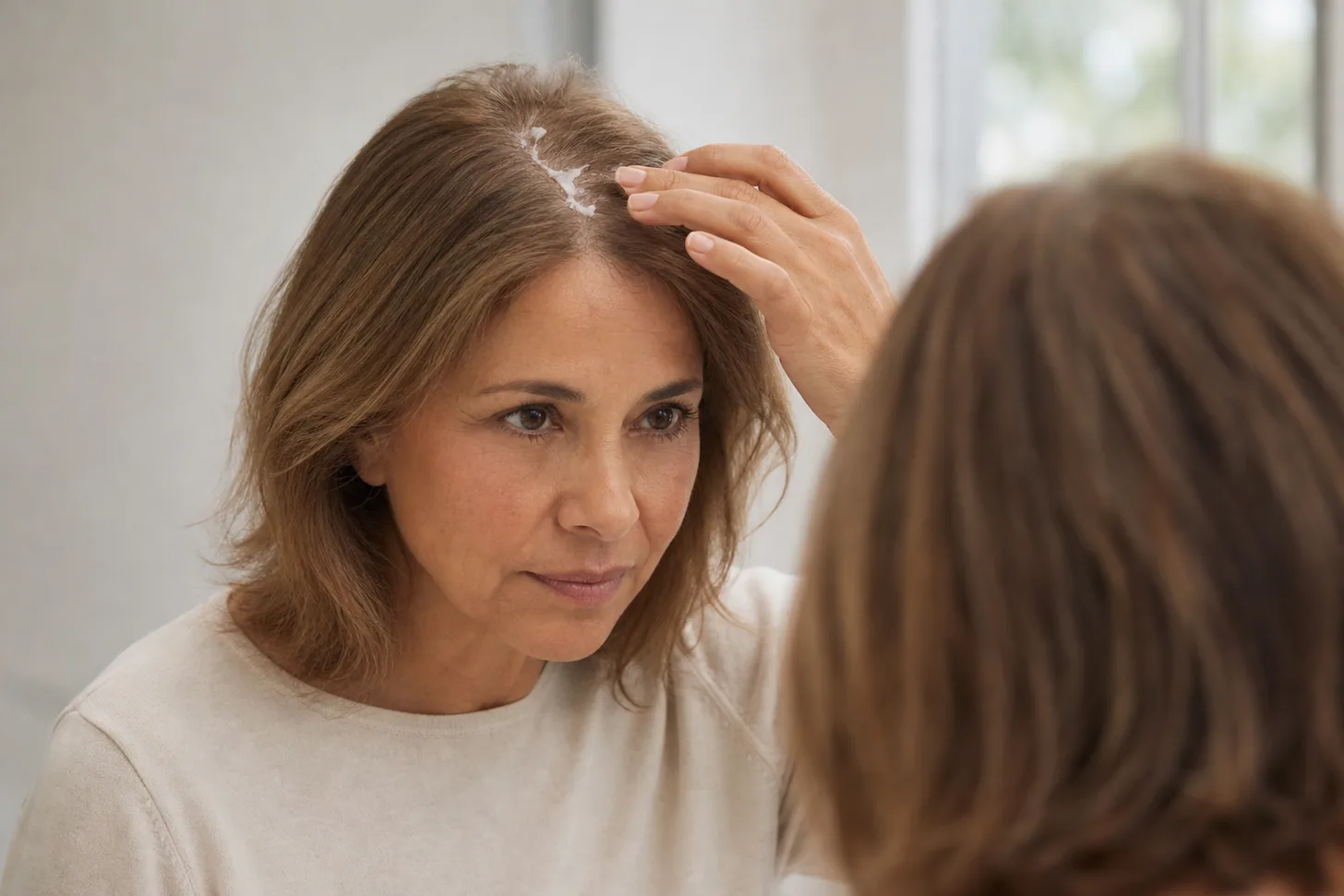
Minoxidil is the one over-the-counter treatment approved for female pattern hair loss, and for most women it is the right first step. Women's products come as a 2% liquid used twice a day or a 5% foam used once a day. The American Academy of Dermatology calls it "the most-recommended treatment" for this kind of thinning. In trials, women using it were about twice as likely as women on placebo to see a moderate or marked increase in hair. That means more coverage on top, not the hair you had at 25.
It is slow (six to 12 months to judge), it often causes a short shed at the start, and it only works while you keep using it. Below is how to choose a strength, how to use it on fine hair without flattening it, and what to expect month by month.
What minoxidil is and how it works on hair
Minoxidil was first a blood-pressure tablet. Doctors noticed that patients grew more hair, and a liquid for the scalp followed. Nobody is completely sure how it works on the follicle. It is known to lengthen the growth (anagen) phase and to help shrunken follicles produce longer, thicker hairs.
That is exactly what goes wrong in female pattern hair loss. Follicles on top of the head shrink a little with each cycle, so the hairs grow back finer and shorter until the part looks wider. Minoxidil slows that process and partly reverses it in some follicles. It does nothing for hair that is snapping off, and it doesn't fix the cause of a shed.
Who minoxidil is for
Women with female pattern hair loss: a part that has widened over years, thinning on top, and often a mother or grandmother with the same pattern. See first signs of hair thinning.
Early thinning. It works best when follicles are shrinking but still there. That's why the AAD says starting early matters.
Not a first answer for sudden all-over shedding after illness, childbirth, stress or a diet (see hair shedding vs hair loss), round bald patches, or hair loss with a red or scaly scalp. The women's foam label says not to use it if your hair loss is sudden or patchy, linked to childbirth, or you don't know the reason for it.
Check iron and thyroid too. Low iron stores often sit alongside pattern thinning. Minoxidil won't correct them. See iron deficiency hair loss.
Does minoxidil work for women?
Yes. Minoxidil has more trial evidence than anything else on a pharmacy shelf for female pattern hair loss.
The Cochrane review pooled six trials. 157 of 593 women on minoxidil (26%) reported a moderate to marked increase in hair, compared with 77 of 555 on placebo (14%). That makes them about twice as likely to improve. Across eight trials, minoxidil added about 13 hairs per square centimetre more than placebo (van Zuuren, Cochrane, 2016).
What "works" means: shedding slows, the part stops widening, and a fuller look on top. Most women who use it don't get a dramatic change, and about one in four in those trials saw a clear one. It won't help every woman, and the label says so.
Why fine hair notices it more than the numbers suggest: when each strand is narrow, a few more hairs per square centimetre and slightly thicker regrowth show up as less visible scalp under bathroom lighting.
Minoxidil 2% or 5% for women?
For hair growth, the difference between the strengths is smaller than the labels suggest. What really separates them is how often you apply them and how they feel on fine hair.
Growth: the Cochrane review found no clear difference between 2% and 5% across four trials with 1,006 participants. In the largest single trial, 381 women used either strength or placebo twice a day for 48 weeks. Both strengths beat placebo on hair counts. 5% came out ahead of 2% only on the women's own rating of benefit (Lucky, 2004).
Side effects: the same trial found more itching, irritation and unwanted facial hair with the 5% liquid.
Convenience: the women's 5% foam is used once a day, half a capful. The 2% liquid is used twice a day. The treatment you'll actually keep up for a year is the right one.
Form
How often
On fine hair
Best for
5% foam (women's)
Once a day
Dries fast and leaves the least residue at the roots
Most women with fine hair, and anyone with a sensitive scalp
2% liquid
Twice a day
Can leave roots stiff or greasy, and the second dose falls in the day
Women who prefer the lowest strength, or whose doctor chose it
5% liquid (sold for men)
As your doctor directs
The most residue and the most itching in trials
Only on a dermatologist's advice
How to use minoxidil on fine hair without flattening it
Apply it to a dry scalp, not to your hair. Part the hair in three or four lines across the thinning area and put the product on the skin. Product on the lengths does nothing except weigh them down.
Foam: dispense it onto cool fingertips. It melts on warm skin, so run your fingers under cold water first. Then work it along each part line.
Wash your hands afterwards, so it doesn't reach your face. The label also says not to apply it to other parts of the body.
Let it dry fully before you sleep on it or use heat. Most people time it for night, so it has dried long before they style in the morning.
Morning styling is unchanged. Use a light root spray or mousse on damp roots and blow-dry with lift. You don't need to wash minoxidil out, but daily washing doesn't stop it working, because the night's dose has had hours to absorb.
Don't use extra. The label says using more, or more often, "will not improve results."
Chair-side note
The most common reason I hear for stopping is "it made my hair greasy." Usually that's the liquid going on to the hair at the roots instead of the scalp, then being styled straight away. Switching to the foam, putting it on at night and parting the hair properly fixes this almost every time. Take baseline photos before you start, of the part, the crown and the hairline, in the same light every three months. They're what keeps people going through month four.
MH
— Megan Holloway, Editor-in-Chief
How long minoxidil takes to work for women
Weeks 2–8: the shed. The AAD says you may notice "a temporary increase in hair loss" in the first two to eight weeks. Follicles release old resting hairs to start a new growth cycle. It's frightening, but it is a sign the treatment is doing something. Keep going.
Month 3: the women's foam label says results may appear at three months with once-daily use. For most women at this stage, it means less hair in the brush rather than more on the head.
Month 6: the label says some women need at least six months to see results, and to stop and ask a doctor if there is no regrowth by then.
Months 6–12: the AAD's window for knowing how well it works for you. New hairs start short and fine, so fullness at the length of a bob takes longer still.
Minoxidil side effects in women
Scalp itching, flaking or redness. This is the most common side effect. It is more likely with the liquid, which contains propylene glycol, and with 5%. The foam is often easier on a sensitive scalp.
Unwanted facial hair on the cheeks, temples or forehead. It is more common with 5% and usually fades within months of stopping. Wash your hands after applying and keep it off your pillowcase until it's dry.
Changes in hair color or texture. The label notes that some people experience this.
Stop and call a doctor if you get chest pain, a rapid heartbeat, faintness or dizziness, sudden unexplained weight gain, or swollen hands or feet. These are listed on the label because a small amount is absorbed.
Pregnancy and breastfeeding
Don't use minoxidil if you're pregnant, trying to conceive or breastfeeding. The label says it "may be harmful" then, and the AAD advises avoiding it. Hair changes in pregnancy and after birth have their own causes, covered in hair thinning during pregnancy.
What happens if you stop minoxidil
The hair it kept or regrew goes, gradually, over the following months. The AAD puts it simply: "If you stop applying minoxidil, you lose its benefits." It is a long-term habit, like brushing your teeth, not a course of treatment. If you need to stop for a while, such as for a pregnancy, the hair loss carries on from where it would have been. You don't lose more than that.
Oral minoxidil for women
Some dermatologists now prescribe low-dose oral minoxidil. It is the same drug as a small tablet, at a fraction of the blood-pressure dose. It is off-label for hair loss. It suits women who can't tolerate the topical, can't keep up with it, or have plateaued on it.
Safety: in the largest study, 1,404 patients (two-thirds of them women) took low-dose oral minoxidil for at least three months. Unwanted body and facial hair affected 15.1%. Lightheadedness affected 1.7%, fluid retention 1.3% and a fast heartbeat 0.9%. Only 1.7% stopped because of side effects (Vañó-Galván, 2021). The study looked back at clinic records and had no comparison group.
Effect: a small randomized trial in women compared 1 mg oral with 5% topical over 24 weeks (Ramos, 2020), and neither clearly won. The main argument for the tablet is that people take it consistently, not that it is stronger.
It needs a prescription and a doctor who checks you, especially if you have heart problems or low blood pressure or take blood-pressure medicine. It is also not for pregnancy.
Rosemary oil: one small trial compared it with 2% minoxidil. It's not a replacement, and putting oil on the scalp can stop the foam absorbing. See rosemary oil for thinning hair.
Hair fibers and tinted dry shampoo: fine to use for coverage during the slow months. Put them on after the minoxidil has dried. See hair fibers for fine hair.
Hair dye: the label says not to use it on a scalp that is red, inflamed or irritated. Many women skip it for a day either side of coloring.
Don't use minoxidil without medical advice if
Your hair loss is sudden, patchy, or came after childbirth. That points to a different cause, and the label says not to use it.
Your scalp is red, inflamed, infected, scaly or sore. Treat the scalp first. Minoxidil will sting and absorb more.
You have heart disease. The label says to ask a doctor before use.
You are pregnant, trying to conceive or breastfeeding. Avoid it until you have finished.
You are under 18. The women's products are for adults.
FAQ
Yes, for female pattern hair loss. In the Cochrane review, women using minoxidil were about twice as likely as women on placebo to report a moderate or marked increase in hair. It slows thinning and thickens the top for many women, but it doesn't work for everyone.
For growth, trials find little difference. The 5% foam is used once a day instead of twice, which most women find easier. The 5% liquid causes more itching and unwanted facial hair than 2%.
The label says results may show at three months for some women and at six months for others. The AAD says to use it for six to 12 months before judging it. Expect a temporary shed in the first two to eight weeks.
It can, especially at 5%. Unwanted hair on the cheeks or temples is a known side effect and usually fades after stopping. Washing your hands after applying and letting it dry before bed helps.
The hair it maintained is gradually lost over the next few months, and thinning continues as it would have without treatment. It only works while you use it.
The liquid can, especially if it lands on the hair instead of the scalp. The foam leaves less residue. Apply it at night to a dry scalp along part lines, and style in the morning as usual.
It isn't clearly stronger. A small trial in women found no clear winner. Its advantage is that a daily tablet is easier to keep up. It needs a prescription and medical follow-up.
No. The label says it may be harmful during pregnancy or breastfeeding, and the AAD advises avoiding it then.
This article is for general education and is not medical advice. Talk to your doctor or a board-certified dermatologist before starting minoxidil, and follow the directions on your product's label.
Images in this guide are AI-generated illustrations, not photos of real clients or results. See our image policy.
Get the good hair intel
One honest, stylist-written guide in your inbox each week. No hype.

 MH