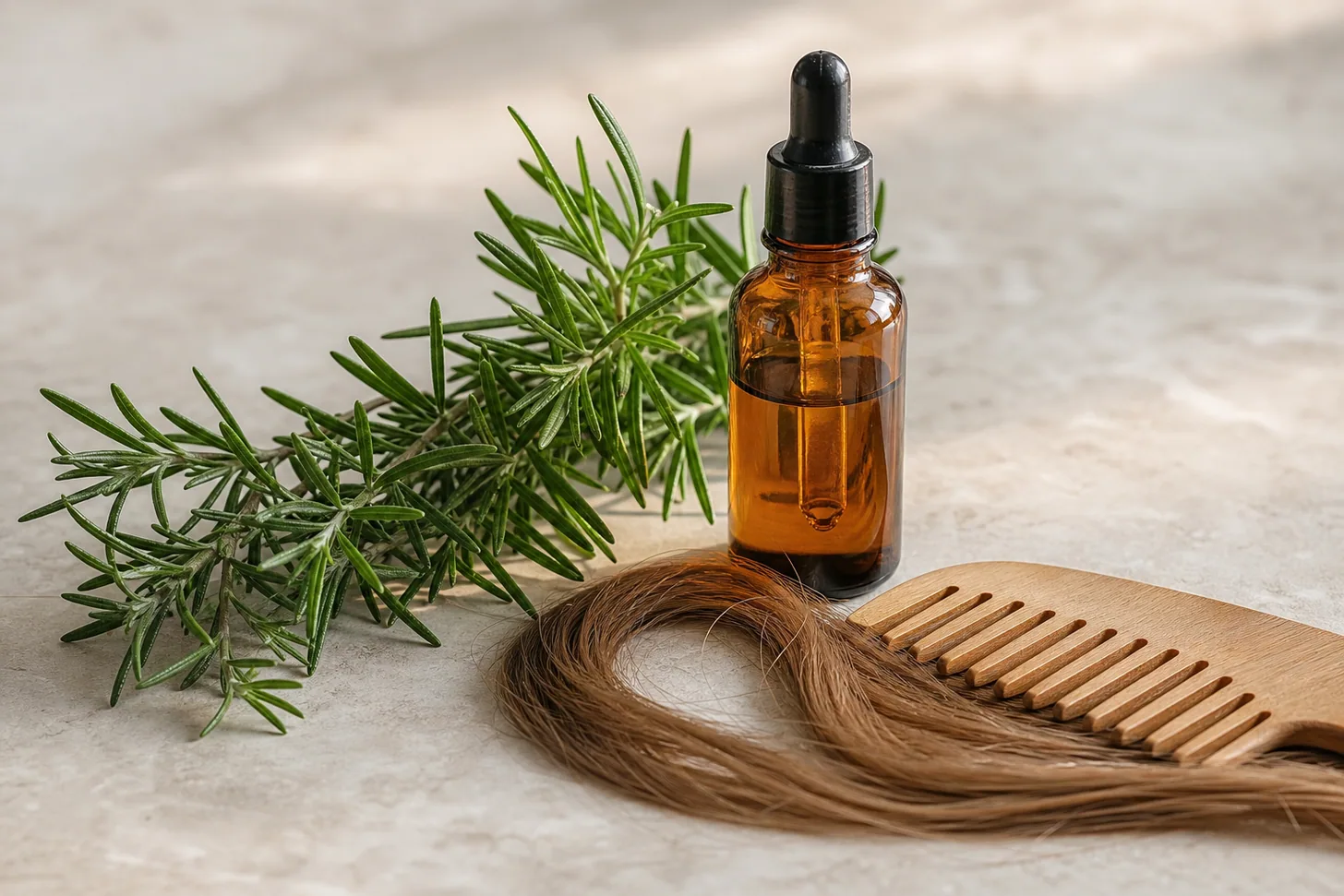
Rosemary oil may help some pattern thinning a little, but the evidence is thin. The study behind most claims is one six-month trial of 100 people with androgenetic alopecia. Rosemary oil and 2% minoxidil both increased hair counts by six months, with no change at three, and rosemary caused less scalp itching (Panahi et al., 2015).
That is a reasonable reason to try it, but not proof that it works as well as stronger treatments. And on fine hair, the oil itself is the problem: put it on the scalp the wrong way and the roots go flat. Below is what the research shows and how to use it without weighing fine hair down.
What does the research actually say?
One human trial, compared with low-strength minoxidil
Panahi and colleagues randomly assigned 100 people with androgenetic alopecia to rosemary oil or 2% minoxidil for six months. Neither group changed at three months. By six months, both groups had more hair than at the start, and the difference between them was not significant. Scalp itching was more common with minoxidil.
The limits matter. It was one small study. It compared rosemary with 2% minoxidil, the weaker strength, not the 5% foam most women are now offered. It has not been repeated in a larger trial, and we found no published randomized trial of rosemary oil in women with female-pattern thinning.
Lab and animal studies
A rosemary leaf extract improved hair regrowth in mice and blocked an enzyme (5-alpha reductase) linked to pattern hair loss in lab tests (Murata et al., 2013). That suggests a mechanism. It does not show the same effect on a human scalp, and the extract in that study is not the same as a bottle of rosemary essential oil.
Who might try rosemary oil
It is a reasonable experiment if you have early pattern thinning, want to try something gentle first, and are willing to use it consistently for six months. It is not a treatment for shedding caused by low iron, thyroid problems, illness or medication, which need the cause fixed. If you are not sure what kind of thinning you have, start with why is my hair thinning. For treatments with stronger evidence, see thinning hair treatment for women.
Chair-side note
My worry with rosemary oil on fine hair isn't safety, it's flatness. Clients come in with roots stuck to the scalp and ends that look stringy, because they've been leaving oil on all day.
On fine hair, use it as a pre-wash treatment, not a leave-in. Massage a small amount into the scalp, leave it for an hour or two, then shampoo it out properly. You get the scalp contact without the flat hair.
MH
— Megan Holloway, Editor-in-Chief
How to use rosemary oil on fine hair
Dilute it. Essential oil is concentrated. Mix a few drops into a light carrier oil such as jojoba, or buy a ready-diluted scalp product. Never use pure essential oil on the scalp.
Patch test first. Put a little on the inside of your arm and wait 24 hours.
Apply to the scalp only, along the parts, with a dropper. Keep it off the lengths.
Massage for a few minutes with your fingertips, not your nails.
Leave it on for one to two hours, or overnight if your hair doesn't mind, then shampoo. Fine hair may need two rounds of shampoo. See clarifying shampoo for fine hair.
Repeat two or three times a week and take part photos monthly. Judge it at six months, not six weeks. See tracking hair progress.
A rosemary shampoo is the lightest option, though it is on the scalp for less time. Water-based rosemary scalp sprays are a middle ground for fine hair. More on oils and fine hair in hair oiling on fine hair.
Rosemary oil vs minoxidil
Minoxidil has far more evidence, including in women, and is the first treatment dermatologists usually suggest for female-pattern thinning. Rosemary oil has one small trial against the weaker strength. Some people use rosemary because minoxidil irritates their scalp, or as a first step before deciding. Don't expect the same results, and talk to a dermatologist if your thinning is progressing.
Who should skip rosemary oil
You are pregnant or breastfeeding. There is little safety data. Ask your doctor first. See hair thinning during pregnancy.
You have a sensitive or irritated scalp, eczema or dermatitis. Essential oils can cause contact dermatitis.
You are losing hair fast or in patches. See a dermatologist. Rosemary oil is not a treatment for that.
You hoped it would replace a treatment that is working. Don't stop minoxidil or a prescription to switch. The evidence for rosemary is much weaker.
FAQ
There is limited evidence. One six-month trial of 100 people with pattern hair loss found rosemary oil and 2% minoxidil both increased hair counts, but it has not been repeated in larger studies or in women.
In the main trial, there was no change at three months and an increase by six months. Give it at least six months of regular use.
It can be used on fine hair, but oil left on the scalp makes fine roots flat. Use it as a pre-wash treatment and shampoo it out.
No. Dilute rosemary essential oil in a carrier oil or use a ready-made scalp product, and patch test first.
No. Minoxidil has much more evidence. Rosemary oil caused less itching in one trial, which is why some people try it first.
There is little safety data for essential oils on the scalp in pregnancy. Ask your doctor or midwife first.
This article is for general education and is not medical advice. It does not recommend for or against any supplement, topical, or prescription treatment. If you have patchy hair loss, scalp pain, or shedding that continues, see a board-certified dermatologist.
Results vary with hair type, density and growth patterns.
Images in this guide are AI-generated illustrations, not photos of real clients or results. See our image policy.
Get the good hair intel
One honest, stylist-written guide in your inbox each week. No hype.

 MH