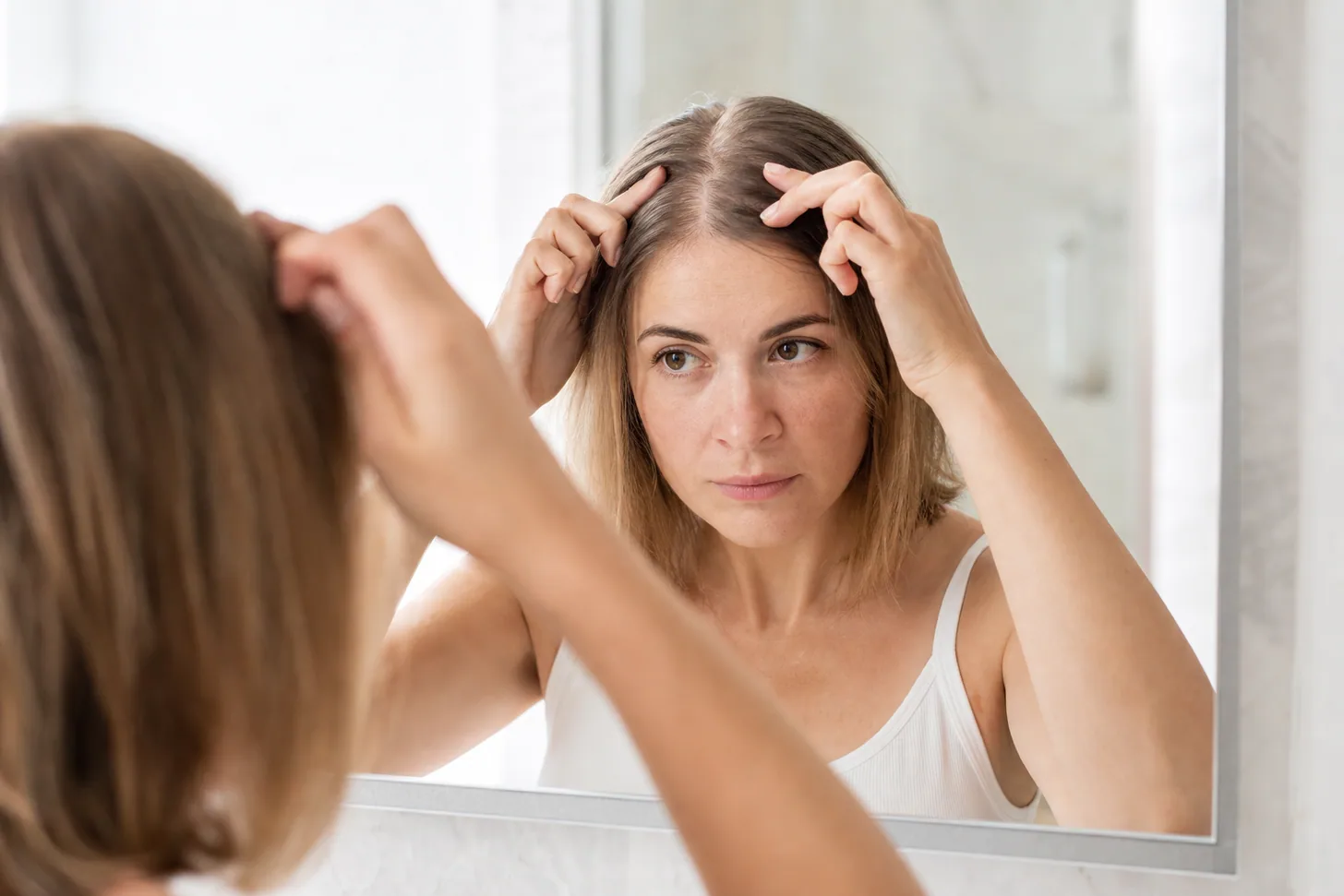
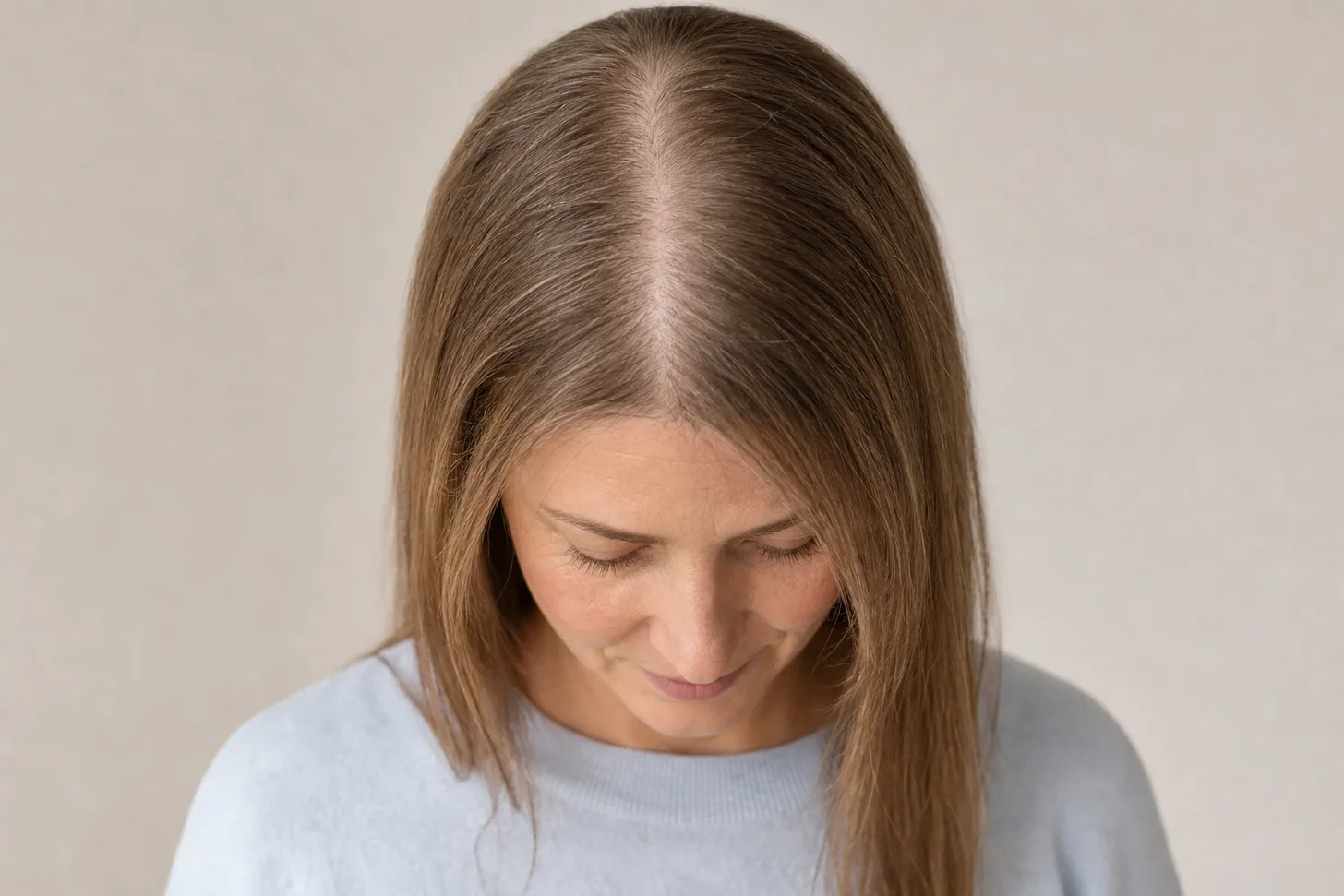
Spironolactone is a prescription pill that blocks the effect of androgens (male-type hormones) on the hair follicle. Dermatologists use it for female pattern hair loss, especially when minoxidil alone isn't enough. The American Academy of Dermatology says studies show it works in about 40% of women with female pattern hair loss. "Works" usually means slowing the loss and some thickening, not a full head of hair.
It is slow, taking six to 12 months to judge, and it is not safe in pregnancy. Below is what to expect, honestly, before you ask for it.
How spironolactone works on hair
Spironolactone was developed as a diuretic and blood-pressure drug. It also blocks androgen receptors and lowers androgen production a little. In female pattern hair loss, follicles on the top of the head gradually shrink under androgen influence, so the hairs grow back finer and shorter each cycle. Blocking that signal can slow the shrinking, and in some women it lets a few follicles recover.
Its use for hair loss is off-label. It is an approved drug being prescribed for a purpose outside its label, which is legal and routine in dermatology.
Who it suits
Women with a diagnosis of female pattern hair loss, meaning a widening part and thinning on top. See first signs of hair thinning.
Women with signs of androgen excess, such as adult acne, excess facial hair or PCOS, although normal hormone levels don't rule it out.
Women in or after menopause, where pregnancy is no longer a concern.
Women for whom minoxidil alone has plateaued.
It's not the answer for shedding after illness, stress or weight loss (see hair shedding vs hair loss), low iron or thyroid problems (see blood tests for hair loss), or patchy and scarring hair loss. That's why a diagnosis comes first.
Does spironolactone work for hair loss?
The evidence is positive but thin. Most studies are small and observational.
The AAD's summary: it is effective in about 40% of women with female pattern hair loss. In one study of 166 women, 42% reported mild improvement and 31% reported increased thickness.
A 2023 meta-analysis pooled five studies with 413 patients and found improvement in about 57% overall. Improvement was about 66% when spironolactone was combined with topical minoxidil and 43% when it was used alone (Aleissa, 2023). The studies varied widely, so the author treats these figures as estimates.
What "improvement" looks like: less shedding, a part that stops widening, and a little more density on top. Hair rarely returns to how it was years earlier.
How long spironolactone takes to work
Months 0–3: usually nothing visible. Some women notice less shedding.
Months 3–6: shedding settles and the part may stop widening.
Months 6–12: the point to judge it. The AAD says to take it for six to 12 months before deciding, and that no regrowth by 12 months means it won't work for you.
If you stop: the AAD says the hair it helped is lost again in about three to four months. It is a long-term treatment.
Chair-side note
Before anyone starts, I ask them to take the same three photos: the center part from above, the crown, and the hairline, in the same light and with hair dry and unstyled. Do it every three months. Spironolactone's results are too gradual to see in the mirror day to day, and the photos are what stop people quitting at month four, just before it would have shown.
MH
— Megan Holloway, Editor-in-Chief
Dose
Your dermatologist chooses the dose. It is usually started low and increased gradually over weeks to months, depending on how you tolerate it, your blood pressure, and your kidney function. Don't change the dose yourself, and don't start it without a prescription.
Spironolactone side effects
Irregular periods or spotting. This was among the most common complaints in the meta-analysis. Some women take it alongside a contraceptive pill, which also steadies the cycle.
Breast tenderness or enlargement. The Aldactone label lists breast enlargement as the most common adverse reaction. It is dose-related.
More frequent urination, thirst, dizziness or light-headedness, because it is a diuretic and can lower blood pressure.
High potassium (hyperkalemia). This is the serious one. The risk is higher with kidney problems or with other drugs and supplements that raise potassium. Your doctor decides whether you need blood tests.
In the meta-analysis, only about 3% of patients stopped because of side effects.
Pregnancy and birth control
Spironolactone can cause birth defects, specifically feminisation of a male fetus. The AAD says it is not an option if you are pregnant or planning a pregnancy, and recommends that all premenopausal women use birth control while taking it. Stop it and call your doctor straight away if you become pregnant.
Spironolactone with minoxidil
The two work in different ways. Minoxidil lengthens the growth phase, and spironolactone reduces the androgen signal. That's why they are often prescribed together, and why the combination did better in the meta-analysis. Some dermatologists pair spironolactone with low-dose oral minoxidil. For how the options compare, see hair loss treatments for fine hair and thinning hair treatment for women.
What to ask your dermatologist
Is this definitely female pattern hair loss, or is something else adding to it?
Do I need blood tests before I start, or while I'm on it?
Should I use minoxidil alongside it?
Which of my other medications or supplements raise potassium?
What birth control do you recommend with it?
When will we review progress, and what counts as working?
Don't take spironolactone without medical advice if
You are pregnant, trying to conceive, or breastfeeding. It can harm a developing baby.
You have kidney disease, Addison's disease or high potassium. The label lists these as reasons not to use it.
You take potassium supplements, salt substitutes, ACE inhibitors, ARBs or lithium. Combined use can raise potassium or lithium levels.
You have a history of breast cancer or other hormone-sensitive conditions. Discuss this with your oncologist and dermatologist first.
FAQ
For female pattern hair loss, often yes, but modestly. The AAD says studies show it works in about 40% of women, and results are better when combined with minoxidil.
Expect six to 12 months before you can judge it. Shedding may ease earlier, but visible thickening is slow.
The hair it helped is usually lost again within about three to four months of stopping, according to the AAD. It works only while you take it.
It isn't a recognised cause of hair loss. Some women notice shedding in the first months on a new treatment. Tell your dermatologist if it continues.
Many women take it for years under medical supervision. Your doctor will weigh blood pressure, kidney function and potassium, and it must not be used in pregnancy.
It is generally not used for male hair loss because of its feminising side effects, such as breast enlargement. Men are usually offered other treatments.
It is often used when PCOS causes pattern thinning, because it reduces the effect of androgens. See our guide to PCOS hair loss.
This article is for general education and is not medical advice. Spironolactone is a prescription medicine. Take it only under the care of your doctor or a board-certified dermatologist.
Images in this guide are AI-generated illustrations, not photos of real clients or results. See our image policy.
Get the good hair intel
One honest, stylist-written guide in your inbox each week. No hype.

 MH