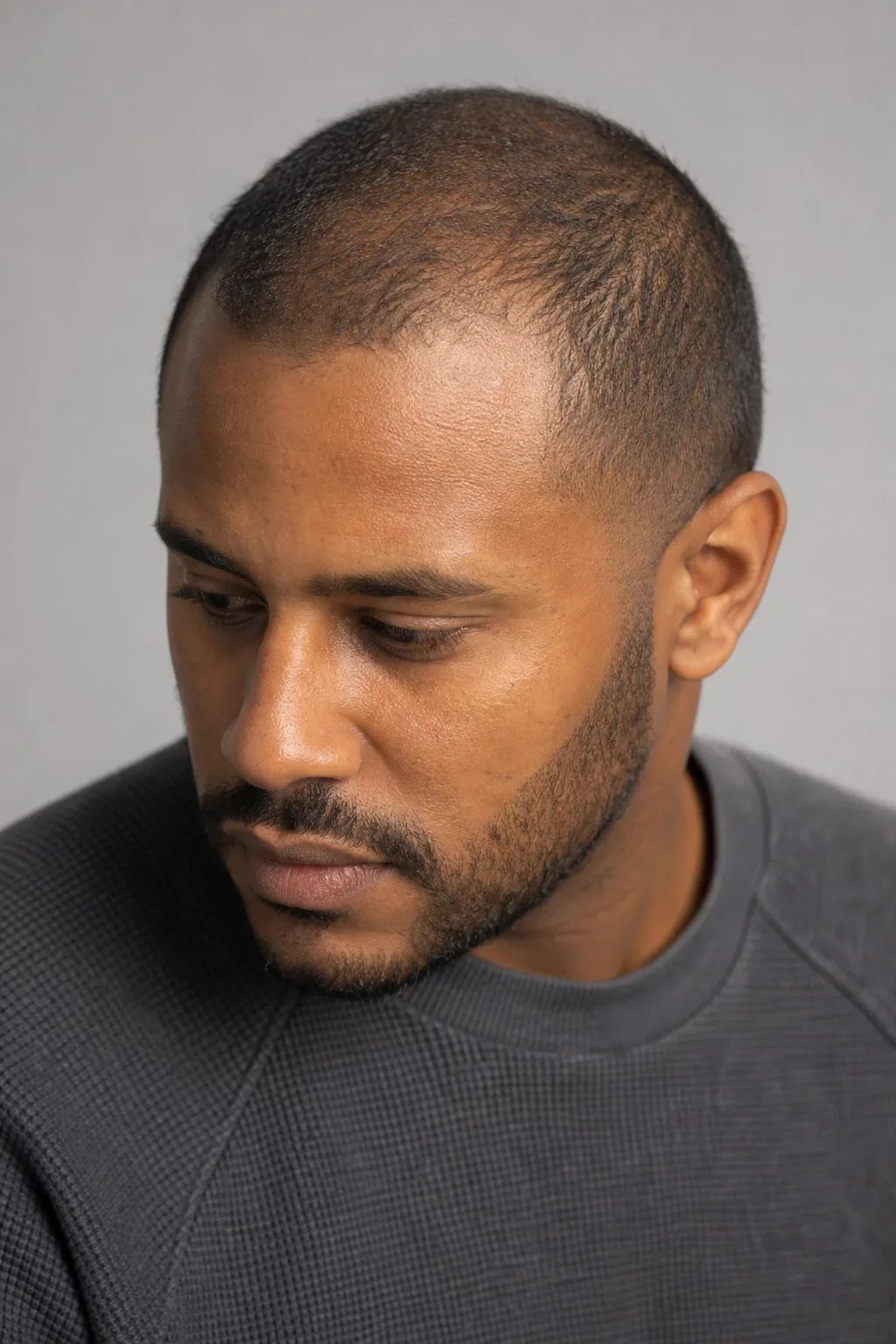
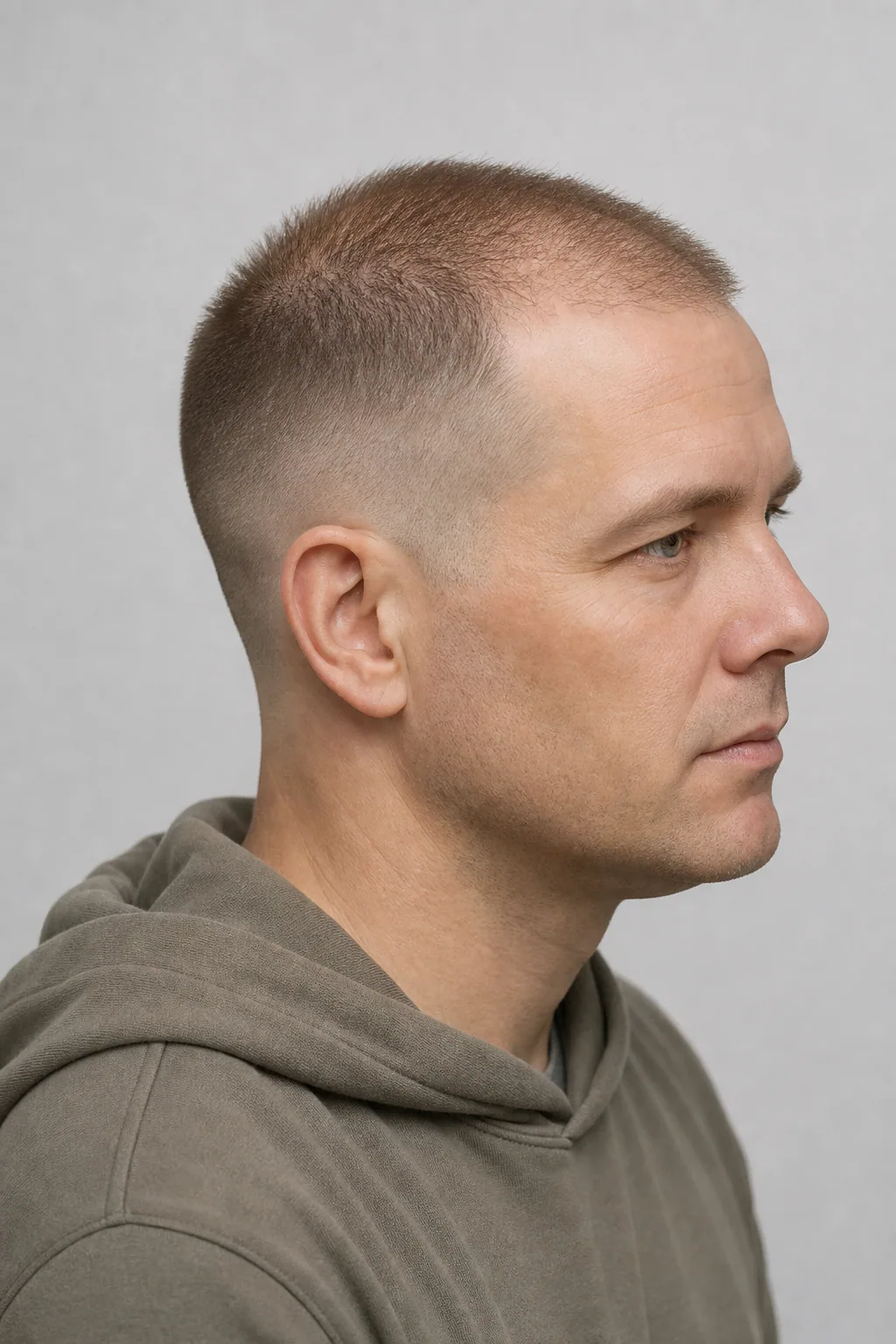
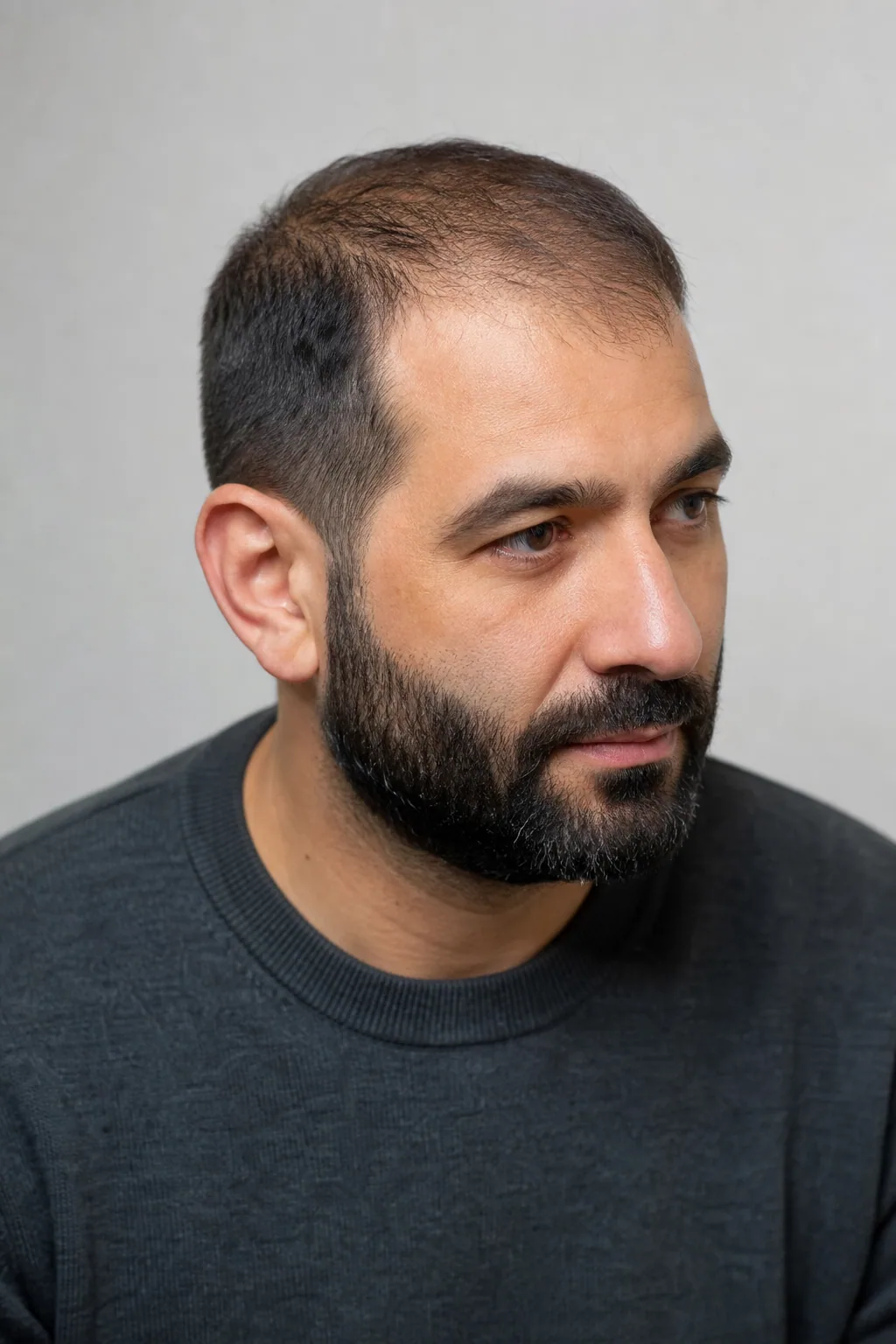
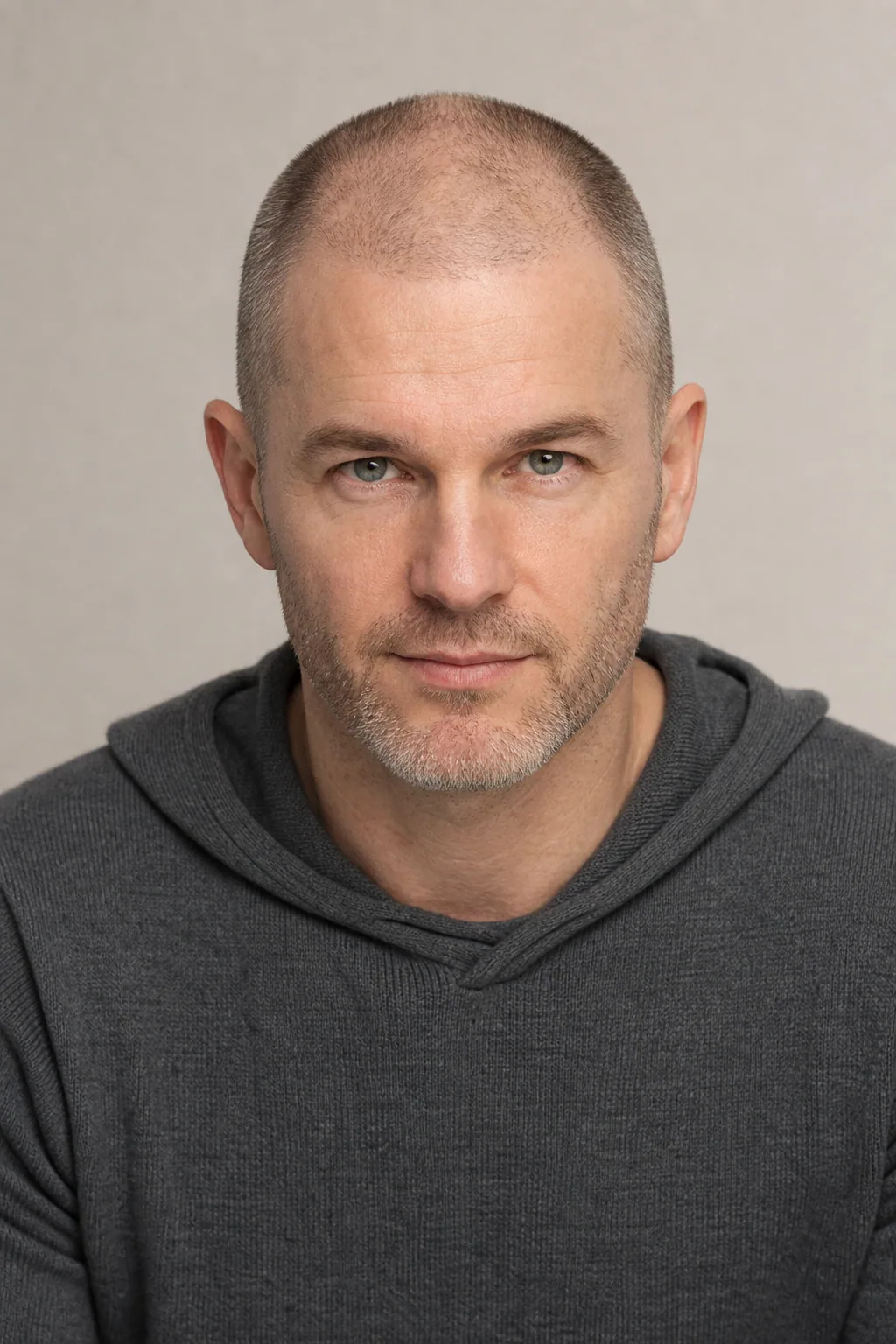
The best haircut for a man with thinning hair is the one matched to where the hair is going and how far it has gone. Receding temples call for hair that falls forward, a thinning crown needs to be cut short enough that it stops splitting, and once the top is mostly scalp the sides have to come down to meet it.
Most men notice thinning in their twenties, thirties or forties, and it rarely happens all at once. It moves through recognizable stages, and each one has cuts that hide it and cuts that advertise it.
Below are 14 cuts grouped by stage, the styles that make thinning more obvious, and the words to use in the chair. If your hair has always been sparse rather than getting sparser, haircuts for men with thin hair is the better starting point.
Chair-side note
The men who look most thinned-out in my chair are usually not the ones with the least hair. They are the ones still wearing the cut they had at 22.
Thinning is a moving target, so the cut has to move with it. I tell every client the same thing: shorten a little each time the pattern changes, and nobody will ever see a "before and after."
SB
— Simone Baptiste, Senior Stylist
Find your stage first
Dermatologists describe male pattern hair loss on the Hamilton–Norwood scale, which runs from a full juvenile hairline to a horseshoe of hair around a bald top. You do not need the numbers, just the shape.
Take two photos in good light: one of your hairline from the front with the hair pushed back, and one of the top of your head from above. Compare them with the four stages below, which are the ones that change what a barber should do.
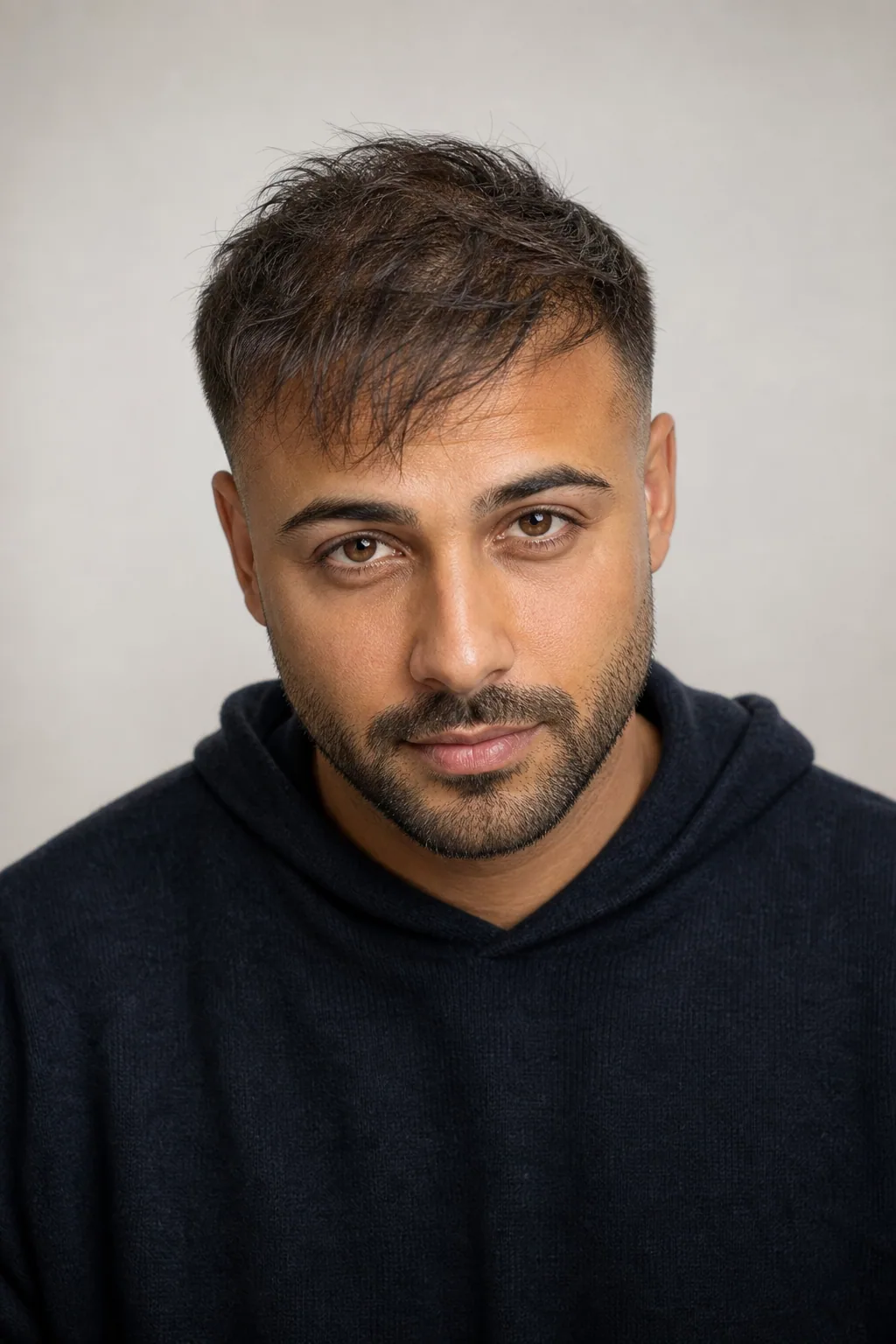
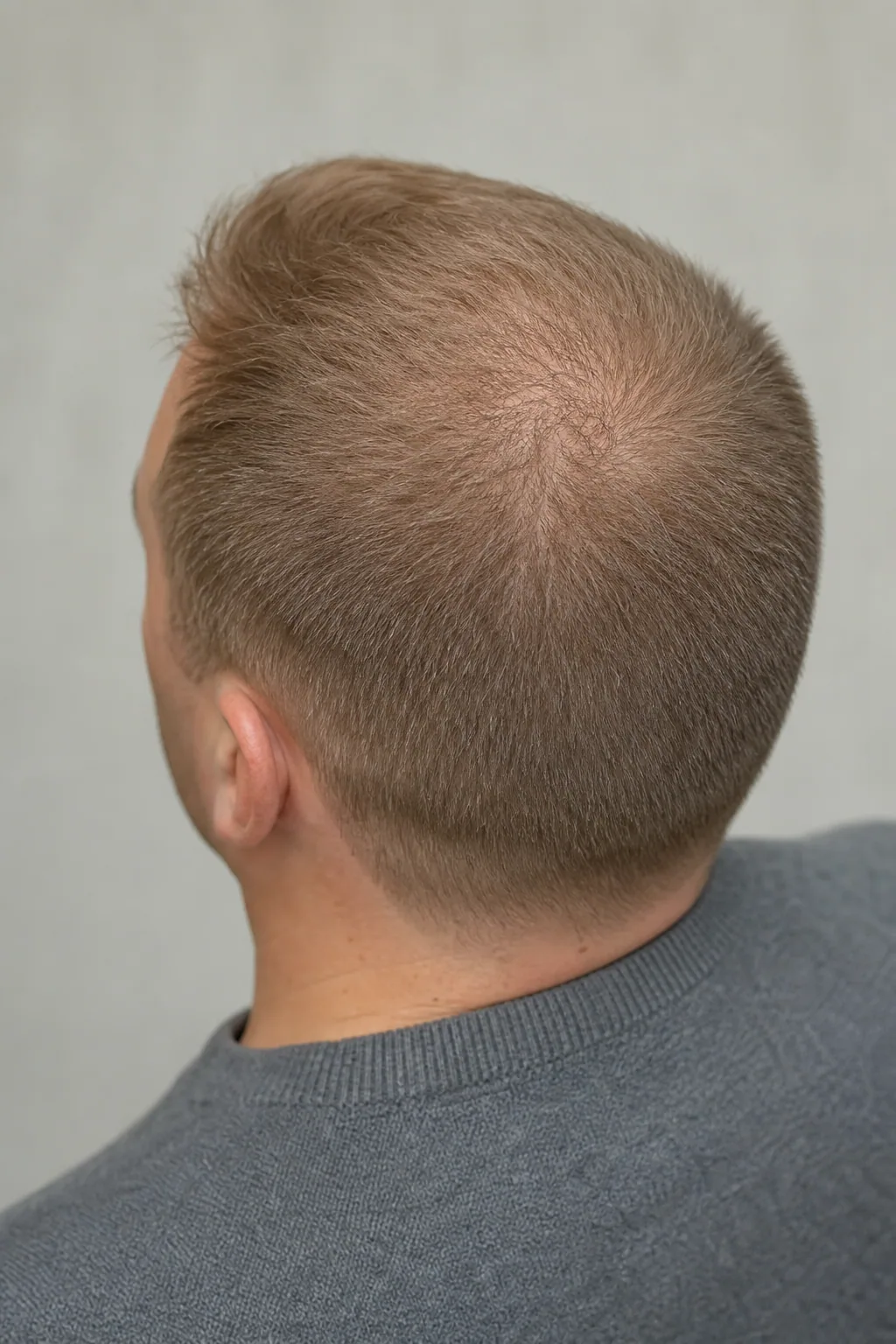
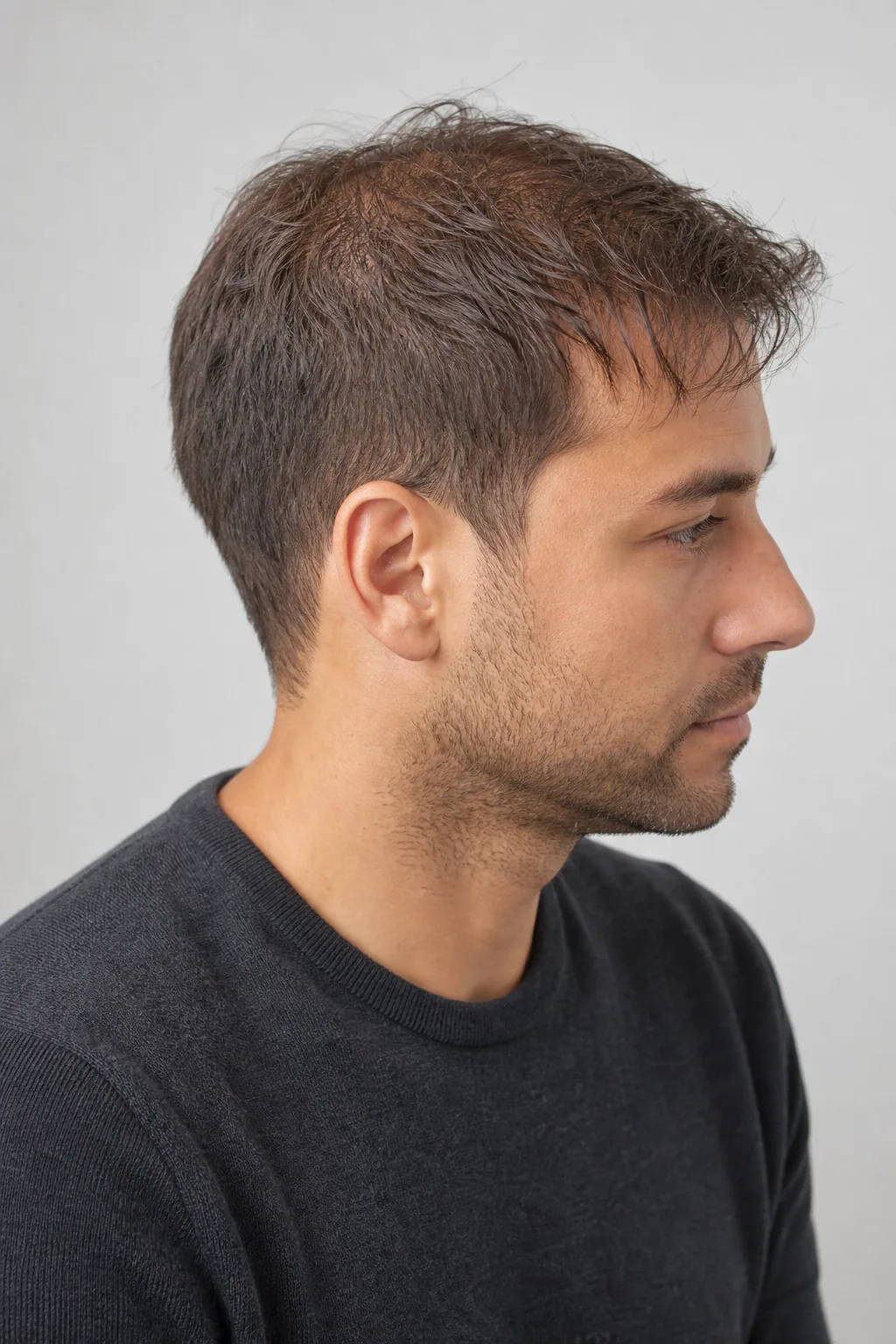
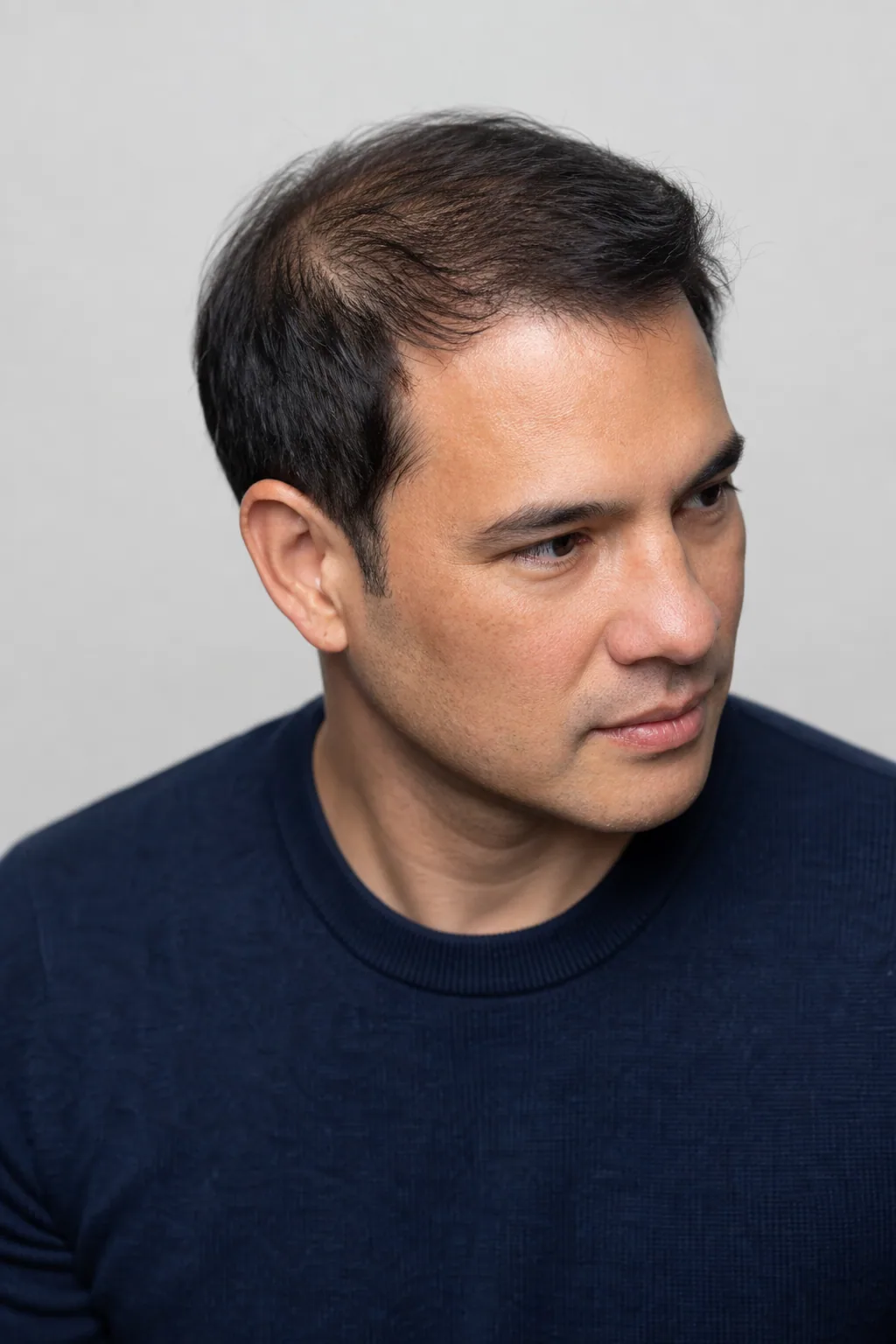
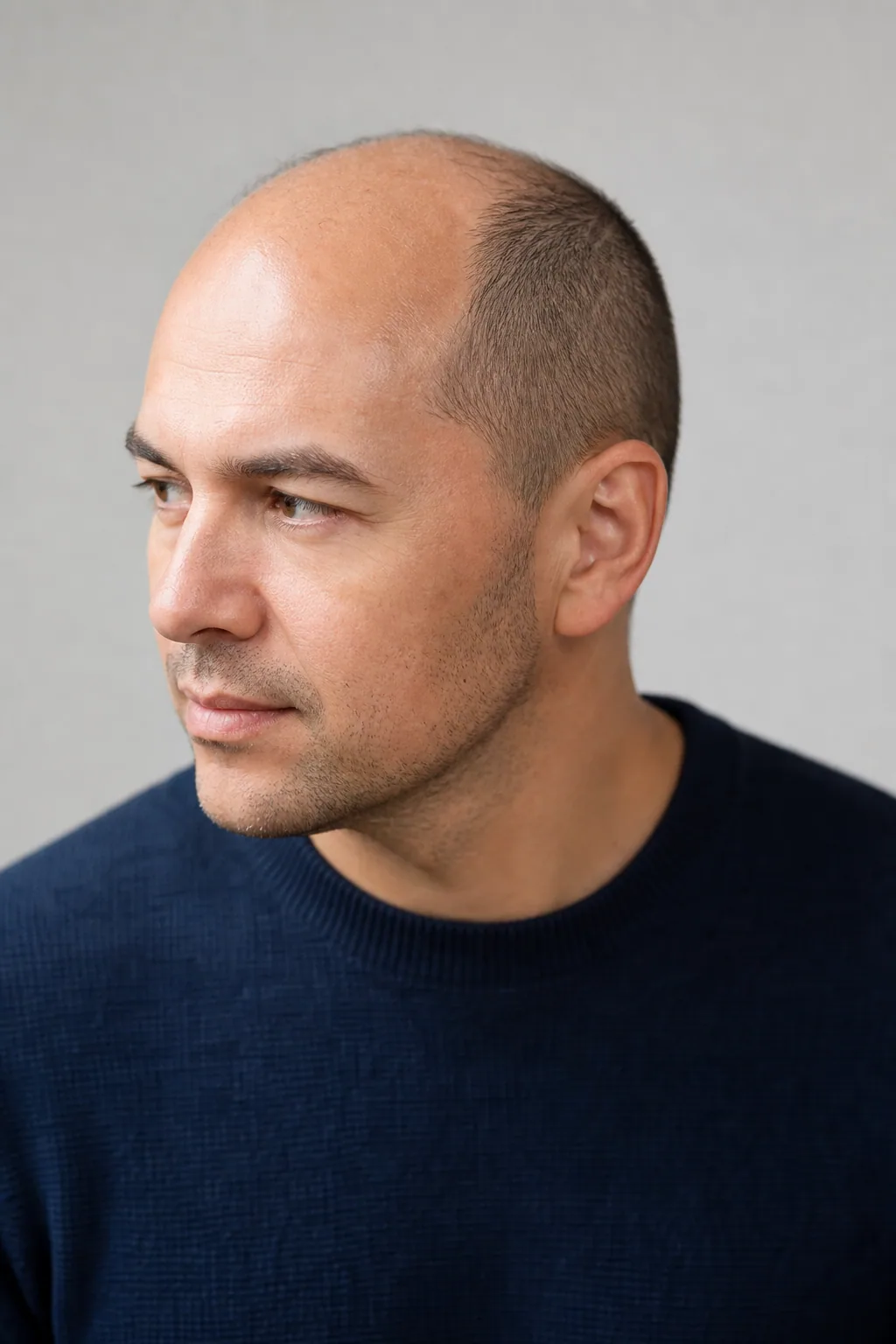
Receding temples — the corners have moved back into an M. Thinning at the crown — a circle of scalp shows at the back of the top. Thinning on top — the front and middle are sparse, and the temples and crown may be meeting. Bald on top — the top is mostly scalp, with fuller hair on the sides and back.
Haircuts for receding temples
This is where most men start. The goal is hair that falls toward the forehead, because anything swept back or straight up puts the corners on display.
1
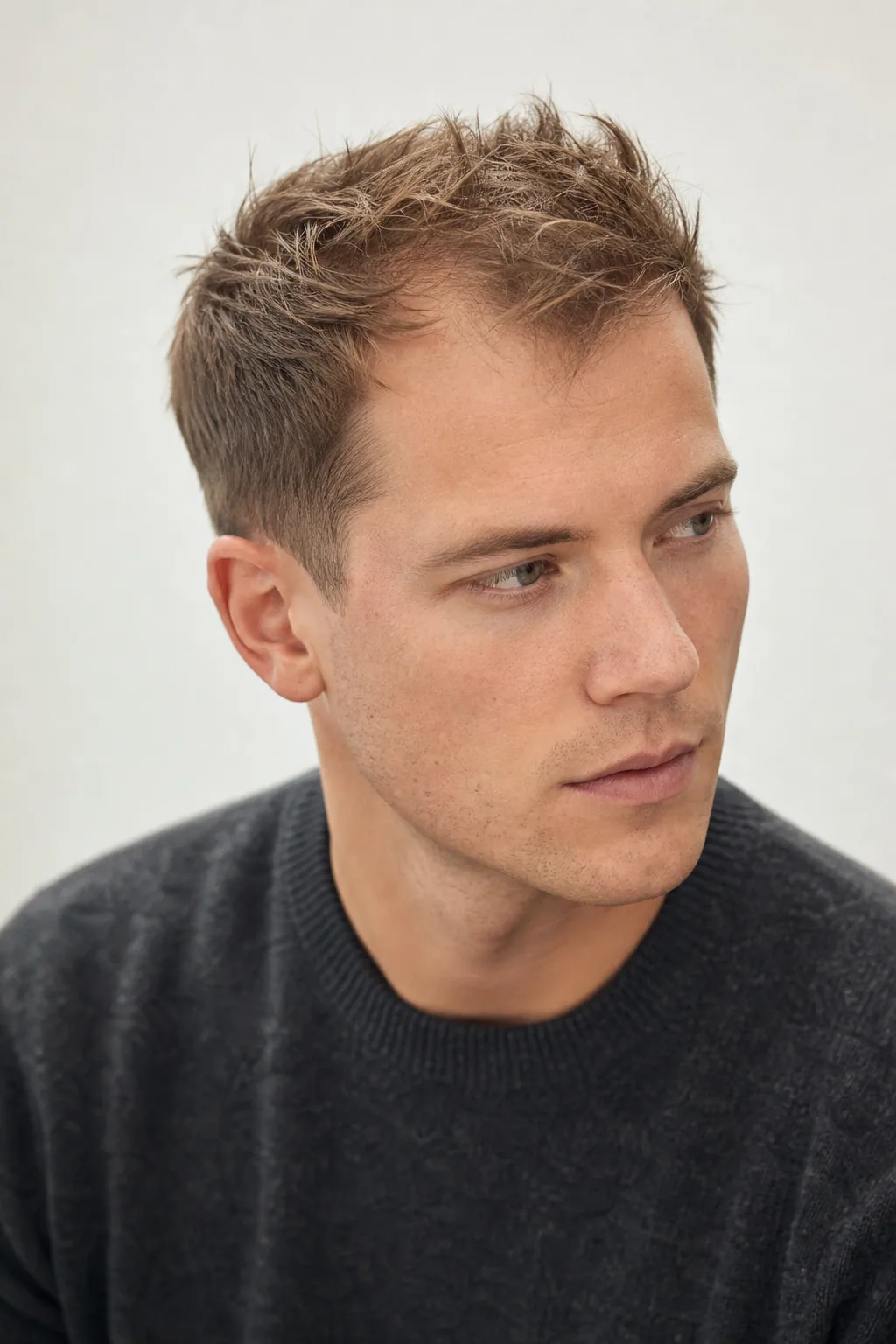
Choppy fringe crop with a low fade
The top is cut short and choppy and pushed forward, so the fringe breaks up over the receded corners instead of outlining them. The low fade keeps the sides neat without making the top look sparse.
Ask for the fringe to be point-cut to uneven lengths. A straight, even fringe traces the M-shape above it.
2
Angled fringe swept across
When one temple has gone further than the other, sweeping the fringe diagonally toward the deeper side covers it. Most men recede unevenly, so this is more common than it sounds.
Keep it short enough to fall into place on its own. A long sweep that needs product and a blow-dry to stay put will open up by lunchtime.
3
Textured Caesar with a taper
A Caesar is short all over with a brief forward fringe, and it needs very little hair to look finished. Adding texture to the top stops it sitting as a flat cap.
On a longer face the fringe shortens the forehead. On a round face, keep the sides a little tighter so the top gets the height.
Haircuts for thinning at the crown
Hair at the crown grows outward in a spiral from a whorl. Left long, it parts along that spiral and opens a visible circle. Cut short, it lies evenly around it.
You also cannot see your own crown, so this is the stage men notice last, usually from a photo someone else took.
4
Short crop with the crown taken to a number 2
The front keeps a little length for shape, and the crown is clipped down to a number 2 and blended so there is no step where the longer hair begins. With nothing long enough to split, the whorl stops opening.
Ask to see the back in a hand mirror before you leave. The crown is the one part of the cut you never check yourself.
5
Forward-pushed textured top
Instead of letting the crown hair fall back and away from the whorl, it is cut and dried to point forward. Hair travelling forward over the crown covers it; hair falling away from it exposes it.
Dry it forward with your fingers for thirty seconds before you add any product. The direction you set wet is the one it keeps.
6
Harvard clip
A longer version of the crew cut: enough at the front for a soft side part, stepping down to a short crown. It looks traditional and office-ready without leaving long hair at the back to separate.
The side part should be soft and finger-made. A hard, razored part line is a stripe of scalp you have chosen to add.
Hairstyles for thinning hair on top
When the front and middle are both sparse, and the recession and the crown are starting to meet, the rule changes. There is no longer enough hair to direct over anything.
The job now is to make everything the same short length, so the thinner top and the fuller sides stop looking like two different heads of hair.
7
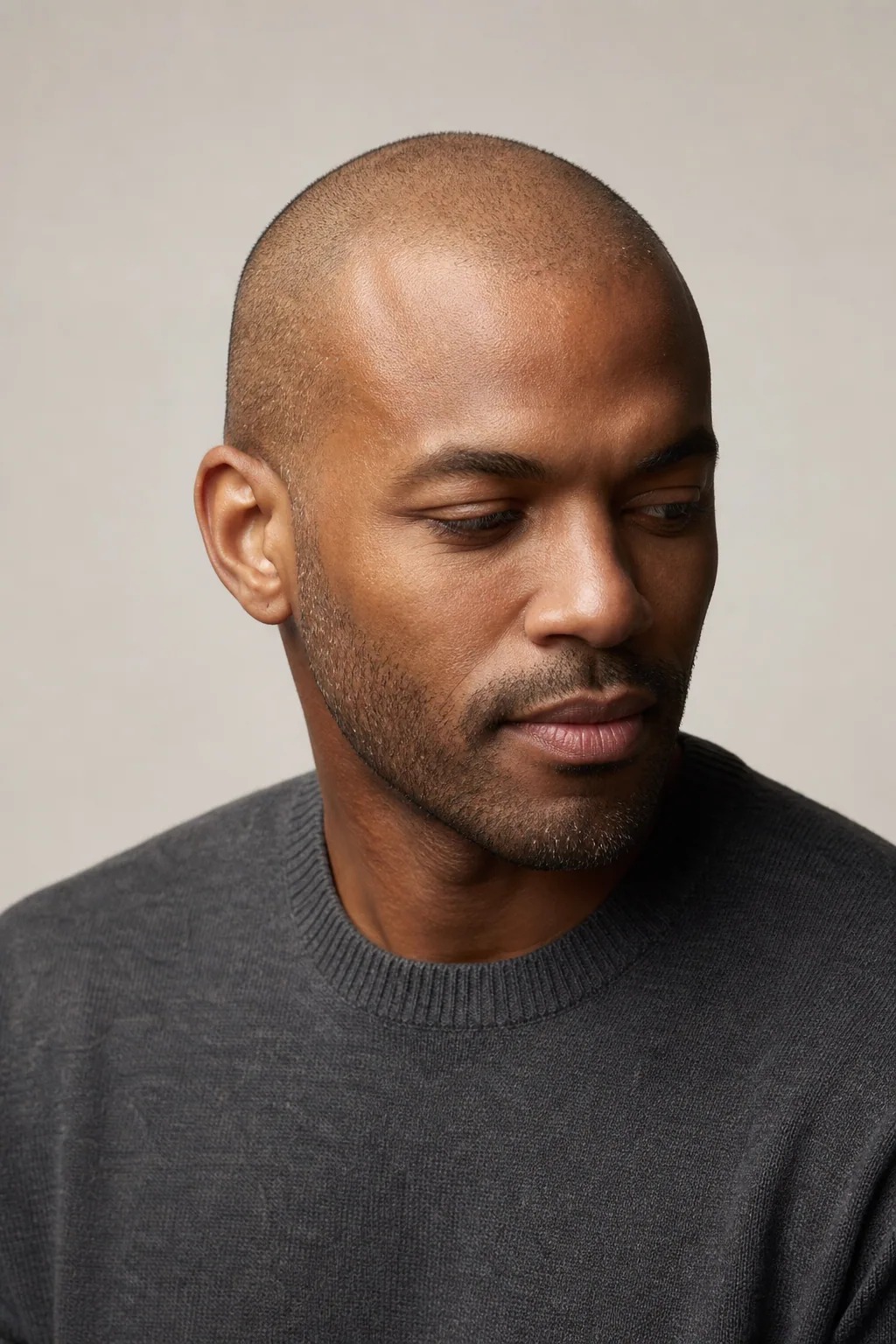
Even buzz at a number 2
One length over the whole head removes the contrast that makes thinning obvious. At a number 2, the hair is short enough that the thin top and the full sides look almost the same.
A high fade usually makes a thin top look sparser by contrast. Here the top is cut almost as short as the fade, so there is no long, thin section left sitting above the skin.
The rule is simple: the fade can go as high as you like, as long as the top comes down with it. The mistake is a high fade under a long top.
9
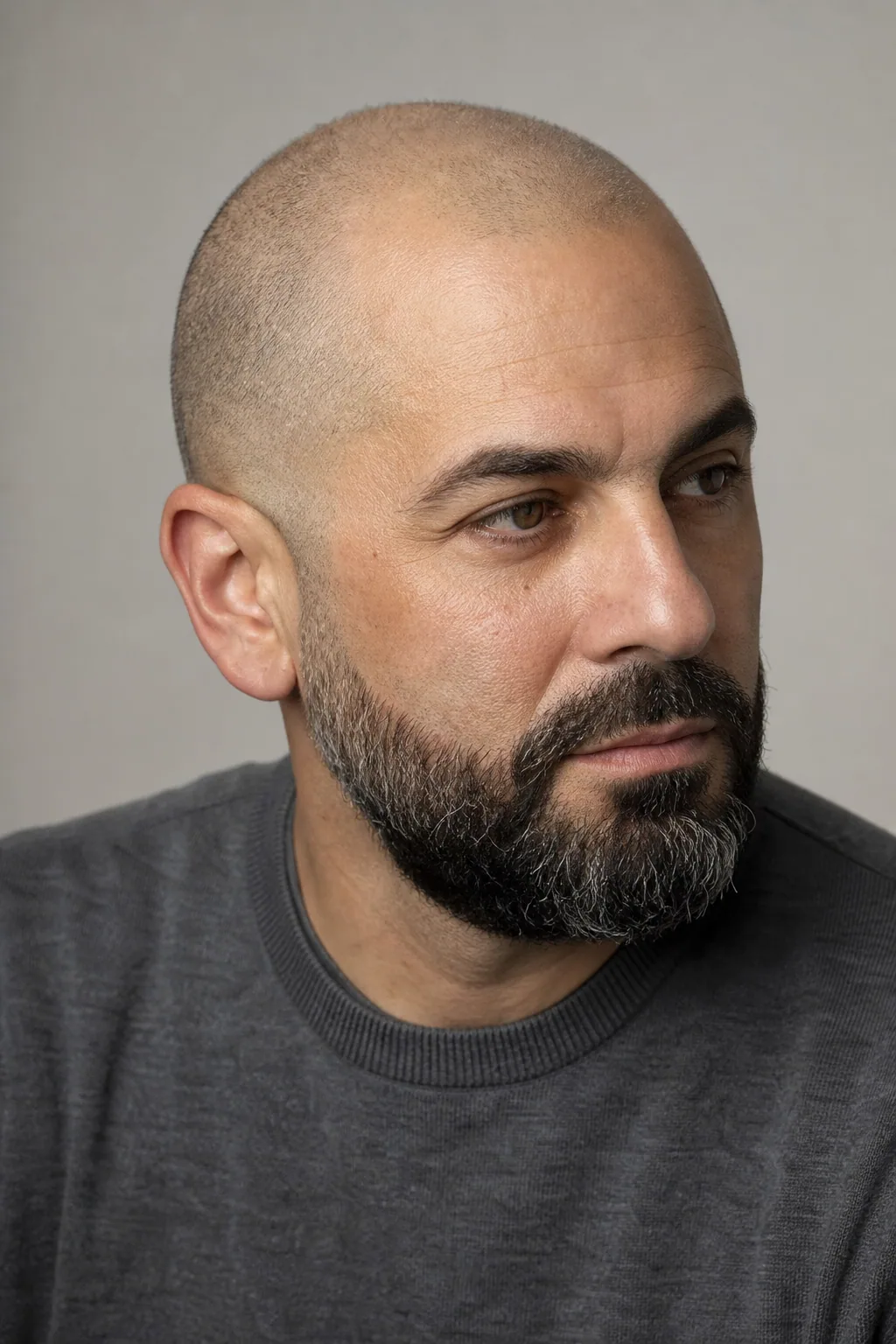
Short crop with a full beard
A beard shifts the weight of the face downward, so the eye goes to the jaw rather than the top of the head. With the hair kept short, the head looks balanced instead of top-light.
Keep the beard shaped at the cheeks and neckline. An untidy beard next to thinning hair reads as neglect rather than choice.
10
Burr cut at a number 1
Shorter than a buzz, so the remaining top hair and the fuller sides both read as stubble. The balding pattern is still there, but it no longer looks like a pattern.
It needs cutting every two weeks to stay even, which is easy at home with a set of clippers.
Balding haircuts when the top is mostly scalp
At this stage the sides and back are usually still full, and that is the problem. A ring of longer hair around a bald top frames it and makes it the focus.
11
Horseshoe clipped close
The hair that is left on the sides and back is taken right down, so it reads as a shadow around the head rather than a frame around the bald area. It is the single most important change a man at this stage can make.
One guard, all around, every two to three weeks. Do not leave the back longer than the sides.
12
Shaved head with stubble
Shaving removes the contrast completely, and for many men it is the version they wish they had tried years earlier. A little stubble on the jaw keeps the face from looking unfinished.
Shave every two or three days with a head shaver, and put sunscreen on the scalp every morning.
13
Skin fade into a shaved top with a beard
The sides are faded into the beard so the hair on the face and the head read as one shape. It gives a bald head structure and makes it look deliberate.
A barber needs to blend the fade at the sideburns every two to three weeks, or the join becomes a line.
When the thinning is only just starting
If the change is slight — a little more scalp in bright light, a hairline that has matured rather than receded — you do not need to go short yet. You need to stop flattening what you have.
14
Messy textured top with matte clay
Two inches on top, cut with texture and roughed up with a pea-sized amount of matte clay. The separated pieces overlap and hide the scalp better than smooth, combed hair at the same density.
Skip gels and shiny pomades. They clump the hair into strands and the shine reflects light off the scalp between them. Our styling routine for fine hair on men covers the blow-dry that holds this up.
Styles that make thinning more obvious
The comb-over. It relies on long hair staying in place over a bald area, and wind or rain moves it. It also makes the covering look deliberate, which draws the eye to exactly what it is hiding.
Slicked-back hair. Pulling the hair straight back exposes the temples fully and separates the top into lines with scalp between them. A hard part. A shaved or razored part line adds a stripe of bare scalp to a head that is already showing more than you want.
Long sides under a thin top. Whatever the stage, fuller hair left long at the sides and back makes the top look thinner by comparison.
What to ask your barber
Say: "My hair is thinning at the [temples / crown / top]. I want it short enough that the thin areas match the rest — push the front forward rather than back, keep the crown short so it doesn't split, and bring the sides down to match the top. No thinning shears and no hard part."
Thinning shears remove bulk, and bulk is what you are short of. Our page on thinning shears explains why to turn them down.
Chair-side note
A haircut changes how thinning looks. It does not change how fast it happens.
If you want to keep the hair you have, the time to see a dermatologist is early, while there is still hair to keep. Treatment works on thinning follicles, not on ones that have already stopped.
SB
— Simone Baptiste, Senior Stylist
When to see a doctor instead of a barber
Your hair is falling out faster than it was, or suddenly. Pattern loss is slow. Sudden shedding has other causes, and our guide to blood tests for hair loss lists what a doctor usually checks.
You have round bald patches, or you are losing hair from your beard or eyebrows. That suggests alopecia areata or another condition, not pattern loss, and it needs a dermatologist.
Your scalp is itchy, sore, red or scaly where the hair is thinning. Inflammation can cause hair loss, and some forms scar permanently. See a dermatologist promptly.
You want to slow the loss, not just disguise it. A board-certified dermatologist can explain the established options. Our overview of in-office hair loss treatments is honest about what the newer ones do.
FAQ
A short cut matched to where the hair is thinning. For receding temples, a choppy forward fringe or a textured Caesar covers the corners. For a thinning crown, keep the crown clipped short so it stops splitting. For thinning on top, an even buzz at a number 2 removes the contrast between the top and sides. Once the top is mostly scalp, clip the sides and back close or shave the head.
Short, even cuts: a buzz at a number 2 or 3, a high and tight with the top kept equally short, or a short crop with a beard to balance the face. When the front and middle are both thin, there is not enough hair to direct over the scalp, so the aim is to make the top and sides the same length so the thinning stops looking like a pattern.
Almost always. Longer hair lies flat and parts, which shows more scalp, and long sides beside a thin top create the contrast that reads as hair loss. Short hair stands up and sits closer together. At the very earliest stage you can keep a couple of inches on top with a textured, matte finish, but shorten it as the pattern progresses.
Only when the top is left long. A high fade under a long, thin top leaves sparse hair sitting above bare skin and exaggerates the difference. If the top is cut almost as short as the fade, as in a high and tight, the contrast disappears. With more length on top, choose a low fade or low taper instead.
When the top is mostly scalp and the sides are still full, shaving usually looks better than any cut, because it removes the contrast between them. Clipping everything to a number 1 is a halfway step if you are not ready. A shaved head needs a head shaver every two or three days and sunscreen on the scalp every morning.
No. A haircut changes how thinning looks, not how fast it progresses. Male pattern hair loss can often be slowed with treatment, which works best while the hair is still there, so see a board-certified dermatologist early if you want to keep it. Sudden shedding, patchy loss or a sore, scaly scalp should be checked by a doctor.
Eleven years behind the chair, specializing in short shapes and fine-hair texture. Simone believes the best haircut is the one you can style yourself in ten minutes.
This article is for general education and is not medical advice. Thinning hair can have several causes, and the cuts here are cosmetic rather than treatment. If your hair loss is sudden, patchy, or accompanied by an itchy, sore or scaly scalp, see a board-certified dermatologist.
Results vary with hair type, density, and growth patterns. Hairstyling guidance is not a substitute for an in-person consultation with a licensed barber or stylist.
Hairstyle images in this guide are AI-generated illustrations, not photos of real clients or results. See our image policy.
Get the good hair intel
One honest, stylist-written guide in your inbox each week. No hype.

 SB
SB