Reviewed by Tara Sullivan · Updated September 2026 · 10 min read
A buzz cut is one of the best cuts for thinning hair because it removes the contrast between the thin areas and the full ones. When every hair is the same short length, a receding hairline or a sparse crown stops looking like a pattern.
But the guard number matters more than the cut. Too long, and the thin top still shows through; too short, and you can see scalp everywhere. Below is how to pick the guard for your stage, ten versions of the buzz, and the situations where a buzz is the wrong call.
Chair-side note
Almost every man who asks me for a buzz because his hair is thinning asks for it too short. He wants the thinning gone, so he reaches for the shortest guard.
Start one guard longer than you think, look at it for a week, then go down. You can always take more off; you cannot put it back for a month.
SB
— Simone Baptiste, Senior Stylist
Why a buzz cut works on thinning hair
Thinning hair looks thin for two reasons: less hair, and the difference between where there is hair and where there is not. A buzz cannot fix the first, but it almost erases the second.
Long hair on the sides next to a thin top draws a line around the thinning. Cut everything to one length and that line disappears. The eye reads one even texture instead of a full frame around a sparse middle.
Short hair also stands upright instead of lying down and parting. Upright hairs overlap each other, so at the same density they cover more scalp than long hairs lying flat.
Buzz cut with thinning hair: choosing the guard
Clipper guards are numbered by the length they leave. On standard clippers, a number 1 leaves about 1/8 inch (3 mm), a 2 about 1/4 inch (6 mm), a 3 about 3/8 inch (10 mm) and a 4 about 1/2 inch (13 mm). Brands vary a little, so compare on your own clippers.
Thinning all over, no bald areas: a number 3 or 4. There is still enough hair to cover the scalp, and more length covers it better. Receding temples or a thinning crown: a number 2 or 3, so the thin spot and the rest of the head are close to the same density.
Thinning on top, with the temples and crown starting to meet: a number 1 or 2. Length no longer covers anything there, so the job is to match the top to the sides. Bald on top: a number 1 or 0 on the sides and back, or shave it all.
Longer buzz cuts: a number 3 to 4
For thinning that is even across the top rather than concentrated in one place. These keep enough length to cover the scalp and still look like hair rather than stubble.
1
Soft buzz at a number 4
Half an inch all over is long enough to look soft rather than military, and long enough that diffuse thinning still has hair covering it. It is the gentlest first step for a man who has never had a buzz.
Ask for the neckline to be rounded and left natural. A squared, sharply edged neckline makes a soft buzz look severe.
2
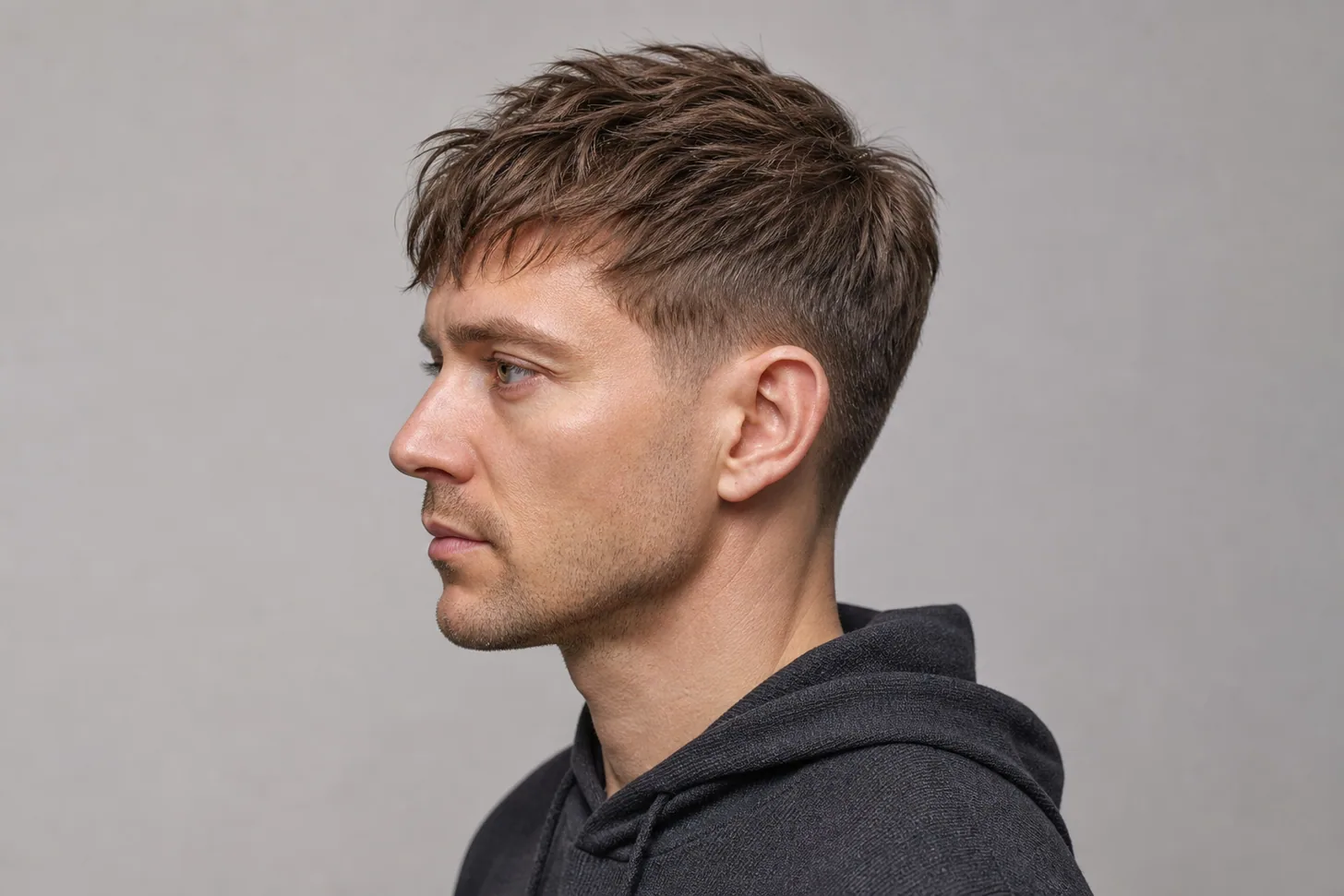
Tapered buzz, longer on top
A number 4 on top blended down to a 2 at the sides. The slightly longer top gives the head a shape and makes the top the fullest-looking part, which is the whole aim.
Keep the difference between top and sides to two guard sizes at most. More than that and the top starts to look sparse against the sides.
3
Even buzz at a number 3
The most useful single guard for thinning hair. At 3/8 inch it is short enough to take the contrast out of receding temples and still long enough to cover a crown that is only starting to thin.
If you only ever buy one guard for home clippers, this is it.
Shorter buzz cuts: a number 1 to 2
For thinning on top, where there is no longer enough hair for length to cover. Here the buzz is doing a different job: matching the full sides down to the thinner top.
4
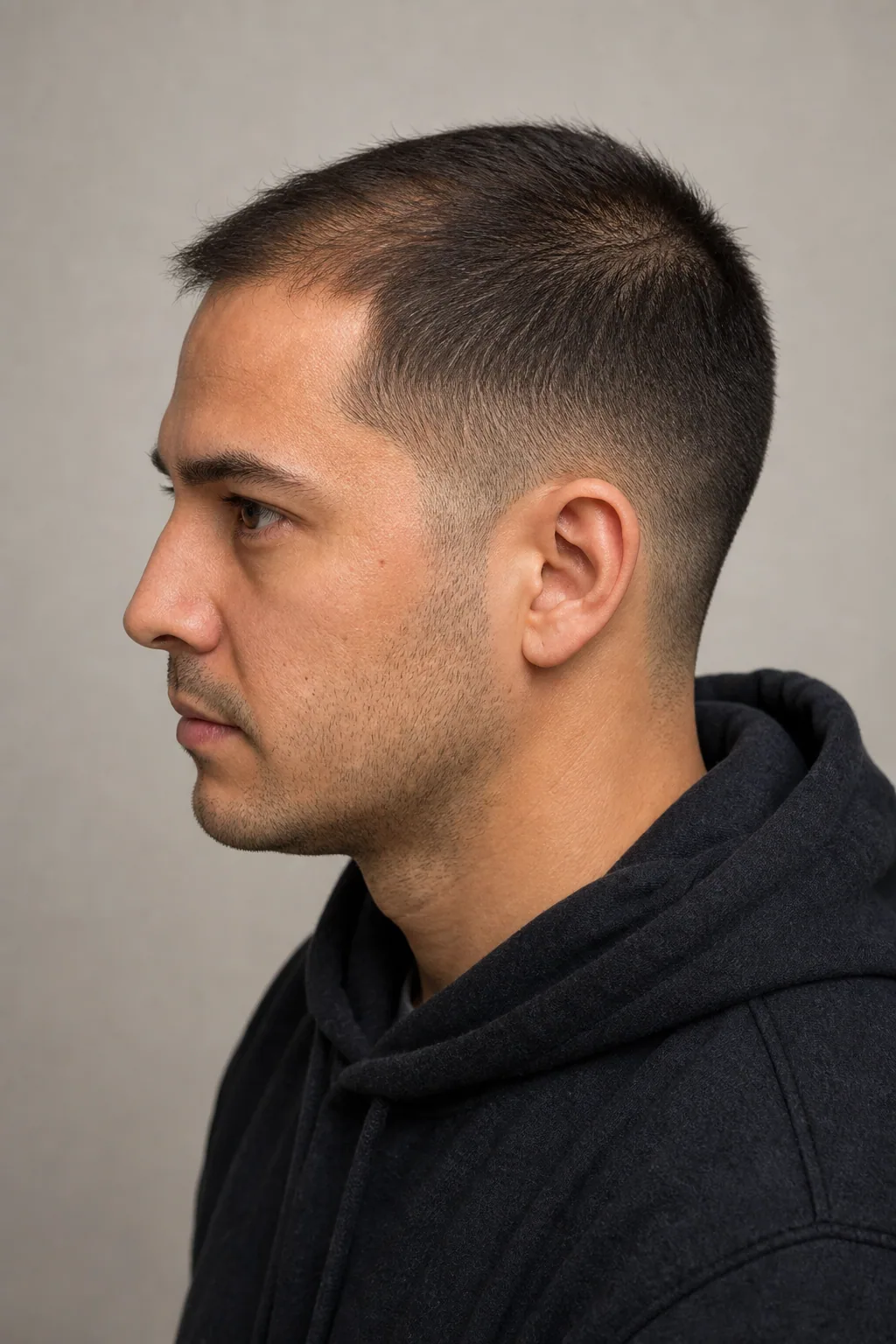
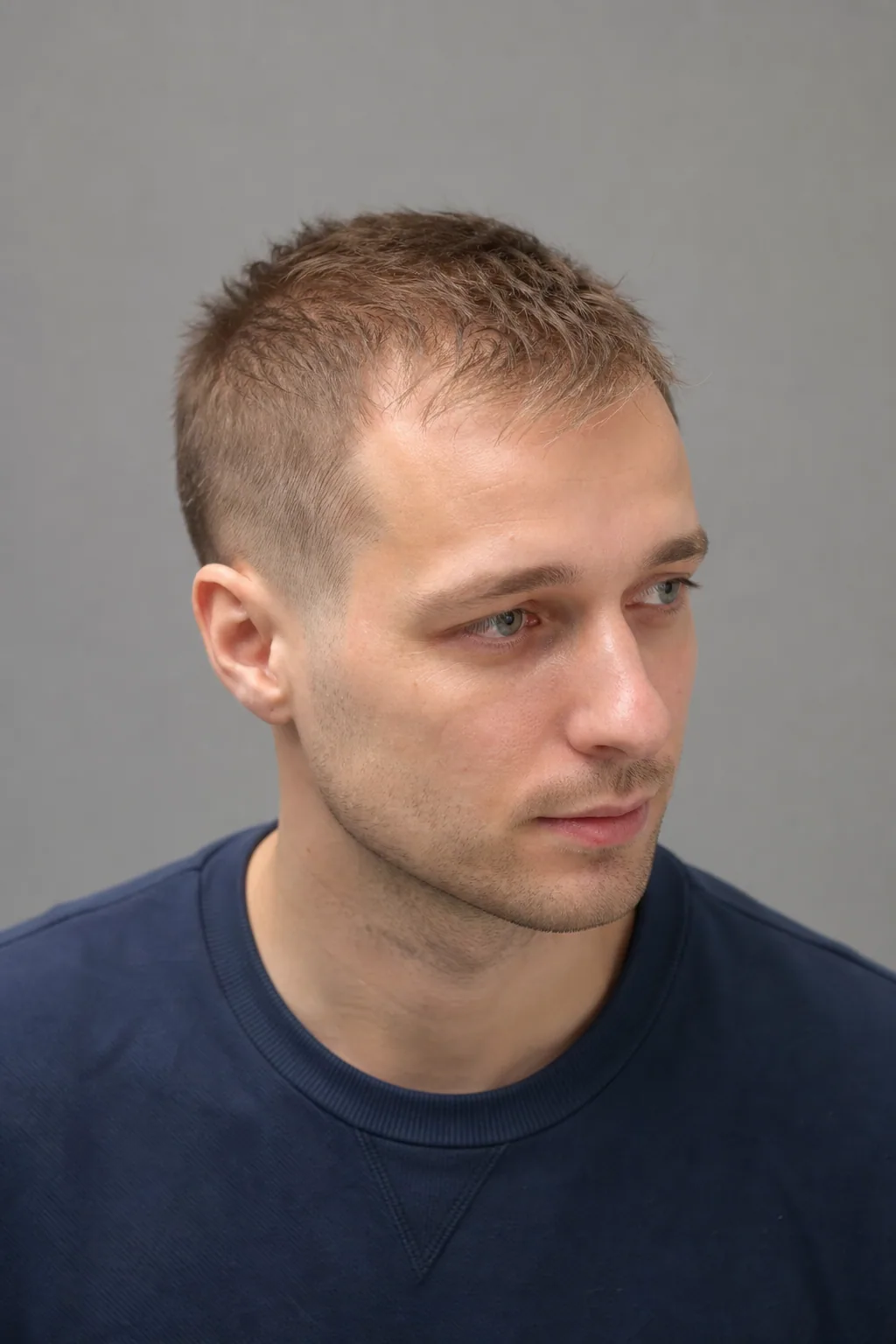
Buzz at a number 2 with a natural hairline
With a receding hairline, the edge matters as much as the length. Left soft, it blends into the forehead. Edged into a sharp line-up, it draws the M-shape in ink.
Ask for "no line-up at the front." Many barbers edge by habit.
5
Balding buzz at a number 1
At 1/8 inch, the fuller hair on the sides reads almost the same as the thin hair on top. The balding pattern is still there if you look for it, but it has stopped being the first thing anyone sees.
This is the length where the buzz starts to need a trim every ten days to two weeks, or the sides grow out and the contrast comes back.
6
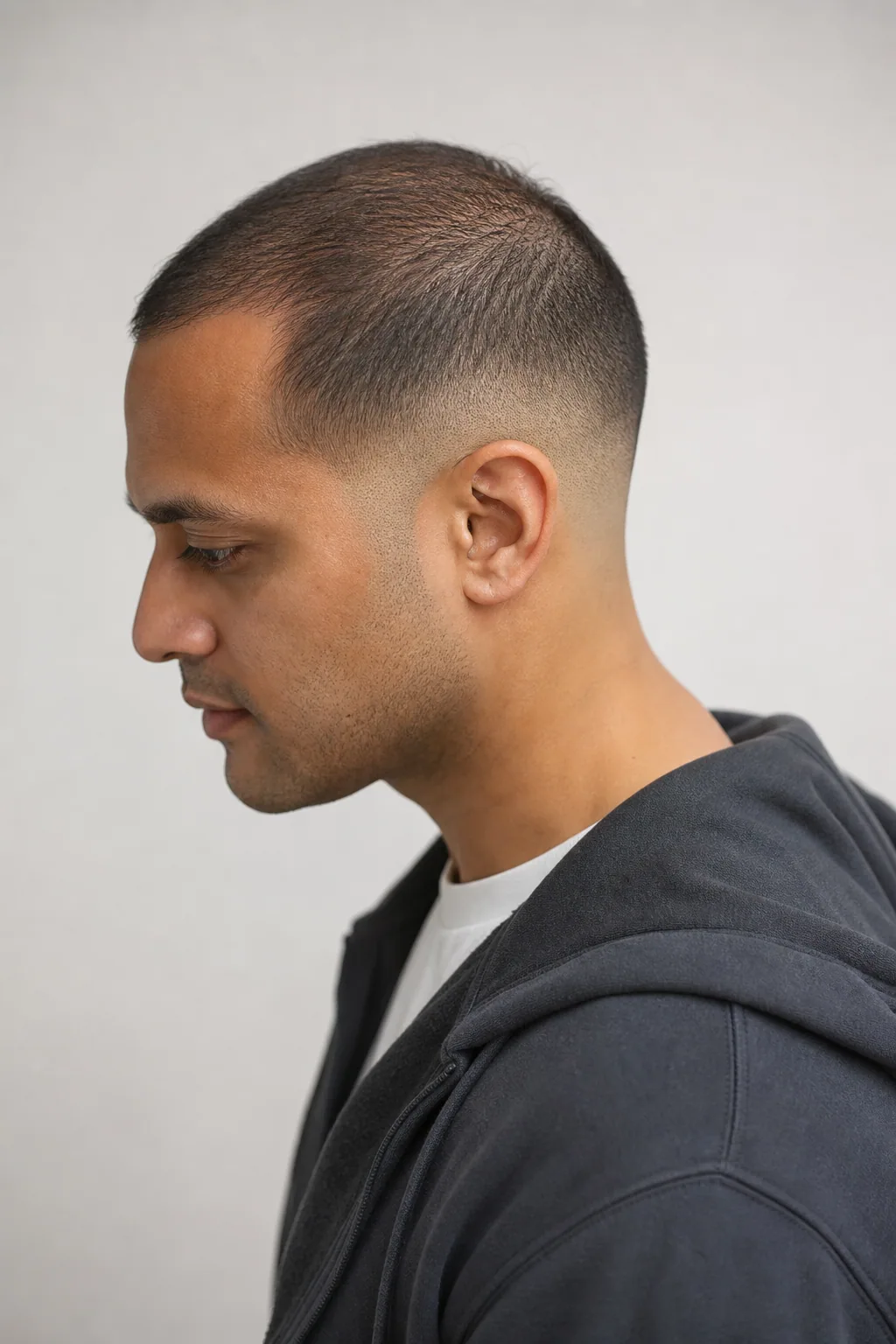
Buzz with a low fade
A low fade tidies the edges without changing the balance of the cut. Because the top is already short, it does not leave a long, sparse section sitting above bare skin.
Keep the fade low, around the ears and neckline. Our page on fade haircuts for thin hair explains why height is the thing to watch.
Buzz cuts with a beard, on grey hair, and all the way down
These three change what surrounds the buzz rather than the buzz itself.
7
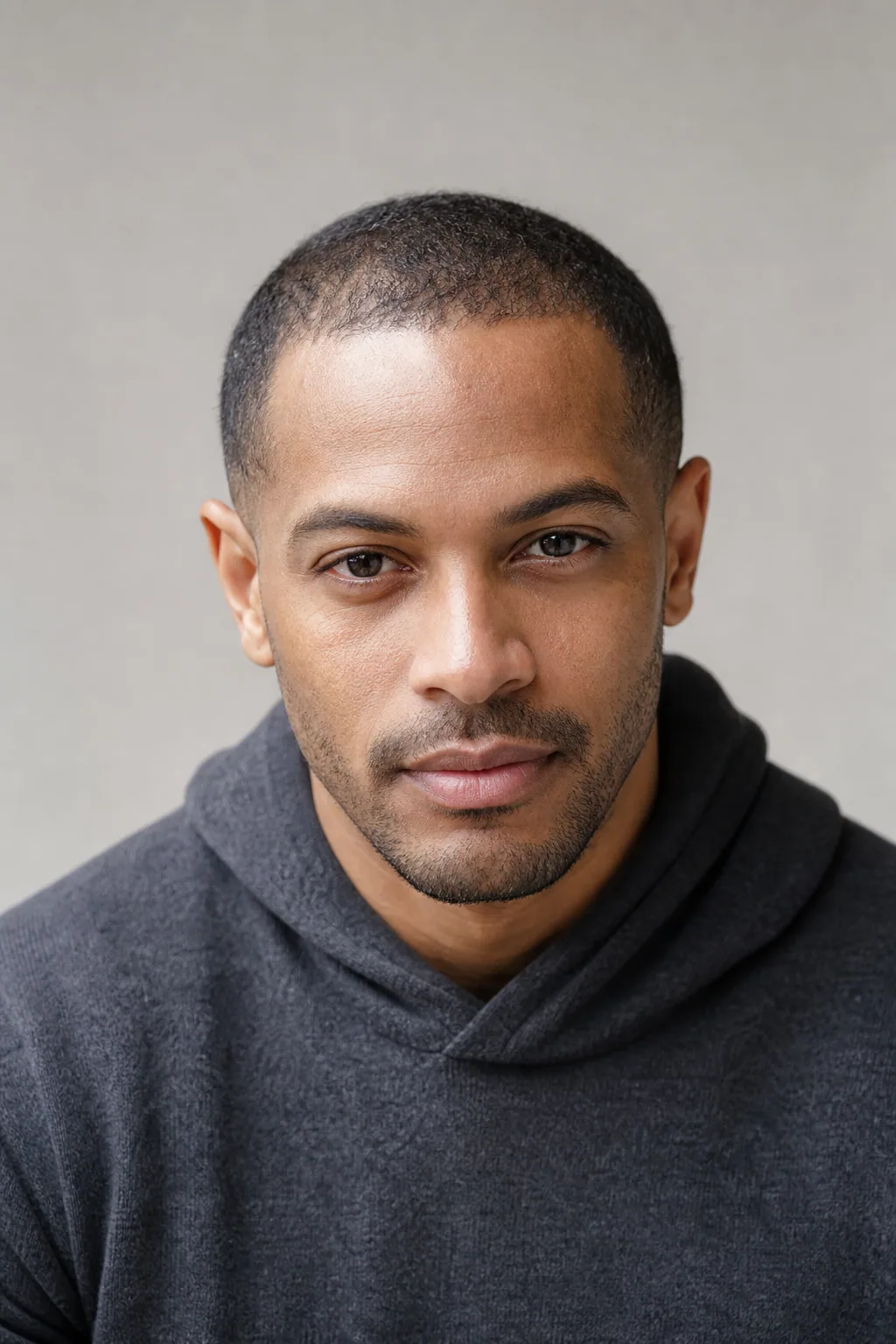
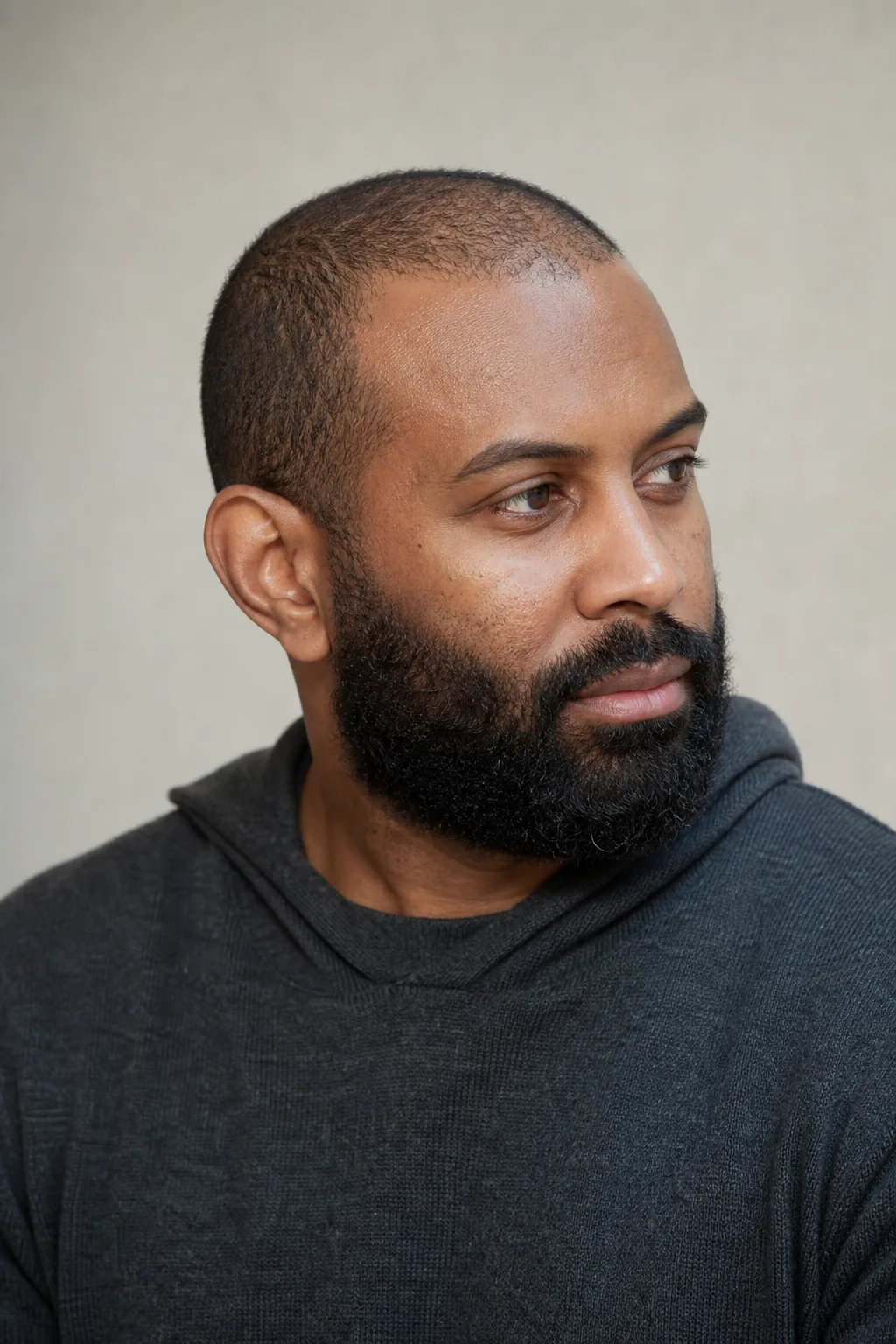
Buzz with a full beard
A beard moves the visual weight of the head down to the jaw, so the top of the head matters less. It is the most reliable way to make a very short buzz look deliberate.
Keep the beard shaped at the cheek line and neck. The buzz is tidy, so the beard has to be too.
8
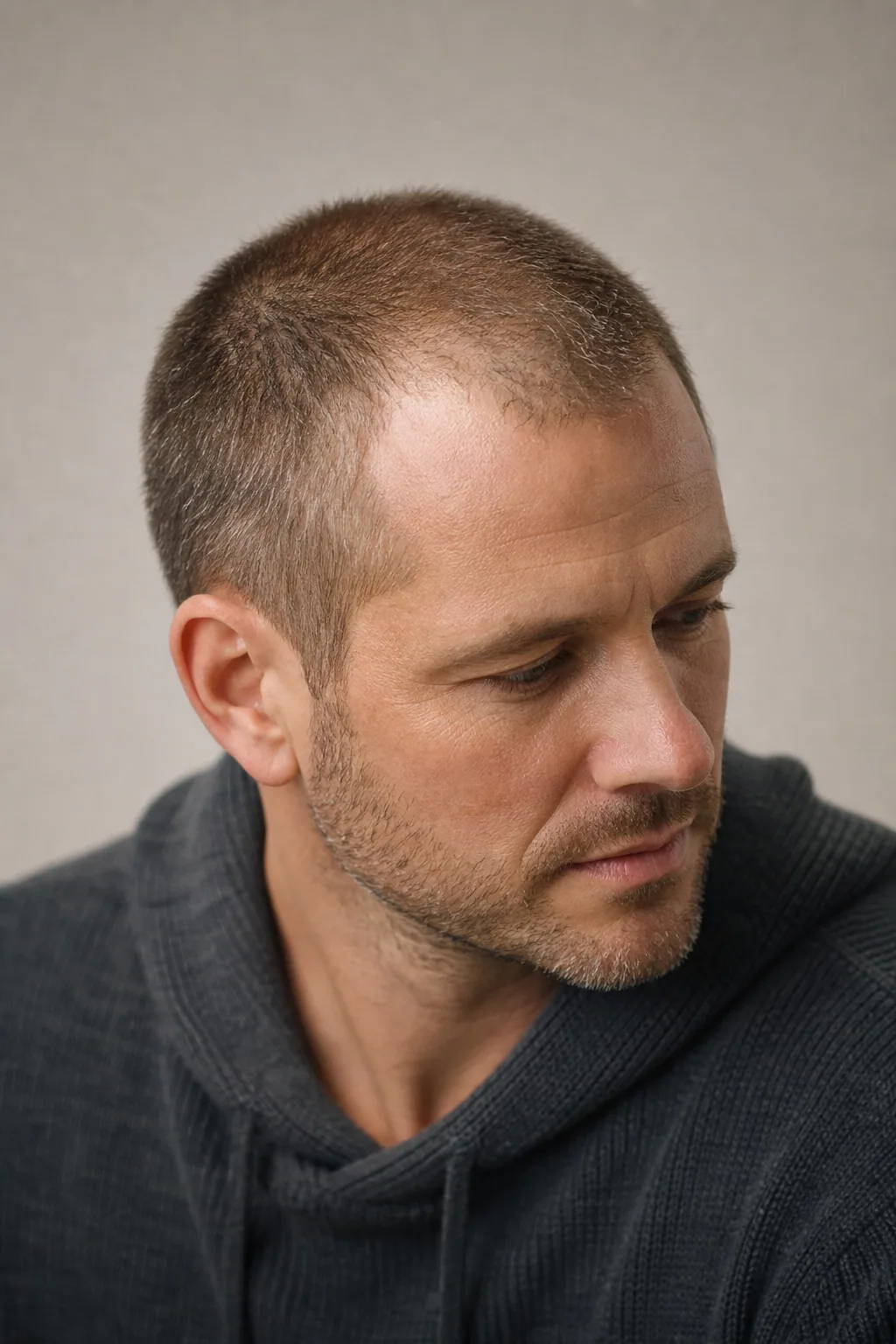
Silver buzz at a number 3
Grey and silver hair shows less contrast against the scalp than dark hair, so the same guard looks fuller on a grey head. Many grey-haired men can stay a guard longer than they expect.
Clippers with no guard leave a shadow of hair rather than a length. It is the last stop before a shave, and many men with advanced thinning find it looks better than a smooth scalp because the shadow outlines the head shape.
It needs a trim every week. Use sunscreen on the scalp daily, because there is nothing left to shade it.
10
Buzz grown to a short crop
If you tried a buzz and want a little more back, this is the halfway point: about three-quarters of an inch on top, pushed forward, with tapered sides. It keeps most of the buzz's advantages and gives the front some coverage.
A buzz shows the shape of your head. Most heads look fine; if yours has a flat back or a pronounced ridge, a slightly longer guard or a taper that leaves more at the crown will soften it.
The bigger factor is contrast between hair colour and skin. Dark hair over light skin shows the most scalp at any guard length, so it usually needs a guard longer. Light or grey hair, or hair close to your skin tone, looks fuller at the same length.
What to expect the first week
The first time you see a buzz on thinning hair, it will look shorter than you expected, and you will probably see the thin areas more clearly than you did in longer hair. That is the light hitting a freshly cut surface.
Give it five to seven days. The hair grows about a sixteenth of an inch in that time, the cut edges soften, and the density evens out. Take a photo on day seven and compare that, not the one in the barber's mirror.
Keeping it even
A buzz only works while it is even, so it needs cutting every two to three weeks at a 3 or 4, and every one to two weeks at a 1 or 2. Most men end up doing it at home.
Cut dry, go against the direction of growth, and do the back with a hand mirror or ask someone to check. A buzz left too long grows back into the contrast it was meant to remove.
When a buzz cut makes thinning hair look worse
When the guard is too short for your stage. With diffuse thinning and no bald areas, a number 1 simply shows scalp everywhere. Go longer.
When the sides are left longer than the top. A "buzz" with a number 4 on the sides and a 2 on top is the contrast problem in reverse. When the hairline is edged sharply. A line-up on receding temples outlines the recession.
When a buzz is the wrong call
You have round, smooth bald patches. A buzz will show them clearly. Patchy loss is often alopecia areata rather than pattern loss, and a dermatologist should see it first.
Your scalp is red, scaly, sore or has scarring. Close cuts expose and can irritate an inflamed scalp. Get the scalp treated first.
You are about to start treatment and want to track it. Treatment progress is easier to judge at a consistent length. Keep the same guard for months, and see our overview of hair loss treatments for what to expect.
FAQ
Yes, for most men. A buzz cut removes the contrast between full sides and a thin top or receding temples, so the thinning stops looking like a pattern. It also makes the hair stand upright, which covers more scalp than longer hair lying flat. The key is choosing a guard number that matches how far the thinning has gone.
For thinning all over with no bald areas, use a number 3 or 4. For receding temples or a thinning crown, a number 2 or 3. When the top is thin and the temples and crown are meeting, a number 1 or 2 matches the top to the sides. If you are unsure, start one guard longer than you think and go down after a week.
It often makes it look more even, which reads as fuller. At the same density, short upright hairs overlap and cover more scalp than long hairs that lie flat and part. A buzz does not add hair, and if the guard is too short for your density it can show more scalp, not less.
No. Cutting hair does not change the follicle, so it does not make hair grow back thicker, faster or darker. Freshly cut hair can feel coarser because the blunt ends are stiffer than tapered ones, but the density is the same.
Every two to three weeks at a number 3 or 4, and every one to two weeks at a number 1 or 2. A buzz relies on everything being the same length, and as the sides grow they start to frame the thinner top again. Most men with a buzz trim it at home.
If the top is mostly bald, shaving or an induction cut with no guard often looks better, because any length left on the sides frames the bald area. If you still have hair across the top, a buzz usually looks fuller and more natural than a shave. Try a number 1 first; it is an easy step back from.
Eleven years behind the chair, specializing in short shapes and fine-hair texture. Simone believes the best haircut is the one you can style yourself in ten minutes.
Results vary with hair type, density, and growth patterns. Hairstyling guidance is not a substitute for an in-person consultation with a licensed barber or stylist.
This article is not medical advice. If your hair loss is sudden, patchy, or accompanied by an itchy, sore or scaly scalp, see a board-certified dermatologist.
Hairstyle images in this guide are AI-generated illustrations, not photos of real clients or results. See our image policy.
Get the good hair intel
One honest, stylist-written guide in your inbox each week. No hype.

 SB
SB