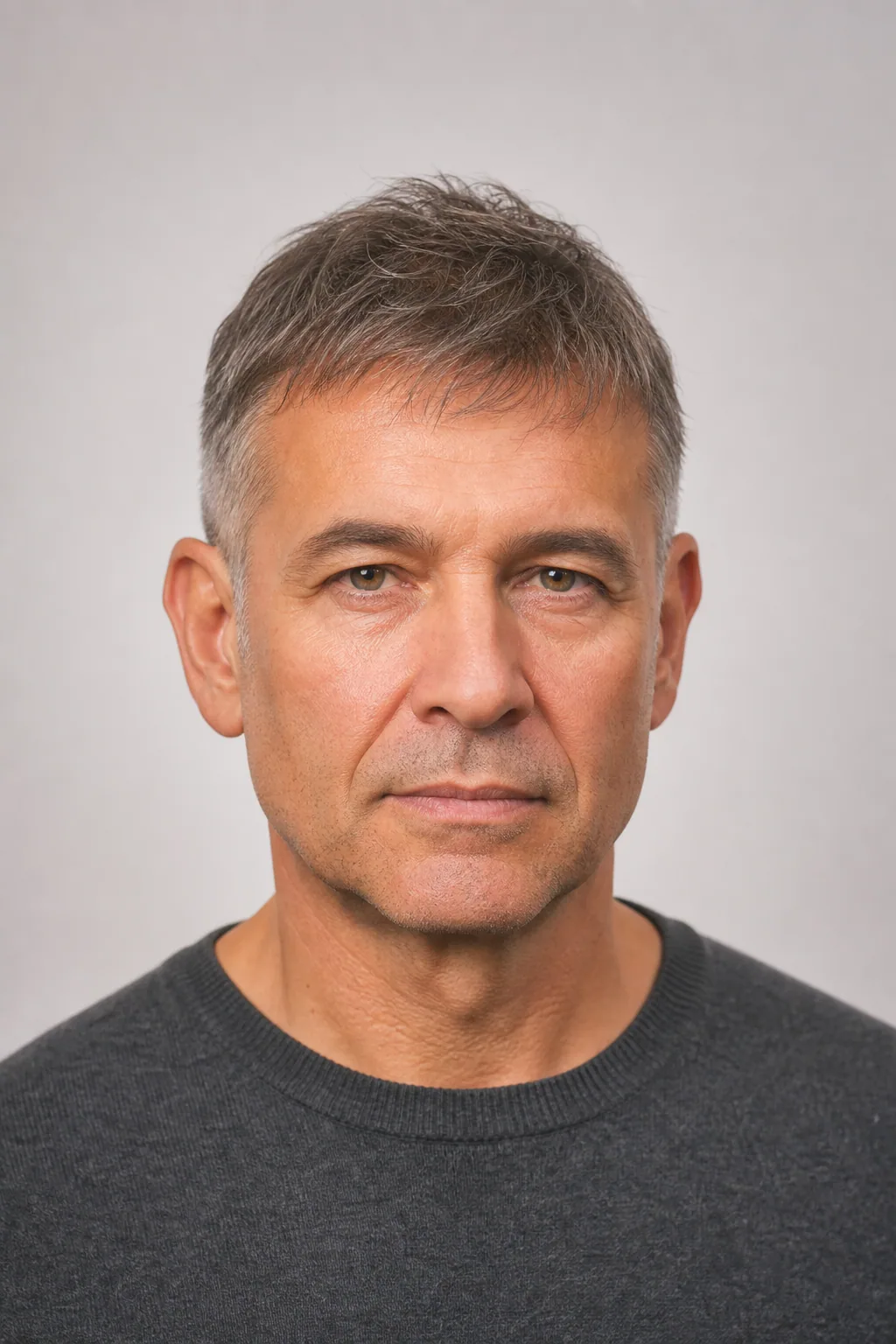
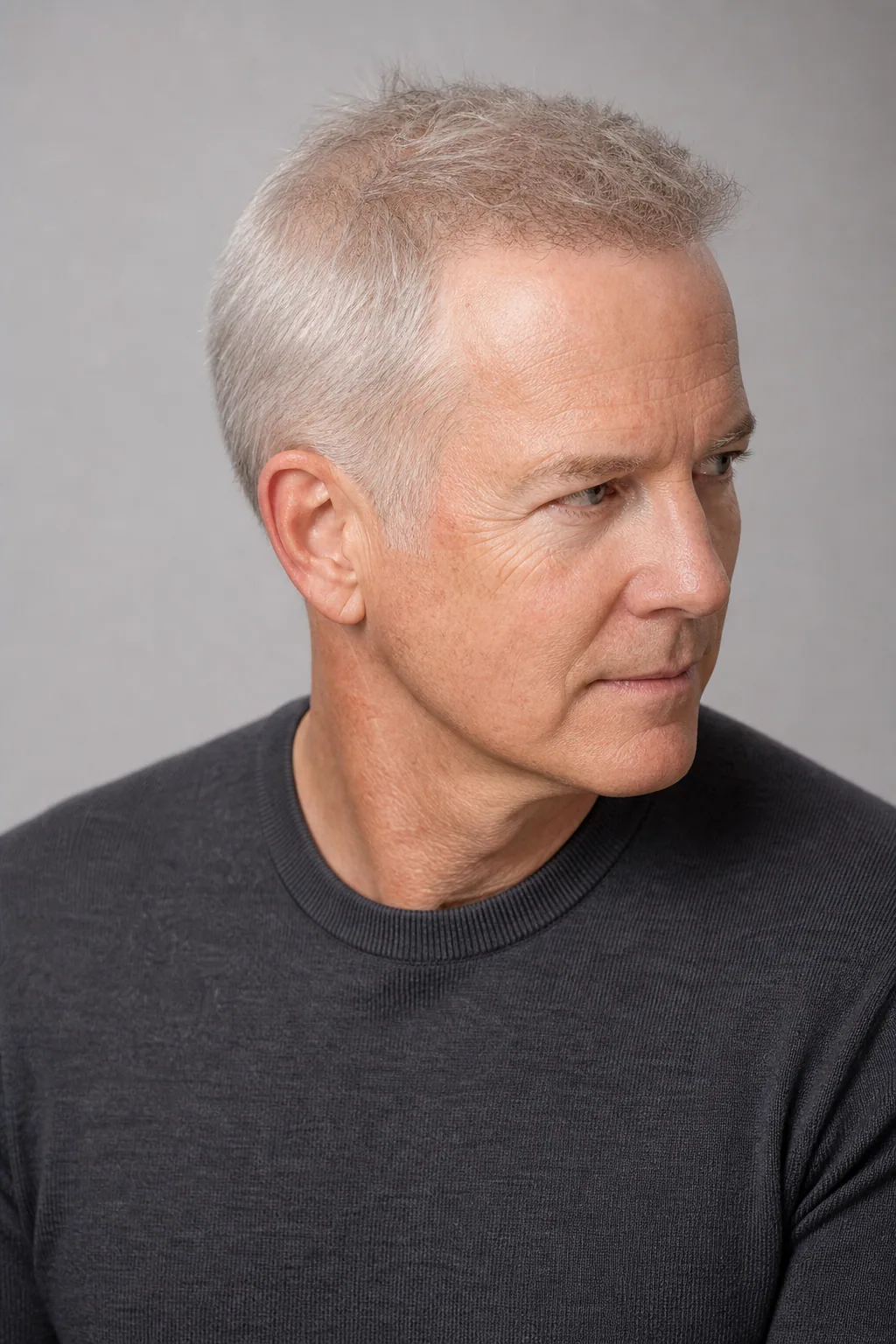
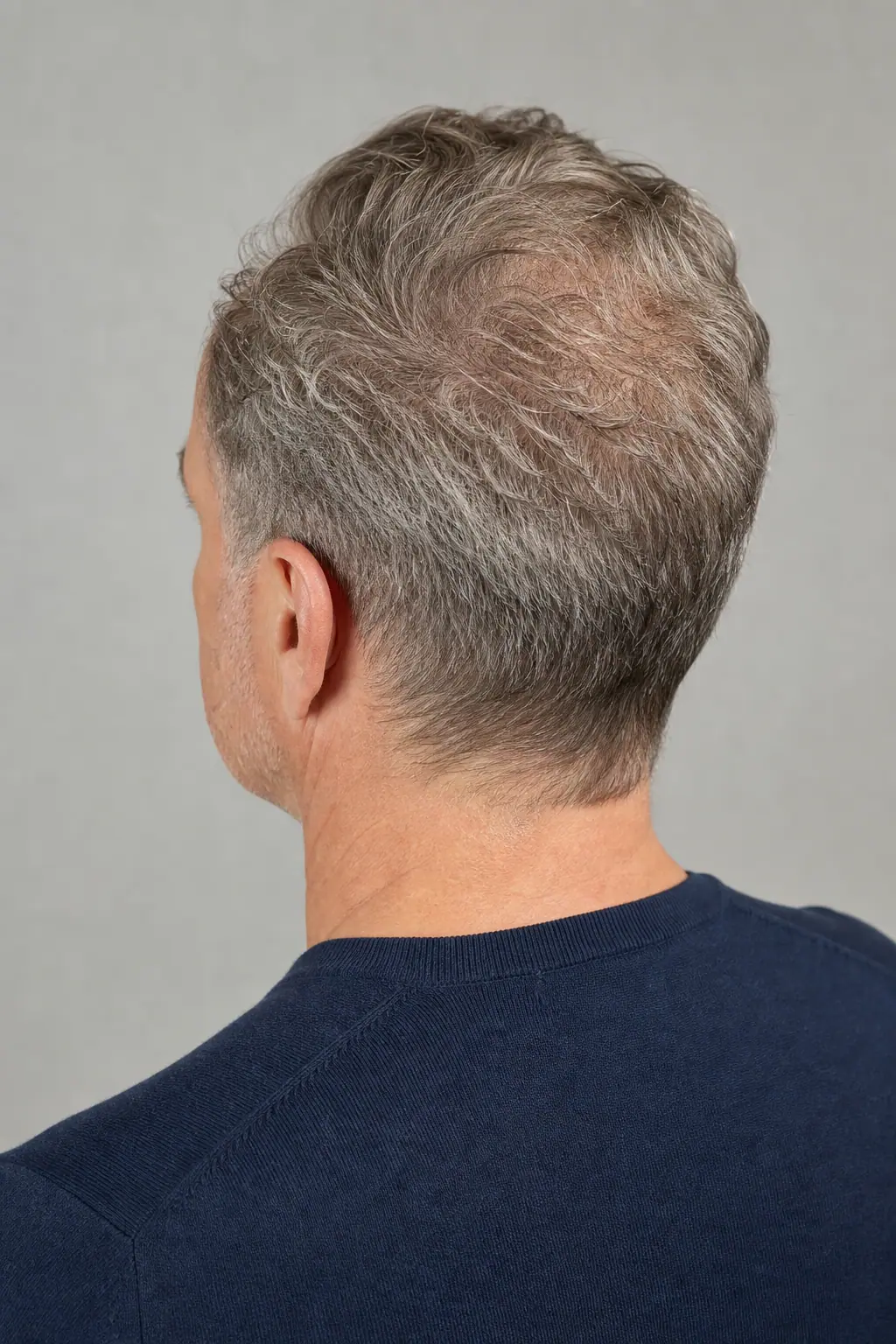
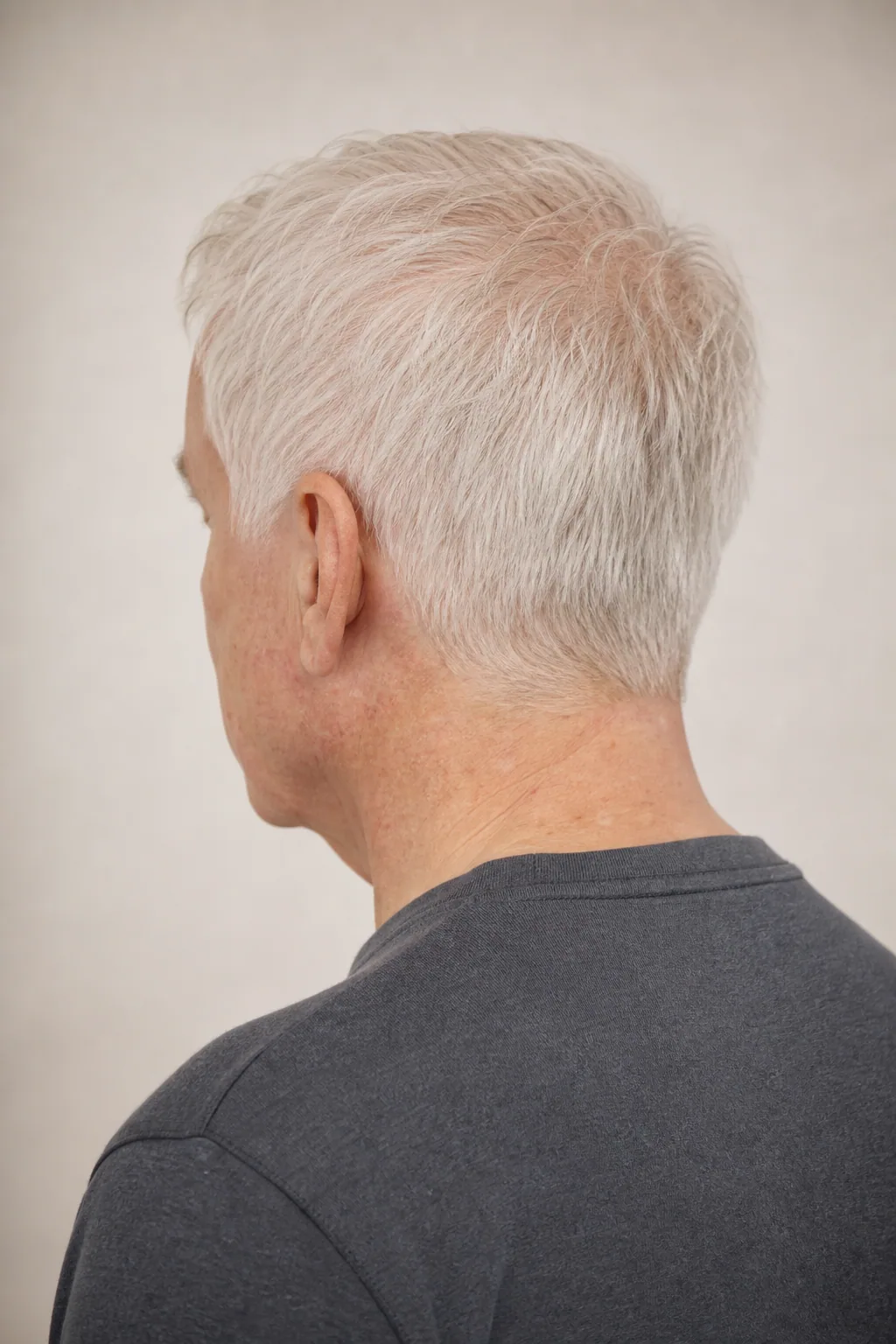
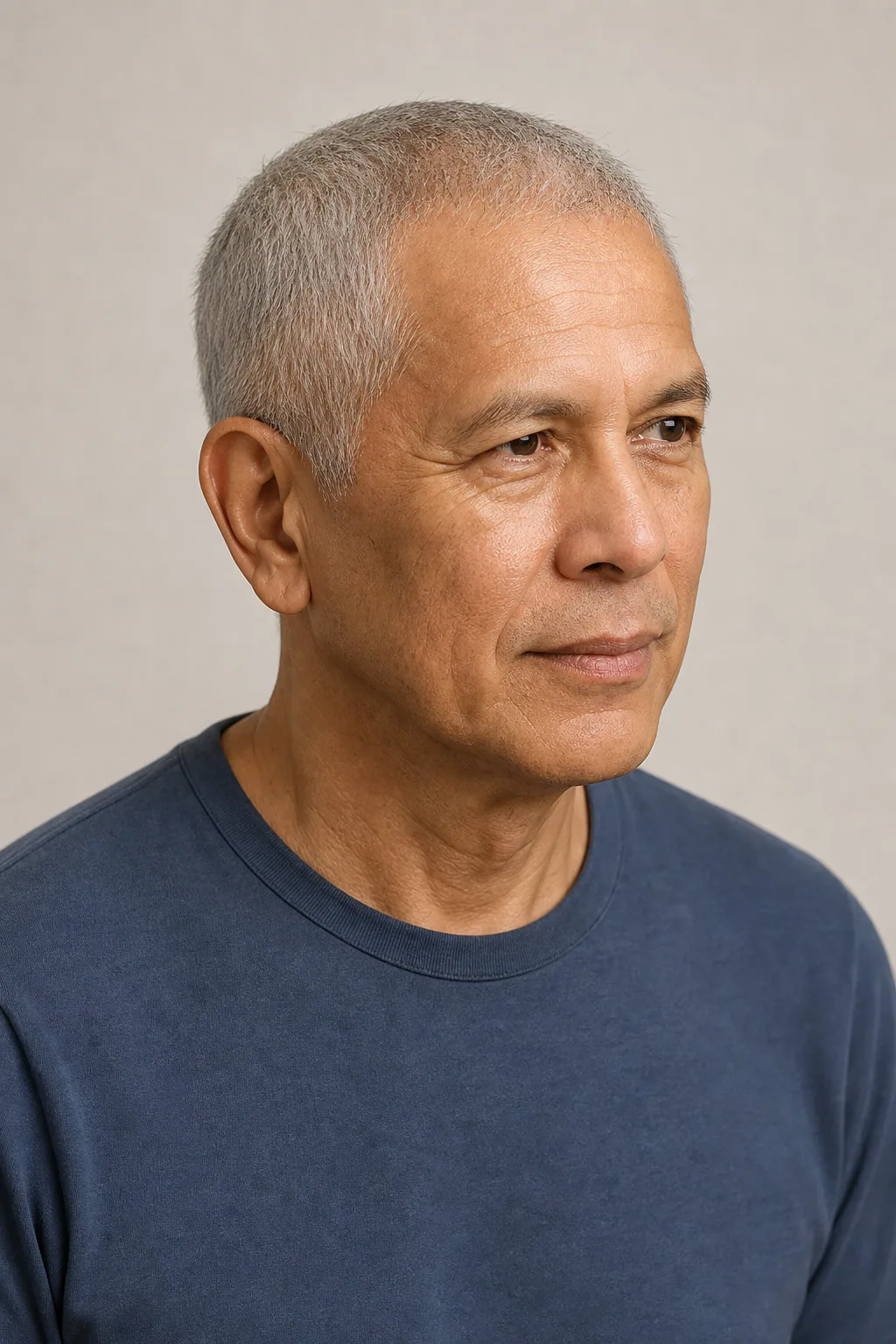
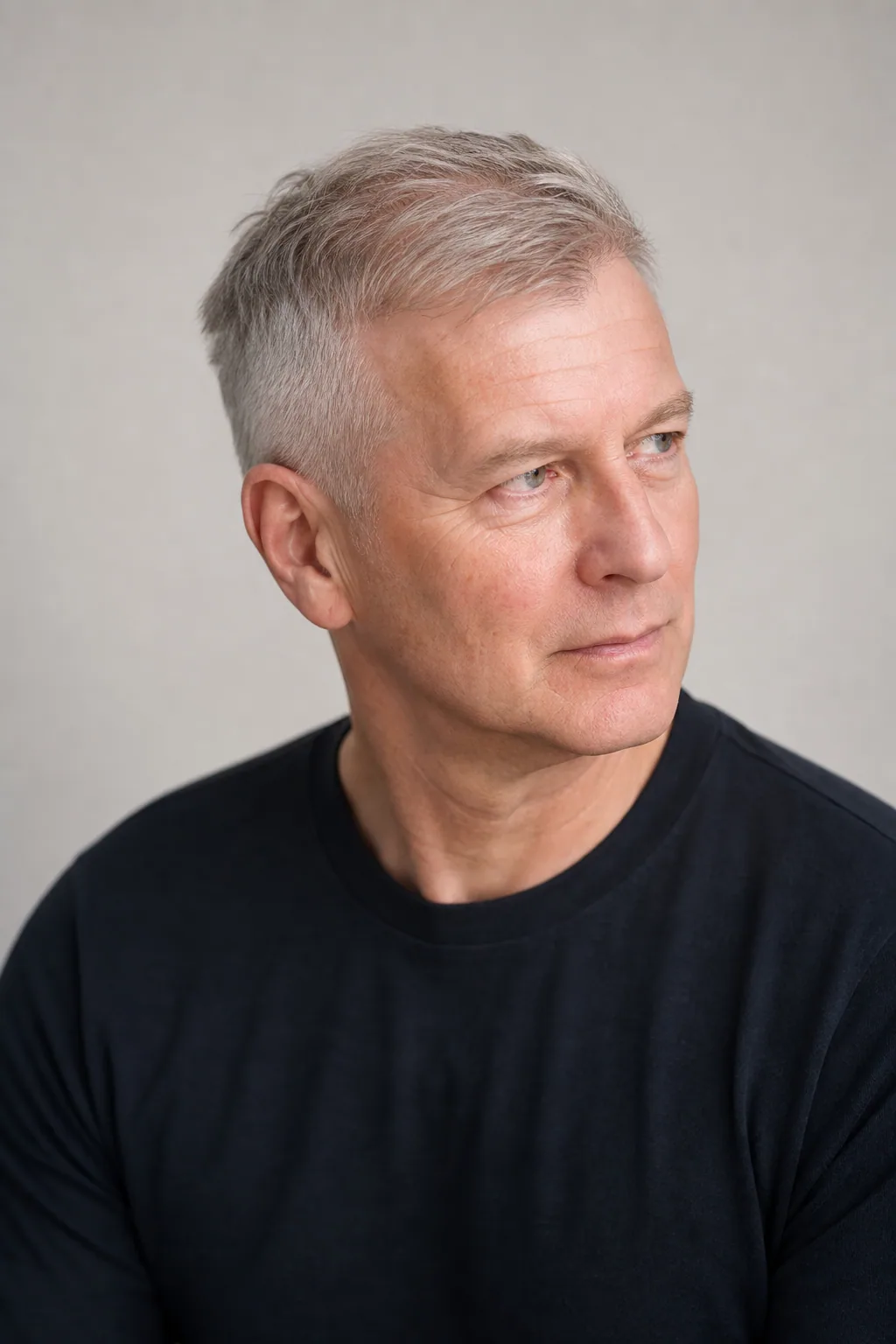
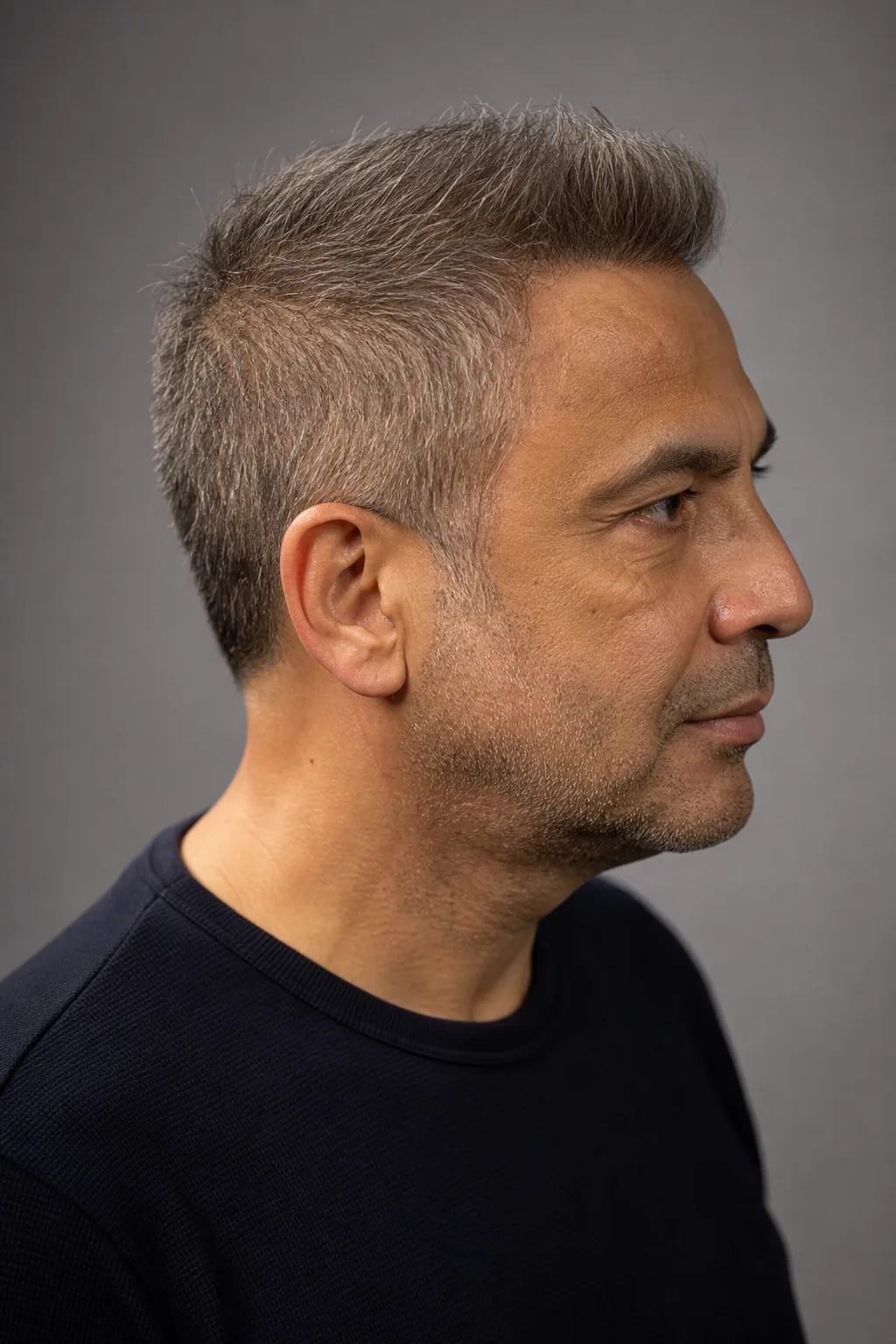
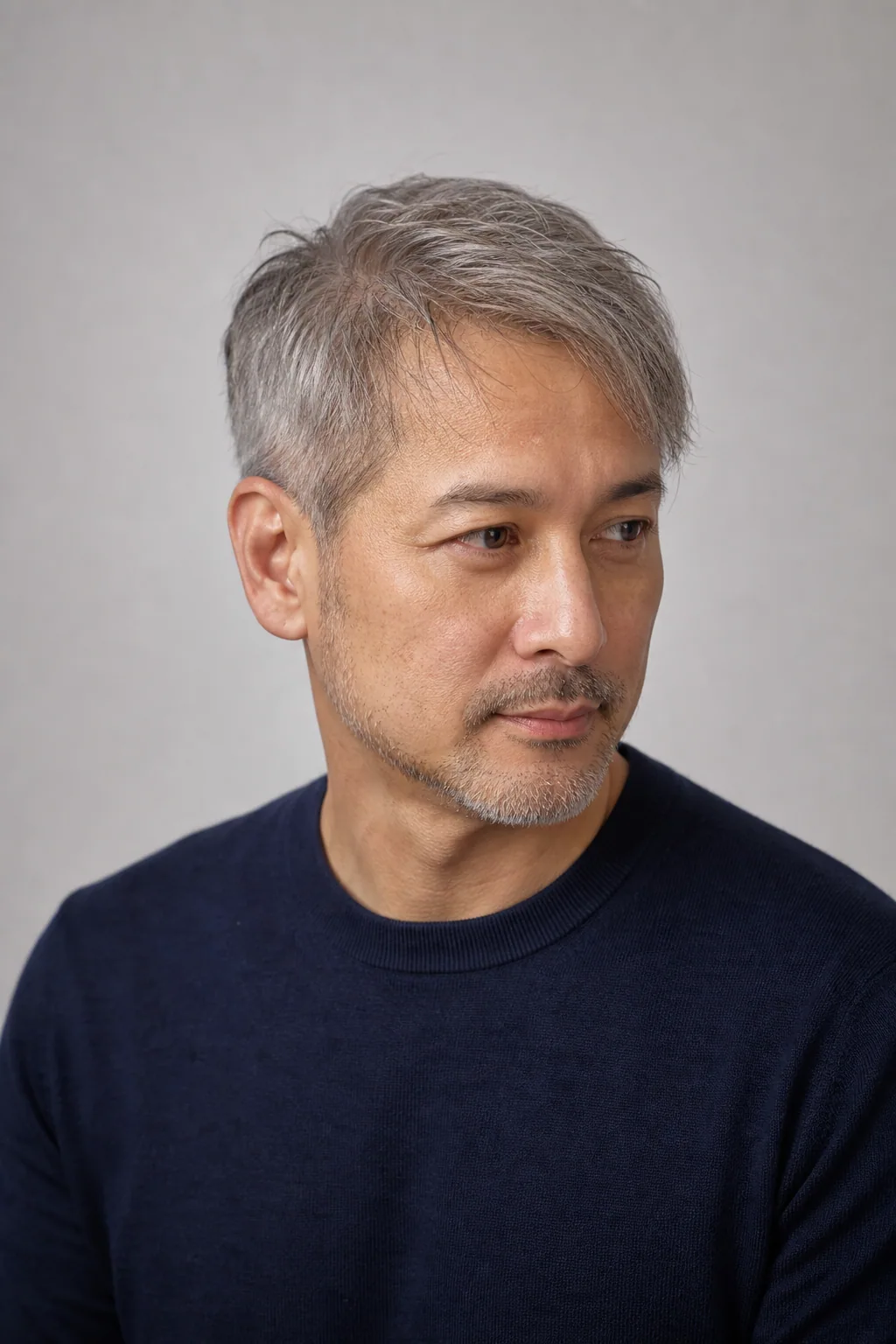
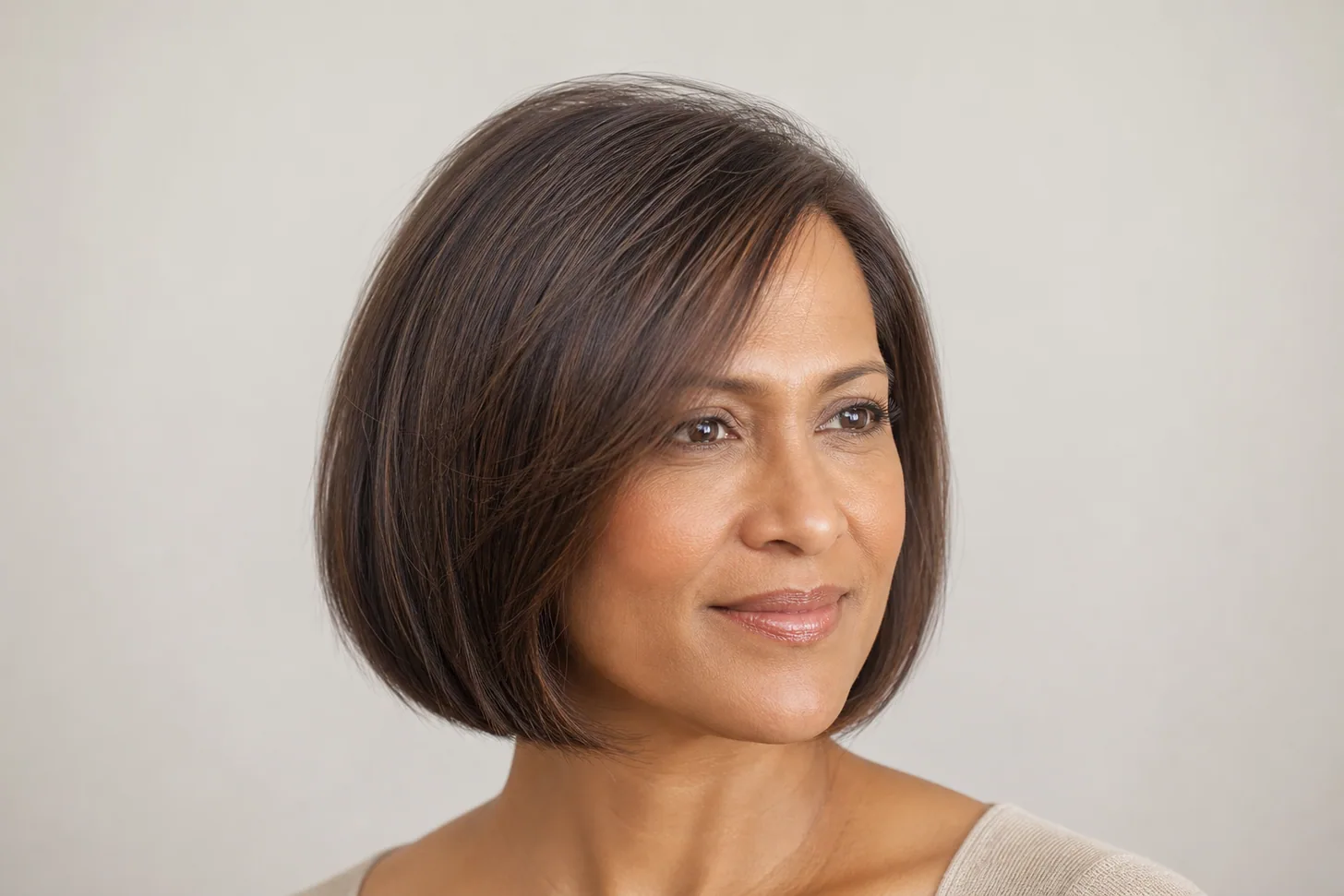
The best hairstyles for older men with thinning hair are short, neat and matched to where the hair is going: a forward-brushed crop for receding temples, a short tapered crown for thinning at the back, and a close crop or clean shave once the top is mostly scalp.
Past 50, most men's thinning follows the familiar male pattern — the temples, the crown, or both, eventually meeting. The pattern tells you more about which cut will work than your age does. Below are 12 cuts grouped by that pattern, what grey and silver hair change, and the words to use in the chair.
The most common thing I change for older men is not the length, it is the direction. Many have worn their hair combed back or parted for thirty years, and as the temples recede that same style points an arrow at them.
Turn the hair forward and cut it shorter, and the same amount of hair covers the places that were showing. Most men are surprised it still looks like them.
SB
— Simone Baptiste, Senior Stylist
Start with where your hair is thinning
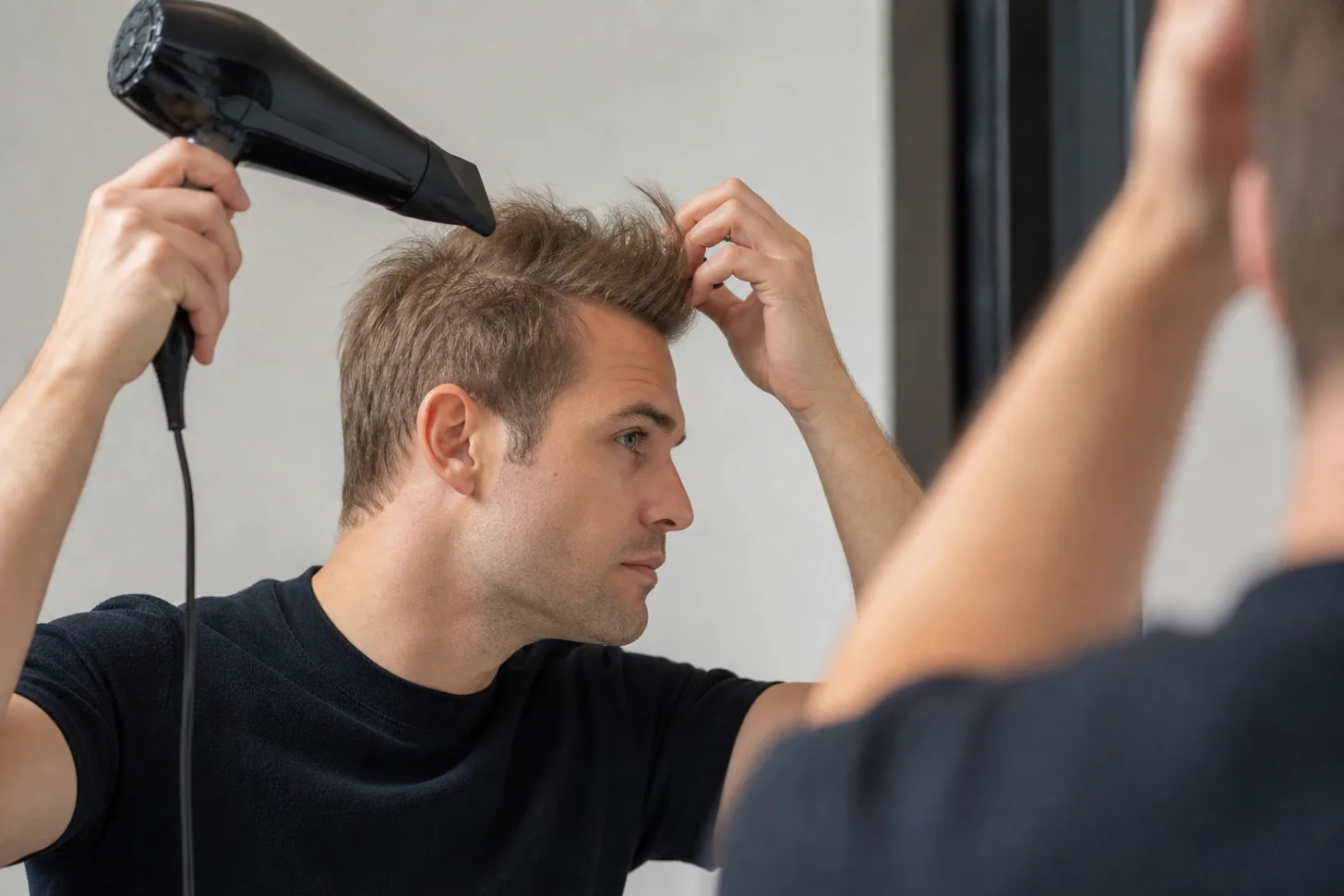
Take two photos: one of your hairline from the front with your hair pushed back, and one of the top of your head from above under an overhead light. Most men over 50 fall into one of four patterns. If you are younger than that, haircuts for men with thinning hair covers the same stages for any age.
Receding temples — the hairline has moved back at the corners into an M or a rounded shape. A thinning crown — a circle at the back of the top of the head where scalp shows. Diffuse thinning — the whole top is less dense, with no single bald area. Advanced loss — the top is mostly scalp, with fuller hair left on the sides and back.
Each of the cuts below is placed under the pattern it suits. If you have more than one, cut for the more visible one — usually the one people see first, which is the front.
For receding temples
The goal is hair that falls toward the forehead. Anything swept back or up exposes the corners.
1
Forward-brushed textured crop
The top is cut short and textured and brushed toward the forehead, so the front hair falls over the receded corners instead of framing them. It looks modern without trying to look young.
Keep the fringe short and uneven. A straight fringe sitting above receded corners traces the M-shape.
2
Caesar cut
Short all over with a brief, straight fringe combed forward. It is one of the oldest cuts in the book because it works: it needs very little hair to look complete.
On a longer face it is especially good, because the fringe shortens the forehead. On a round face, ask for the fringe to be textured rather than blunt.
3
Crew cut with a soft front
A standard crew, but with the front pushed slightly forward rather than up. The inch at the front covers the hairline, and the taper to the crown keeps the back tidy.
This is the cut for a man who wants to look like he just came from the barber every day with nothing more than a towel-dry.
For a thinning crown
Crown hair grows in a spiral from a whorl, and when it is left long it opens along that spiral. Cut short, it lies flat and even around it.
4
Ivy League with the crown kept short
Enough length at the front to part and look groomed, with the crown taken short enough that it lies evenly. It gives a traditional, businesslike shape without leaving long hair at the back to separate.
Ask the barber to show you the back with a hand mirror before you leave. The crown is the part of the cut you never see.
5
Short scissor cut, crown blended
Cut entirely with scissors, so the edges stay soft rather than clipper-sharp. The top is slightly longer than the crown, and the two are blended so there is no step where the hair starts to split.
It suits men who dislike the look of clippers, and it grows out gently — five or six weeks between cuts is realistic.
For thinning all over
When density has dropped evenly across the top, the cut's job is to keep everything the same short length so no one area looks thinner than another. Our guide to the buzz cut for thinning hair explains which guard to use.
6
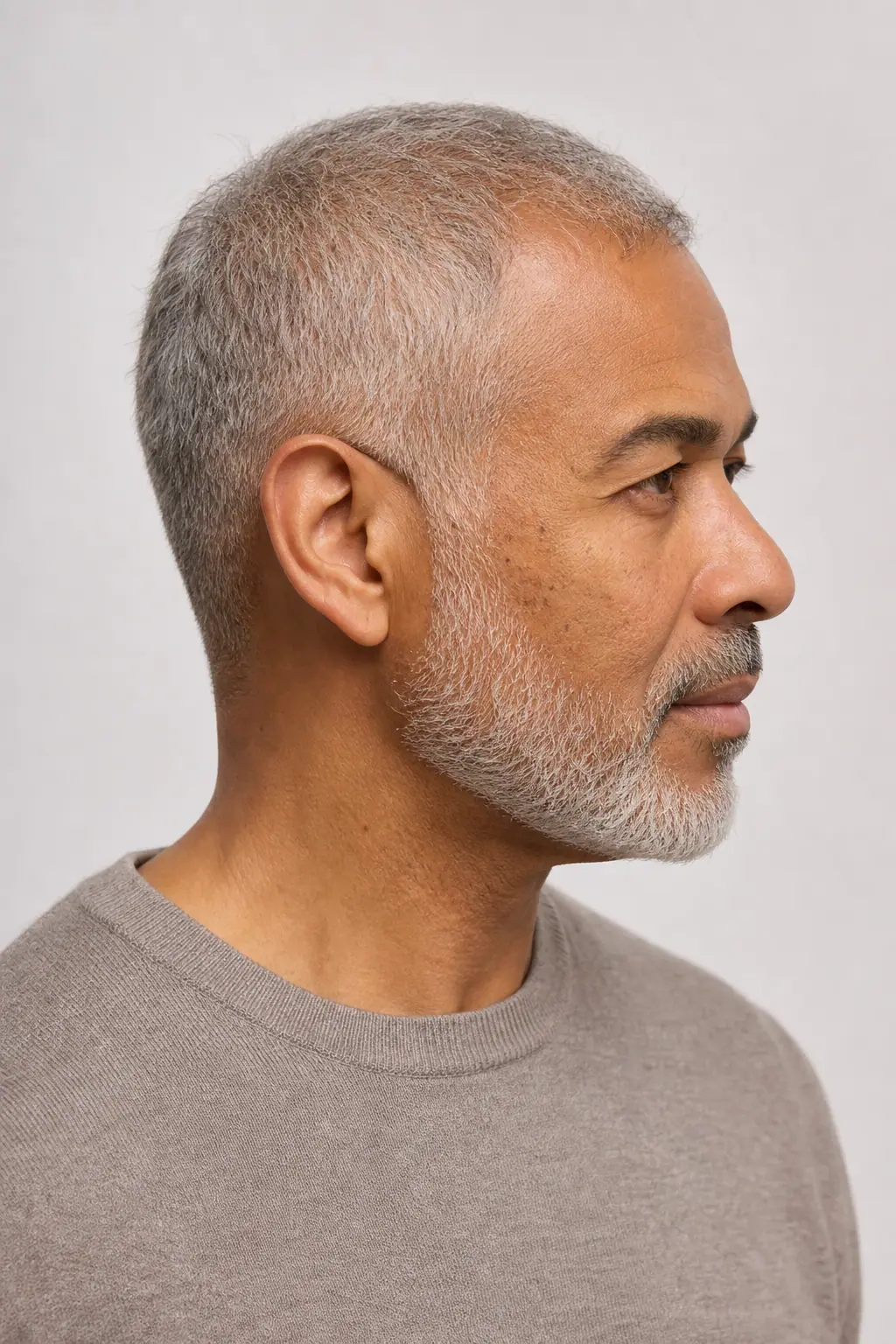
Silver buzz cut at a number 3 or 4
One even length removes the difference between the fuller sides and the thinner top. On silver or white hair, the result is particularly clean, because pale hair against the scalp shows less contrast than dark hair does.
Stay at a number 3 or 4. Shorter guards expose the scalp rather than disguising it.
7
Classic short back and sides
The traditional barber cut, with the top left a little longer and combed loosely to the side. For diffuse thinning it is the least dramatic change from what most men already wear.
Ask for the top to be point-cut so it does not sit as one flat sheet, and comb it with your fingers rather than a fine comb.
8
Short brush cut
The top is cut to about an inch and brushed up, so the hairs stand vertically instead of lying down and parting. Upright hair covers more scalp than flat hair at the same density.
A small amount of matte paste worked in from the back holds it. Glossy products will make it separate.
What grey and silver hair change
Grey hair helps in one way: it shows less contrast against the scalp than dark hair does, so a thinning crown is less obvious on a silver head than on a dark one.
It can also behave differently. Many men find grey hairs feel wirier and stick out at odd angles, and very short cuts control that better than longer ones. If your grey has a yellow cast, a purple or silver shampoo once a week will brighten it. That is cosmetic only — it does nothing for density.
9
Salt-and-pepper side sweep
If the front is still reasonably dense and the thinning is at the crown, you can keep a little length at the front and sweep it loosely across. The mixed grey softens how much scalp shows.
Sweep with the fingers, not a comb, so there is no hard part line.
10
Close crop with a grey beard
A close crop moves attention to the face, and a trimmed beard gives the head a frame. Together they look intentional rather than like hair that is disappearing.
Keep the beard short and shaped. A long, untidy beard next to a thinning top reads as neglect.
When the top is mostly scalp
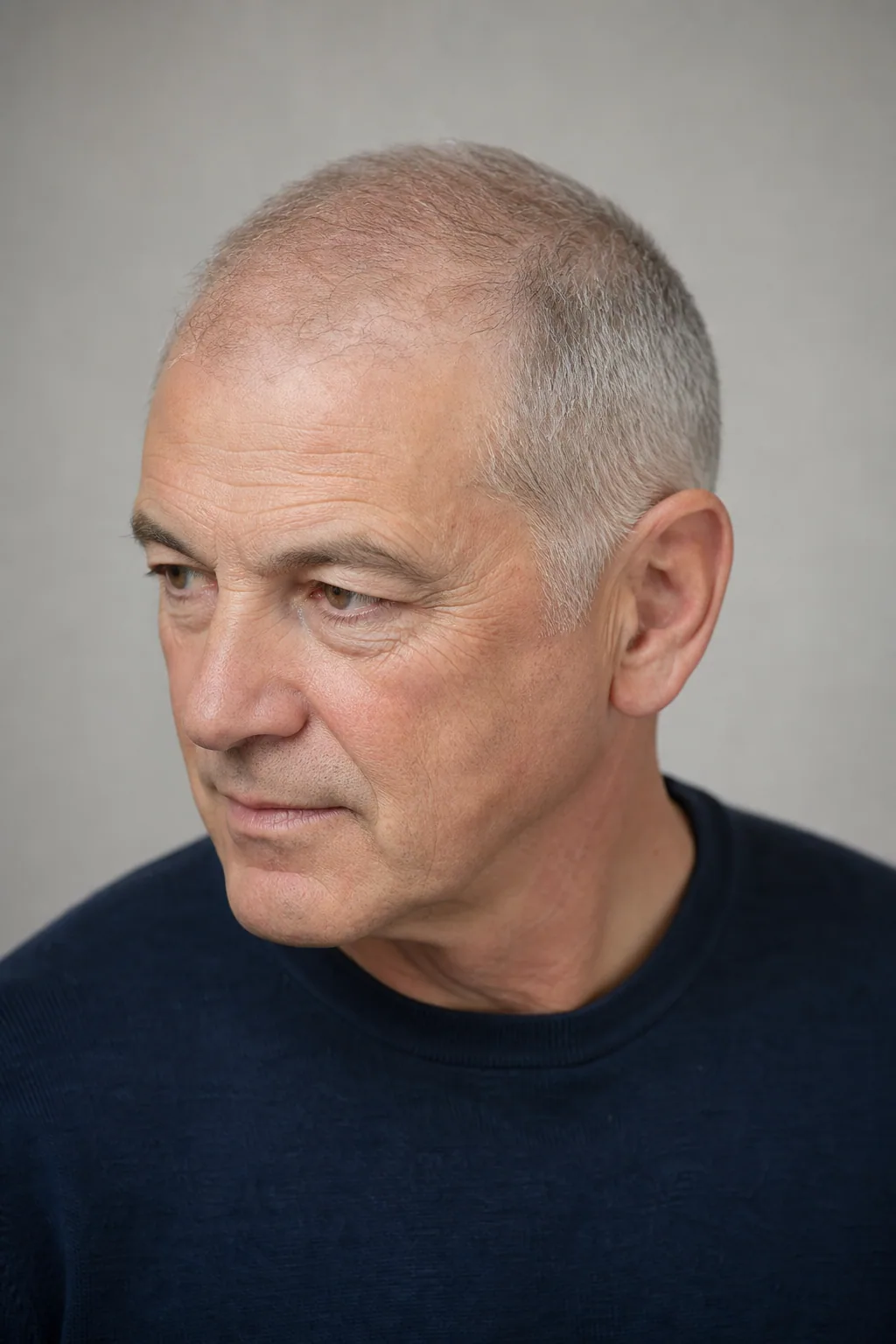
With advanced male pattern loss the hair on the sides and back is usually still full. Left long, it frames the bald top and makes it the focus.
11
Tight crop on the sides and back
Take the sides and back down close so they match what is left on top. Once the whole head is the same short length, there is no ring of hair drawing a line around the bald area.
This is the most important cut on the page to get right, and the easiest: one guard, all over, every three weeks.
12
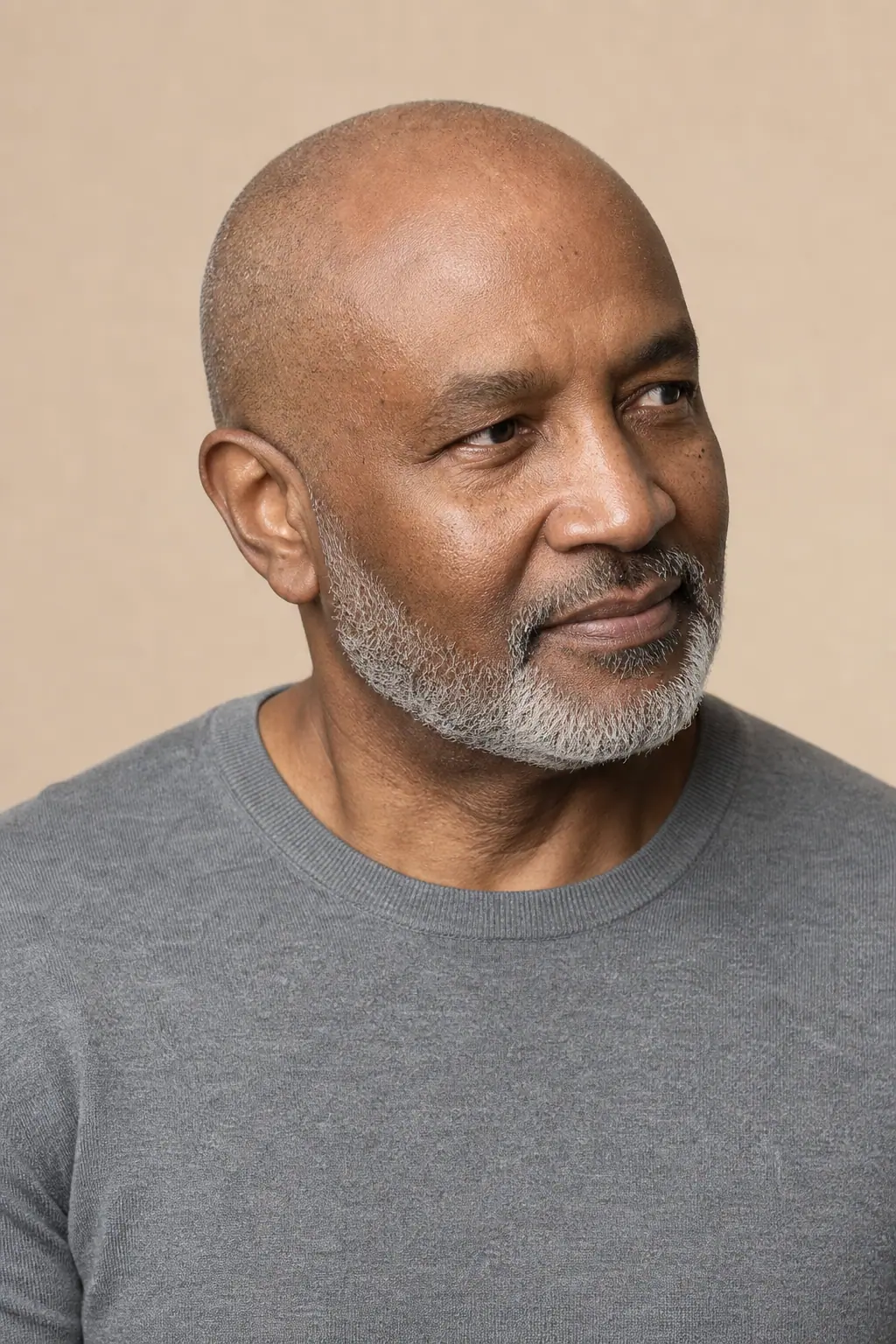
Clean shaved head
The cleanest answer to advanced loss, and one of the most confident-looking looks at any age. It takes a head shaver every two or three days.
Protect the scalp: sunscreen daily and a hat in strong sun. Older scalp skin has had decades of exposure already.
Styles to avoid
The comb-over. It uses longer hair to cover a bald area, and in wind or light rain it moves and exposes it. It also makes the cover look deliberate, which draws the eye.
Long hair on the sides with a thin top. The contrast is what reads as hair loss. Heavy, shiny products. They clump thinning hair into strands and reflect light off the scalp. Use a matte clay or paste, and only a pea-sized amount.
What to ask your barber
Say: "My hair is thinning at the [temples / crown / all over]. I'd like it short and even so no area looks thinner than the rest — brush the front forward rather than back, keep the crown short so it doesn't split, and match the sides to the top rather than leaving them long."
If you see the same barber regularly, ask them to tell you when the pattern changes. They see the back of your head more often than you do.
Chair-side note
I always ask older clients one question before I cut: has it changed in the last year? Slow thinning over decades is pattern loss, and the cut can handle it. Sudden shedding, patches, or thinning that has sped up is worth a doctor's visit first, because some causes — thyroid problems, low iron, certain medicines — are treatable.
SB
— Simone Baptiste, Senior Stylist
When to see a doctor instead of a barber
Your hair is falling out noticeably faster than it was. Rapid change is not typical of pattern loss. Our guide to blood tests for hair loss lists what a doctor will usually check.
You have round bald patches, or you are losing hair from your beard or eyebrows. That pattern suggests alopecia areata or another condition, and it needs a dermatologist.
Your scalp is itchy, sore, red or scaly where the hair is thinning. Inflammation can cause hair loss, and some forms scar. See a dermatologist promptly.
You want to slow the loss, not just disguise it. Treatment works best on hair that is still there. A dermatologist can explain the established options; our overview of in-office hair loss treatments covers PRP, microneedling and laser devices honestly.
FAQ
A short, even cut matched to where the hair is thinning. For receding temples, a forward-brushed crop or Caesar cut covers the corners. For a thinning crown, keep the crown very short so it does not split open. For thinning all over, a buzz cut at a number 3 or 4 or a classic short back and sides keeps everything the same length. When the top is mostly scalp, clip the sides and back close to match it, or shave the head.
Yes, in nearly every case. Longer hair lies flat and separates, which shows more scalp, and long sides next to a thin top create the contrast that reads as hair loss. Short, even hair stands up and sits closer together. Men who still have good density at the front can keep a little length there, but the crown should stay short.
Usually less. Grey, silver and white hair shows less contrast against the scalp than dark hair, so thinning at the crown is less obvious. Grey hair can feel wirier and stick out at angles, which shorter cuts control better. A purple or silver shampoo can brighten yellowed grey, but it does not affect density.
No. A comb-over depends on long hair staying in place over a bald area, and it moves in wind or rain. It also makes the covering look deliberate, which draws attention. A short forward-brushed crop or a close even cut covers thinning more convincingly and needs far less upkeep.
When the top is mostly scalp and the sides are still full, shaving often looks better than any cut, because it removes the contrast between them. A close crop at a number 1 or 2 all over is a halfway step if you are not ready. A shaved head needs a head shaver every two or three days and daily sunscreen on the scalp.
Male pattern hair loss can often be slowed, and treatment works best on hair that is still present. A board-certified dermatologist can explain the established options and whether they suit you. Sudden shedding, patchy loss, or thinning with an itchy or sore scalp should be checked by a doctor, because some causes are treatable.
Eleven years behind the chair, specializing in short shapes and fine-hair texture. Simone believes the best haircut is the one you can style yourself in ten minutes.
This article is for general education and is not medical advice. Thinning hair can have several causes, and the cuts here are cosmetic rather than treatment. If your hair loss is sudden, patchy, or accompanied by an itchy, sore or scaly scalp, see a board-certified dermatologist.
Results vary with hair type, density, and growth patterns. Hairstyling guidance is not a substitute for an in-person consultation with a licensed barber or stylist.
Hairstyle images in this guide are AI-generated illustrations, not photos of real clients or results. See our image policy.
Get the good hair intel
One honest, stylist-written guide in your inbox each week. No hype.

 SB
SB