What developer actually does
Permanent hair colour needs two things to work: a way into the hair and a way to lighten your natural pigment. Developer does both. The peroxide, helped by the alkali in the colour, swells the cuticle so the dye can get inside, and it bleaches some of your natural pigment so the new shade can show.
The higher the volume, the more pigment it removes and the harder it works on the cuticle. That is why the strength you choose decides how light you can go, and how much wear your hair takes to get there.
The developer strength chart
Matrix, one of the largest professional colour brands, sells its cream developer in the four standard strengths and gives this guide to lift. Other brands use the same percentages, though the lift each one gives depends on the colour it is mixed with.
A "level" is one step on the 1 to 10 scale colourists use, where 1 is black and 10 is the lightest blonde. Going from a level 5 light brown to a level 7 dark blonde is two levels of lift.
Why fine hair needs a lower developer
A fine strand has a smaller diameter and fewer cuticle layers protecting the inside. Developer gets in faster, lightens faster, and reaches the point of damage sooner. The ends, which are older and often more porous, go fastest of all.
In practice that means three adjustments. Choose the lowest developer that will reach your target, and on fine hair that is often one step below the chart. Check a strand early, from about ten minutes before the end of the stated time. And never leave colour on longer "to make sure", because on fine hair extra time is extra damage, not extra colour. Our guide to whether colour thins your hair explains where the damage shows up.
20 volume developer: will it lighten hair without bleach?
Mixed with a permanent colour, yes: 20 volume lifts natural, uncoloured hair up to about two levels without any bleach. It is also the standard strength for covering grey, because it opens the cuticle enough for the dye to take on resistant white hair.
On its own, no, not usefully. Developer is not a lightener by itself. Painting plain peroxide on your hair gives patchy, brassy results and dries the strand for very little lift. Do not use it that way.
And no developer lightens hair that is already coloured. "Colour does not lift colour", as colourists say; removing old dye needs a lightener or a colour remover, which is a job for colour correction, not a stronger developer.
30 volume developer on dark hair: what to expect
On dark brown or black hair, 30 volume mixed with a lift shade can take you up about three levels. The catch is what dark hair reveals as it lightens: red, then orange, then yellow. Three levels up from dark brown usually lands in warm, coppery territory, not cool blonde.
That warmth is normal, and it is why lighter results on dark hair nearly always need a toner afterwards; see brassy fine hair. If your dark hair is also fine, try 20 volume first: two levels with less wear is usually the better trade.
40 volume developer: why fine hair should skip it
40 volume is the strongest standard developer. It is mostly used with high-lift colours and with lightener, typically for foils that sit away from the scalp. Peroxide at that strength can irritate or burn the scalp, and on fine hair it can lift the cuticle so far that the strand turns gummy and snaps.
For big jumps in lightness on fine hair, a colourist will usually go slower: a lower developer, more time, sometimes two sessions. If you want highlights, our highlights for fine hair guide explains what to ask for.
10 volume developer: the fine-hair friend
10 volume lifts little or nothing, and that is the point. It is used for toners, for demi-permanent shades, for going darker, and for refreshing faded colour. Because it opens the cuticle only slightly, it is the gentlest way to change tone on fine hair. A hair gloss often works the same way.
How much developer to mix with hair colour
Follow the ratio on your colour, not a general rule. Many permanent creams mix one part colour to one part developer; Matrix's SoColor, for example, is 1:1. Some brands use 1:1.5, and high-lift shades often use 1:2.
Measure by weight on a small kitchen scale rather than by eye, because a runny mix lifts unevenly and an over-thick one under-processes. And keep to one brand: Matrix itself warns that substituting another developer gives unpredictable results, because each line is balanced to its own.
How long to leave developer on
Use the processing time on your colour; Matrix gives 30 to 45 minutes for its permanent shades at room temperature. Do not add heat unless the instructions say so, and on fine hair start checking a strand about ten minutes before the end.
If the strand has reached your target early, rinse. The time on the box is a maximum for average hair, not a target for fine hair.
Before you mix: the safety steps
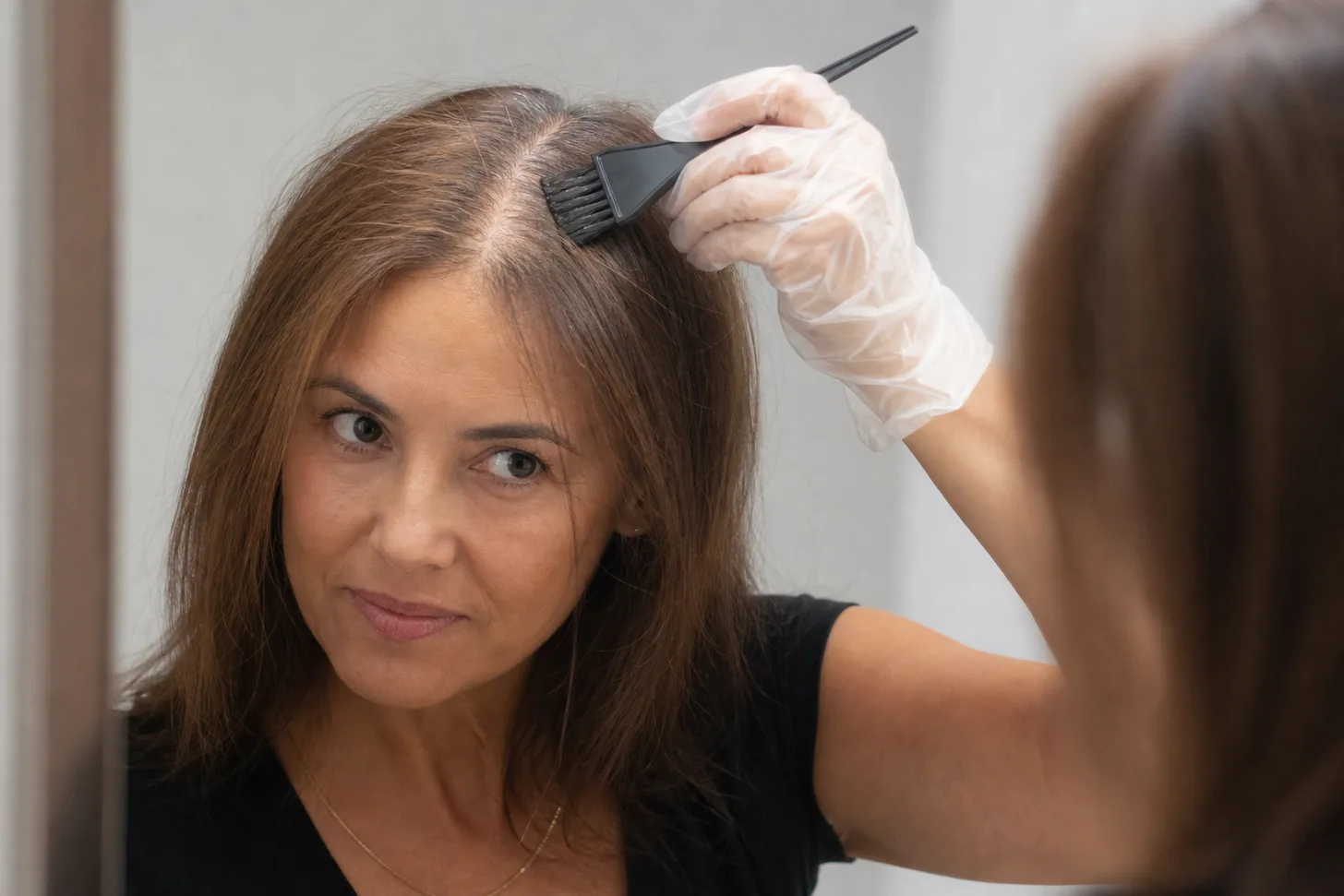
The US Food and Drug Administration advises a patch test before every dye, even with a brand you have used before; most kits ask you to do it 48 hours ahead. Wear gloves, keep developer away from the eyes, and never use hair dye on eyebrows or lashes.
If you colour at home, at-home colour for fine hair covers the whole process, and the best hair dye for fine hair lists kits with gentler developer built in.

 PN
PN